Essential Strategies to Improve Operations & The Member Experience
This is a YouTube video titled "Essential Strategies to Improve Operations & The Member Experience" recorded in December 2023. It features a discussion between Richard and Brian Waldron, CEO of Dort Financial Credit Union, focusing on credit union leadership strategies, operational efficiencies, member experience improvements, and the impact of economic factors like rising interest rates. The conversation includes interactive polls and addresses topics such as data-driven decision making, automation, member education, and community engagement within credit unions.
To do. Thank you so much, Krista. We're going to do what we, we came to do, drop some knowledge and education for everybody. I really appreciate you guys all coming here. We're going to be talking about essential strategies to improve operations in the member experience. And so, you know, if you've come to learn that you've come to the right place, I want you to be part of this conversation. You know, we love questions. There's, it's a small intimate group here of credit union leaders and executives. I've looked at the registrant list, all of you that are, that are here and I promise you this, if you're writing in the chat, I'm looking at the chat right now and we will be talking about what your, if you ask questions or make comments. Well, we will be addressing your comments live because I'll bring them up. So please ask questions away. You know, ask, write in the chat. We love participation. So let me without further ado, let me introduce our guest of honor. You're looking right at him is Brian Waldron. Look, first of all, he's a fellow twin dad. So I have a lot of respect for Brian. But Brian is also a seasoned credit union leader. Right now he is CEO of Dort Financial Credit Union before he was chief lending officer at Hudson Valley Credit Union, chief lending officer at Scott Credit Union and a history of leadership positions at credit unions. Dad of three boys, four dogs, loving husband and awesome human being all around. And I'm glad, I'm proud to call him a friend. Brian, thanks so much for, for joining.
Richard, I appreciate you having me along. Thank you. And thank you for the kind word.
Yeah, of course. So here's what we're going to do. I'm going to start this off by going through some statistics that are happening. I don't think, excuse me, I don't think there'll be a surprise to many people who are listening. But I think you'll learn. We, you might learn something or, or maybe you'll have something to contribute in the chat. So we all know that retail deposits are rapidly shrinking. About 70% of financial institutions indicate increasing deposits as a top priority. We've all seen this. So, so you're all aware of that liquidity is an issue at most institutions. Brian and I in the pre show we're, we're talking about that auto loan interest rates are driving up the average monthly payment for consumers. You know, and I think of course mortgage interest rates are going up and that's what Acuma is focused on. And then We've seen recently, in the last like day or even weeks, we've been seeing rate changes in a, finally a positive direction. And so you've been seeing a lot of headlines. And so some of those headlines that I put in here is like Fed, Fed's holding the rate steady and they're forecasting three rates, rate cuts. And you can see what that does to the average 30 year fixed mortgage, like immediate, immediately.
Right.
You can see it in the graph, I've circled it in red. If you're, if you're actually listening and paying attention, please write in the chat how you feel about that. I'd love to hear that. And where, you know, about, about where you think that's going to go. Another thing, I mean, how does this, Brian, I think before we jump into our first poll, I'd like to ask you, like, how does this affect your, you as a credit union leader when you, when you see these kind of things coming out in headlines? Because, you know, members are thinking about this, your, your team is thinking about this every, you know, and, and where, where are we going? You have all of these different members with borrowing needs. So I'm going to give you a chance to, to respond right now.
Yeah, so obviously, I think when you start to look at these, you know, types of data points, you know, that you just had pulled up on the screen, you know, panic starts to ensue, right? I mean, liquidity crisis and you talk about debt to income members, you know, going into a recession, you talk about inflation, all these things, you know, really start to hit home and how it affects the consumer and especially the member, but it also affects how we do business. But I think the biggest thing that I can, that I'm taking away from this is, look, I've been doing this for over 20 years and so the epiphany I had about, I don't know, two months ago was, you know, the question came up in the boardroom is when does this return to normal? And I looked at the board of directors and I said, you know what, after about 15 years, this is our return to normal. This is where we need to start operating again. Right? The Fed rated 0% for, you know, 15 years or so. It's just, it's unsustainable. And so we're coming back into our mortgages are going to be about 6, you know, 5 to 6%. Car loans are going to sit anywhere from 5 to 7%, you know, for your prime borrowers. And I think this is just, it's been a long road but it is a return to normal. And so I think your business operations have to start addressing those situations. And how you do that is, you know, simply by educating your members, talking about it and not creating the panic. Right. The other thing you can't do is start talking about when rates go back down. I just don't think it's going to happen. At least that's my interpretation at this point. And I've been wrong so many times in my career and I'll probably be wrong again. But I do believe this is our return to normal.
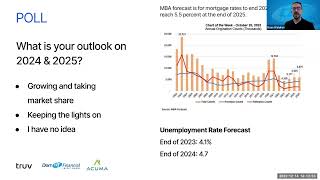
Nice. That's a good answer. I like that. Return to normal. So let's kick off our first poll here. The poll that where I'm going to ask right now and I've run similar polls for with banking, with banks and with IMBs outside of credit unions. So I'll be interested to see what the know how, how the this poll, how this group feels. What's your outlook on 2024 and 2025, please, if you're in the audience, I'm going to launch the poll right now. Please let us know. Brian, unfortunately you're not allowed to answer because you're a panelist, but I would like to ask you, you know, hopefully you don't influence it too much, but how are you feeling?
Look, I'm feeling confident, right. Credit unions have a way of sustaining through, you know, any type of bad economic factors. And so I do believe that, you know, we need to continue to what we, what we do best. Right. Be involved with your community, talk about education with your members, talk to your staff, if you're an executive, and keep educating everyone as you go through this process. Remember, for some of our younger loan officers, this is the first time they're seeing mortgage rates at 7 or 8%. And so they, they just don't know how to talk about it. But you have to kind of remind them of history and talk them through that process. But I have a very positive outlook. I think credit unions have always remained very member centric. I think it's what we do best. And I think if we continue down that path and not panic, that we'll do. We'll come out ahead of this.
All right, I'm going to end the poll. And you know what's really funny is this actually exactly matches the results, the percentage wise of what I ran on the other, the other group that I was having a webinar on. I ran the same poll. And so I would say IMBs and banks are matching credit unions on how they're feeling it was 75% roughly growing and taking market share, 25% was keeping the lights on. I do think it's important to. Oh, I had to share the results with the group. I'm sorry, everybody. I do think it's important that we address the fact that 25%, 27% of the group here that are in the attendance right now are keeping the lights on. I do think that, like, that's worth acknowledging. Brian, do any of these results surprise you?
No. You know, I think, you know, first of all, I think, I think all of us could have answered. I have no idea. Right. Because the future is so unknown. So I think it's okay to admit that. I think the second thing is, look, I think we should have an anticipation of growing and taking on market share. Regardless of your liquidity stance right now, you know, you're going to fight through that, you know, with the, with the accounting teams and your lending teams. You're going to work through those processes and procedures and you're going to continue to have market share. But there is a component of keeping the lights on. Right. And there are some credit unions right now who are simply just trying to fight this liquidity issue. And it's tough. Right. And I have a certificate out there right now at 575 for 19 months or, excuse me, 11 months. And we are seeing our dividend expense quadruple what it was last year. So there is kind of that panic mode when it hits roa. And how are you going to continue to stay afloat and continue offering new products and services and continue doing that as your entire loan portfolio tries to reprice. So keeping the lights on is a big component, but I think now is the time to continue pushing forward, find a way to lend, find a way to bring in the deposits. If anyone finds that silver bullet, please message me because I'd love to know how to get it, get that in the door without quadrupling my dividend expense. But, you know, we'll survive through this. And I think again, like I said before, credit unions are going to come out on top, as they always do.
I love, I love that ending in the positive note. Excuse me. All right, so let's jump into our first question here, Brian. Where have you realized the greatest increase in efficiency? And let's talk about it in, you know, the last, let's say, two years since, I would say since the rates have started to increase, you know, until like, present. Yeah.
So I think, you know, as, you know, as rates start to increase, that. Right. Obviously things start to slow down especially. Let's take a look at our real estate portfolios. Right. You know, we're not having the originations we had two or three years ago. And so things are slowing down. And so this is the time that we're really taking a look. We're assigning our teams ways to go through their policies, processes and procedures and really trying to align them up to create a more efficient process, not only for themselves but for the members. And so I think, you know, as you go through that, it's a cost saving measure, right? So that's important. But also for your members, you want to create a very seamless process so that they can get that mortgage very quickly and get through the channels as they need to. It's a big purchase and for most people it's the, you know, for first time homebuyers it's, it's, it's mind numbing. And even for seasoned veterans who have bought three and four homes, it can be a little, a little daunting. And so I think just kind of create, going through your process, looking at everything you do from a member perspective, how does the member apply if they're going online, what does that process look like? Take the time to really spend some moments and going through that process and looking at it with a fine tooth comb and find a way to create that efficiency, reduce, you know, the touch points if you can.
So I going to, I am going to jump back and forth between operations and borrower experience, member experience questions as we go through this present, as we go through the, the progression here. But I am, we are the sponsor and I do have a quick piece that I am going to actually speak to you right now. And that's true and what true does and it's because we just talked about increasing efficiency in operations and everybody bear with me, this will be quick, but I do think it's really important right now. Savings is king, right? In this kind of operating environment. Most, most credit unions are not breaking records with a number of loans that they're doing right. And so when you can save cost, you're, you're basically saving the day. It's, it can come down to saving an employee, you know, some of the savings that we're offering some of our credit union clients. So the question is, you know, what can true do for your organization? Here's why most organizations are interested in learning more about Truv. We save about 60 to 80% over the work number for your verification. That includes income, employment, insurance and assets. You can expect about the same performance or better in terms of conversion. And the borrower interface is beautiful, slick and really easy to use. You know that's like I said, that's the cost of a few different full time employees and we have lots of plenty of credit unions that absolutely love us and, and are happy to talk to anybody. If you ever want to reach out to us, I encourage you to do it and say that you'd love to talk to credit union because our credit unions do love us and they're happy to give references. I think the other thing I'll just quickly add is that we got our true was approved by Freddie Mac yesterday. Big, big day for us. So you know, I don't know your relationship with Freddie Mac but if that's important to you, a lot of lenders find it very important. So it was really important from the feedback we're getting from our customers that now we are an approved AIM provider. So reach out. If that's also relevant to you, reach out to the True team. Tell them you'd like to learn more about that. All right, Brian, I'm going to jump back into your next question. How are you using data to improve operations right now? We talked about this in the pre show and for me this really shows the sophistication of like kind of a modern leader right now.
Yeah, so when I came on board to Door Financial almost two years ago, we were just beginning our data analytics and pushing value with that prop, with that department. What we're creating internally is we're now making decisions based upon data. And I can give you a really great example of that. You know, we're all looking, most of us on the call are probably looking for deposits and we had a vendor reach out who has this really slick process for those members who are 50 plus. And like many of us, my marketing team said to me we don't need to worry about those deposits, we already have those numbers captured. We need younger people. And I said why don't we just, instead of just making a statement, let's pull our data analytics team and let's have them look at our 50 plus members and how that's, you know, what, how we're involved in their financial life cycle. What we found actually overwhelmed us. My business intelligence analyst put together about a seven page review of 50 plus members and it showed that we were actually starting to trail off in that membership. And so using data to create, you know, to make a decision has really been impactful to us. And so we've launched this new product and service I don't have any data on what that's done for us yet because it just launched a couple of days ago. But you know, again, I believe it's important to spend the time, effort and money on creating that data use and how you use it and what we can do next with it. You know, some of the things we're looking at next are, you know, next best product for our member. How can we anticipate what our member needs before they even know what they need? Right. And it sounds a little Big Brother, but at the end of the day it's helping us as executives make decisions that really impact our business operations.
That's a, that's fantastic. I, in, in doing a little research for this event, I, I was looking up credit unions and the ability to get current members to switch their primary checking account to their credit unions credit their, their credit unions deposit account. And it turned out that it was like 50 plus. If you're 50 plus it was like 11% would be willing to do it. And that's like, with a lot of begging and pleading. And then below 50%, I think the sweet spot was 25 to about, you know, 40 something. And that, that was like, you know, 30 in the high 30s would switch with some, with some work. By the way, true has a direct deposit switching account. So it's not by an accident that I was doing that research. But it's interesting when you look at those kind of those results and those statistics and you think about what you just said, right, and most people, most credit unions might not be looking at that 50 plus population in terms of retention or growth and overlook it, but the data told you otherwise and I think that's fantastic.
Well, I think Richard too, what it, you know, it allows us the, is the executive team to do is make quick decisions, Right? Because that's what we really want to do is make very quick decisions. But we're using data to support that. So we're not making a quick decision, realizing we're wrong and having to correct ourselves, which in the past, that's what you basically had to do. Did it work? No. Okay, we need to go back to the drawing board. You know, I have 15 year old twins and so it's really like using the scientific method all over again. Here's our hypothesis and then we run through it and then we either implement or don't and we move on. And we can do that very quickly. The key is to have some great business intelligence analysts who understand how to use the data and how to interpret the Data and how to get you what you need very quickly.
I am impressed that you used the word science and your parenting skills in the same sentence. Mine, I don't even know what I'm doing. Just figuring it out.
Parenting skills could be a whole another podcast.
Totally. All right, so we're going to jump into our next poll. I'm about to run it right now. Again, everybody, I would really appreciate your participation. Takes two seconds. Just make a selection. What are you most focused on in terms of improving your borrower experience? Again, Brian, I'm hopefully you're not going to influence everybody too much but I would love to hear how you feel about that while people are answering.
So you know my, I don't see it on there but I would say all the above. But I think if I really had to be true on what we're doing internally is we are really looking at education right now and how do we educate the borrowers. Again, you know, I go back to rates being 7, you know, 6%, they're high. You know we were doing, you know, when I moved to Michigan from New York, I was on a, in New York, I had a 2 1/2% 15 year mortgage and obviously I don't have that now. So you know, I think it's educating borrowers on, you know, what that means for them. Right. You know, it's now time to look at arms again and people are scared of that word because for so long a 30 year fixed was so low and so really trying to understand your borrower and instead of just putting them in a single product, we really start to understand their financial needs and what their future looks like and start to build that form and educate them on the benefits of the different products and services you offer. You might have to go back and study up. Some of us have to do that occasionally and I think it's a really important invaluable process.
Well, so I'm going to end the poll now and I am going to share the results with everybody. I would love to see anybody share anything we I missed in this pick list. Right. This is me making this pick list. So I would love to see if anybody's focused on anything else in in when they think about the borrower experience right now. I'd love to have you share that in the chat. But Brian, if you look at these results, ease of the process is at the top and actually maybe everybody who's who had picked. There's four folks that had picked ease of, ease of the process. I would actually like to know what they meant by ease of the process. If you don't mind sharing that in the chat. I just, you know, it can be just a sentence but because it can mean a lot of things and I don't want to, I don't want to guess on what that means. And so Brian, when you think of ease of the process, like what are you thinking in terms of improving the borrower experience?
Yeah, I think that it's just, you know, it's, it's an incredibly time consuming and you know, process for our members to go through. And so how do we make that easier for them? How do we get them to upload their documents that they need? How do we get them signatures? How do we get, you know, everything that we need from them in a very timely process without having to, you know, pick up the phone and call them all the time or constantly send them text messages, you know, setting the expectation ahead of time, you know, or, or having a letter that you can give them and say, this is what we're going to need throughout this process and you know, what the best time to reach you is, you know, how do you best like to be contacted? Trying to understand the member and how they operate best, I think is really, is really important here. I just, you know, it's a long process and a lot of it's regulatory. Right. There's nothing we can do about it except we can try and work with the member the best way they know how. And I think, you know, having a dedicated MLO who's really, who's willing to put the time in to walk through that process with the member. And I agree with both Bri and Danielle as I'm reading through the chat myself. You know, you have to, you have to be given the chance and then you have to educate those borrowers. I think it all goes hand in hand.
Yeah, I love, I love the comments by the way, Bri, that's fantastic. I mean getting your right speed to contact.
Right.
If you, if you never have the conversation, I believe I don't remember the statistics, so I'm not going to throw it out there, but I definitely know your chances of actually getting a loan or getting their business goes way down. If you're second or third, I think if you're after third, it's pretty much over.
Right.
Especially when it comes to like a mortgage loan, I think, and then properly educating, that's, that's setting expectations up front. Right. And so that people really know what to expect through, expect throughout the process. I have heard that over and over again in the lending space. Specifically to Richard.
I don't want to interrupt, but I think too, you know, when you talk about, you know, when Bri mentioned that you, you know, you might not be the first one that they call, I think, you know, you really have to do it. And this is old school, right. But you have to dedicate time to creating relationships with Realtors and some of those relationships are hard to break. And so, you know, we've spent some time going to the local schools that are actually teaching real estate classes. I know a lot of it you can do online now. But, you know, if you get into a local community college or a college that's offering that certificate and you can present at the class on mortgage or work with the professor or the teacher on how you can get in and start creating that relationship, you're starting out with some new real estate agents, many who may not make it, but some who do. And you've created that lifeline for them and they start to use you. So that's something we're doing internally as a way to combat that. The other thing too is everyone, well, not everyone, but a lot of us have a mortgage and we've used a realtor. And I bet none of us said, how about you try our institution first? Right. And work through that process. Those relationships are really hard, but I think you have to spend time and continue to work at them.
Yeah, I love it. All right, I'm going to stop sharing this poll and we're going to get back to the next question. Brian, this one's member experience focused. How can you grow membership and deposit holders in a world where banks seem to have infinite marketing budgets?
Yeah, well, you have to, you have to have a great product, right? You have to have a compelling reason for them to come over to, to the credit union. And it has to be simple. You know, I tell people all the time, I have the best checking account in the state of Michigan. You can earn six and a half percent up to, on deposits up to $10,000. And you'll have to do two simple things. You have to have direct deposit and you have to either use your debit or credit card for 25 swipes a month. It's that simple. We don't try and we don't try and overdo it. We don't try and convolute it, but we want people to use their, their debit or credit card and obviously we want direct deposit. So keeping it simple, you have to get out in front, right? And you have to understand Your market, you have to market it a couple different ways. We market through, we advertise the 6%, 6 and a half percent, but we also talk about how they can earn, you know, $650 a year. And then we also have a very just brand centric marketing campaign where we talk about how we've been involved in the community for seven years so we can reach people kind of where they're at. You know, sometimes it's not even the best product, but you have, you know, I think that's where that brand presence comes in. You have to relate to the community that you're a part of, as most of us do. But, you know, as I drive up the biggest interstate here in Michigan is probably I75. It's one of them that goes from Ohio all the way down to Florida and then out through the state of Michigan. And when I first arrived here, you know, everything was talking about product, it was product centric. And to me, there has to be a brand presence. You really have to, you know, be involved with your community and you have to tell people how involved you are so that they can see that and create that loyalty process. And then suddenly the products will start, you know, then you start to intertwine some products and some of the. Then it will start to come together.
Yeah, yeah, totally. So I. Doing some research for this question. I, I was, I. It was amazing to me just to see the bounties that different banks right now are throwing out there to try and acquire new customers. It's ridiculous. I mean, 2,500 bucks Wells Fargo, I saw one ad for 2500 bucks. I don't know what it would take to actually get that, but that's pretty hard to compete against. Personally, I go to my local credit union. My mortgage is with them. You know, Tara Federal, they're a great credit union here, local to dc, Maryland and Virgin. And you know, I get, I can't compare the experience of a Wells Fargo versus my local credit union. When I walk inside and how the, how the branch actually treats me. They treat me like a human, you know what I mean? And they all know me very well and they're willing to do, like, it's amazing how much they're willing to do to help me. So, you know, from my perspective, your answer on like being part of the community and really just kind of over serving the members is how you do that, you know?
Yeah. Let me also add that, and I'll be happy to share the details with this with anyone on the call. They just have to reach out. I think you have my email at the end or my LinkedIn, and that's fine, too. We created internally a employee incentive, a community VIP program. So our employees have an incentive to go out and volunteer their time in the community at different events. And so at this point in the year, we have, we have donated over 22 hours of employee time out in the community. And the feedback that I'm getting when I go out and start talking to people is, wow, Dort is everywhere. And that's really what we want. Right. So again, we're not only connecting via a marketing brand or a marketing ad, but we're also having our employees volunteer their time out and about in the community. Whether it's an Alzheimer's walk, whether it's handing out water bottles, whether it's going to the local human aid society, but creating that true impact and people start to, that starts to resonate with people and they understand that, again, we're here. It also gives you a chance to talk to people. Right. All the time. And you can say why you're better than a bank. But your marketing budget of spending money on the TV and on billboards, you know, you can do that with a, with a shirt that says, you know, volunteer incentive program or, you know, Dort Financial VIP. And it really works.
Yeah. I see on your LinkedIn all the time the different things that you're participating in. It's awesome. Awesome.
Yeah.
I'm going to jump forward now. There was a piece of research I did. I thought this was really interesting. According to bank rate money, that the average U.S. adult has used the same primary checking account for an average of 16 years. Right. So in terms of, in terms of like, the strategies and initiatives you're putting in place to try and get more of your members to do that. Brian, do you have anything you can speak to that? Like, is that, is that a big focus?
You know, I think that just comes with natural conversation. I'll be honest with you. I mean, it's hard, it's hard to switch your direct deposit, but I think you just have to have the conversation. And sometimes you have to have at 7, 8, 9, 10 times of a member. You know, I think it's important to let people know that you're here to help them with their, you know, their child. Look at the average age of 16, you know, where are they going to get their banking right? How are they, how are they learning about the credit union? You know, I mean, some of us get stuck in the, in the TikTok world. For hours on end at night. But, you know, there are influencers out there. And I think this is something that we have to look at, right. We have to be part of this generation on where they're getting data from. And it's Tik tok, it's Instagram, it's Snapchat. And how are you as a credit union addressing that?
I love it. Yeah, we're also distracted. I'm sure there's a lot of people on this call right now that are distracted. All right. On the member experience, Brian, this one is a really great question. In my opinion. This is your dashboards. This is what you're looking at with your team on a daily, weekly, monthly, quarterly basis, yearly basis. How are you measuring and how are you improving the member experience?
Yeah. So, you know, the first thing we're doing is, you know, obviously we're researching on how we can, you know, do an NPS type scoring. You know, here at the credit union, we don't have that implemented at this time, but we are constantly looking at is our Google review score and we're trying to, you know, raise that score up as high as we can get it. And we're paying attention to it. And the other thing we're doing is we're, we're paying employee important or employee. We're paying attention to employee engagement, not just employee satisfaction, but the true employee engagement score because we believe that engaged employees are going to create the best member experience. And so, you know, I tell, you know, I have 350 and then I have another 44 after we complete our bank acquisition tomorrow. So I have almost 400 employees. And I do tell them at our all team meetings that, you know, what keeps me up at night is all basically 400 of them. Right. I want to make sure that they're engaged, that they're creating an, that they're happy coming to work, that they're happy in the job that they're doing, that we're creating components for them to, you know, advance and learn new things. Because I truly believe that, that an engaged employee is going to create the best member experience. So you can focus on trying to make everything better for the employer or the member. But I think it starts with your employees.
Yeah, that's very well said. So you, it starts with your employees. That's the takeaway there. Let me ask you, on the operations side, we're jumping from member experience to operations. How are you automating your operations?
Yeah, you know, what AI is here, right? So we're trying to figure out how we can use that. It's a little bit scary words. Board members don't like to hear it depending on the age, you know, their age, but you know, it is here to stay. And so one thing that we're looking on is, look, we're a big indirect shop, so we have a lot of indirect loans coming in. And so we're looking at ways that we can have computers read those documents, ensure that everything is filled in, at least filled in and signed appropriately, and that we have all the documents that we need from the dealer. So basically the dealer stack, right. And then in the morning that it's ready to go to for funding. So again, we're addressing that speed of process by running this overnight with all the documents that are sitting in a queue. And the next morning, all of my funding team, all they have to do is go through and fund that loan. So we're getting the dealer their money faster. The members have their loan on the books faster, which means they're getting our welcome letter faster. So again, everything is moving at warp speed. But we're trying to use AI as best we can. And we started in our consumer world.
Yeah. Some of the folks that I've talked to who have started using automation and pieces of AI to improve underwriting, to improve processing, and some of those steps in the lending process have definitely had success because they have to meet certain guidelines and regulations. But they have find that they are also having to hire people with specialties for managing the automation or the AI. You run into any of that, or have you heard of any of that, Brian, where it's almost like it creates a new category of employee needed to, To. To. To manage these technologies.
Yeah, you know, that's the key. I think with any type of new technology, you have to look at what your spend is. Right. Is it, you know, if you're creating, if you're creating a whole new department, is it really worth the spend in that automation? But yes, I do. You know, I agree with you. You have to somewhat monitor it. Right. And you have to have the security around it. So you really have to understand what you're diving into. You know, I'm just, I'm always, I'm always cautious about, you know, over having someone over promise and then under delivering or it causes me angst because I had to hire five more people to do a process that three people were doing. And so, you know, you just have to watch that. Right. So make sure when you're working through these processes and procedures and you're working with vendors and you're working with your team that you really are creating that efficiency model.
Yeah, for sure. I mean, we use AI and ChatGPT and a few of the other. I forget the name right now, but we use it on creating images. We use it in creating, you know, summaries for this webinar. Afterwards, I will create a summary and probably put it into Chat GPT, but you know, I'm going to have to review it afterwards to make sure because it never gets it right so far on the first pass. So. So my job is secure for now, for sure. Last question here. Brian, you have been fantastic, but this is on the member experience. How are you personalizing your service for members at scale? This is a hard thing to do and do. Right.
You know, again, I go back to our business intelligence unit, so we're really working with them on how do we create that next best product for our member or anticipating our member need. You know, 75% of the time we may get it wrong. And, you know, just continuing to look at that process and procedure, look at the data we're reviewing and just make sure we're trying to get it as right as possible. If this is not an easy task. Right. Because, you know, what we're selling as a credit union is really a commodity. Right. Everyone has a checking account, everyone has a car loan, Everyone has a mortgage. Well, not everyone has a mortgage loan, but some people don't do them. But in the sense that, you know, we're offering the same thing that the neighbors are down the street. And so, you know, I think it goes back to creating that engaged employee, so creating a member experience, but also creating it online and being able to reach members where they're at and helping them. This goes over to your collections team. How are they handling collections calls? Right. Are they personalizing that service, trying to get the member to understand, you know, build a budget and work through a process rather than just dialing for dollars. So again, taking a look at all of your processes and procedures and member contact points and, and ensuring that what you're doing is, is what you say you're doing.
Yeah, I love that. Brian, for everybody who's listening right now, we are at the end of our, our period here. Brian, I just want to say thank you so much and I do want to give a chance for anybody who has any questions or comments to put them in the chat. If you have any questions for Brian, we're here. Ask away and we'll, we'll give it an answer. If not, you know, I'll just say as a sponsor True for this event if you're interested in learning more about how you can save 68% on the work number for your verifications or you're interested in our direct deposit switching product I would reach out to True right now for, for a demo. Outside of that Brian, I'm not seeing any questions jumping up right now and everybody also if you don't have time right now or you're maybe going to catch the recording later, Brian is an awesome stand up guy. You can reach out to him on LinkedIn and he will make time to speak with you. I'm, I'm an example of that. So Brian, thanks so much for joining.
Richard thanks for having me. I really appreciate it and for all the attendees out there thanks for know I wish you all the best this holiday season and in the new year.
Thank you. Thank you Tubri. Bye everybody.
Bye. All right.
More from Kirill







How CrossCountry Mortgage Saved $10 Million Annually with Truv's Verification Solutions



