Minimizing Risks with GSE Borrower Verifications
Kirill Klokov, CEO of Truth, joins executives from Revolution Mortgage, Freddie Mac, and Fannie Mae to discuss how digital verification platforms reduce risk in loan processing. The panel covers adoption barriers, cost savings, and operational improvements from using permissioned borrower data instead of traditional verification methods.
Well, it is now 2pm Eastern Time and we're going to go ahead and get started. So good afternoon and welcome everyone to MBA Education and Truth's webinar Minimizing Risk with GSE Borrower Verifications. My name is Sheila Coble and I will be assisting with facilitating today's session. Just a couple of reminders about the Zoom platform. You can bring up the chat box by clicking on the chat icon on the black bar located at the bottom of your screen. You may need to wiggle your mouse a bit for the bar to appear, but once you click on the icons, a box should pop up and this is where you can ask questions or make comments for the presenters. Also please note, at the end of the presentation today, we'll ask you to complete a brief survey. We encourage you to provide your honest feedback as it will help us to improve our future webinars. Once the webinar has concluded, we'll provide a link to today's recording along with a PDF version of today's presentation for your convenience. In addition, we encourage you to type your questions into the chat throughout the presentation today. We'll do our best to to answer them as we go along and if not, we will address them at the end of the presentation. I would now like to introduce you to our moderator for today's webinar, Richard Greiser, Vice President of Marketing with Truth. Richard, the floor is all yours. And again, thanks everyone for joining us today.
Thank you so much, Sheila, and for putting this together. Welcome everybody. I'm Richard Greaser, VP of Marketing. I look like I'm in witness protection in a hotel room because I'm at the Housing Wire conference right now. But you've come to the right place if you're here to learn about minimizing risks risks with GSE Borrower Verifications. This is really about providing practical guidance that your organizations need to optimize your Borrower verification workflows. And there are new platforms similar to like True that have are consumer permission platforms that are really cutting edge right now and you can learn right now from, you know, someone who's using it right now. And we're going to introduce Femi. We're really privileged to have him here. But without further, further ado, let's jump into the the introduction slide if you don't mind, Sheila. And what we're going to do is introduce. Each person's going to introduce themselves individually. So my name is Richard Geisser, again VP of Marketing at truv. I really, I'm really happy That I are. My CEO is able to join us too. So, Kirill, you want to give a quick introduction, maybe say something fun about yourself and a little bit about your background?
My name is Kirill. I'm CEO and co founder here at Truth. The fun fact is, truth exists because I was rejected for a loan and I couldn't get it for a little bit and I couldn't figure out why until I figured I learned that they couldn't really verify my income. And that's why we're here.
Femi.
All right. I'm femi, ie, EVP of operations at Revolution Mortgage. I keep the mousetrap working together. We're, we're a relatively new IMB in the five year old span and we're doing about $2 billion in business. So we're growing pretty heavily. Hope to be in that 3 number by the end of the year. Fun fact about myself, I don't know. I love cooking, I love bourbon, I love wine, and I love playing cards in my spare time. Also, Six Sigma green belt.
Wow. All right, Jody, please.
Awesome. Thanks, Richard. I am Jodi Eberhart. I'm a director of Seller strategy and Optimization here at Freddie Mac. I'm part of Kevin Kaufman Seller Engagement Team. My team is really a small consulting group and we help lenders leverage Freddie Mac technology to save money and reduce risk and implement affordable landing programs. I guess a fun fact about me that was a surprise question. So home for me is South Texas Lake near South Padre Island. And in my spare time, my husband and I go out and play music. So I play fiddle, he plays guitar and play out a couple times a week at coffee shops and bars.
Very cool.
Hi everyone, I'm Brooke Smith. I'm a senior manager at Fannie Mae in our loan sourcing digital solutions group. I have been at Fannie mae for almost 20 years. Really focused on technology and improving innovations that can help kind of move the needle on the the goal of a digital mortgage. Let's see, I am currently the product owner for DU Validation service. And I guess a fun fact about me, my first job at Fannie Mae was as an intern when I was getting my mba. And my whole job was to go around and talk to the owners of different technology solutions to make sure they were ready for Y2K. So that just kind of tells you how long I've been around at Fannie Mae.
That's awesome. Well, Jody and Brooke, thank you so much. And thank you so much to Freddie and Fannie for allowing you guys to participate and being part of this conversation. You're doing a lot of great stuff, lenders, and that's what this is about. So without further ado, why don't we start off with everybody in the audience, a little bit of participation here. Just write in the chat, if you can. Why are, you know, why are you here? What business problems are you trying to solve? Are you trying to just learn more about the webinar? Please. We'd love to see some participation. So give it. Write, Write something in the chat, if you don't mind. And while that's going on, Sheila, you can kick off that first poll whenever you're ready. You know, go for it.
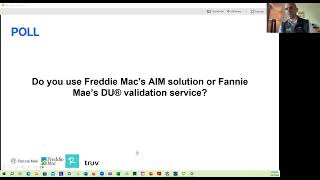
While you guys are going on that poll, the polls asking if you use the Fannie Mae AIM or the Freddie or, I'm sorry, if you use the Freddie Mac AIM or the Fannie Mae DU validation service. I want to hear from you guys, more importantly, do you use it, do you use it at the level that you're comfortable with? Are you happy with your percentage of files that are using these validations?
Love that. Well, I mean, the obvious question is, do you mind taking a stab there and letting everybody know a little bit of how you would answer that?
Well, sure. I'm on the spot. It should be fun. We're, we're using it. We're, we're not leveraging it to where we need to be, which is why you guys have seen so much of me over the last couple of months. We've got a, we've got a big push within our platform to try and start getting the rapid warrants on about 16% of our, of of our total business that we're producing so that we can kind of create a fast lane in underwriting that says, you know, minimum documentation, minimum standards, faster production. So we are, we are, we are deep in the, deep in the platform with you guys to, to try and make that a reality for 24 and 25.
I love it. I love it. So before we do the poll results, let's just speak to some of the comments that I'm seeing coming coming in right now. Some people are just here to learn more. Some people are here to improve the bar experience, which is great, David. And there's one that I thought was like, was really, really relevant was how do I get my sales team to use it? I thought that was pretty big, too. So we're definitely going to touch on all of these topics here, everybody. So, like, we've this. You've come to the right place to learn to learn about these, about These topics here. So why don't we do this? Sheila, why don't you share some of the poll results and let's take a look and see what, what do we got here? Wow.
Surprise, surprise, surprise. 59 in the nose. What?
Yeah, strange. Well, it's interesting. Can, can anybody who's in the audience who answered no to this question, can you please for this poll just write into the chat why, if you just. It would help us to understand, kind of catering to the audience. Yeah, if you can. No, not that you answered no, but like why you answered no, like why aren't you doing it right now? I'm just curious. So let's move on to the next question. I'm going to get back to the answers if people answer that. So. All right, let's go to the next question. Sheila. Cool. So I'm going to start just, I'm going to tee this up to Femi first. How do we move as an industry towards the digital future?
Breathing and taking this in a, in a small step, by step. Reasonable, reasonable response. Reasonable response is we start by showing ROI and showing the improved speed on the manufacturing of, of loan products. We turn effort into a marketable security when we make a loan. There is no raw material in our manufacturing process. So our limits are, it's really up to what you can produce. Moving us in towards the digital future is getting people to say, you know, I've been doing something the same way for 30 years, changing that mindset and start to say, how do we do this the fastest way possible? How do we do this at the way that scales the best? How is it that I can walk in and buy a car and be in and out in two hours and I'm still taking 26 days to take a mortgage? We've got to take a certain point from, from the lender's aspect. We've got to be able to take technology, show the ROI and the technology and then leverage that ROI to in to increase production or increase production, increase profitability from the individual lenders using the, using the tools like your company's product and using the outlets that Fannie and Freddie give us the option for that allow us to make a more secure, better verified note that's not going to come back and bite us in three years later on and just do it on a faster process.
Jodi, do you want to comment there?
Yeah, I can add on a little bit for to that too. So I think Femi's right. I mean, the first step is really helping people understand the value in what they do, we see lenders every day that are leveraging these tools to really scale to market demand. So as volume goes up and down, it can really help them do that. Obviously we're here to talk about risk today. That was kind of our core talk about fewer errors and greater loan quality and more consistency in the process. But the other thing I'll mention as a comment to the loan officer question is really helping the loan officers understand that out of this process you can actually end up with increased customer satisfaction and, and some more loyalty. So you're going to eliminate those lost documents, which is the number one dissatisfier in some of the Stratmore surveys. And then the other thing is reducing that time to close and giving the borrower more certainty by giving the loan officer more certainty up front. So really helping everybody see the value end to end. I think the other piece that we're going to touch on is there was a few metrics we can share. So last year Freddie Mac did a study on digital innovation and how it drives loan quality. And I think these metrics really help people understand. So what we found is lenders that had a fairly high use of ReadyMac technology, meaning all the rep and warranty offerings that we offer, we saw that they produced loans that were $1,700 less expensive, which in today's world is a big deal. We saw that they had a seven day shorter cycle time, also a big deal in this market. And then lastly, 40% fewer defects and that's not only defects from repurchases, but femi. To your point, that's the what happens three years out. We saw reduced risk all the way across the board.
That's awesome. Brooke, do you have anything you want to add?
Yeah, I would just add, I mean we have a similar approach and we've looked at similar data. For us, we also looked at the defect rate when a lender uses one of our solutions. And for us with one solution, it's generally 33% lower defect rate. But when we're using two or more of the solutions, we're talking income, employment, asset versus verification. The defect rate is reduced by 50 to 70%. So you can imagine that just the certainty involved with having used a digital verification service really helps to ensure that you're not hit at the back end in the QC process.
Very cool.
Sure. We're going to talk about those later on when we start doing the case study.
Yeah, for sure. Well, I just want everybody to know if you're looking at the chat, there's Some fantastic comments coming in right now. You have folks talking about they want more education for their los, so they get more reps and warrants. You've got folks in capital markets who are reviewing loans and trying to understand how, you know, something like a consumer, consumer permission platform affects those loans that are coming in. So fantastic audience. You're getting pretty much across the organization at a lender right now in the audience, and they're all interested in this. So I'm really excited for this. Let's keep going. Let's go to the next question. So how can a digital strategy help? Some of the challenges and really this, the three challenges we've thrown here, this is these, everybody knows it's a little bit doom and gloom for the industry, but what's really great is we've got these products that are being offered by Fannie and Freddy to really help lenders overcome a lot of these challenges. And so, you know, folks like Femi are taking advantage of these and are going to help talk about it during this call, during this webinar right now about how they're being successful with them. So, you know, I'll just go through them really quick. Average IMB lost $2,109 in Q4 less than MBA. They've been putting this out since 2003. You know, the average profitability. And some people, you know, look at this calculation differently. But, you know, I think that's it's a good overall stat for the industry up to three years after buying a loan to request a repurchase. Right? That's, you know, that's basically the risk that a lender has. And each buyback can result in an average of $100,000 loss. And then finally, I think the biggest one here for most, just for our industry, you know, I'm at a conference right now, so everybody's talking about is basically, rates aren't coming down as low as everybody thought just at the end of last year. I mean, we're talking about like three rate cuts in December. Everybody was it sound. There was a lot of lenders who sounded like they were like making plans based on that. And it's not looking like that right now. Right? Matter of fact, it's definitely not looking like that. So, so, so, Femi, why don't you take a stab at this? How can, how can a digital strategy help alleviate some of these challenges?
I want to focus on number two, really. I want to focus on number two, but I want to identify how number one gets, is really connected with number two. So when you start saying the average IMB lost 2100 per origination. What's going on in those numbers is the total cost that it takes to operate the IMB divided by the total number of units that they're closing. All right, so if you have giant repurchase costs, or you have indemnification costs, or you have things that are loan quality costs, right? That's not actually saying that you're losing, you know, 2,000 every time you close a unit. If I was closing a thousand units a month and losing $2,000 per loan, I wouldn't be on this webinar, right? So that's something that's in there to understand. But in the piece that I really love about this is if you could, for everybody that's sitting in my chair, that's in operations, that's responsible for loan quality, that's responsible for manufacturing a quality product that's going to be sold the first time and quickly, if you could just eliminate your ability to, or eliminate your exposure to fraud and eliminate your exposure to, to documents that are insufficient and just put yourself in a space where you could trust your information at day one. Up front, think of what you get in benefit for there, what you save in QC and qa, what you save in third party review, what you save in underwriting, what you SA processing, what you, what you benefit your, your loan officers and your originators with, with being able to give direct answers right up front. That's where you want to go. So the real question is, how do you get a digital strategy to help some of these. Your digital strategy again, if you want to start saving money on loans, lower your cycle times, you stop paying employees 65 hours to do one particular product when you can get that product down to an hour by that employee, right, you want to start working those things as fast as possible. That'll start raising your, your revenue per loan again. If you can increase your validity of your information up front, get it right, get it once, get it the first time, you're going to limit your exposure for buybacks. And number three, I hate to use my dad's parables, but if you're praying for rain and you're waiting for that to happen, you're going to lose out to everybody that's out there farming right now. So get to work, don't worry about the rates. We're all playing in the same environment. It's not like some evil empire out there has access to 4% and we're competing against that. We're all playing the same game right now. And, you know, people need a place to live. Affordability is at an all time low. Challenges are at an all time high. Producing a mortgage is as hard as it's ever been. Let's figure out ways where we can strip out some of the things that have been piled onto US since 2008, 2009 and start to say how can we get direct to source data information at the front of our process as fast as we can trust it, verify it, move on.
Hey, before I tee this up to Brooke first, then Jodi, I do want everybody in the audience to know that, you know, I tend a lot of conferences, I talk to a lot of lenders and Femi is looked amongst his peers as one of the experts. And as you listen to him talk, he really knows what he's talking about. So this is a great opportunity. If you got questions, even specific questions, he's happy to jump into it and I'm going to call him out. So throw it in the chat if you've got a real specific question, like this is your time to get the question answered. And he loves helping so like you can reach out to him individually. Brooke, please.
So while I, while Femi was talking, I was thinking about another aspect of this with rates not coming down, kind of addressing number three. And if you think about it, you don't have, there aren't as. There are a lot of potential borrowers out there, but they don't have as many, there's not as much volume, there's, there's not as many opportunities for home purchases right now. So you're really kind of trying to make sure that if you have a consumer that you're working with, they're, they're kind of connecting with you. There's, they're sticky, they're having a good experience. And so I think this digital validation rather than having to deal with a lot of paperwork can really help a consumer experience. And that's one of the reasons that I loved devalidation service from the very beginning, was that, that really painful experience. And on top of dealing with the rates, just thinking about what that consumer experience is like, and we'll talk, I think a little bit more about how to make the experience smooth from, for them end to end. But I think that one way to look at addressing some of these challenges is just trying to how do you reach a borrower by demonstrating that you can close a loan quickly or not ask for a lot of additional documentation and that kind of thing.
Jodi, you know, I think back to number Three in the purchase market, those loans just historically have higher defect rates anyway. So regardless of whether you're in a purchase market and there's higher defects or you turn to refi and you want to use these tools so that you can scale your resources better, either way is a great time to move more toward a digital strategy. So I would ignore the rates and just step in and get started. I think the other thing that I'll mention is that seeing kind of the financials really can help you create a business case. So what we see as a trend right now is a lot of the costs are being pushed out to the branches, for example, where they have to pay the cost for these reports. But the benefits are are really at an organization or a company level around repurchases and operational efficiency and all these other things. So as part of how I think about these benefits is you really have to get the organization to think of them as a whole because you're going to make a pretty significant tech investment up front and you need to get the loan officers engaged but the benefit is realized for the whole organization. So I think that's probably a challenge for all the lenders on the call is to really get everybody thinking along the same line.
We have a question in the audience that I think is pretty interesting. It's from Kelly Haney and she's saying we have a wholesale channel. What's that? He's saying oh sorry, apologies, look at that. So they have a wholesale channel. He's saying any tips to get higher adoption rate? And so I think they're talking about adoption of reps and warrants right through Fannie and Freddie. I don't think they're talking about consumer permission platform yet. That's how I interpret that. Do you agree?
I've known Kelly for a little bit and I'm. What I think he's trying to get at is how does he get the people that are selling his wholesale to use the rep and warrant relief. And my secondary is the one place that I don't really play in when you call it out on, on. I know what I've got going on but what I would specifically say is you could offer a slight pay up because you'll have validation where you don't have to worry about misrepresentation. You don't have to double check the information if you have the rep and Warran that are on there. So you can either offer incentives to folks that are using rep and warrants when they're delivering to you or you can essentially you know, require specific amounts or specific percentages to have those specific characteristics.
Interesting. Well, you're getting some follow on questions that are very similar too, right. From J. Chapman and Alan. You know, let's start with. I'm actually going to. Because it's similar to what you were saying. Alan was saying. Do you have a standard document documentation verification pathway you follow for every loan like a work number standard Voe, Fannie or Freddy tools like Troop? You see that comment?
Yeah, I can see the, the request in there. And what I can say is we do, we've actually, we've, I mean, you know, we've been, we've been friends with true for a little while now. I was, I was a, I, I think a rather tough fish to get up. Started talking to you guys in February. We did, we didn't have verifications going through until August because, because there's a lot of information to validate along the way. But one of the things that we realize is that we need to cast the widest net possible, right? You're not going to get day, you're not going to get day one certainty or aim verification on every usage that you get that you are on every file that comes back, but you are going to get it on a high percentage. So the first thing is you've got to cast a relatively wide net. And the other thing is that these consumer permissioned items are actually, they're allowable via Dodd Frank, so you can put them at the front of the application. You don't necessarily need to have intent to proceed in order to get the consumer permission information out there. So I would start with that with your, with your branches and, or with your, with your originators is get the information upfront integrated into your POS system, integrated into your workflow. So it's the very first thing that they can do. Jody and Brooke can talk about their benefits of their VOA platform and, and you can work with your individual reps at any of the different companies that offer the consumer validation services that you can come up and say are the consumer permission validation services. You can come up and say, hey, I want my waterfall to start with a VOA and then I want to go to the VoI and then I only want to do re verifications at this specific space. So putting that at the front of your application and understanding that the wider net that you have, the more pickup you're going to get is really where I would start.
So let's jump into the next, the next slide if you don't mind. This one I think is really kind of getting into the meat and potatoes. I'm going to tee this one up to Kirill. Kirill. What is a consumer permissioned verification provider and what are the major benefits? We've been talking about this on this webinar, but some folks in the audience are very new to this, so why don't you take it away?
Thanks, Richard. I'll start with saying what is true. We're an open finance platform, so we don't think about us as a consumer permission, just verification provider. We do a little bit more than that. The idea is always the same, is like instead of me going and buying data from third parties and then relying that the third party has accurate data, I go, we can go directly to the source. And when you go directly to the source, whether it's a bank or payroll provider or anything else, you can actually get better quality data. But you need consumer engagement. And that's why it's called consumer permissioned verification. Right? Consumers have to give you explicit permission. And the way we do it is by, let's say you have adp, we ask you for login and password, or we'll ask you to confirm your identity with six digit code where you get an email or a phone number or you get a text. And when we log in into the payroll provider, we get the data directly from the source and we guarantee the quality of the data. And that what really makes. It's a very different business model. So it makes two things available for the lenders. First, the data is high quality. You get rich data. You get data for, let's say, the last three years of pay stubs. You get W2s, you get reports, summaries and work with both Fannie and Freddie. We're AIM certified with Freddie as of December. So that kind of, I guess, proves that the quality of data is good. But the second part to it is we are also working. When you work with a borrower, they give you all the data that is accepted by, let's say, Freddie, right? In that situation, the process is done. It's really quick, it's straightforward. Process takes about 30 seconds. And the second piece is because we don't have to go employer by employer or payroll provider by payroll provider and pay a toll fee like some other databases do, we can save you a lot of money. So our cost is really just implementation costs and working with you so you can save up to 80% on your verification expenses today. And these are the two major benefits, I would say the secondary benefit and I think femi Will talk about it is actually because of the good quality and how fast it is, you can put it right at the front of a application so you can cast the wide net. You can get more data up front and the cycle times on this loans. Because if you look at pieces, you need that to verify to underwrite a loan is one of them is income and employment, and the other one is asset. If you could get everything up front while you have the borrower on the phone or even before you have them on the phone, it's then manufacturing. That loan becomes very cheap and the risks are reduced. So all in all, it's a very different way to approach acquiring the data and acquiring data directly from the payroll providers or bank, but with the same benefits as with any other automated solutions.
Can I jump in here and right before real quick.
Yeah, please, go ahead.
Yeah. So one of the things Kirill mentioned is that they don't have to attach a database. And I think that's something that people that are sitting in my chair on the other side of this webinar need to understand is the companies don't need to sign up for this. It's not, oh, we've got to start sending our information here and we have to get our information there. It's just a simple matter of whether or not the, the vendor that you've chosen is plugged into those particular payroll providers. And vendors, like true, have coverage. What is your coverage of employed people.
In the U.S. it's 92%.
Say that again. 92% coverage. Come on. Right. We're gonna get hits back. We're gonna get hits back. Where we're not gonna get hits back are the guys that's working on the pawn shop that's getting paid in cash. It's not gonna get a loan anyway. Right. We've got to turn upward and figure out where we're trying to document this. Like, you can bang your head against the wall and go look for a payroll ledger on somebody who's still physically writing checks. But those are the only people that the consumer permission platforms aren't going to cover. And it doesn't require a database. I'm not paying the incumbent, the incumbent company out there to access their database and realize that it wasn't updated but once a month. Because the, because the company that I work for only set up that for their cadence to update items. Like, we understand that it's really bringing it down to the consumer level where they're just passing you their information. That's, that's live. I think that's really important.
That's great. And. But I'm gonna have the. Kirill is going to respond to the comment that just came in in the chat. And honestly, I'll be transparent with everybody. I think a lot of vendors would shy away from answering these kind of questions on a webinar in front of everybody. We definitely have no problem with it. So feel free to ask these questions before Kirill does. Jody and Brooke, I want to give you guys a chance. How do you think about new CP consumer permission platform providers, you know, like TRUV and others? How do you guys think about them? Jodi, why don't you start?
Sure, I'll start. So we have through aim, a whole spectrum of income assessment. So starting with the direct source assessment that we rolled out about five years ago, all the way to our newest offering that covers OCR from Paystub and W2. So this consumer permissioned piece falls squarely in the middle. And I think Curl, you did a great job of really covering the benefits. It does reduce risk. It is a way for that in the documents to show up instantly so you're not waiting for the borrower to send those in and you're going back to source data. So I'd like to kind of connect the dots to P. Kelly had a question there about rep and warrant and what do you actually get. So with any source data, whether that's direct source or credentialed, it's rep and warrant both on the data and on the calculations. And Krill mentioned, you know, it's all source data. Like that is kind of the holy grail. I'll differentiate that from our pay stub W2 OCR offering, which we rep and warrant the calculations, but we don't rep and warrant the data because we can't verify where that actually came from or where the pay stub came from. So you do have a little bit of advantage there in the again, with a credentialed solution that it's instant and it is true source data. So it helps from a fraud and a risk perspective.
That's a great answer.
And from our perspective, we and probably Freddie is in the same boat. We're looking for providing multiple opportunities for lenders based on their business models. And so we're not, you know, we want to support different approaches to obtaining data as long as we know that it's secure data. So this is something that we have reviewed and considered secure data that we're obtaining. And we do have the same kind of rep and moritz that Freddie has on the calculations. And the source data for income, employment and asset verification. And like Freddie, we have a similar, similar type products where we may just rep and warrant the calculation. We have a new income calculator tool that is specifically for self employment income and that's just on the calculation. But I think the real what we're talking about today with the real benefit of the source data gives you that much broader rep and warrant relief.
You have an engineer in the comments.
Oh, Michael. Hi. Can you get obtained the data in JSON format? Yes, you can. We make it easy because we are integrated with POS's LOS and we can deliver data directly to POS LOS or we can deliver data to you if you want to develop a custom application. And we'll give you the JSON but we'll also create the PDF format report that your lo can look at and say okay, I got reps the in warrants on this specific connection or and in that case they can easily move on to the next step. So the data comes in different formats and depending on who is the user or what platform you use, we just make it as smooth and as easy as possible for the user of that platform. Our docs are public. It's docs.troof.com.
Love it. All right, we're going to jump into a poll now. Our second poll and this should kind of wake everybody up a little bit. You can launch it whenever you like. Our first poll was, you know, do you use DU validation in aim? And it was surprising actually to see the lower results, lower than 50%. We were thinking it would be in the, in the higher when we were backstage. This next poll is do you use a consumer permission platform for your verifications? Like you know, similar to TRUV or another option that's out there. You know, basically is the borrower actually given permission to access their source data. That is what a consumer permission platform is. And do you use one for your verifications? And so obviously FEMI uses them. Uses. Uses us. And we're going to get into, we're going to. Let me see here. I don't see the results just yet. But Sheila, when you, when you feel like you're comfortable with the results, you can share it. All right, well it looks like 50, 50. That was my guess backstage actually. So 5050 in the audience. And what's really interesting is in that 50% people are trying to get more adoption and just get more reps and warrants with this. So it's just a fantastic discussion we're having right now. And I want to get into the case study with TRUV and Femi right now. So. But real quick, before we do, why don't we jump to the next slide and I just want to kind of frame that discussion with the lens of Fannie Mae's DU validation service and Freddie Mac's AIM program. So, actually, I'm going to tee this one up first to Femi and I'm going to say Femi. Why do you think it's important as a lender? Sheila? Yeah. Thank you, Sheila. Go ahead.
Why is it important as a lender to use a supplier that's approved by the agencies? Is the rep and warrant relief. The stats that Jody was mentioning earlier and Brooke was saying that they had similar studies for, of actually reducing your cost and reducing your cycle time. Those were people that were leveraging their technology at a high level. So you want to be able to use early check. You want to be able to use Rapid warrants with your income. You want to be able to use Rapid Warrants with your assets. You want to be able to say, hey, I've got this. Not only do I have this in a digital format, but I have this in a digital format that's going to give me rapid warrant relief. Without the rep and warrant relief, you can increase your quality, but you still have exposure to your list, to your risk while using the items that come with the rep and warrant because of the consumer permission, getting it directly from the source data, like Jody said, that's the holy grail of the data. We know it's accurate. We know it's. We know it's true. We know it's not been manipulated. You can ingest that into whatever you have for an income calculator. You can, you can run that through a proprietary service that, that I. That identifies this. You can use pay for party services, and you have the source data. You have the rep and warrant relief. You shorten your manufacturing time and you eliminate risk.
Brooke, really briefly, do you want to give a. You want to answer this question really briefly and then I'll give Jody a chance?
Well, I think from our perspective, it's. The answer is obvious. I mean, we want to offer rep and Morant relief. We want to make sure that lenders are able to streamline their processes and so we don't see the data. If you aren't choosing an authorized supplier at this.
I missed one sentence too in there. The. The piece that I missed. There is no lender out there that has the resources to do the data validation or to do the validation behind the vendors that Fannie and Freddie have done, let them do the hard work of vetting whether or not they're going to get a certain percentage of the 12 month history on the VOAS. Let them vet the accuracy of the information let's use from the selected pool. That's been, that, that's come out of there. That's, that's, that's a herculean task that I, I tried to do previously and wasted a lot of time on.
Awesome. Jody, you have anything you want to add or should we go ahead?
I'll, I'll add one quick thing. You know, in terms of metrics, we do see aim on about one in four of our loans at this point. So we are really seeing that usage increase. And we've invested a lot in these technologies in the industry. And I know, Brooke, your company has too. I think we only get where we need to go if we all really make this the norm, make the borrowers and the loan officers expectation that we're going to really move the needle on this digital strategy. And so to Femi's point, if you're using an authorized service, you're using a validated service. That's what brings you all the benefits and benefits, the whole process. So, you know, it's really about how do we move the industry along and really make this kind of the process sets the norm for everyone.
Ticking and screening is how we move them along. We drag them.
That's your, that's your part. I mean, I can only use words of encouragement. Right.
So I don't want anyone kicking and screaming.
Before we jump into the case study, I just want to say to Pete Kelly, who threw in the comments there, yes, that's, you're correct. That's how, that's how I interpreted the explanation too. And it's because they need to be able to validate the source data where it's coming from. Let's jump to the next slide and I'm going to hand this over to Kirill. And Kirill and Femi are just going to have a quick, quick discussion back and forth about his experience with Drew. Take it away, Kirill.
A million percent unrehearsed conversation.
Well, first, Femi, thanks for being a customer and we really appreciate the partnership. And Julie and Brooke, thanks for being great partners as well as well. It's been wonderful working with you, Femi. I guess let's just start with how do you use Truth today? What products do you use and what's your tech stack? Where do you use Truth in terms of Your funnel over the application and technology.
Sure. We use the VOA product from TRUE very recently and we use the verification of income product from TRU presently. Right now we are, we're using them at our pos. They're actually, they're not quite integrated in, but as soon as our POS is done, it fires off a web hook that throws off the, that throws off the TRUE piece so that we can start capturing data at the point of application as quickly as possible so that we can have as much rich data as we can to make the decision as quickly as possible and also use it in attempt to limit the cost. I know we've been saying use a service, use a service, use a payroll provider server or, sorry, use a consumer permission data provider service over and over. And we haven't mentioned any of the cost savings since we started, since we started this dance together. We've taken our, we've taken our cost for verifications from 8 basis points to loans down to 3 basis points for loans by using your consumer permission service.
I think you got to say that again. You got to say.
Yeah, I got to say it again. Got to say it. We went from eight basis points per verification cost, largely using the incumbent database service, to about three basis points for. For verification cost using consumer permissions.
Wow.
As I mentioned at the beginning of this webinar, we are going to be at a heavy focus in 24 and into 25 into extracting every bit of rep and warrant that we can and kind of fascinating those through our underwriting process that says, I can have somebody that has X, Y and Z skill do A, B and C tasks because they only have to look at this subsection of the information because I have rep and warrant on the rest of it. So we're going to try and crank up the volume really fast and really, really, really lean into where we can get that rep and warrant relief with your product.
Thank you, Femi. So savings and reps and warrants, what else do you see in terms of metrics? Right. You spoke a little bit about the cost of like, speed of manufacturing the loan and also how much menial labor goes into producing every loan. Can you talk a little bit about that?
Yeah. So let's do it from the, let's do it from, from an operations manager's chair. So I'm sitting in here and I'm saying my underwriters are doing X X file files per day. And they're doing X X files per day because when they get to a pay stub, they have to look at the address. They have to look at the, the name on the pay stub. They have to look at the name of the company. Does it match the, does it match the 1003? Are the deposits matching what's going in here? Are the deductions correct? Are there, are there any additional deductions for what's going on? They I our company's been working on a document to get us into a task oriented production system and the document for what you look at on a pay stub is mind boggling. I left the meeting the other day and I said I don't ever want to see another pay stub ever again. When I get these, when I get these platform or when I get these reports back from True, I can do what the other person was asking about. Can we get it in JSON format so I can get it to my engineers and I can have them run it through my calculation and say this is my number. I can take the report back and say I've been working on this OCR technology and you guys no longer need to be trained on every, every permutation of what a pay stub looks like. And we can say I need you to train on this format for my items and I can get my, get my information back quickly. You can look at something like, like another calculation service that has rep and warrants as well to what they're, to what they're calculating, if that's what your source is. The benefits of having a standardized format that I can have one of my people in the underwriting say I don't need to look at any of this other information. I only need to calculate. Even when you don't have reps and warrants you can pick up in your manufacturing, in your manufacturing setup. Other examples are things like QA or QC. You've got to do 10% of your total files to keep up with agency standards. And that's the minimum guidelines. There are a lot of folks that are trying to do more and more and more right. And that costs if you're using a third party service, that costs if you're using internal labor for it. If I can come up and say I have rep and warrant from this, I cross that off the list. So now I've got a file that was done from underwriting. It's moving itself over to closing and my QC person has 18 tasks less to look at. That means that I'm shortening my cycle time and I can get to my closing department faster. You can find ways in your manufacturing process that Start at the POS for document collection and that go all the way through shipping where you can just sit there and say I can save here, I can save here, I can save here, I can save here. All the way throughout the manufacturing cost or throughout the manufacturing process. It's ridiculous how many points your people touch things and my favorite of everything is that I don't need to check the checker. Everybody who has sat in a room with me has heard me say I lose my mind. When an LO checks an LOA and the processor checks the LO and the underwriter checks the processor and the QC person checks the underwriter and then the investor check. Why find the source of data, validate the source of data, lock it down and move on. Once you start doing that, you will start seeing cycle times just drastically shortened.
I guess the last question FEMI is with the cycle times. How do loans which where consumers engage on consumer permission data and they can get verified instantly. How does the pull through rate looks on those type of applications versus more manual type of applications?
How do you know what I'm doing this week? Working on that this week. I don't have an actual number for you but what we wanted to come up with is I've had people say they're, they're being penny wise and maybe pound foolish and they're worried about what their upfront cost is because they do so many pre applications and their conversion rate is a little bit lower. Some of the benefits from your particular program, you get multiple re verifications for up to 90 days so your capture percentage is larger which means that your income is good for as long as it can be. Right. Whereas you can, you need to have a pay stub document. It needs to be within 30 days of the application. Takes you 42 days to, to find a house because inventory is low. Now you're going back and you're collecting the same document earlier. Jody even mentioned earlier in the Strathmore surveys you want to anger a customer asking for something you've already gotten, right? It doesn't even matter if you explain, yes, that was at the beginning of this but it needs to be 30 days later or it needs to to be within 30 days of your application. They don't understand, they don't care. We know what Fannie and Freddy's guidance is. We know that if we can make them do something one time we're going to have a higher capture percentage.
Right?
So it's, I'm working on a study for that so that I can actually come up with some Real numbers, but just in the simple fact that you can, you can alleviate the number one frustration to your borrower by using a consumer prevention platform. People are getting used to this. They're getting used to saving their passwords in their Google profile. They're. One of the challenges that we saw when we started rolling this out was when people change jobs, it's okay that they change jobs. If they still have access to their ADP to go log into their old 401k, they can still get those same documents up front all the way there. And I can tell you with 1 million percent, with 1 million percent certainty, if you give a customer the actual answer for what they're allowed to shop for on day one, you're going to be stickier than saying, oh, you've changed your loan amount. Let me go check again. Oh, we've done this. Let me go check again. Now we're talking about overtime. Could you give me your last two pay stubs from the end of the year? Because I don't want to spend $60 on a verification from the incumbent. Right. Like there's, there's ways that you can get through, through this particular platform that gives you your data up front that gives you the most accurate piece of information and that's going to make everybody stickier. Right. They're just, the experience is just infinitely better. All right, he's got a great question that hits him. Yeah, stone cold. Yeah. Is absolutely on the agency products all day long. This is the same, this is the same documentation level that, that a written verification would have been. Richard or Kirill. You guys want to actually talk about what people get back out of the box from you guys?
Karrel, go ahead.
I can cover. It's, it's three pieces, right? It's, you get a JSON file with all the information. You get a PDF of all the documents, wtp and then you get also a report. And report is the most rich report which can be with attached PDFs of paystubs and W2s or just by itself where you can see all the income summary, pstap information, income broken down, all the identity information, everything. It's about 150 data points that we return instantly that you can look at. And again, it's within the guidelines of, of both Freddie and Fannie.
Excellent. So, hey, before we're going to jump to the next slide, and this is kind of our send off question, but Femi and I were at a conference recently together and I was in the room with a bunch of lenders and I just surveyed the room and said of all the lenders here and there's probably 20 lenders in the room. I said of all the lenders here, how many of you are going to sign up with a consumer permission provider this year or you know that you need to this year, as is how it was phrased. And 100% of the lenders said yes. So this is just something that needs to be done at this point, right. In terms of like cost savings and optimizing. From most of the lenders that by far the majority that we've spoken to, the question is just how you're going to do it and when you're going to do it. So but this is a good send off question that I want to end on. And Femi, I'm going to give this to you first, but I want you to, I want you to answer. There was earlier a question in the, in the, in the chat where someone wanted to talk about how do you get this adopted? There was actually two or three comments around adoption and how do you get your organization, your los to start using it? Right. And so how would you advise lenders to create their digital strategy? And I'd love you to touch on that a little bit.
All right, so I'm going to try and breathe and talk through this as quickly as I can, but keep it concise. Number one, develop a plan and then check to make sure that each step that you make along the way is actually bringing you back to what that original plan goal is. So set your overarching theme and then you can say, oh, I started to get into this, I started to get into this. In this business we go down rabbit holes left and right. You want to make sure that you're still pointed at the same path. So our particular goal for revolution is to get between 16 and 20% of our files to have the rep and warrants for day one certainty or AIM validation. That's what we're looking for and that's what we're going to spend the rest of 24 and much of 25 on is until we can start fast laning like 20% of our production. That's what we want to do. So every step that we make along the way has to come back and say, is this in service of this? How does this help? How does this help? Now your strategy or your starting point doesn't have to be 16% usage. Your starting point could be increased convert, could be increased conversion from your loan officers. So then it's a question of whether or not you can educate them on how much faster the loans can be done by, by using digital strategies. Your, your goal could be how do I get consumer experience to this? So you take a look at the Stratmore surveys and whatnot and say what causes angst amongst borrowers and say, how can we take a digital item to eliminate that? Pick your starting point and make sure each of your steps along the way get you in that, get you in that direction. I think that's where I would, that's where I would advise everybody on the broader scale of how to start this.
Jody, do you want to take it, Take a stab?
I will. First, I'm going to answer the last question that came in the chat. So we get to it talks about income report being acceptable in place of pay stub W2 when it's not rep and warranted. So there's different types of rep and warrant. So rep and warrant. Keep in mind means like income, rep and warrant on calculations mean you had enough income to fully qualify for the loan. There's another scenario where we might grant through aim, partial rep and warrant, which means we were good with what we saw for this borrower for this job, but it still wasn't enough income for the whole loan. So I'm just going to tell people, you know, it's really important to read those messages. The other thing is, even if we didn't get rep and warrant, we will give you messages about what we saw in that report. Maybe the income calculated didn't match what was on the loan app close enough. And we'll tell you that, we'll tell you if there are problems with the data, we'll tell you if there's risk of fluctuating income. So there's value in that report whether you got rep and warrant or whether you didn't. And I don't think we touched on that, any of the other things, but it's just super important to read that messaging that comes back and make sure that you're using the whole thing. So back on femi, your point about tracking progress, we also did roll out some eco reporting in Freddie Max Technology so lenders can track their progress and you can see, you know, what's coming through. What'd you get Rep and warrant. And in cases that you didn't, why not? So there's some, some good tips there. Now back to the question. Sorry, Richard. Was how do you advise lenders to create a strategy? I think thinking end to end is super important and making sure the borrowers and loan offers know this. So What I see lenders do is, well, ask the borrower to do their assets and now ask them to do their payroll and now ask them for something else. Set the stage at the very beginning with your loan officers in the borrower that we are a digital first company and digital first means the borrower enters their loan app, the borrower does their bank statements online, the borrower does their payroll, they do E disclosure and ideally they close through an E mortgage or at least a hybrid. And that way your loan officers aren't trying to sell piecemeal. And you as a lender say, we have a digital strategy and this is it. So that's my advice is think holistically, not trying to really just do one thing at a time.
Love it, Brooke.
Yeah. And so I'll just reiterate a few more tactical pieces of this because I think we've talked about high level. I mean, you've used the term strategy here, but there are some tactical things to think about, like adjusting your workflow, which is what Jodi was just talking about, pushing that, obtaining the digital documents up front, thinking about any technology changes you might need to make in order to make this happen, and then training your staff, making sure that you're connecting with your loan officers and there's a buy in across your organization. And then I guess really the last point that I would make is around this. Not every consumer is on board with a credentialed model. And you need a strategy to make sure that they're comfortable with providing access to their data. They can get there. And a lot of people really are. But in some of our studies, there's a whole range of people that really aren't. This is a safe mechanism, if you think about versus sending an email. Make sure that the consumer knows that and the borrower knows that and hold their hand through that person process. So that's, that's. Those are some suggestions that I would have.
Spot on on the secure point, Brooke. I can't believe I never mentioned that. Spot on. Everybody's used to connecting to Venmo or Cash app or something else right now. They're a little easier they are on their bank statements than they are on payroll items. But we can get the field there and we can get them without the kicking and screaming.
Yeah, I love it. We spent a lot of time talking about that in prep and actually didn't talk about it for very much on this webinar, but for another day, for another time. Kirill, do you want to take us away here that you're the last one.
I think that the adoption challenge really comes down to benefits. There are benefits for the business when you save money, right? It's great. There's benefits when you save cost on the operation side. But when it comes down to a loan officer, how do you suggest the benefits? Because the best option is just I click a button, I get the report back and even if it costs hundreds of dollars, that's really not as much of my problem. And when you talk to the loan officer, I think convincing them this is actually good for them because if you run a waterfall of solutions, you run say consumer permission data, you get reps and warrants, you are going to close the loan faster. That's why I asked FEMI about the pull through rate actually. I hope you'll see this in your data. But we know the data from other customers, the pull through rate actually improves because if somebody is willing to share their credentials and the process is faster, they're more committed so there's incentive to close faster and they're more willing to work with you as a result because they trusted you with their quite secure information. But for the loan officer, I think the biggest adoption is just make it easy for them. Find it in like we have integrations with a lot of platforms and then obviously like explain the benefits of closing faster, closing better because you don't need to go back to the borrower multiple times if the document is missing. If you need to do re verification, nobody wants to do that. As a borrower, we all went through the process. I don't want to be called multiple times a day during the meeting to just send you another pay stub. You click a button, you get the data back at any point throughout the process. Process. And as you explain to the loan officer that their pull for rate is going to enclose rates would be better if you can incentivize with some commissions because you're going to get reps and warrants. That's excellent as well. So I think the adoption comes down to how do you motivate your sellers to be the best sellers they can be and just close faster and with a higher success rate. That's I think what really comes down to and I think that consumer permission data fits right in there. We saw loan officers being pretty happy about the commission and paycheck at the end of the month when they use this data. So it's been nice. I'll leave it at that. Richard, thank you.
Thanks so much everybody. Let me just say thank you to all of our panelists. Femi you are a superstar. Jody Brooke, thank you so much for joining. All of these people are. And Kirill, of course, my CEO. Everyone is available on LinkedIn. If you guys have questions you didn't get to them, feel free to reach out. Everybody likes helping in this industry, so, you know, you can always get your questions answered. Thanks, everybody, for joining. Sheila, did you want to say anything before you send us all off?
Yes, I just again, would just like to echo Richard, what you said to thank all of our panelists for participating today. And before everyone goes, we would like for everyone to respond to our poll questions. And I'm just in the process of launching that hopefully.
Oh, MBA poll questions.
Yes, MBA poll questions.
Exciting.
Ideal. If. Let's see. Duplicate. Let's see if we can get that to. To launch. Let's see.
Does Richard look like he's in witness protection.
Refresh. Unfortunately, we are having some technical difficulties with our poll. Let me see if I can get it to launch.
In the meantime, thank you at the NBA for having us on the screen. That was really fun. I'm really excited to work with such industry professionals like Jody and Brad Brooke. I mean, this. That's all. It means a lot to people in the industry that we can actually reach out to people at agencies and that you guys are here to help us, help to help us deal with you in a better fashion. It's a tremendous thing. Every. Every once in a while, we start looking at these guys as the. The great and powerful odds behind the curtain, but really amazing to know there's people like you behind.
We're just real people. Yeah.
Yeah, definitely.
No.
Again, thanks for all of our panelists and unfortunately, we were having a little technical difficulties with our poll, but we will follow up with a PDF and recording of today's session. And again, thank our panelists and thank you, participants for joining us. And we look forward to you joining us for another MBA education event. So everybody have a great day. You can now discuss Connect. Thanks so much. Take care, everyone.
Thank you.
Bye. Thank you.
More from Kirill







How CrossCountry Mortgage Saved $10 Million Annually with Truv's Verification Solutions



