Navigating The True Cost of Mortgage Operations
This is a YouTube video titled "Navigating The True Cost of Mortgage Operations" recorded in June 2024. The content is a webinar-style discussion featuring multiple speakers including Richard Greaser (VP of Marketing at Truth), Kevin (KP, Chief Lending Officer and shareholder at PRMG), and Rob Christman. They discuss the rising costs in mortgage operations, breaking down cost components such as commissions, operational expenditures, and technology investments. The conversation covers industry challenges, strategies for cost reduction, the impact of regulatory scrutiny, and the role of leadership in driving operational efficiency. The format is an interactive panel with audience participation via polls and chat questions, focusing on mortgage lending business insights and operational strategies.
All right, come one, come all, everybody. We're going to give it a minute or two while everybody pours in. And you know what I'm going to do? I'm going to do something fun here. I am going to share my screen, and then I am going to launch a poll for everybody to break the ice and get everybody to have some fun here.
This is.
Hey, don't ruin it, kp. If you know the answer, don't ruin it. And you, obviously, you do, Rob. Oh, look, we've got some folks who know the turtle.
Do people just click on the.
Yeah, you're not allowed to, obviously. Rob, come on. It's your. It's your animal. I love this. This is why people. This is the reason that people actually came to the webinar. I want to be honest.
The most famous pet in the entire housing industry.
Probably. Maybe.
Maybe. Hey, just. Just so you know, I'm. I'm a huge cat aficionado. Peppercorn.
Oh, you did it.
Come on. Oh, come on. Everyone knows. Jesus Christ. Come on. Like, everyone. There's no way anyone's gonna get this. No way. Who put dogs. Turtle. Come on. Myrtle the turtle. That's actually pretty good. There's.
The turtle is really good.
There's. Now, I tried to. I tried to click Marmot, because that's a line out of Big Lebowski that nobody gives a. A rip about, the marmot. But I came home From Nashville, the NBA annual, and my cat of almost 20 years, literally almost 20 years, was on her last legs. And so my second daughter, she. She came with me and we put her down. So I ended conference season with the death of my cat, Peppercorn. So long live Myrtle.
How old was Peppercorn?
She. I found her as a stray in Austin in almost two decades. She was 19 and a half years old. Wow.
So did you enjoy going to the vet? And then the. The receptionist come out, comes out at the appoint appointment time and says, peppercorn Panio.
Awesome.
My cat did not like the vet, that is for sure.
Well, we. I'm gonna give this over to you, Robin. We can kick this off in just a second, but please accept my friend request on LinkedIn to. To Myrtle Myrtle Chrisman.
And.
And in case everybody's still wondering, Myrtle's.
G. All right.
All right, Rob, take us away.
So, Richard, thank you for. For having us today. I think what. What we would. What. What we really want to start with is a. Not a dower analysis of the industry, but. Or where we're going and where we've been but more try to make this as constructive as possible. The session and we're looking at the true cost of mortgage operations. And I think it's always interesting when you talk to people about how much does it cost? Like if you look at your, if you talk to somebody about their utility bill or how much they spend every month or let's look at your credit card bill, I think people are always surprised about what they see there. And the interesting thing, obviously when you're running a complex organization, you know there's all kinds of costs that you may or may not be aware of and that may surprise you. So I think I'd like to talk about that today. And you know, if it's okay with you, we could introduce the two of you could introduce yourselves for 15 or 30 seconds each even though everyone probably already knows you.
AP Please take it away man.
Okay, thank you Rob. My favorite thing to do when I'm together with Rob is to try and make him blush and give him a compliment. But I'm not going to do it today because he will deflect. It is quite an honor to be on here with Rob obviously and Rich. We Richard's been with a couple really good innovative fintech companies now and so it's always a pleasure. I'm KP, one of the four owners of PRMG. I've been with the company 13 and a half years. As chief Lending Officer my main role is to oversee, you know, sales and the harmony between ops and sales for our correspondent which is both non dell and delegated and then our wholesale and our retail channels. But as, as a shareholder I get to see a lot of different stuff and it's fun to, to share with the world what we're thinking and our thoughts and we just had a senior management meeting yesterday once a month. So I've got some fresh information. Look forward to this great conversation.
Love it.
That's good. Kevin. You have senior management meetings and I've got senior moments. So anyway, Richard, on to you here.
I'm Richard Greaser. I'm VP of Marketing at Truth. I brought. I just love the banter between KP and Rob and had to get them on a webinar. So, so that's why, that's why I'm doing this. But, but also to see if we can come up with some really good strategies that we can share. Maybe the audience can take away some of those today to lower the cost of doing business in lending.
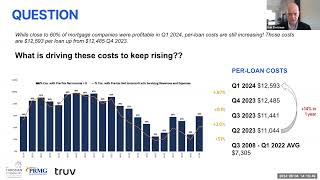
We could all use that and it's, it's important, you know you don't. When you see the average cost per loan and average loss per loan from the mba, it's really sobering, frankly. And you have a lot of people out there saying, wow, you know, if you're going to lose $1,000 loan, you don't make that up in volume, those kind of comments. So I wanted to talk to the two of you about, you know, if you look at the statistics from the first quarter and I can't believe we're in the last month of the second quarter already, but the, if you look at the companies that were profitable in the first quarter, I think, I think the number was right around 60% of mortgage companies were profitable in the first quarter. But you know, per loan costs are still increasing. They're up well over $12,000 alone, up from the fourth quarter of last year. And I wanted to ask Kevin, start with Kevin, you know, you know, what is driving these costs to, to keep increasing?
You know, there's a lot of different reasons and I love that you're quoting some information from the Mortgage Bankers Association. They do such a great job with their research and analysis and breaking these costs down to get very granular. So let me just preface this by saying we are built by originators for originators and in a purchase market where it's grinded out, built, doing battle, lock in arms realtors whose commission is under attack with the NAR settlement, it's all about sourcing and finding and grinding out and trying to get deals done. And that puts a lot of value on the originator. And as loan amounts go up, we see home price appreciation go up every month. It seems like certainly, you know, when you smooth it out with all the wrinkles in a 12 month, you know, calendar cycle, home prices are appreciating. That means loan amounts go up and the commission is going up for originators. And that is your biggest cost to produce. It's not an attack on it, it's just a fact. It is what it is. If you took out that 12,005, let's call it $12,600, about 2900 to 3200 of that is OPEX and operational expenditure. Okay, so the cost to produce alone, all of your staff, all of our departments, all of our, you know, different, you know, underwriting, fulfillment closing, funding, post closing, risk losses on loans, everything, it's only 2900 to 3200 alone. The rest is commission for the originator. And they deserve it because they're the ones finding the loans. So, you know, I, I see that Going up in these quarters kind of commiserate with the percentage of home price appreciation. And, and so it's obviously not this crazy levels you could see earlier in the chart, you know, there's a lot less profit per loan. That's another big component, although that's starting to ease a little. That's a secondary market function. If you hear people talk about spreads with a spread, right? So a year ago, nobody want to pay for an 8% mortgage because they knew it was going to pay off soon. So there's not a lot of margin in there. You know, in the secondary market, nobody wants to hold mortgage backed securities for loans that will pay off. I think everyone kind of thinks as soon as the Fed cuts, at some point every single loan that's been done the last two years is going to refinance. But if they don't cut as much or cut as soon, or, you know, maybe the rates stay higher for longer and people believe it, the secondary market starts to believe it and there's a little bit more margin. So I'll just, I'll just leave one last thing. The spread between the 10 year treasury and the 30 year fixed rate of a mortgage had gotten to some crazy level like 310 basis points. That's improved by about 25 to 30 basis points here in the last six months, which is so Kevin, and that's.
For novice, novices like me when you talk about 310 basis points, basically 3%. So if the 10 year were at 5%, 30 year mortgages would be at 8, is that correct?
That's about right. And that's exactly where it was in October when the 10 year peaked and 30 year fixed rates peaked in this cycle. You nailed it.
So to continue on that vein, digging into your capital markets expertise, you could have an environment where quote, interest rates are stable but mortgage rates are coming down, is that correct?
And that is correct. And that stability is what gives potential bond buyers, mortgage backed security buyers, institutional buyers, that gives them some certainty, they feel that the market's less volatile. It's hard to decide how to spend literally billions of dollars every day. So yeah, that's dead on.
All right, Richard, are you seeing the same, the same thing?
Well, we had a good question actually that I want to address from Patrick in the chat. I like things to be participatory. So if you're watching right now, you've got a question, we'll address them as they come up. If it's a good question. I think Patrick, Patrick's got a good question. He Just wants to confirm. Did he hear this correctly? Assuming The CTO is $12,593, the OP costs are $2,900 or $3,200 and the rest is paid in commission. That's the clarification question.
That's correct.
Yeah. And so that's why you're saying. Yeah, go ahead.
Yeah, yeah. And I would say, Patrick, you can also get a pretty detailed breakdown if you go to mba.org and you go into the newsroom, which is one of the links at the top of the page, and you go back to all the press releases. The NBA does a good job of releasing the cost per loan and the data. Like, they will break it down. They will break down that $12,593 to the dollar. So some great data in there. And yeah, commission is the biggest part for sure.
Well, so I'll, I'll take this stab at answering. Get, get. Just a quick turn to my plug. This was the data that I threw up on the slide after talking to Rob. And Rob kind of guides me on what data I should go and pull. What really struck me is when I pulled Q3 2008 cost, the average cost per loan, all the way up to Q1, 2022, if you took the average cost, it was $7,305. And if you look at that jump in increase in costs just to Q2, 20, 23, it's about 51% jump right from that average. But if you look at the jump from just one year ago, it's 14%. That to me, told me there's something that's wrong here. And that's kind of why I called this webinar together. Originally, I asked Rob and KP to jump on here because something's happening in the industry that's accelerating these costs, like way more than it has been historically. And it's very clear. So we're going to get into answering exactly what's driving that.
And that's a. That's a great stat that you have right there on the screen. And it's a great. You are comparing a Q1 where there's less volume because January and February are typically your slowest, and shortest, coldest, crappiest months of the year to a Q2, which is usually the best quarter of any seasonal purchase here. Right? March, April and May. Excuse me, excuse me. April, May and June are your sweet spot for spring purchase season. March is great, and sometimes March is good enough to bail out all Q1 for a lender's profitability. But April, May and June are peak purchase season. By far the most volume is in there. And, and so it's, it's, it's a, it's slightly apples to oranges, but, but, you know, again, most lenders, we're happy to pay our originators the commission because they're hunting the deals. So I have to focus as a lender on that 2,900 to $3,200. That's what I can really, really control, that I want to control. So how do I work on, you know, you know, my cost for marketing, my cost, you know, do I have marketing, my cost for underwriting, my personnel cost, my cost for verifications, credit reports, you know, all these different things that, you know, we're looking at that add to that, that little piece and if I can get that number down and just, you know, for PRMG, we are under that 2900 number and it's still not good enough. Like, our goal is basically, you know, our, our underwriting, admin closing, whatever, whatever fee that gets passed on to the borrower, let's call it like 1375. We'd like. Our goal is to get as close to that as possible. So we're printing money. Love it.
Rob, I'm going to hijack for a quick second.
All right.
A poll that we're going to run really quick just to see the audience. I just want to know, are your cost per loan lower, the same or higher than what we just showed you was what was just shown by the MBA? That's $12,593. And if you don't know there's an option for, I have no idea, which is totally fair. But I think you can learn something from that, especially if someone's in, you know, especially if someone's in the management at the lending organization.
Yeah, the, the, the things that we were talking about, when you talk about areas that you can cut costs and what I'd like to talk about next are kind of the, the buckets, you know, where, where are these costs coming from? But when you look, or when you hear campaign talk or talk, you know, when you hear politicians talking about, oh, we need to cut the budget, cut the budget, cut the budget. And when you look at where the government spends money, regardless of administration, so much of it is in, you know, Social Security and Medicare and you know, the, the armed forces areas where the government might not be able to cut at all. And when you look at the discretionary spending of any administration, it really is similar to the discretionary spending that spent On a loan. I mean Kevin's right. You do need people out there getting these loans. So the question is how can you trim operation costs? But go ahead, Richard.
Looks like we have, we have the poll results. I've just shared them with the group. So I think the folks that know the majority is lower than what the MBA is sharing and there's a good, I think the same, basically the same number of folks in the audience have no idea. So kp, I would just ask you, does it surprise you at all?
No, no, I don't think so. I think, you know, last year lenders that were heavy and non QM were more profitable. There's a lot of non QM lenders that had a really good job. You know, the Scotsman guy just released the rankings. We were I think top 10, maybe eight seventh. I don't know where we were somewhere in the top 10 in non co production and we're an A paper lender so it certainly helps out. Consumer Direct is a model type where origination commission or you know, lo commission is, has crammed down quite a bit and it's not, you know, it's not the best model in a purchase market. It's hard to trust someone on a headset, you know, in a random phone bank somewhere with your local decision, especially if you're a first time home buyer. But they still get it done. And, but that model is usually pretty profitable because they don't put as much credence in an originator. They just don't put the originator first. They put their tech and their marketing first and they try and give a better deal to a consumer by cramming down that $12,593 by gutting out the commission from it. It's just a different kind of model. Right. And so you know, and just, you know, if we're going to wax, you know, philosophical here, there's a lot of forces out there that are technology people that are not in our business that are trying to come in and say why do we have anything in the middle? Why, why don't I just have the borrower be able to get the best price, the best experience, the best everything, the best, best, best, best right there at the click, you know, like ordering a Lyft or an Uber or you know, whatever it is that's convenient to you? You know, so there are a lot of forces that have been trying to circle around and get more data and tech driven to create to cut us out of the middle who are originators.
Yeah, that's that's a very difficult thing to do. You know that that's a big advertising slogan, right? Oh, eliminate the middleman and that that's nearly impossible. Even you mentioned Uber or Lyft. I mean, even Uber or Lyft are taking whatever slice they take and leaving the drivers with whatever. And it's surprising how much the company takes versus how much when you pay, you know, you pay $30 for an Uber ride and how much the company gets versus how much the driver actually gets. So it is interesting. I also wanted to, to go back to that, Richard, you don't have to change the slides, but I think it's very important for management to tell employees and I don't know who all is on the phone today with us, but it's important for everybody at the company to have the same goals and objectives as senior management because you want to incent the employees to, to, to, to all go in the same direction. And part of that, I think is education. And part of that education is telling, saying, okay, the MBA said it costs this for, you know, IMBs to originate a loan. And here's where we are and here's what we need to do to get to wherever we want to go. And so it is important. I think it is. It was a little bit disheartening to say, I don't know, because arguably I think folks should know. So go ahead, Richard. Oh, well, I should ask, I should. You know why, you know, I mentioned buckets a few minutes ago. You know, what, what are the major cost buckets and what kind of change are we seeing? Kevin, can you address this?
Yeah, I mean, you know, for what, what we focus on at, at PRNG is the opex. We focus on the operational expenditure. And by the way, as a three channel lender, we have different models there which address compensation differently. You know, so, you know, just not, you know, not to take that too far, you know, in beat a dead horse here. But you know, if you're a broker, your maximum compensation is 275 basis points to run your entire business, you are capped by Dodd Frank and the LL Comp rule. So that forces you down. That forces you down, right? And that's to run your business. That includes all expenses, right? Correspondent can be a little higher. If you work at a bank or a credit union, we all know that model, those loans don't get paid a lot of commission. Maybe they get paid 75 bips, 80 bips. Some are even less than that. And so the bank and the credit unions, like, hey, these Are our members. You're lucky to be working here. Maybe builders. You know, I don't know the comps at builders and their mortgage arms. Like, we're the builder, we built the product. So they're coming to us no matter what. We have a housing shortage. I don't need to pay you commission. So there's just all these different models out there. And the good thing is there's enough business to go around, which is why we have three channels. So we focus on, you know, being, you know, operationally excellent in the costs that are, you know, driven there behind the scenes. So how do I get more data driven? How do I, you know, how do I compress that loan process down with as little human error as possible? And then our people that work in fulfillment, let them focus on the exception processing. The stuff, the deals of hair on it. The deals that like somebody to look at with some eyeballs that can't just get data here, here and here and just pump it through the system. We work on those deals too, but we, we, we don't do that to eliminate jobs and people. We do that to allow our people to work on the tougher deals. 9QM is a great example, which of course they're higher margin, so they just take much more time and effort. So, yeah, I mean, all these different buckets that are on here that are on the screen, you know, we're working a lot on opex on that 2900 to 3200 credit reports. Wow, what a, what a pain that is. There's a lawsuit now, I believe, against the work number I saw that's out there. You know, that, that just, just came out like, you know, last several business days. I think it went out Thursday, Friday. You know, it's an interesting development, you know, you know, so there's so many different, you know, facets of that 29 to $3200 that we try to attack every single day. And, and having a technology partner to help you tackle those costs and create efficiency, if you can create efficiency and cut costs, that's a huge double win. That's a win win.
So, yeah, you've raised all kinds of issues. I wanted, and Richard, you just put up the question that I actually wanted to ask, which was ask you specifically. You see a wide variety of clients in your, in your job. You work with a lot of clients who are saving various amounts of money or trying to save various amounts of money. Can you talk about some of the strategies that you are seeing clients execute to that end result?
Oh, yeah. I mean, I.
Go ahead, Katie.
I'll go ahead. Richard. No, no, no, you first. I talked enough. I'm going to drink some water.
Yeah, I mean, Rob, did you intend to ask that to me?
I just want to make sure I did. I did.
Okay.
I know that Kevin has some ideas, but I wanted to ask you because one of. One of your. One of, you know, one of the benefits of working with you are cost savings. So. But what. Maybe you could talk a touch on some of the other things that you're seeing, because you must see companies doing certain things and you think, wow, that's pretty neat, or, oh, I can see how they can save money doing that.
So the number one reason that folks come to TRUV is because they save about 80% over the incumbent verification provider. That's the number one reason why most folks want to work with us. Right. We're a consumer permission platform, meaning the borrower gives explicit permission to pull their data from their payroll provider. It's direct from source. It's up to the minute, it's complete. It's as accurate as it gets, and it comes with full reps and warrants from the agency. So. So right there, that, in a nutshell, is our value proposition. That's why clients are loving us. What I see is amongst different lenders, I see different levels of success, and I see different levels of success in the. In the way that they implement. And if I had to attribute it a reason to more successful versus less successful, it really comes down to leadership. So we have a couple clients that. And KP knows this. We have a couple clients that only use truth. Like they have eliminated the incumbent and other forms of doing verifications, and their conversion rate is through the roof. And because it takes that kind of strong leadership to push that in, the organization is. But what it's amazing is to see that that is possible. And I would. I would say that in general, it's usually better when an organization has a junior does not use a choose your own adventure policy where the leadership says there, you know, what's a leader's job at the end of the day, Right. Is to solve problems. That's kind of my observation. Over time, leaders are here to solve problems. I got a CRM. Nobody's using it. I got to get another CRM and solve a problem. Cost of credit's gone way up. I got to do something about this. I got to solve the problem. My verification costs are high. I got to solve the problem. And the leaders that get laser focused on solving the problems are the ones that typically tell like the, they really like wave the flag and charge it in the organization and the organization gets behind it because it is change. The incumbent is doing this behind the scenes. The borrower doesn't have to do anything. Right. So like for example with tru, you know, the borrower's got to log in and it's a change for, for the way that organizations are used to doing it. But I guess my two cents right there is just that strong leaders are really shining right now in this market. And in terms of the ROI that I see it clear as day just for our product. Kp, you want to add anything to that?
Yeah, I mean we're huge fans of true. We, we verifying employment is a big deal. Right. And so from a risk management standpoint do that in a quick, efficient, cost effective manner is, is so important. So you know, I will tell you, you guys have a great tech team and you guys are, you guys are true technologists and you know, you came in and built fantastic tech and so we love it. It's the best tech when it comes to employment verification that we've seen. And so you know, we're constantly trying to, you know, get data straight from a source. Right. So if a borrower is willing to come in, which they are, I mean first time home buyers are skewing younger. They freely give away all their data, their usernames and passwords. Yeah, log in here, I don't want to be talked to, don't talk, don't call me. You know, so we're getting data straight from the source from all these different places, which is fantastic. So I would just say that that's one strategy we've implemented. We're trying to think of ways on the credit report side to do that as well. You know, we're trying to think of ways to get credit data in pre qual people without having to pay the exorbitant credit fees. Although we have some great credit partners. I mean, you know, I know you guys have done some work together. True together with Zakdis and they're a great partner of ours. And so you know, that's a big cost that we have to deal with. My underwriting that is from a human capital expense. My underwriters, we cherish them. They are the inside that drives the outside. They allow the salespeople to do what they need to do and confidently go out and sell and get business in the door and know you're going to get an answer to get the deal done or that you have an underwriter that does what they can to find a solution to get the deal done and still have a sellable investment quality grade loan, you know, and, and they're worth every penny. And they're, you know, they're, they're expensive. You know, when, when I don't know how much volume is coming and we didn't hire ahead of this full flush of loans and then we're paying time and a half. It's very expensive. Right. Which we're happy to do because, you know, we have, if we're doing it because of too much business, that's a great problem to have, especially if margin continues to come back in from the secondary mark market, which we still have margin compression out there. So, you know, how do we hire the best people? How do we have the best people that work in ops at Pure Energy? How do we maintain the best leadership of that operation team? You know, how do we keep them happy? You know, how do we make them like their job and let them know that they're part of a great privately owned organization that supports 2,000 plus families every single month getting into a home, you know, how do we put them on a pedestal and thank them? So there are a lot of different ways to address operations and all the, the, the different mechanics and people and parts that go, you know, to go with it.
So, Kevin, one of the, one of the questions Alan asks here in the, in the, in the, on the, in the chat, is there anything lenders can do to provide more clarity to their rules? Slash, remove underwriter discretion to decrease the stress on MLOs. So an MLO might be happier with less compensation. Any thoughts on, any thoughts on tweaking the model a little bit to along those lines?
Yeah. I will tell you that underwriters wholeheartedly have the best intentions. So let's just start there and then so do the lenders they work for. So, you know, I see it. I've been in the weeds. I'm starting this business 2001 as an account executive in the wholesale side. And people came to me to solve problems like, hey man, your underwriter out of this condition and I don't need it, you know, and so, you know, it, it, you know, there's a beauty and an art to that and thank God it isn't all data driven because if it was way more black and white and there wasn't gray area and hair on deals and all that back and forth, that can be frustrating. What, what do we need it for? I mean, literally, you want to, you want to erode yourself out of the business as a. As an originator, it's get more commoditized loans. We don't want to do that. So, you know, so. So the fact that there still is, you know, some sausage making that goes on behind the scenes is what brings value to both the originator and the underwriter. How do you navigate that water? Again, if it. I mean, if it's. If there's no, like, black and white, like, well, what about this credit explanation or, what. Why is this person's income wonky? Okay, they're a nurse. They have some shift to income on this pay stub, but not on this pay stub. Does it. Is it actually good for a month, for a year, for two years? Can I count it? Like, all that back and forth? And that kind of talking an underwriter into the comfort of the deal honestly brings value to the originator. And so again, you got these technology people that come in from outside of our business that want to get rid of salespeople and their commission and underwriters too, by the way, and they want completely fungible, you know, commodity loans, and they want to just cram them through in a heartbeat. And, you know, well, then, you know, none of us are really needed, right? So, you know, let. Let. Let the AI just do it. So, you know, I. There's no. There's no silver bullet answer to that. But I will tell you that, you know, at least what we do at pmg, every time, if we see an underwriter that's maybe new to our culture and they add what we call a comfort condition or say, hey, you know what? You don't need that here. You know, we sell directly to Fannie, Freddie, and Ginny, and this is not part of their guideline. And this is not an overlay here. Maybe it was where you came from. No problem. Your intentions are good. Next loan. Don't worry about it. So that's how we kind of tackle it one at a time.
Interesting. All right, good answer. Thank you.
Thank you.
There is one more question in the chat, kp, that I think is actually a really good one from an operations standpoint. I put your technical los operations hat on. Amy. Great question. You said, what are you seeing as the average cost per loan for your los? And, you know, I think this is kind of a nuance on how you calculate roi, essentially, but, you know, for your LOS specifically. So what she clarified when I asked is looking at your annual LOS cost, plus your salary for administrating the system over the loans closed. So I think to start with, is that how you calculate it? KP and do you have those numbers that you track?
No, we're just, we're kind of big dumb salespeople. We just. How much does it cost per loan? Right. Like, we keep it simple and obviously I can't get into our cost per loan. But I will tell you that ICE Mortgage Technology, Encompass, that's our, our LOS partner, they're a great partner. You know, they're fair. I mean, you know, they're a massive data company that owns them. They're in it for the long haul here. Obviously they acquired Black Knight and they are making a long day to play here. So, you know, I would say that, you know, you do these three year contracts, you know, with, with, with, you know, the large LOS companies and you try and negotiate tiers. Like if we give you this much business per month, it's funded, therefore we have revenue to offset the cost. You charge us X per loan. Right. And so when things are great, like in 20 and 21, it's great for us. Like we feel like we're winning in that contract. Then when volume goes down, we feel like, oh, we got this minimum. I got to pay every month even if I don't do one loan. And so, you know, you take the good with the bad and that's just kind of how our business is. But I will say that, you know, our partner is fair and that's typically how it works. But our model's different. We're a three channel lender. You know, you may have other models where, you know, they don't have to have all that back office support or an enterprise level system. They may just need to do point of sale and you know, a little a mini los, you know, so just for origination, that's different for every company. Yes, support is a big deal. How much do you want to scale? That's the other question. Like, how much do you want to scale as a company? I mean, we want to get, we want to get bigger than we are. Not for the sake of getting bigger, but we just, we feel like, let's take the wholesale channel, for example. At the end of 22, we were like the 10th largest wholesale lender. Five of our competitors went out of business. Literally just poof. Yeah, we're a hedge fund. We don't want to lose money. We're out. See you later. Peace. It was nice, you know, and so, but we're privately owned, we're committed to the space and we want to do nice, slow control, growth and so, you know, we, we have to think about building the resources and engineering and developers and architects and cyber security and infrastructure. We have all that. And it's a lot. And, and sometimes, you know, you sit there and go, oh my God, we're paying $10 million a year in it. If we don't do one loan, you know, which by the way, is down from say 14 million a couple, you know, a year ago. Right? Those are our 22 and 23 numbers. Just giving you some raw numbers, you know, and, you know, there's a lot in there. There's a lot that goes in there. And it just, it's, what model do you want to run? How big do you want to get? You know, if you have a big lawsuit because you don't take care of your data, or if you cheat and you lie on your FHA underwriting, you have a False Claims act put you out of business, which, by the way, you know, we, you know, we self report. We don't, we don't go, we're service services. Throw this crap in there and no one will ever see. We would never act like that. And HUD has recognized that, so is the Department of Justice. We beat our False Claims Act. And so we feel like we do things the right, you know, we're not trying to cut corners here, control growth, do it the right way. You know, we'll continue to build and scale into the next part of the cycle. And again, those are all questions that you need to answer for your own business to actually answer. How much does your OS cost?
So, Kevin, earlier you've mentioned a couple companies names that I won't repeat that Some, some people in the industry will say, oh, they've got a monopoly. And monopoly has always been this kind of evil term. And growing up, you play monopoly and, and you're fighting against your, not fighting, but, you know, you're, you're playing against people who are trying to create a monopoly. And monopoly, you know, it's evil and, and so on and so forth. Now, we've had some news recently about, you know, monopolies in the, in the mortgage industry, especially when it comes to verifications and credit and so forth, you know, and price increases. And Ravi Chopra, you know, called them out at the recent conference in Manhattan. And so I wanted to ask Richard, you know, do you think this will continue with a microscope on the monopolistic practices of some in the industry, especially when it comes to verification, or do you think regulators are doing something about it? And if so, are they doing the right Thing about it.
Yeah, that's a great question. I've been watching the news pretty closely. KP called it out earlier that one of the verification, the incumbent verification provider came under fire with, with a lawsuit about exactly this. And, you know, if you look at credit and verifications, I think almost everybody in the audience, please write it in the chat. If, if your credit and verification costs are going up, you know, exponentially, way higher than inflation. But let us know. That's why we're, you know, I would say that's why my company is so successful. It's definitely why people are looking for alternatives out there right now. And it's what Rohit Chopra was talking about at secondary, you know, some of them, 400 in one year time period. That's crazy. So, I mean, whether, whether something is actually going to get done about it, you know, something is going to get done about it. I don't know. You know, this is, there's a lot of complicating factors, right? This is an election year, right. And I don't, I don't know if things get done in an election year, to be, to be frank.
Well, first, certainly at a congressional or administration level, the. We're basically frozen with any decision making from here until, you know, maybe, maybe till the end of the year. And some people like that. So what happens is agencies and regulators step in who have a little more dictatorial power than, say, Congress. And they can just do things or put things in place that, you know, will make a good impact or bad impact, depending on how you look at it. Kevin, what do you, what are you hearing in terms of regulators coming in and doing, say, the right thing or the wrong thing or, or trying to take a hard look at these costs that have gone up so much.
Well, I hope you guys, I know you guys are, you guys are so good. You guys aren't saying names. And I get it, and maybe I shouldn't say names either. But let's just call what it is. And it is what it is. It's in the news. You know, it's worth talking about. But, you know, capitalism has a funny way of working out, right? Like, you know, of course, every business wants to, like, you know, grow and be the best. And sometimes when you have such a good business model and you're the best, you get, you know, monopolistic or you get that tag. Capitalism has a funny way of busting that up, you know, whether it's through regulation or the courts. And so, you know, I guess smoke them while you got them, right? Until, until you got to pay all that money back that you made if it's too much and the court or the regulator will tell you, you know, whether you made too much or not. You know, having said that, it's expensive. You know, lenders don't, lenders lost money generally the last, you know, I'd say two years as of this month. June was really when rates fell out like, like, like holy smokes. The best interest rates we ever saw was February of 22 and they rapidly deteriorated all the way into June of 2022. And since then the last two years, save this last spring purchases in the last few months we've had been very tough to be a lender. And you know some people take this and I don't understand, they take this approach, well, you made all this money in 2020 and 2021. Okay, that mean we have to lose money today. So, so when I say things like well we are now charging borrowers upfront for credit cards on their credit card for credit reports, we're trying to at least you know, which is how it used to be done in our business because we can't absorb this massive bill. It's a massive bill. I say that in a closed room with regulators present and they're like, they're like blown away. And I'm like well what do you expect? I mean we are losing money, right? This is a very difficult market. We've got to do something, we've got to change the way we operate. And so then we kind of pivoted off that. We, you know some bars that they push back and the branch will pay or the lo pay or whatever, we'll do a bundled cost. If we fund one out of five deals then the cost for the credit port for that one deal that funds is larger than it really should be because we have no way to absorb all this other cost. There's so many different ways to tackle it. But at the end of the day we have to provide investment quality loans that are sellable and fungible in a mortgage backed security in the secondary market. And these costs hurt. It's tough. And so you know, not every company can handle it. I mean I see individual los, you know, in these little one man shops in the broker channel, they're like I'm getting killed on this credit report bill every month. Well yeah, you're running a business, you're running your own little lender and you know you're capped at 275 max to run your whole business. And this cost went up for you too. And it really hurts them. And to be honest, those street level originators in all of our channels, they're the ones serving the underserved. They're the ones hunting for tough deals. You want us to hunt for tough deals? We're gonna have to run a lot of credit reports from people with bad credit. But that's the reality. Ask for your comments, Rob, about Rohit and the cfpb. You know, look, I love that they're shining a spotlight on things and in spurring discussion, I don't know what will come of it. We're in an election year. I don't know how much is talk versus action, but what I do like is that the CFPB is very collaborative with our industry. And for those that were at the NBA in New York, you know, we've had several years now, Bob Booksman and Rohit Chopra from the CFPB having a great dialogue and conversation. The NBA lobbies on behalf of all of us in this industry, whether we're a member that's paying or not. They've got a great relationship with the cfpb. And so I, I love that collaboration. I don't know, it doesn't feel like the days when it first got started, you know, and it was like a, like, like let's punish everybody and not tell them what we're punishing it. We want to do the right thing in the lending community. We want to serve the underserved. Let's work together and do that. So I, I, I like, I like where the regulatory environment is right now.
Just throw out there in the chat it says, Teresa was saying that several of their clients are doing exactly that. KP charging upfront for the credit pulls and with a credit card. And Mark was saying they do it at closing for the, for the, for verifications. So people, I mean right there, that's lenders having to pivot, you know, and change the way they're doing business to like you say, like the business stays the same but the costs are going up. So you got to do something.
Right? Yeah, yeah, I see your comment. I feel you.
When you're talking about lo comp and reducing lo comps, of course, nobody wants to be the first penguin in the water, right, when it comes to oh, we're paying these folks how much? A point and a half. Well, maybe we should point, you know, maybe we should pay a point a quarter and we'll say we're going to use that extra quarter for marketing or underwriting, you know, training or whatever it might Be. But nobody wants to take that first step in reducing lo comp. I've heard, Richard, to that question about our lenders charging up front. You know, yeah, you can charge a closing. I mean, you should. That's one way to do it. But you know, that person, in effect, when they pay for a credit report, they have to cover all the other loans, credit reports that didn't fund, that didn't make it to closing so that those borrowers could pay. So you're running credit reports on loans that never fund. And that was always a question in secondary marketing, like, oh, we've got this hedge cost, and we lost money on this securities hedge. What loans can we assign that to? Well, some of those loans didn't fund, so you can't, you can't really do that. I know we're running a little bit short on time, so I'll stop yammering. But I wanted to ask Kevin, the, the productivity, you know, per employee, you know, one loan, you know, it's mostly looked at in terms of production. Oh, you know, we, we want two loans per loan officer per month or four loans. It used to be, you know, four or six loans, and now it's almost like one loan a quarter. We're going to keep that, we're going to keep that originator on board. How much of a, how much of a function is that of rates? You know, do we need rates to come back down in order to boost productivity? Or what is, what are you doing to boost, boost productivity if rates were going to stay here for the next six months?
Yeah. Great questions and, and I'll share with you some, some data in real time. Lily, Just, just from our, our company. I think that's one thing, Rob, why people love reading your blog is because you guys are so transparent. You talk about this stuff and I wish more people would come on here with you and do this. We are 10 FPE. That's 10 fundings per employee. That includes all of our staff. That's, that's about how we've been running. We love. We're trying to shoot for 12 and a half to 15. Our. We have, we bracket this loan per employee on the sales side. We bracket that out by how long a loan officer has been with us. So if a loan officer has been with us for 90 days, we have a list of how many of them have funded a loan. One loan in the 90 days. And so out of 700 loan officers, you have like maybe 300 that are funding at least one loan every 90 days. Then we have Everyone else where it's basically, I would put that number at about 2.2. So and then of course you've got your high producers and we have people last month that funded, you know, 25 loans, you know, your top producers. So that whole 80, 20 rule. So, you know, this is real time data for us. This is how we look at productivity. And as far as a salesperson getting better, I mean one, I mean there's, there's three things I've been preaching for about a year and a half. Non QM is a great way to get more profitable and get more loans. And that loan is typically going to be a refinance again later when, you know, rates come down or that borrower gets, gets right with whatever it is that force them to go non QM to begin with. So learning that product, I mean as an original, just learning basic product knowledge on a new product. Let me. The riches are in the niches and there's so many nuggets inside our non QM guidelines. So that's number one, social selling, love social coach. Love the apps that get your face out there and you know, don't, don't just put your phone in front of your face like I do for free and expect to have business drive in. Just spend, you get what you pay for. Right. Just spend a little extra money. Get some like professionally done videos that make you stand out. Grow that database and then mine your database. Those are, those are probably the key success that we try and get for our originators to, to get, to get more production.
Yeah, you can't, and obviously you can't change what you, what you aren't measuring. And you always hear from loan officers say, oh, well, I've got this in the pipeline or that in the pipeline. Well, you haven't closed a loan in a month and a half. Yeah, but you know, this is, this is why. And this happened to that loan and this happened to this loan. Yeah, metrics, metrics are so important. And you're right, if somebody just kind of shrugs, says, oh, we'll do, we'll do, you know, we're going to do whatever or just kind of plot along. You can't do that in this environment. And I've seen it time and time again where companies have improved their, improve their measurements of different parts of their business so they can meet with managers and say, look, here's what you need to do, especially when you're comparing it with some of the MBA statistics or the NBA Stratmore peer group results that are out there. Look we have the industries, we have this many loans per underwriter and we are at this level and maybe we're above or maybe we're below, but you need to be able to change. You can't just say wow, it seems kind of slow out there. Maybe we should take a look at, you know, you can't do that. You have to have these numbers. So going back to. I'm going to start with Richard because Richard, you haven't said much recently.
Yeah.
And once again you deal with a wide variety of lenders out there. Any advice, you know, from, from what you've seen the last three to six months in terms of what's working and what companies are striving to do?
Yeah, I, I would say, you know, if you're, I think everyone can be a leader and just be a leader. Right. Focus on a problem that you want to solve and be like a pit bull going after it. And I think you, you will, you will be able to move. I, I've, I believe that there's a room for improvement in almost every part of the organization. I don't care what company it is. So just focus on solving whatever you think is the biggest problem and going after it. I mean there are people out there that I've met recently at the housing Wire conference that I'm just on the revenue generating side that are very successful right now. The riches are in the niches. You've all heard that before. And for example I just met this one direct to consumer lender who is killing it right now. They're growing really fast and they're growing really fast because they have a talk track. One talk track they buy leads from like LendingTree and they buy leads only that have high, high credit card debt. High credit card debt plus high equity. That's their buyer, that's their borrower and that they have just specialized their entire operation on that. And all of their loan officers can only talk really that one track and they're killing it. So I, in my opinion there are certain niches out there. I know I met another lender who just, just does construction loans and, and new construction loans are doing really well if you get the right partnerships. And then the third one that is just jumping to my mind right now is the, the lender that has a specific religion and they only sell loans to members of that religion and there, there they can't be charged interest rates by policy for their religion. So that's what I mean when I say like riches and initias you have to really, I think you can, I think you can solve some of these growing revenue, which is, I think, harder than lowering costs right now. So that's my takeaway right now. Focus on a problem, be a leader and do everything you can to try and solve.
As opposed to the saying that the subprime ministry used to use, which is riches in the ditches. So anyway, Kevin, closing, closing advice, closing thoughts. If you had. If your son or daughter were starting a mortgage company, what would you tell them?
Be. Be better. Be more punctual than your dad and I did show up to show today.
You're doing okay.
You know, the magic behind the scenes. Have better attendance. Be more like Rob Christman. You know, I already blew my perfect attendance for the California NBA. I couldn't make the last legislation one year, one year in, and I already missed the meeting. Man. You had perfect attendance for six years. Set that as a goal. Be like Rob Chrisman, attend every California NBA event. And I blew it my first year in. Gosh dang it.
Yeah, it was a term out after nine years. Well, good. There was good food and actually more seriousness. I mean, to be able to, to be able to communicate with people in the same room, you know, as equals versus, you know, some of the, some of the interaction that we have. I mean, to. To be able to interact with other people in the industry who are very intelligent and very well thought of is. Is very important and a great benefit if you can do it so well.
For my part, I just want to say thank you to both of you. You guys constantly give back and nobody is paying. You guys, you're doing this for free. So you guys are constantly giving back to the industry. I just want to say thank you. I learned a lot from both of you.
You bet. Richard, happy to help.
Yeah, same. Thank you guys.
Thanks so much, everybody.
Thank you.
Have a good one. Bye.
More from Kirill







How CrossCountry Mortgage Saved $10 Million Annually with Truv's Verification Solutions



