Strong vs. Weak Leadership: Effects on Organizational Change
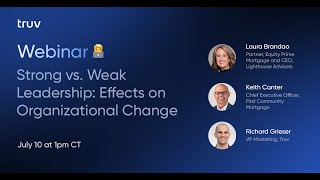
This is a YouTube video titled "Strong vs. Weak Leadership: Effects on Organizational Change" recorded in July 2024. It features a moderated panel discussion hosted by Richard with two senior mortgage industry leaders, Keith Kanter (CEO of First Community Mortgage) and Laura Brandow (Partner at Equity Prime Mortgage and CEO of Lighthouse Advisors). The conversation explores leadership styles, decision-making, change management, and organizational culture within the mortgage lending industry, including interactive audience polls and leadership book recommendations. The discussion is aimed at mortgage professionals interested in leadership development and effective organizational change.
All right, here we go. The attendees are flooding in right now. We're breaking zoom. Keith and Laura, welcome. Thank you so much for joining me. Let's give attendees probably, like, a minute to join, and then we'll kick it off while we're waiting. I am going to ask you, Keith, before you even intro yourself, to say a fun fact that most folks who are on here probably won't know about you while we're waiting for everybody to join, and then I'll let Laura give her a fun fact. Go ahead, Keith.
Yeah, I don't know if it's a fun fact, but a fact about me is I am an introvert as a leader. And so anyone that might surprise some people, I've learned to mask it. Yeah, exactly. I've learned to mask it pretty well. So it does surprise people. And I hope it's an encouragement to those out there that might want to grow in their leadership that it doesn't matter if you're an extrovert or introvert, you can. You can do whatever you want in leadership. It's. It's just personality.
I love it. Laura, by the way, I never would have guessed that, Keith. Never.
So, very interestingly enough, Keith, but the last time I answered this question, that was my answer. But now that you've already said that, I'm certainly not going to use that as my answer. But like you, you would think that I'm the extrovert, but it actually takes a lot for me to get out of that. But I've learned that that is part of leadership and something that we have to show. So my fun fact would be that I play a whole bunch of different musical instruments. I started very, very young where my sister just one day started teaching me the clarinet. And from there, I realized that I very easily could pick up musical instruments. And so therefore, it's something that I'm passionate about and something that I don't really speak a lot about, but that is a fun fact about me.
We are definitely talking about that later. That's so cool. Hey, everybody who's joined right now, we're going to kick this off in just a second. I see a bunch of familiar, familiar names that are in there. Bucky, we just saw each other in Total Experts Accelerate Concept Conference. Thanks for joining. You know, Sarah Dodson. What's going on? Deborah? Deborah. What's up, everybody? Just. Just let me know where you're at in the chat, and, uh, we're about ready to kick this off. Without further ado, let's do this. So if You've come to learn about, from, from some really seasoned leaders in mortgage lending about the effects of strong versus weak leadership on organizational change. You have come to the right place. I have pulled in two really great leaders because I think our industry is at a time where we need great leaders and I want to learn from, I want us all to learn from them. So I've got Laura Brandow, Partner, Equity Prime Mortgage and CEO Lighthouse Advisors. Please, why don't you give yourself a little intro, tell people a little bit about you and your background. Go ahead, Laura.
Absolutely. Well, first off, thank you so much for the opportunity to be here. I know you had put something out on social that the three of us had the pleasure of having a dinner together when we were part of lenders 1. And what a wonderful evening of getting to know each other. And, and I think, you know, if I was going to say anything, one thing that I'm proud of within the mortgage industry is the great relationships that we have formed and the fact that, you know, we do understand that this is a unique industry and we do have a lot of camaraderie and support. So a little bit about me fell into the mortgage industry like most people have as a young mom. Started out in a call center and realized that having those foundational skills of running a call center, trying to motivate, inspire, train and teach people that really didn't want to be there in the evening and on the weekends making cold calls, I learned very quickly that those skills were going to help me throughout my entire career. So from there went into operations. And then in 2007, I got the call to have the ability to build a wholesale lender. And for 15 years I was an owner and partner and I built AFR wholesale until 2022 when I made the move over to EPM and became a partner here. And now I'm also, in addition to the lending side, I'm also at this point working in other ancillary businesses and consulting for the mortgage industry through Lighthouse Advisors. And once again, thank you so much for the opportunity to be here.
Well, thank you so much for joining us, Laura. As I look through the different attendees, just so everybody knows, we have a lot of senior leadership at different mortgage companies that are in attendance right now. So thank you all for joining. Keith Kanter, Chief Executive Officer at First Community Mortgage. Why don't you tell us a little bit about your background, Keith?
Yeah, thanks again today, Richard. I would echo Laura sentiments and it's really great to be an industry that gives back and just incredible Leadership across the industry. And it's, it's great to be with so many of my peers here today. Like, like Laura, I fell into the mortgage business, wanted to be a financial planner, realized I was going to starve. I didn't know anyone. And a guy that I was working with said, hey, I own this mortgage company. Why don't you come over here and work and you can come back to financial planning. And of course, I never did. But after a couple of years as an elo, I started a small mortgage company for all the wrong reasons because, but, but it all worked out and I sold that company to first community bank in 2002 and that was the formation of First Community Mortgage. Been there ever since. So 24, 22 years have been the CEO of First Community Mortgage. We're a wholly owned sub First Community Bank. And what's really nice is it's a small community bank, given us great support over the years and we kind of operate like an imb. So kind of the best of both worlds. Very blessed and very humbled to lead a tremendous organization of great people and a great team we've put together. So happy to speak on this topic today and look forward to the dialogue.
Well, thank you so much, both of you for joining us today and sharing your experiences with, with everybody. Look, if you're, you know, an upand cominging leader or whether you're a seasoned veteran and a leader, I think you're going to learn a lot from what Laura, because we've done a lot of practice on this. So I think from what Laura and Keith have to share here. So, you know, this is going to be a fun. I think the, the rest of the hour is going to be a lot of fun. We've got some questions. We're going to ask them. We have polls for the audience. I love to see interaction. So please ask your questions. I'll bring them up as they come up. I love seeing questions. So, you know, we got people from all over the country. I'm in D.C. and I can see Maryland and Virginia close by. Me, I was just in North Carolina. I see North Carolina, New York, pretty cool. Got people from all over the place. Seattle. So a real, real geographically diverse audience. Let's kick it off. I think we're all here to talk about leadership and I would just like to kick it off by setting the table. I'm going to give this question first to Laura and I'll just say, in your, in your point of view, what is the main responsibility of a leader?
A couple of Things. Right. But I think we set the vision. I think we're the ones setting the vision, providing the plan of where we're going. And then I think the second piece, we are only as good as the team that we are surrounded by. So it really, really goes back to giving to our people, putting our people in the right roles in order for them to excel, in order for them to be developed. And I will tell you, I'm working really, really closely right now on the power of feedback. And it's interesting that, you know, I recently read a book where they were speaking about and for any of you that know me in the industry, I am a real advocate about women leadership and the power of building women up to become strong leaders. And I interestingly read something in this book that said there is an unconscious bias where women do not receive as much feedback as men. And the reason why is, number one, people are unsure how it is going to be taken and therefore they hold back. Where a lot of times with men, they'll kind of hit them between the eyes and say, hey, knock that off, don't do that. You know, you're doing this wrong. So another thing is being a leader is not only setting that vision and kind of plotting the course of where we're going, but it's really our responsibility to our people and lifting them up to provide them the best resources and support and feedback to make them as great as they can possibly be.
I love that answer. Keith, might you want to take a stab at that? What's the main responsibility of a leader?
Yeah, I think it depends on which stakeholder you talk with. Right. Because I'll say something controversial. I don't think it's controversial, but nobody wants to talk this or put it on their website. But the reason why a for profit company is started is to make money. Right. So if you're talking to a board of director or a shareholder of your organization, the main responsibility of the leader is to make money. And maybe I'll just say it like this. I think the main responsibility of a leader is to help each stakeholder win. So if you're a shareholder of the organization, your responsibility to that shareholder is to help them have a return of capital. But you can move that down through the organization. Right. What's the responsibility of a leader to our clients of First Community Mortgage? You know, you have to figure out what it is, what a win looks like for our borrowers, our clients, and then same thing with our team members, same thing with the community. That's another key stakeholder for our organization. So it really depends on the stakeholder, but ultimately there has to be benefit across all of those areas. As a leader, I think that's what you have to provide and it, it really depends on the audience that you're speaking with.
Yeah, I love both of those answers. You know, I work with a lot of leaders at our clients and in, just in general talking in the industry. And just from my own observation, as an armchair for mortgage leaders, the really great ones I see get really focused on solving a problem that they know is like, what's the most important problem I could be solving for the organization? And there's just like a pit bull. They grab that problem and they focus on solving that problem. And I know I've talked to both of you about, about, about your approaches that you just went, went through before. Listen, I have a poll to wake everybody up because sometimes when we do these people tend to fall asleep or check their slack and stuff like that. But these, we have a couple fun polls to, to go through today. So I'm going to kick the first one off. And that poll is should change come from the top down, the bottom up or a hybrid of those two? And sorry, Laura and Keith, you're not allowed to answer.
And I was trying to vote. It wouldn't let me.
No, no, no, no. Only for the, only for the, only for the audience. So this is. The audience gets to participate. And by the way, audience, I'll say it again, we love questions. I would love you to ask questions. I'm going to ask you about why you chose to vote the way you did. I think it's pretty obvious with this poll and I'll share the results because it's, it's obvious who, what, what the, the consensus is here. Let me just end the poll right here and share the results and I'll just ask, you know, Laura, Keith, does this surprise you at all that the hybrid is the. By far the, the, the preferred from, from everybody in the audience?
Not surprised at all.
Yeah. Yeah. How does it normally. I mean, go ahead.
Sorry, I, I was going to say I don't think you can effectively drive change if it's one way or the other. I think it has to be a hybrid in order to effectively, you know, enhance and process through the change.
Keith, you have anything you want to add to that?
Yeah, I would only add that if you could, if you could express some percentages. I think there has to be a little bit more from top down, to be honest. I definitely think there's, there is a Large portion for collaboration and input. But I think that top down is valid. Whoever the one out of the 14 was, I think that's maybe what they were thinking because that's maybe what I would have chose. You know, when you say, you know, again, I'm all for collaboration and I always think people need to be involved, but there is something about the top down approach.
Well, if anybody is on right now that wants to elaborate, throw your thoughts in the chat. We're going to jump on to the next question that I've teed up for our panelists here. Is there a right and a wrong way to make decisions? We're taught, we were just talking about top down, bottom up. In a hybrid, is there a right way and a wrong way to make decisions? And so Keith, I'm going to ask you to take this one first.
Yeah. As I think about that question. Question. I really think about it kind of in three ways and I'll give you the maybe, the right and then just, just oppose it to the, you know, to the, to the wrong or however you want to do this or like compare them. But first I think about like time when you make decisions and I'm not really talking about decisions that are day to day that are within our subject matter expertise, like an underwriting manager or, or a closing manager, whatever. And they're just going about their day and they're using their expertise and their knowledge and they're making decisions on the fly. Right. That's they should be doing that. But when you're making critical strategic decisions, I think you see two types of leaders. Right. You see an impulsive decision maker that doesn't take time to really think about the decisions they're making. And they may make one decision one day, the next decision the next day. And they're going in different directions. Their organization feels that back and forth and they're chasing shiny objects and it's really just like an impulsive decision maker. I think that's really poor versus a judicious decision maker that is looking at all the facts, all the things that are out there and really taking some time. So I think time is important around a right and wrong way to make a decision. I think the next is bias comes into our decision making all the time. Laura mentioned bias around female leadership already. Like we already have these biases that either we're aware of or not aware of that we need to make sure that we stay out of emotional decision making. Right. It's either emotional decision making versus like objective decision making. So how can we Maybe get feedback around bias. How can we put that bias down? How can we look at a situation and make a leadership the right leadership decision the right way versus an emotional or a biased way? And then the last thing I talked a little bit about it, of course, collaboration around decision decisioning is important. You don't want to be that leader that makes a decision in a vacuum. You know, and maybe it's a really high level decision that you can't bring a lot of people in, go outside the organization. Right. Like there's, there could be a coach that you work with, there could be another peer. I could call Laura and ask her about a decision I'm looking to make and she could have experience to help me. Could be just a top level in your organization. But there's a biblical proverb out there that says there's a wisdom and a multitude of counselors and there's a lot of truth to that. And so you don't want to be making really high level strategic decisions in a vacuum. Now, yes, as a leader, you called upon occasionally to make a few of those. Yes. But primarily you have the time. You, you want to be judicial, you want to be objective and you want to get some counsel.
I love it. Laura, do you have anything you want to add to that?
Sure. And you know, Keith used a lot of great words in there. You know, he used the word of making emotional decisions. And Richard, you even had said, you know, we're problem solvers in the mortgage industry. You are correct. The best people, a lot of times that rise to the top and make it through are problem solvers. Solvers. They're people that can identify. There's a gap, there's a blind spot, there's something that's a pain point. What can we do about it? But the wrong way to make decisions, to Keith's point, is number one, jumping too quick, being emotional. Now, there are times in the industry when where we have to, right. There is something where we have to on the fly make that decision and we have to stand by that decision whether it was a good one or whether it wasn't a good one. Sometimes you have to make that decision. But I'll tell you, I'm a big fan of L10 executive meetings, a very big fan of them. If we are in an organization where they are run properly, meaning that you're actually bringing up the issues you're actually going through. The consensus of this is something that I want to bubble up. I would like everyone's opinion on this. And therefore, you know, there is ultimately a decision at the top, to Keith's point of, you know, how things are run, but getting all of that different perspective. And another thing, another very big thing that I'm harping on right now is asking questions. We find that sometimes what's the wrong way to make decisions? Not asking enough questions and truly diving deep to understand how will this affect, what will this decision, how will it affect our clients? How will it affect our other team members? How will it affect our future of the direction that we want to go? And so many times I see where decisions are made, even collectively, but we don't necessarily stop and ask the appropriate questions to where we can make those educated decisions.
Laura, you know, what you brought up that I don't even have as part of the questions for this, for this event is you brought up the leadership, the way to manage the company in your L10 meeting. And we used to run that at a company I was at before. We used to run L10s very successfully. Matter of fact, I think it was a big part of our success was the leadership team was very close knit and aligned on what goals are most important for the company because that's what it really is. And it makes those very clear with KPIs. So, you know, you don't have to use L10. You can use OKRs or, or whatever your chosen, chosen choice of leadership management is. But it definitely helps get the organization aligned. And I love that you brought that up. I am going to just real quick call out a comment that Matt made in a question on the poll before and he said, I would like actually Laura and Keith, if you have a comment on it. Matt said, does the poll reflect a lack of top down leadership in our industry? Remember Keith, you were saying, hey, I would have, I would have checked top down. And only one person out of all the folks that did the poll checked top down. So, you know, you guys are definitely in the minority. What do you think about Matt's comment there where he says, does the poll reflect a lack of top down leadership in our industry? Maybe just this call, but you know.
I, I don't know, I, I, I there, look, there's some great leaders in our, in our industry. I think we're all trying to figure out the best way to efficiently run our organizations. And I do feel like, you know, right now the prevailing sentiment of leadership books and podcasts and things that you hear is, is all about, you know, collaboration and, you know, and getting, you know, the organization aligned. And honey, and there's a lot of wisdom to that. So I don't know that it's an indictment on leadership. I just think it's the prevalent leadership style today and it's probably the best I think, I mean I think we're going to get into subjects here on this podcast which are going to talk about why building a consensus in your organization is important. I just, I'm just a strong believer that, you know, Laura talked about it. The leaders got a set vision. The leader has to establish some things that are in a sense non negotiable but, but ultimately you need a lot of input from your team, you know, on how to get there and the way you go about it. So I don't know if it's an indictment on leadership. I just think it's where we're at today in our.
Yeah, and to Keith's point, I mean if you went back to 1980s, 1990s leadership style, style, it was very dictator like, I mean I know when I was a, a young person in the mortgage industry that was the way it was. This is what you did. I don't really care what your opinion is, I don't really care what you want to do. This is how you do it now. I think we've really evolved now to Keith's point. There are certain things absolutely top down, it has to be that decision and that's the direction we're going. And but I'm also someone where the why is extremely important. You know, if we get into change management and how to effectively drive change, people are going to get behind. Why, why are we making this change? Why are we changing technologies? Why are we changing the strategy of the company to go all in in one channel or why are we deciding to go in this direction? Understanding that why again it is the style now. I mean right or wrong, that's kind of the consensus at this point.
Yeah, I love it. So listen, I want to wake the audience back up again. Laura. Thank you very much Laura and Keith. I'm going to wake them back up with another poll and let me just quickly intro the poll if you want to sound smart at a cocktail party. This is called operant conditioning. It's a learn learning method. And there's really kind of, as a parent I experience this a lot, right. Like I, I, I lean towards the stick, I lean towards. If you don't do this, this is going to happen. As opposed to the positive reinforcement with rewards which is I think really popular amongst, for example, dog training. I don't like to put together raising kids and dog training. In the same sentence. But. But you see what I'm saying. That's. So this poll is really learning behaviors. You're trying to teach your organization to do something that you know you need, you need to do. And so there's different way. And this might actually hit close to the heart for a lot of folks. I don't know. If it does, please let us know. But I'm going to ask this, this question right now. Is rewarding good behavior better than punishing bad behavior or do you need both? So I'm interested to see what this group says and actually I am going to let you both influence this. If you want to take a stab on how you would answer that. Laura and Keith.
Go ahead.
Laura, I think you need both. So. So as part of one on ones with our leaders and with our team members, I mentioned a lot about feedback. Right. That feedback is extremely important. So I think you need a balance of both. But it's healthy to have both of those things. I don't think you can always say, I'm just going to give you kudos and I'm just going to constantly give you the pat on the back and tell you all the things that you're doing well, but I'm never going to tell you the things that you need to get better at. What you. Or the room for improvement. I think having a culture within an organization or a team or, or, you know, any community that you're in, if your people trust you, if your people believe in you, they want you to tell them how they can be their best. That is part of being a great leader. If you just tell people how wonderful they are all the time, then they're kind of like, listen, I can't possib be right every time. I can't possibly always be crushing it. There has to be some way. It honestly gets boring. There's no room for improvement. There's nowhere to go. So I think it's a healthy balance now, not necessarily a 50, 50, you know, I mean, it all depends on the situation. But I think you have to have a culture, number one, to have the trust to accept it. Because if you do not have a culture to where people are like, oh my God, they're pointing it out again that I did this wrong, well, then it's not going to be utilized for everyone to move forward in a positive way. So I think it starts with how it's being framed, not just the good or bad.
Yeah, Keith, you have anything you want to add to it? It's okay if you Don't.
A quick analogy used dog training and kids raising kids. I'll use. I'll use a perfectly manicured yard. Like, it needs water and fertilizer, which is good, but you also need weed killer. And. And, man, you got to get those weeds out. Like, so. I mean, you got to punish the bad behavior. And, you know, there's players that don't need to be in your organization. They need to be removed. And you really, if you want to build a healthy yard, that's what it's got to look like. But anyway.
That'S a great analogy. I'll. I'll give a real world example for my company. True. You know, if you don't know what we do, we do verification of income and employment, and we save about 80. And, you know, there's positive rewards that I've seen amongst leaders who roll this out, roll our technology out. The technology is fantastic. But a positive reward could be like a contest, right? The loan officers who do the most verifications get a reward, that kind of thing. And then there's. There's basically punishment that's put out there where, hey, if you use the incumbent provider and you don't use true at the top of the waterfall, you're going to eat the cost for your branch or something like that. And I've seen both be super effective, by the way. So, like, I'm not making a judgment at all. And I think you can see that in the poll results, by the way, Laura, it was neck and neck between. The answer was neck and neck. Yes. And. And you need both until you started answering. So you definitely influenced the group. I definitely want to throw that out there. You can see that most folks, you swayed folks towards. You need both. I like, I love. I run these polls a lot during webinars, and it's always interesting to see the power the panelists have over these. So, yeah, so, yeah, and I saw.
I saw the comment that someone wrote about the coach. That was a very good comment that someone just heard there.
I love it. Yeah. Yeah, Deb, you're totally right. I think a good leader is also a good coach. Your team needs to know what to do to improve as well as what they have done. Well, I love it. We also have a question that I'm gonna actually just pause, you know, break it. We'll break up our rhythm really quick, and I'll just say, do you have any leadership books that you recommend? I mean, we talked about this, I think briefly during the prep, and people are interested. So if you have any, you can recommend Keith or Laura, please let us know.
I. I have to tell you, I'm like, I can never get enough of reading. Like, so it's like a constant. I will just see something on a podcast or I will read something someone posted and. And it was actually funny. I just this past week. I. I was on vacation last week, and somebody posted on Facebook, and I use this as my motivational. Monday on. On Monday, where the book was. It's not how, it's who. And when I went into Kindle to buy the book, it turns out I bought the book, like a few years ago, read the book already and reread the book. And that particular book, not specifically about leadership, but it was speaking about the power of team and the power of building. Again, all of this that surrounds leadership is really what we're building collectively, together to accomplish whatever our mission is as a company, to serve, you know, and ultimately, to Keith's point, and to be successful and profitable. So 100% good to great. I. I love that book. I. I think that is a phenomenal, phenomenal book. I mean, John Maxwell's, if you go to the basics of leadership, right. With his leadership principles. We. We actually just read that book. And my favorite on the. The moment that literally we're focused on as an organization is Unreasonable Hospitality. That is my number one book right now. And for anyone out there read that book and realize that all of us can get better at what we can do to serve, whether it's internally, externally, to our communities, to our families, we serve to whoever we do business with as clients and partners. Unreasonable Hospitality. Phenomenal.
Love it. Keith, you have any off the cuff?
Yeah, I would just say that Laura mentioned Maxwell, and, you know, I think the reason why Maxwell is such a great leadership author and. And speaker is because he can give you analogies that are really simple to understand. And. And I always like the 21 irrefutable laws of leadership. And, you know, because it's so basic and I can remember them, you know, oftentimes when. When I enter, you know, encounter things that I'm dealing with on a daily basis. So anything that Maxwell does is. Is great. Like, that's old school, but it's. It's really good.
Yeah, I think I'll throw one out there, and it's never split the difference. If you've ever read that book, that's Art of Negotiation by an FD FBI hostage negotiation negotiator. Very entertaining. Too good. All right, let's jump. Let's keep going. This question is going to be. I'm going to tee this one. I think. Who did I do last time, Keith or Laura?
I think I went.
So yeah, Keith, you're going, you're going this time. How do you overcome team objections and change mindsets? That this is really near and dear to me, especially working at True because we are changing the way people did verification of income and employment. It's a consumer permission platform. Literally have to. A borrower logs in. It takes two seconds and it's done. But it's different from pressing a button behind the scenes. And so there is team objections and change management. Change management. And there's a great, there's, there's very successful playbooks that we have. But I would love to hear from both of you, how do you overcome team objections and change their mindset?
Yeah, I think first, the first component that has to be there is an alignment to the mission, vision and values. If you don't have that, you're really just fighting an uphill battle that I don't know that you can win. Right. Like your team has to be, you know, all in on where you're going and how you're going to do it and like how you're going to go about it. Right. What are the values of the organization? So if you have that, even if you have that, it's still going to be a challenge, right. Like, like Laura mentioned, you know, active listening. Like she, she's. She was talking about that. How you listen, how do you validate concerns in the journey, how do you communicate the benefits that are going to take place with what we're trying to achieve. A lot of times you've got to provide the data and the transparency that people need to see so that they can remove that bias of how we've always done it is the way we need to keep doing it. Why do we need to change? You give them the data, you give them the transparency, then you start to build the consensus through collaboration and the work together and, and then as a leader you got to provide them the resources, the tools, everything that they need and then big, big celebrations on the wins and then you just like start over. Like it's just a continual like process. Right. Like once we've done that and we kind of move to next and we just build on that and it, you know, it takes time, right? It takes years. But you start to build a culture of continual improvement and the idea that it's not about change. This is just the norm that we live in. We're always, you know, trying to improve and get better. And just because we're, we've built this culture of improvement doesn't mean that we, we're, we're criticizing the past.
Do you have anything you want to add to that, Laura? For my part, I just love the rewarding, you know, celebrating the successes. I love that. I think that's a lot of folks miss that actually.
So important, so important, you know, it going back to my unreasonable hospitality, There is a part in there that spoke about Chick Fil A because everybody always says what a great measurement of, you know, you, consistency and you know, what you're going to get every single time, regardless of where you go in the country. Right. And they said that it took seven years to accomplish having that consistency and everyone using the same terminology and the same responses. So although sometimes you see things now that have just become normal and just have become. Oh, that happens every single time I go there. But it took them seven years of painstakingly reinforcing first, to Keith's point, communicating, why are we doing this? Why are we looking to have you say this when you first greet a guest, when you give them their order, how long the wait time is? What happens if there's this many cars that line up? How do we, how do we take care of that? What happens at those moments? And getting people to understand, why are you doing this? What is the important then of course, defining those objectives. Right. Inviting your team. You know, I do like collaboration. I want to invite my team in the planning, in the implementing, in the evaluating the change, involving them also with thinking. Who needs to be aware of this? Something, you know, very early on in my leadership career, I would think, oh, I don't have to involve. I'll just pick a department I don't have to involve. Post closing. Why does post closing need to know about this change that I'm implementing on the sales side? Yeah, big mistake. Because obviously the loan is going to go through, it's going to close, it's going to get to them and, and they have to be part of those conversations. So making sure that as you are implementing or thinking of implementing a change, make sure you have the right key stakeholders in those conversations. Because a lot of times change doesn't happen because we missed one of those people involved in there. Then I always appoint change leaders. Someone that's going to quarterback this, someone that's going to, whether it's one or whether it's multiple people, depending on the scope of the particular project. But you kind of need someone that's going to manage this change. And make sure that it's happening. And to Keith's point, be transparent. Let your team know what these changes are. Don't be afraid to share, you know, reasoning with them as to the what this is going to do, what the outcome we're looking to do. And bottom line, what Keith said so important, keep them up to speed as to the progress you're making and celebrate those wins, whether they're little wins or big wins. And you know, it's interesting, I'm thinking back of a particular time where we. It was a really big refi boom and we were trying to shave down the number of days in turn times on refis. And the way that we focus in on it is we would meet literally every two and a half hours. Every two and a half hours, we would bring the team together to say, okay, where are we? What's in the pipeline? Where are these? How fast are they moving? And just diligently working now. At first people were like, this is crazy. Every two and a half hours, I have to go and I have to meet with you. Eventually people were excited about doing it because all of a sudden they were like, oh my God, we just shaved off this amount of time. Oh my goodness, look at the progress that we're making. And all of a sudden everyone came together. So it's possible, regardless of what the change is, it's possible that if you set it up, why you're doing it, you have the right key players, part of those discussions, and you put someone in charge, you can drive whatever that change is.
I love it. You know what I really love about what you said, Laura, was, you know, in that analogy in the book, it took seven years for them to get their process correct. Right. And so anybody listening, like, don't be afraid of things taking a long time and a lot of work. Matter of fact, that's usually means you're going to make a bigger impact. In the book Good to Great, there's a great line where it says it's impossible to have a meaningful life without meaningful work, that you made an impact, that you made a difference. And so that doesn't happen in life unless you put real work in, right? And it's not going to be like overnight success or anything like that. That's going to be other people usually realizing it after time and they tell you what an impact it's made and you're like, oh, wow, I was just in the weeds the whole time. I didn't realize that all of this change was happening. I've heard that from A lot of people who lose weight per time who say, I didn't even realize I'd lost the weight until people started coming up to me and were like, is that you? Oh, my God. Like, because you are focused on just kind of the next step on. On that progress the whole time. So I have another poll to wake everybody up, and this one, this might scare a couple leaders that are participating, but, you know, you shouldn't be scared. This one's very straightforward. On a scale of one being like a dumpster fire and 10 Winston Churchill, how would you rate your organization's leadership? I mean, this is really putting leadership out on the spot here for all the attendees, but it's. I always find this interesting, too, and it's good feedback, I think, for leaders across the industry in general. Right. I will just give this. Let's just give this a couple seconds before I share the. The results here. Oh, we're. We're getting very disparate answers, but I will say they're skewing towards higher numbers than I would. I thought it would be. So that's good. All right, I'm going to share the results here.
Let's see what we got here.
Looks like about a 7 or an 8 out of 10. I think that's actually pretty good. What do you think, Keith and Laura?
Did we get any tens?
We did, yeah, we got a 10.
Okay, good. I'm glad there's one Winston Churchill out there. Yeah. So it was only, you know, there was only like three or four that were below five there, but that's good. It's positive to see.
It is positive to see. Laura, do you have any, Any. Any.
You know what, what this makes me think of another thing, you know, in addition to the L10 is, you know, having an ENPS score, you know, have. Doing surveys with your company. That's something that's very, very important to us where it's broken down, obviously. Anonymous. Right. We never want team members to actually feel on the spot or feel like they're going to, you know, have anybody retaliate against them if they give them a poor score. But this is a great way for team members to give their analysis of how do they feel about the leadership, leadership as a whole, as an organization, or even down to their department, because you can learn so much in terms of, again, those blind spots, those looking for those problems. Where are there areas of concern that you want to know how your team is feeling and addressing those things and really diving into if there is a concern or something that might be Bubbling that you need to address.
I love it.
Keith, you have anything you want to add to that, or can we move on to the next question?
Move on.
Let's move on. All right, this one's going to Keith. First. This is really the meat and potatoes of why we're all here. You know, what are some traits of strong versus weak leadership that you've observed? Observed.
Yeah. So we could write books here, right? Like, this is, like, you say, the meat of what we're talking about, and there are, like, literally volumes of books written. I'll just highlight a couple and really, I'll highlight a couple that I think I've struggled with and I've done good.
And bad with meat and potatoes of why we're all here. You know, what are some traits of strong versus weak leadership that you've observed? Observed.
Yeah. So we could write books here, right? Like, this is, like, you say the meat of what we're talking about, and there are like, literally volumes of books written. I'll just highlight a couple and really, I'll highlight a couple that I think I've struggled with and I've done good and bad with. And first is, you know, one thing that I think that I've done well over the last few years is really spend a lot of time trying to self assess and understanding what my strengths and weaknesses are. And I think ultimately, like, self awareness is at the top of my list because you really need to delegate your weaknesses as. As a leader, and you need to enhance, you know, take your strengths and like, maximize those and spend a lot of time those. That's what's going to bring the most value to your organization. So if you don't know what those are, if you don't know where you're at, if you don't know how you're showing up in a stressful situation as a leader, you know, really, you know, some might sign this as, like, maybe some, you know, you know, a leader has to have some humility, and, you know, that takes time, right, to have that. So that's one thing. I think another thing is, you know, willingness to put aside the fear of people. You know, I struggled with that. I struggle with fear of people for. For a long period of time. You got to remove the politics, the favoritism, the nepotism. You know, this can sometimes be a leader's downfall, right? Is if you want to build a great organization, you have to put the leadership. You have to put the organization first. And you can't, you can't. You can't Bow down to, you know, factions and, and, and play favorites or, or because you want to be popular, you know, make those decisions. And then I think that what I'll, what I'll kind of close with, although I could just like keep going on and on, is I think, and I'm not trying to, I'm really not trying to brag or I'm not trying to bring attention to FCM, but we've been around 22 years and I'll even focus in on the last three years. I think that what my people appreciated was the perseverance of me just showing up every day, leaning in, not shying away and just like getting in front of them as much as possible and like just showing up and persevering. And I think people want a leader that, that's willing to persevere. And we certainly had some trying times and some challenging times, you know, and, and I lied. I did want to say this. I think a good leader, a good trait of a leader is going to shine the spotlight when things are going well on the team and they're going to shine it on themselves when things are going bad.
Consistency. I love it. Yeah, I love it. Laura.
So true. And, and Keith, you. The first thing you started with is something that most of the time does not come up in these types of conversations, but yet it honestly is one of the most important things when, when Richard asked about the books, right. And, and regardless of whether a book was written 20 years ago or whether the book was just published yesterday, as a leader, one of the things is, you know, it leadership starts with us first, us as individuals. We can't possibly expect anyone to follow us or trust. I love that trust word. Trust us to have them put their families in our hands to make decisions if we are not continually improving ourselves. See, a weak leader assumes that, that they're strong and they never change. They just think they know it all. They think they've already read the books, you know, 15 years ago and they no longer need to do it because they have a certain title or they, they already have made X amount of dollars. But that doesn't work like that. A true leader is never done. We are continually evolving and changing. Just look at our industry, what worked 15 years ago completely. Maybe a couple of things might be applicable, but for most of the time, what we're dealing with right now is completely different. So we have to continue to evolve. Also, weak leaders focus on emotions and events. Strong leaders focus on results and relationships. I started out right in the beginning with saying what A blessing it is of the wonderful industry we're in and the relationships we have. Those relationships are part of being a great leader. Weak leaders seek approval. Strong leaders are not looking for approval. What Keith just said, the good stuff, we celebrate with the team. Everything that goes wrong points right back here. We're the ones that are taking the brunt of that. We're the ones saying, okay, we're going to fix this. I take accountability and responsibility for it. Now, going back to that question about do how do we make decisions top up, you know, which direction and do we collectively, a weak leaders manage by consensus, but a strong leader also isn't afraid to walk alone. There are times where maybe everyone is saying, go right, go right. This is the direction every, all the other companies are going. Right. And you're saying, no, we're going left. That's the direction that we're going. And you have to know that you've done your homework and you've analyzed it and you've looked at the vision and you've said, we're going left. And that is the direction the leader is taking you in.
Yeah, I love that courage of your convictions. It definitely comes with responsibility. Right. We have a example of a good leader in. In the audience, Bucky Hauser. I was at Total Experts Accelerate conference and he was giving an example of how he got change in his organization. And oftentimes it is celebrating the success that folks who are exhibiting the change behavior that he wants, you know, the success that they're having. And that's just a fantastic strategy in my opinion. And I know we both, we, we've talked about that in the practice calls leading up to this. Listen, we don't have a ton of time and I want to make sure we get through all of our questions. So this is something that came up in our practice call. You know, it's interesting to hear this from you. All your competitors are trying to put you out of business. First of all, it's just interesting to hear that said. Right. Like that. That is the mindset of most folks in this industry. Right. But by the way, I love the fact that you're willing to give back and still give back to the community, even though you have that in the back of your head and sometimes in the front of front of your head. How do you stay ahead and build a culture of continuous improvement? You had touched on this earlier, Keith, but I'm actually going to give this to Laura to start with.
So I kind of have a different approach to this. Honestly, I am not someone that, but I don't even think about competitors. I honestly am not at all even concerned because in my. And when I say concerned, I mean obviously they exist. And yes, I want to always strive to get better, but that has to do with me and us as an organization and a team, not necessarily focused in on that. Now listen, I love the fact that there are many different options out there because it pushes all of us to continue to get better. Like, if one person has one thing, then we're going, okay, I need to have better turn terms or I have to look at the rates, or I have to look at the programs, I have to look at the, the service levels and I have to continue to get better. So going back to, you know, why do we ask for the surveys? Why are we focused in on unreasonable hospitality? Why are we continually looking to improve our brand and our culture? Because I think if we focus in on our house, well, then our house will always continue to be the best that it can be. So I have a little bit of a different mindset to that. But Keith, I'll let you take on the competitors.
Yeah, I'll go real quick here. I know what the question and what we're trying to say. We, you know, we certainly want to win and we want to grow our organizations, but I don't see it as a zero sum game. And I know there's some competitors out there and I won't name any names, but there are certainly some competitors that do that, try to win that way. I have found leadership across the mortgage industry. But, but to not have a scarcity mentality, to have abundance mentality, but I think Laura hits the nail on the head, is like you want to look at your peers for, for data to establish your KPIs and all those things, but ultimately it should be about how do you continually improve your own business, how do we get better as an organization? And you better do it. Because while again, I don't think people are motivated by putting others out of business, at least from the majority of companies out there, the reality is that it does. So I'm not trying to talk out of both sides of my mouth, but it does happen. Because if you look 20 years ago at the top lenders, a lot of them are gone. And I think if you fast forward 20 years from now, a lot of the top lenders will be gone as well. And I think that becomes through poor leadership decisions, some of it's strategic. Right. We sold, we merged, we acquired. Those things happen. But I think more, more often than not it's poor leadership or it's complacency and someone moved their cheese talking. We'll reference another book, right? Someone moved their cheese. And all of a sudden it's like, we didn't, we didn't adapt to the, to the changes. And so you better change because we're in a commodity based business and you'll get, you'll get left behind if you don't.
I love that, man. Great answers. I love it.
I want to add one, I want to add one thing to that. Keith just said something that I want people to hear. So do you know what the number one skill for success is?
What's that?
So Keith just said the word. It's adaptability. Think about that, right? All of us, for all of us. How can you withstand change? How can you go with whatever direction that we're going in? You have to be able to adapt because if you don't, you become the dinosaur.
Yep. Very good point. I love it. Both of you just gave fantastic answers and we could wrap it up there. But, but I do want to leave some folks some takeaways here with this last question. I really love this last question, something I firmly believe in. And it's really, in my opinion, great leaders aren't just born, they're made. Right? I really believe that. It's like, I just think that's a fact. And I think it comes through the experiences that you have over time and what you learn. And so, you know, I would just ask both of you, for folks who are kind of, you know, in the audience right now, maybe you are a very senior leader, maybe you aspire to be, and you're on that journey. You know, what are some of those pivotal learning moments? You know, you might call it a tipping point that you've had in your career because you, you, you both spelled it out in the beginning. You guys started almost at the bottom of a totem pole and worked your ways up, way up in these careers. So there have to have been those pivotal moments in your careers where you just had a really like, aha moment that you might be able to share and help someone else out. Who's in the audience. Oh, yeah.
I'll let Laura lead out here. Okay.
Well, I'll tell you where what I realized I was doing wrong that I had to get better at. Right. My pivotal moment of the biggest thing. Well, as I came up through the ranks in leadership, I had a real struggle with delegation. A real struggle to the point that I was a lunatic working probably 18, 19 hours a day. You know, non stop because I believed in my brain that I could do it better, faster, whatever, right? Meaning that I couldn't possibly be able to get as much production out of someone as I could do myself. Big mistake, Huge mistake. If anything, that right there is a definition of a weak leader. At that moment I was completely doing that wrong. Now luckily I had the CEO of the company at that time. He brought that to my attention. He said, Laura, you are a phenomenal. You know, everyone loves you, they want to work for you, they want to run through the wall. You're great at execution, but if you don't start to delegate and building up a team around you that can actually move us forward and be able to scale, you'll be stunted that you're never ever going to go any further. And I find that this is a common struggle for people as they're making their transition into a leadership role. So for me, that would be. If I was going to give one piece of advice of what trap not to fall into, that would be it.
I love it.
Yeah. My, that's really good stuff, Laura. My, my one piece of advice. We've talked about it, but I've got to say it again. I want everybody to like leave with it. You, they heard Keith Kenner say this, this is like the most important and, and it would be the more you can learn about yourself, the better leader you can be. And I'm just like, if you don't have self awareness, if you don't understand what your strengths and weaknesses are, if you don't understand what your biases are, if you don't know how you show up in a stressful situation, you know, how can you effectively lead people? And, and ultimately our business is hard, but it's not that complicated, right? Like we have people, we have process, we have platform or tech, if you want to call it that. And you know, what biases and how do you approach each of those things? Let me give you a tech bias. Right now we're all talking about AI and if you have a bias towards AI, well then like if it's like you having a bias towards the Internet or the smartphone, because it's coming. So you better like drop the biases, learn about it. I'm not saying that it's like you have to like put it over people. That's not what I'm saying. But you better get ready and you would be burying your head in the sand. You, you, you would not be a good leader if you don't work through those biases. Yes. In an ethical and moral and, and, and, and, and treating people the right way method. I'm not talking about compromising values, but to think that AI isn't going to have an impact on our industry and our world. You're fooling yourself and you're not doing your organization a good service. And so you got to figure out where those biases are, where those weaknesses are, and learn to navigate that way. So it's just continually learning, continually growing, and really looking in that mirror and figuring out the person that you are.
Let me just say you're both incredibly, incredibly humble people. If you haven't had a chance to meet Laura and Keith in person, you won't realize this. I was shocked the first time that I met them. Just how, you know, these are, these are leaders of their companies. Right? They built and sold companies. They're very super humble. And so if you have questions after this webinar and you'd like to talk to them, you can find them on LinkedIn, you know, reach out to them. I'm sure they're happy to talk to you. I personally count them as friends and want them in my network forever. So, like, I would recommend anybody else who's they've heard something that resonates with them, go connect with them on LinkedIn. If you've got a question, reach out to them. They're, they're servant leaders, true servant leaders. And I think a lot of people say that, but this is my opinion. I'm not just tooting your horns. I really do think you guys embody the servant leader, what you hear constantly. You guys really do embody that, that, that way of life. Thank you so much for everything, guys, everybody. I hope everybody in the audience enjoyed that as much as I did. I, I, I sure got a lot out of it. So we're going to send the recording afterwards and we're going to send those book lists that we, the books that we mentioned to everybody. Keith, Laura, thank you so much for joining us.
Thanks for having such a pleasure.
Thanks, Laura.
Take care, guys.
Bye everybody.
Bye bye.
Mentioned to everybody. Keith, Laura, thank you so much for joining us.
Thanks for such a pleasure.
Thanks, Laura.
Take care, guys.
Bye everybody.
Bye bye.
More from Kirill







How CrossCountry Mortgage Saved $10 Million Annually with Truv's Verification Solutions



