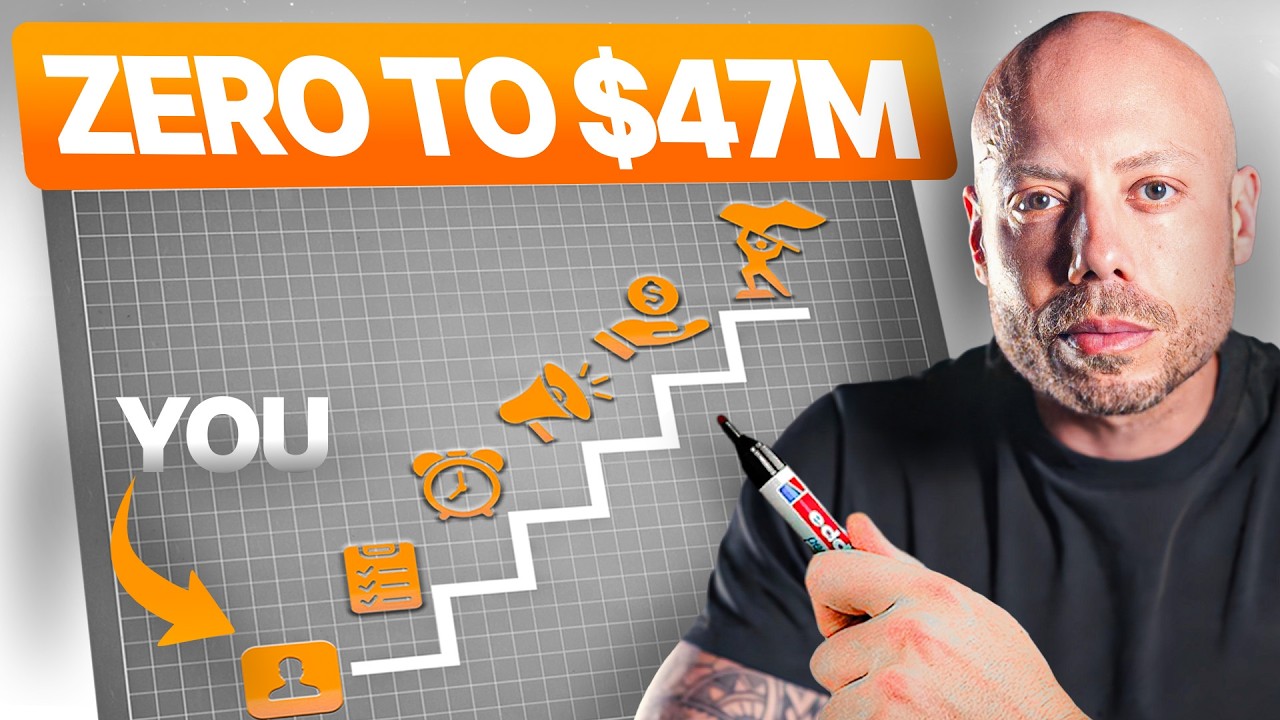
In this 10‑minute solo presentation, serial entrepreneur Kit Barber (25 years in business, $47 M revenue) shares the practical systems, structures, and mind‑sets that enabled him to build a company that runs without his constant involvement. He recounts his early breakthrough—repaying a $300k loan in eight months—and contrasts his initial “work‑hard” approach with the later, system‑driven model. Key turning points include (1) implementing robust processes, SOPs, and quality controls, and (2) assembling a diverse board of directors with complementary skill sets. Barber warns that many owners misunderstand scaling, focusing on revenue growth without ensuring profit (EBITDA) and exit readiness. He describes his personal experience of being trapped in endless hours, leading to the creation of frameworks that let him work smarter, not harder. Core frameworks presented are: • FAFA – a feedback‑action‑follow‑up‑repeat loop for team and board performance; • Clear, time‑bound delegation with specific briefs; • Measurable sales pipelines that identify leaks; • The “snowball” method – sell more, lead better, grow faster – which he claims can lift businesses from six to seven‑figure revenue quickly. He emphasizes measuring owner hourly earnings to reveal trapped value, and offers a 90‑day ROI guarantee on his coaching, stating he has never refunded anyone. The overall message is that owners should shift from being operators to owners, building businesses that increase in value without increasing dependency on the founder.
Chapters
I'm Kit Barber. I've been in business for 25 years, and my $47 million business basically runs itself. Today, I'm going to show you how you too can successfully run a business that works for you, not on you. At a young age, I've always been super interested in business. I like the reality of the way that people could make a lot of money and basically control their own lives moving forwards. They're in charge of their own destiny, and I really, really like that. The speedier you are, the quicker you work with things, the quicker you can get to your market, and you can beat and dominate your The specific moment that came to me when I realised I could actually build and grow a business is when I took out my $300,000 loan. Within eight months, I'd actually recouped all the money back and I paid back that loan. So I was now at zero risk. From my perspective, that was amazing. And I knew deep down then I could go ahead and I could launch my businesses because I had the confidence behind me. I used to get stuff done by just working hard every day. I put in so many hours to get results because I was the best in the business doing the stuff that I did. The difference that I'd have now compared to my first five years is that. My entire businesses now are built around systems and processes. Having the right leadership in place to run the businesses with the right standard operating procedures, right quality controls in place, it means they can get the job done without me constantly having to do all the work for them. And that is a game changer when you get to that point. There were two massive turning points for me that allowed me to grow my businesses up to the $47 million mark. One is where I'd put in processes and systems in place, allowing me to grow and scale, regenerate my cash, and leverage it to put new units in place. To bring in new industries, to use my skill set in other places as well, to really grow what I have, my portfolio, which was amazing. The second biggest thing that I did, thing I'm most proud of, is put in a board of directors. Some of the businesses I work with who've got a board, their biggest mistake is they recruit people who are just like them. Now the trouble with that is you all think the same, you all see the same thing, and you all do the same skills, which is great until there's a skill gap. So when you get on a board, you have to make sure you've got different people with different skill sets. Salespeople, finance people, production people, people that like systems and processes, people that have the vision but can't necessarily do the detail. If you get that right, your business will absolutely sing. And that's exactly what I did when I stepped into CEO. I brought in a board of directors. What do most business owners completely misunderstand about scaling? The thing that I see is that they're happy with the scaling. They understand what scaling is. It's bringing in growth into your business, but they miss the mission. Some people just want a load of money. They want the revenue, but is Is there any profit there? Are you scaling for sale? Because you've got to factor in your net profit there to make sure that it's got a decent number on it so that when you factor, when you scale your EBITDA, I don't know if we're going a bit too heavy here, but when your earnings before interest, tax, depreciation, and amortization are at a decent level, you're going to get more when you want to sell it. So the thing they get wrong about scaling is not the scaling itself, it's the thing at the end of it. If you're selling it, you have a very different business that you have to legacy and get ready as opposed to one for a lifestyle. It's well documented that I've spent probably about 10 years longer than I need to being trapped in my business. What that really looked like was me working all the hours under the sun. I used to work 40, 50, 60, 70-hour weeks and then still have to get up to do other things on top because my business just ran around me. I was the business. My team were amazing, but they came back to me for everything at all times. I had to provide the answer and then either do or delegate. And most of the time, you know what? I did because it was flipping faster than getting someone else to do it. My typical day would look like 5 AM, get up, 5:05, check my emails, 5:15, check more emails, then get to the gym for 5:30, go and lift some weights for a little bit, come back. Guess what? Check some more emails, then get the inevitable phone calls. Something's broken, something's happened, some customers have cancelled, a staff member's in sick. It was incessant. It was repentant. It was obsessively horrible all the time. And eventually It pushed me enough to create the structures that I needed and the frameworks that I now absolutely love. One of my great philosophies in life is to work smarter, not harder. And for me, in a business, it's all about your systems and your processes, your frameworks. If you have those, you are absolutely going to be winning all the time, but they have to be very clearly documented and easiest for your thickest mate to deal with from day one. If you get those right, you will be winning. I realised 15 years ago that without frameworks, I was the business and I couldn't be the business to scale. So in order to do that, that's why I started working heavily and investing heavily into frameworks and processes. Sales operating systems are all about measurement. So it's looking at a pipeline of sales and importantly, where are the leaks in your pipeline from the point you get a prospect, a lead, to the way you qualify them, the way you get them set up for sale, and when you're converting them to sale. Those all have numbers. If you can measure those numbers consistently across all of your team and across the business, and if you've got multiple businesses, in comparative industries, you can see where all the gaps are. Those numbers are going to change and fluctuate, sometimes seasonally, sometimes team-based, and often that's just a training issue. To build a team that can make decisions without constantly coming back to you, the owner, is just all about training and delegation. So you want to have a feedback format in place. I call it FAFA: feedback, action, follow-up, repeat. So all you need to do is to make sure whatever it is you train them on, that you then have to observe them. You do some feedback, how they're getting on with it, We're not going to talk about if they're not done very well. We're not going to be doing personal attacks. We're just going to say on this date and time, this thing you didn't do correctly. Then we're going to set some actions that we all agree, typically 2 or 3, no more than that. So you're going to work on the core actions. Now you're going to follow up. So feedback, action, follow up, and then repeat. On the follow up, we're going to test a few days later, maximum a week later. Are they now doing their behaviours? Are they eliciting the behaviour that you need to improve your sales or your process, whatever it is that we're focusing on? That's where the follow-up comes, and then we're going to repeat. It works throughout all of the business. And as a key tip, as a business owner, if you're a bit bigger and you're getting a board of senior leaders or directors, FAFSA still needs to be done on them as well to make sure they're doing their job correctly. Because guess what? Humans change over time. They deviate. They move away from best practice. The biggest mistake that business owners make when they're trying to delegate is they are simply not clear. So it's all about being very specific and being time-bound. Now, a lot of people miss this. They'll say, I need it done by Friday, please, Dave. I don't know who Dave is, by the way, but they need it done by Friday. Well, what time on Friday? It all needs to be specific. So now Dave should have a very clear brief on how to do it and should have a timeline to get it done in. If the timeline is more than a week, you probably want a touchpoint in the middle as well that just touches point with Dave and go, Dave, how you getting on? Show me what you've done so far. So you can make sure that if it's massively off point at the moment, he can bring it back on with a little bit more training. Most of the businesses I work with are super successful. But tend to be exceptionally chaotic. So the first thing I always look at is their sales framework. Have they got a clearly measurable pipeline in place that allows you to measure where the gaps are so you can increase your sales without doing a huge amount of more work? The next thing we always look at is the leadership. So are they leading their team well? Are they very clear? Are the team trained? Have they got clear delegation in place to allow their team to thrive without constantly coming back to the senior leaders or the business owner all the time to ask the same flipping questions? If you have that leadership structure in place, which is what I provide, they will absolutely smash it through. After that, once the business can sell a lot more and they can sell consistently and they're leading their team in order for them to sell more stuff as well, and they're leading them nice and clearly, we're then gonna look at the growth factors. So how can they grow? What are they trying to do? What's their vision for their business moving forwards? It's called Grow Faster. And that allows us now to create some scale. Call it the snowball method. They're starting to sell more, then they lead better, Now they grow the business faster. And that process works in every business I've ever worked with, whether or not it's the little tiny businesses with 3 to 5 team members in there, maybe even 1 or 2. They're turning over 6 figures a year. That's fine. But as soon as we install the snowball effect, they tend to at least add it to 7 figures straight away because it doesn't take long to create that snowball to get the rhythm really going. The 7-figure people tend to move to 8 by doing that as well. I'm looking at selling more, leading better, and growing the business faster. If I could sit down with the business owner that I was 20 years ago, the first thing I'd say is make sure you get your flipping frameworks in place. You cannot do all the work because then the business is solely you, and you didn't go into business to be your own employee. So it's all about scaling by creating structures and frameworks, which sound a little bit boring, but they're super easy to do, really, really fun. The team love them, and it allows you to grow your business without being embroiled in absolutely everything all the time. It allows you to take a step back, take some time off, and focus on the growth of your business and look at it as an owner, not an operator. For a business owner who's making great money but feels completely trapped by the business, the first thing they should start doing is measure out all the stuff they do in a week. Look at how many hours you are working. Now look at the pounds or the dollars that you're earning, the money that you're earning over that time period. Quite a lot of the time, they're absolutely shocked to learn that they're the lowest earning employee in the entire business, because the amount of hours they're putting in for the good money they feel, they've never actually done the calculation. So the first start point is what are you earning per hour? It's a bit of a shocker for a lot of people, but that is your start to give you the push in the right direction to give you some freedom and some time. If you implement the 3 things that I teach, sell more, lead better, and grow faster, I guarantee that you will have a different business in 12 months' time. You'll have more time and you'll have a lot more profit coming into your business cuz you've got sustainable cash flow. And I actually guarantee it in the first 90 days, if you choose to do any work with me, that you make your investment back in the first 90 days or you get your money back. And guess what? So far I've never had to give any money back because the frameworks are super simple, they're easy to put in place, and actually your team will love them. And you will go from being stuck and embroiled in absolutely everything to having a pipeline of clear sales that's made it very, very manageable. You'll be able to lead your team so much better that they'll be coming to you with their suggestions and ideas for growth in your business. And that's going to give you the time to go back and grow your business as an owner, not an operator doing absolutely everything. The goal isn't to build a business that needs you more. It's to build a business that becomes more valuable without becoming more dependent on you. And that comes down to the 3 things: sell more, lead better, and grow faster. Because if your business can only grow when you work more, you haven't really built freedom. You just built yourself a bigger job. If you're ready for your freedom, watch this video next.