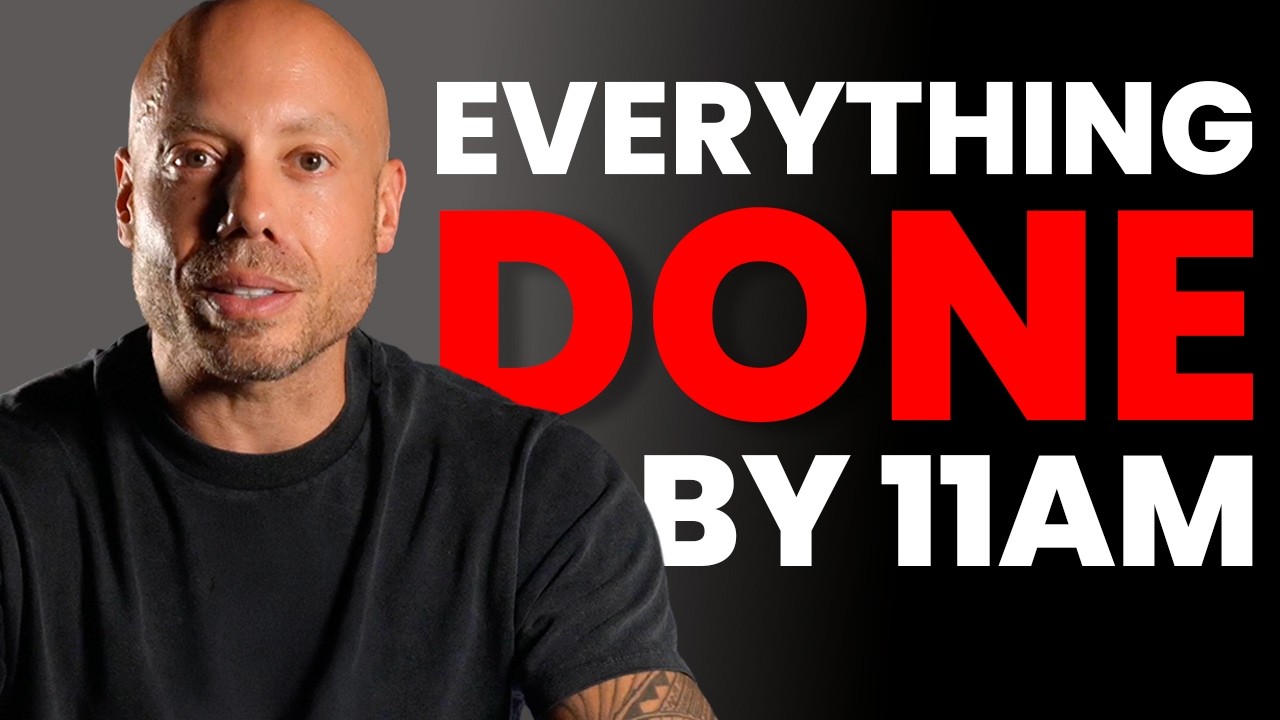
In this 30‑minute YouTube monologue, entrepreneur and business coach Kit Barber recounts how he built a $47 million enterprise by shifting from "working harder" to "working smarter." He opens with a personal story about losing his mother while he was at work, using the regret to illustrate the hidden cost of being trapped in daily operations. Barber then introduces his proprietary "Snowball Method," which consists of two core frameworks: (1) Sell More – a repeatable sales system that identifies pipeline leaks, trains the least‑confident team member to close deals, and boosts revenue without extra marketing spend; and (2) Lead Better – a leadership structure that delegates departmental authority, allowing the founder to step out of day‑to‑day management. He explains how these frameworks were iteratively refined over years of trial, measurement, and pattern‑recognition. Barber shares concrete time‑management practices that underpin his freedom: daily journaling, planning three big tasks per day, quarterly goal‑setting, and strict work‑hour boundaries (no calls before 9 am or after 5:30 pm). He describes his current routine – early gym, family time, focused work blocks – and the psychological shift from being busy out of necessity to being busy by choice. The video also promotes his Business Accelerator program, promising a 90‑day ROI guarantee and informal bets on reclaimed time, while clarifying that the method works for any people‑centric business but not for fully automated or AI‑only operations. The overarching message is that time, not money, is the scarce resource, and by systematizing sales and leadership you can win it back hour by hour.
Chapters
Most people think that the harder you work, the more money you make. They think staying busy is what leads to real success. And I used to think this way as well, until I made $47 million in my business by simply working smarter, not harder. Today, I'm gonna show you how you can do it too. In this video, I'll walk you through exactly how that happened, the story, the systems that came out of it, and the blueprint so you can start doing the same thing this week. Before I built the systems that I run now, the business had every hour that I had, not just my desk time, my mental time too. Every conversation Everything in my head was about work, whether I was sat in the office or not. Here's how bad it got. 10 or 11 years ago, my mum was in a hospice. She was dying of cancer. Every morning and every evening I was with her, but in between I went to work. I went to the business on a Saturday to do sales because I told myself I was the best in the room at it and the business needed me there. She passed away while I was at work. I've carried a huge amount of regret over that. She'd been ill for a long time, so you'd think that I'd have learned to expect it, but you never know when that moment is actually coming. And I chose to go to work I did it that day because it felt like I didn't have a choice. But I did have a choice. I just hadn't built a business that gave me one. And that's what the hours were actually costing me. It wasn't just time itself. What I was sacrificing without even realising it was my own development, personally and in the business. I was so buried in doing everything myself that I never had the space to grow. And the business couldn't grow either because I was too stuck inside it to build anything bigger than, well, me. The Snowball Method didn't come from a textbook. It came from years of trial and testing, watching for the patterns underneath all of it. Measuring the pipeline, where the sales were actually leaking out of the business, where my salespeople were weak, whether that was converting or handling objections, personalising the experience of the customer. That gap is what became Sell More. Sell More meant my team could sell better than I could, which meant I'd become the worst best salesperson in my own business. The best in the room was exactly the reason that the room couldn't function without me. That's what led me to step out. But stepping out needs somewhere to step out to. I'm good at leading people, even if I do say so myself, but the problem was nobody else in the business was at any flipping good at it. So I built the structure for it, the frameworks that let me bring in people to lead the entire departments the way I used to. And that's what Lead Better is. That's exactly what allowed me to leave. Once I had the money from Sell More and the freedom from Lead Better, growing faster stopped being a leap of faith. It became the same format dropped into a different industry in multiple locations with multiple businesses, but it's the same system every time. It doesn't care what industry you're in. The first thing I handed off was sales. The system was built so the least confident person in the room can follow it and still become genuinely good at selling. And while that's happening, you can see exactly where the leaks are. You don't need to spend more on marketing. You just fix where it's leaking and convert more of what's already coming in. Some people ask, do I know my hourly rate now versus then? And I do. And I'm not going to tell you what it is, but I'm properly pleased with it. What I will tell you is what it used to be. I did the maths on it once, hours against salary and dividends, and I was the lowest paid person in my own business. That was properly scary maths. Try it yourself sometimes. It's more sobering than you probably think. The part that gave me the most time back though wasn't the sales, it was lead better. The moment your team start leading themselves properly, you go from managing everyone to having a handful of people reporting to you only. That's it. In my biggest business now, I've got a board running and I'm not operational at all. The business thrives without me in the room, which if I'm honest, it does sting a little bit, but it's also brilliant at the same time. And there's one rule that I keep purely out of selfishness. I don't take calls before 9 AM. I don't take them after half past 5. That's so I can be there for my kids. I can watch them grow. I can be present for all the stuff you miss when your business has got every hour that you've got. I didn't have that with my older kids, and I'm not missing it again. The first properly free afternoon I had, I didn't have a clue what to do with myself. It felt kind of odd. Over time, you learn what actually flicks your switches. The devil makes work for idle hands, and mine were no exception. And I'm not working on the business, I'm working on myself. Sometimes that's physical stuff— MMA, rugby, or at the gym. Sometimes it's personal development, sharpening myself as a leader, a salesperson, a business owner. And I'll be honest with you, most of the time when I've got free time, I fill it with more business stuff. I love the game of business, not the money. It's the game, watching people thrive, being able to pay for someone's rent, their houses, watching them build wealth and knowledge for themselves. That's what I actually get off on. It's a bit sad, I know, but saying it out loud like this is weird, but it's very true. To protect the time I did have, I had to retrain myself completely. Years ago, I started journaling and planning. I hated the idea of it. Genuinely thought it was like hippie nonsense, man. Write out your day. How did it go? What are you grateful for? All of that stuff. I leaned into it anyway. It's the only bit of hippie nonsense I do in my life, and it flipping well works. I plan 3 big things for the day, 3 big things for the week. I work in quarters. Goals set every quarter, broken down into weekly goals, broken down into daily ones. When something's not really working, I adapt. I can see exactly where the gaps are before they become a problem. And you know what? Yes, I'll admit it, I do write down what I'm grateful for. I also write down what went well at the end of the day, what didn't, and what I'll do differently. Now, I've done this for over 10 years now, and it's one of the single biggest reasons that I manage my time so well. And honestly, one of the biggest reasons I'm successful at all. That's what I reckon. And the moment I actually had time, my family and my friends noticed it before I did. I wasn't stuck on the phone all evening. I wasn't taking calls at dinner. The gap between the work I had to do and the work that I thought I needed to do, it, well, it widened massively. And it was the people around me who pointed out first, I got compliments for it. And that made me lean in even harder. I had to relearn how to enjoy it. And I'll be honest again, I'm still rubbish at a lot of it. Put me on a beach at an all-inclusive, sat there doing nothing all day long, and I absolutely hate it. I can't do it. I like being busy. The difference now is though, I'm not busy because I have to be. I'm busy because I choose to be. Some days that's a business idea that I want to chase or the next investment I'm looking at. It's a choice now. It's not a demand. So here's what my day actually looks like now. I'm up at 5, I go to the gym for half 5, I train, and half the time I end up coaching whoever's next to me. It's old habits from years of owning gyms myself. I come back home, I walk the dog, I sort the kids out, get them to school. By half 9, I'm sat down. Now, a couple of video calls go on, catching up with my ops director on the biggest business, and then I work through my day against my 3 big things. And the first thing I did with my time back wasn't more business, it was stepping away. A proper break, recalibrating my family and my friends. Then I moved into growth. Then I invested in the next business. But there's a real test. If I took 2 months off and I went traveling, say around Europe, the team wouldn't miss me. The business would carry on thriving without me in the room. And that's kind of the whole point. That's what everyone's actually trying to build towards, whether they've said it out loud or not. My mindset's changed though. I used to be pure growth. Grow, grow, grow. Turnover, more money. But revenue is vanity. Profit is sanity. And cash is reality. The more successful you get, the more opportunities that land on your desk. And you have to get good at saying no to most of them because there's always another one coming. And now I build lifestyle businesses. I've done the growth. Now it funds what I actually want to do with my life. And I always said that I'd retire at 40. The truth is I probably could have, but I don't need to. I enjoy it too much to stop. And if you think more time only comes with less income, just look around. There are a million case studies of people running big businesses and small ones making proper serious money without giving up their week for it. A lot of them are in my business accelerator right now, which is part of the group coaching that I run, learning the snowball method and everything that goes with it. And they've all figured out the one secret: you don't get paid for your hours, you get paid for your results. Results come from selling more, leading better, and growing faster. If you're losing your whole week to the business right now, the first hour you reclaim is for planning. When you're buried in the operational side, everything just, just gets thrown at you all the time. Your time gets stolen all day, every day, without you noticing it happen. So you protect your planning first. Plan your 3 big things, the tasks that actually move your business forwards. You guard that hour like it's the most important meeting in the diary because Guess what? It is. The biggest mistake people make is thinking stepping back fixes the time problem on its own, but it doesn't. Step back before you built the structure underneath it and things are gonna break. It's as simple as that. And the bit that nobody warns you about is this. Once you get used to working less, you get comfortable with it, but your results drop because the frameworks still aren't there. So you end up in the worst version of both worlds. You don't want to go back to grinding, but the business isn't performing, so you have to go back in and you've gotta work twice as hard just to fix what fell apart while you weren't looking. Does this work for any business? Yes, because it's built on people, structure, and process. I work with service businesses mostly, but I've got fintech in there, large construction firms, all sorts of stuff. If there are people involved, this thing works. Where it doesn't work is anywhere there aren't people to lead. Pure AI-run operations, prop trading, complex investment plays, and no team underneath them. If that's you, this isn't your system. If I had to put a number on it, comparing where I am now to say 5, 10 years ago, this has handed me back multiple months a year, time I actually control and time I actually choose. A year from now, if you do this properly, here's what I'll actually guarantee. Officially, you'll make your investment back within the first 90 days. That's the real guarantee, and I've never once had to pay it out. Unofficially, and I'm not putting this in writing anywhere, I bet you a pint you'll get at least one day a week back, maybe two. I am that confident in it. If you want to know more, click the link in the description. It'll take you straight to the page that'll tell you everything about the Business Accelerator. There's no salespeople there. There are no sales calls. If you do want a bit of advice first, you can jump on a call with one one of the coaches will point you in the right direction, even if that direction isn't working with me. Either way, the choice is yours. So if you take one thing from this video, let it be this: time is the one thing you can't buy back later, but you can start winning it back today. The Snowball Method isn't about working less for the sake of it. It's about getting your life back one hour at a time. If you're tired of your business owning your week instead of the other way around, don't wait for burnout to force the change. The link's right there, and I'll see you in the next one.