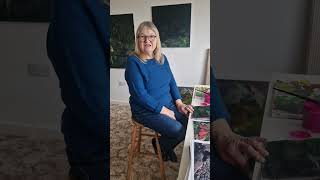
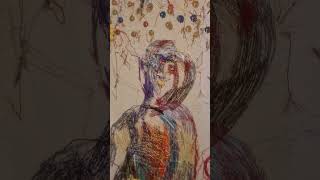
In this YouTube interview, presenter (Speaker A) visits artist Ruth Piper’s studio in Lyme Regis. Piper explains that she begins her practice with small, spontaneous sketches on paper, using them as a way to re‑orient herself between larger works. She creates these sketches with acrylic paint applied thinly, almost like watercolor, building many translucent layers that can darken the paper. The sketches often feature trees, nocturnal scenes, and imagined critters, reflecting her fascination with nature and a “shadow self” theme that emerged midway through her series. Larger works on canvas follow a similar layered acrylic approach, with dark initial layers (indigo, dark green) giving way to subtler colors, producing depth and subtlety. Piper notes that the time required for a piece varies; small sketches can be quick, but some take as long as a large canvas. She discusses the unconventional, somewhat random composition process—collecting bits from various sketches and assembling them into a cohesive, unsettling landscape that resists easy interpretation. Finally, Piper and the interviewer talk about the upcoming London Art Fair, anticipating that the original, uncompromising subject matter will make a strong impression on viewers, who will need to spend time absorbing the work.
Chapters
Hello, Ruth Piper.
Hey!
And we've found you at your studio in Lyme Regis, and looks like you're working on some small sketches. So is this how you start your work?
Yes, it's what I do in between paintings, bigger pieces, and just to get myself orientated and back in there really, after having a bit of a break. And I just allow myself to, um, just, you know, start anywhere on the paper and just keep going until something emerges. And, um, I can spend quite a lot of time making sketches in my sketchbook, um, layering the paint, etc.
And can we see some more?
Yeah, sure. Trouble is, I don't always work up the same way, so they all get— yeah, they're a bit random.
And they're very inspired, obviously, by nature.
Oh yeah, I love trees, as you can see. And what's going on in the trees could be all sorts of goings-on, especially at night. Um, Here you can see some, maybe some critters in the trees, uh, having a bit of a conversation. So I'll often sort of use bits and pieces of each sketch to incorporate it into a bigger piece, um, just to see how it works out.
And these are acrylic on paper?
These are acrylic on paper, yeah. Sometimes I put so many layers on, the paper gets a bit destroyed, but because I forget what I'm working on. It's not canvas, it's paper.
But behind you we have a couple of canvases.
Yeah.
So they're again acrylic on canvas.
Yeah.
And, um, how long do these typically take you?
Oh well, the smaller ones might happen quite quickly, um, But then sometimes they can take just as long as a large piece, um, to work out.
And there's many layers, aren't there?
Yeah, yeah. And first layer will probably be quite dark, maybe really dark blue like indigo or dark green, um, and then you get all sorts of different colors coming through.
You get amazing subtlety and depth in your paintings.
Yeah, it's like I kind of like use the oil— use the acrylic as like watercolor really. So I use it quite— I make it quite thin and it's so that it stains. The acrylic that I use is very high pigmented but it's quite translucent as well.
It is. You've certainly mastered the medium. And it's also this— the subject matter seems quite dark, mysterious, like the, the shadow self almost.
Yes, I think that's probably correct. Um, that didn't occur to me till about halfway through making all these works, and I thought maybe I am working with my shadow side now because I do love the darkness and what comes out of it.
They are very original pieces in terms of their subject matter and the sort of uncompromising nature of the subject matter, and I think they're, uh, yeah, they're going to be— they're going to make quite an impression, I think, at the art fair.
I hope so. I mean, they aren't landscapes in the traditional sense of the word, but they're parts of landscapes. They're sort of homing in on, on all sorts of different areas and putting all those different, different references that I've got together in a fairly random way and then putting it all together, putting it all together, or bringing it together on the canvas.
And they're very much paintings that people just need to absorb, aren't they? And yeah, take time with.
Yeah, and they can be quite unsettling at times as well, I think, um, because you don't quite know what you're looking at.
That's right, yeah.
Even I don't know what I'm looking at. I think, what have I done? What is that?
That's right. Brilliant. All right, well, thank you very much, Ruth, and we look forward to introducing people to your work at London Art Fair.