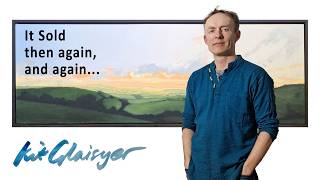
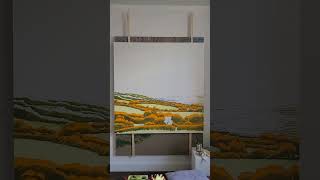
In this informal gallery talk, the artist explains the creation, evolution, and reception of a 4‑foot (120 × 40 cm) oil on canvas painting that belongs to the "Midsummer on Egerton Hill" series. The series stems from a single midsummer evening in 2017, captured initially through photographs and later developed in the studio over two years. The speaker describes his preference for a 3:1 panoramic format, the lengthy studio process, and the shift from a more defined early version to a looser final execution. He outlines how the work generated numerous commissions (12‑15 variations), culminating in the sale of the original and a companion piece at the London Art Fair in January 2025. The artist attributes the painting’s popularity to its glowing midsummer palette of greens, oranges, and blues, and discusses his lifelong affinity for green, rooted in a rural Dorset upbringing. He reflects on his artistic lineage—learning to paint from his father, a skilled watercolorist and oil painter steeped in the British watercolor tradition, while also being influenced by Cézanne, Gerhard Richter, and other modernists. The talk covers his early plein‑air practice, the limitations he perceived in that medium, and his current studio‑based workflow that integrates sketches, photography, and Photoshop manipulation to capture and enhance fleeting moments. The speaker concludes by inviting viewers to view the painting in his gallery.
Chapters
Hello there. I just want to talk about this painting quickly. I just came down to my gallery and even though it's at night, I just thought I just need to talk about it. Let's have a look at it. So this is a 4-foot, what is it, 120 by 40 centimeter canvas. Oil on canvas. You can see the size of it there on the mantelpiece. And it's— so I tend to work in these 3:1 proportions. I really love them, this panoramic proportion. It just kind of makes sense to me, really, because we have two eyes and we we kind of see, you know, life in this way, I think. And this painting is part of a series I've done called Midsummer on Egerton Hill, and it's basically— I've done a whole series literally based on this one evening in 2017. And the particular evening, I mean, it didn't even kind of look like this, but I basically— it was a beautiful evening and I took these photographs. And as I tend to do, I went back to my studio and I was looking at them later. I think this was about 20 2020 that I actually started on this series. Was it 2020 or maybe 2019? And I spent 2 years on the first painting, which is not— yeah, which is quite usual for me. You know, often when I start a new series of works, you know, they do take a long time. And I think I was, you know, I was just trying to figure out how to capture the ambiance of that particular evening. And the painting was a lot more, um, kind of, um, definite, you could say. This is quite loosely painted now. And but it took me sort of 2 years to get that sort of feeling that I really wanted of the, you know, to capture that day. And I was pleased with the painting, and I exhibited it, and I showed it over the years. And then I began to, um, get asked to do commissions of it, um, and so I did sort of variations on it, and people kept asking me, and I kept doing these commissions on this one, this one day. I mean, I've done other commissions in the meantime. But this particular painting, I mean, I don't know how many I've done, 12, 15, maybe more, I can't remember. And then I finally sold the original, um, at London Art Fair in, um, January this year. And I also sold, uh, one of the companion pieces. Um, so what I tend to do is when I do a commission I tend to make 2 or 3 pieces at the same time, mainly because when I'm making a commission, there's often lots of different ways I could go. And often, you know, the client has a particular idea about what they would like, and then I might think, oh, it might be nice to do it like this or like that. And, and so the one that I sold was— it was actually incredibly popular at the fair. I, I, I didn't think it would be So actually the variation was actually the first one to sell. That was the most popular, and then the original sold later on. And then this one here is— and so basically the ones I sold at the art fair were both 6-foot paintings, 180 by 60, and then this is a 4-foot one. So this is a smaller, you know, more manageable sort of size, but the same idea, you know, the same theme essentially. I'm very happy with it because it's got that sort of glow. I sort of love, I just love the glow of the, yeah, just that midsummer light. And for some reason it's just this palette is really popular, you know, sort of the greens with the oranges and the sort of blues I don't know, yeah, it's just, it really resonates with people. I mean, it's funny, sometimes people talk about, you know, how green is a difficult color. I mean, I don't find green at all difficult. I love, I love painting greens, you know. But then I, I grew up in rural Dorset, you know, and so I didn't have much choice. I had, I had to just learn how to paint greens, and I love greens. But I also just love these beautiful glowing colors that you can get. You know, this is obviously oil, oil on canvas. I just, I love what you can do with oil. So I, I essentially grew up, my father taught me to paint. I mean, he was a brilliant painter actually. He was a doctor, but he was also a brilliant artist. He was a brilliant watercolorist and also a brilliant oil painter. And it was quite intimidating for me to think about it. So I was a young boy and I used to go out and I used to paint you know, with him. And I knew that my work would be completely rubbish compared to his, you know. I had a long time, a lot to learn, you know, you could say. And, and so I, I always had to figure out a way to kind of make the painting work without rely on his kind of sort of accomplishment, you know. So he sort of had this accomplishment of, you know, it was like he loved the British watercolor tradition, you know, Cotman and Turner and, you know, I can't really remember, you know, but there's a very strong kind of British watercolor tradition and he loved that and I love them too. But I also was, you know, brought up with Cézanne and, you know, sort of abstract painting and modern art and contemporary art, Gerhard Richter and all this kind of stuff. So for me, although at that age I wasn't really aware of Gerhard Richter, when I was a boy I was more aware of, you know, Constable and Turner and Friedrich and, you know, the Romantic painters. But so I had to go out there and I had to somehow make a painting that was sort of honest and it captured something that I kind of felt, you know, had a kind of compositional quality to it. And so I learned very early on to find some theme to sort of catch on to, you know. Maybe, maybe it was a tone of a, of a distant wood, you know, in the mist, and that, or, you know, or a particular shape against another shape or something. I don't know. I mean, I guess my father was doing the same thing, but I was sort of doing it without his knowledge of, you know, having learned to paint, if you like, you know. And so then I, then I basically moved into oil plein air painting as a teenager, which I really loved. Again, just sitting out trying to capture something. In the moment. And it was actually that work that got me into art college. And I know I love painting like that, but I actually got a little bit frustrated with plein air painting because it very much relied on that particular time, you know, whatever it was, 2 or 3 hours. And I kind of thought, well, actually there's so much more subtlety that could be captured that you can't really capture in 2 or 3 hours. And so these are very much studio paintings now. So it's still very important to really go out, and these are based on a particular moment, you know, and sketches and photography as well. Photography is actually very important to me now because it allows me to sort of remember a moment, and the paintings are like improvisations inspired by a moment and a photograph. And then often I'll go into Photoshop as well, and I'll I'll, you know, I'll exaggerate areas or I'll remove areas or I'll change the color or the tone, you know. I'll just, to, you know, find, find a theme that I find interesting in a painting. Sometimes I don't need to. Sometimes just everything's right, the composition, everything. And it was in this particular case. This, this Midsummer's Evening was perfect. But I didn't know it at the time, you know. I just, I started painting it and people loved it, and it's great, you know. So that's it anyway. I just thought I'd just, I'd just have a quick little chat about this because I, yeah, it's still really one of my, my favorite series of paintings. And yeah, I've got this 4-foot one on show in my gallery at the moment, so you're very welcome to come have a look at it. And yeah, I think I'll leave it there.