In this interview, artist Dan Bendel discusses his remote Dorset home, which serves as a living installation and source of inspiration. He cites British Romantic artists William Blake and Samuel Palmer as key influences, especially Blake’s poetry and imagery. Bendel explains his collage and print process, which involves repeating a single image many times and allowing it to transform gradually, a method he applies to designing exhibition flyers. The conversation explores his use of surrealist ideas, the role of the unconscious, and how intuition guides his creative decisions. He reflects on the iterative nature of ideas, the importance of trusting intuition, and the fluid evolution of visual concepts from simple repetitions to complex, sometimes surreal, narratives.
Chapters
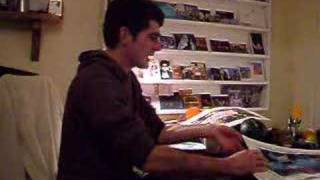
Right, Dan. So in your house near Nettlecombe in Dorset, your living installation, I'd say. And it's very homely, kind of in the middle of nowhere, at the bottom of a long drive down a Muddy lane surrounded by trees and the wide countryside, I suppose.
Lovely.
So this is where you get your inspiration for your— Well, partly.
I mean, yeah, that feeds into the work. What I see in the landscape, and yeah, that's part of it.
And you're inspired by British artists, Samuel Palmer and, well, Blake and that lot.
Oh, definitely Blake and his poetry, but I mean, I appreciate Palmer's stuff, but I mean, I would say, yeah, yeah, direct influence.
It's one of many.
It's one of, well, yeah, yeah, yeah, that's definitely Blake.
Blake is Nameplate. So up to your left here, we've got this case that you made for these cards that you made.
That's right, yeah.
Which people can look at on the website as well. But now you've got all these other images up there, which is nice as well.
Yeah, they're just like images that I like. Or images from other artists, really.
Is that one of your drawings on the right there?
Yeah, that's right. Yes.
I do like your drawings.
Oh, do I like them?
No, no, I like them.
Oh, thank you.
I really like them, yeah. In fact, maybe you could show us what you've been doing here. You've been designing the flyer for the exhibition you're doing.
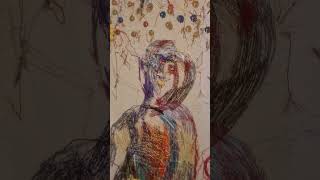
Yes. Some ideas, yes. I work in a collage sort of way, and previously with these, I've made images of myself and repeated those images, about 80 of them, and the image changed throughout. And this is the same idea, the same image, but it's transforming slightly or dramatically. And that was some ideas for the poster. But I started off with this. This one. As an initial idea. And then you've got the names around the edge. And there'd be more. There'd be, you know, whatever the title of the exhibition, that's the word, and the date. That's just the sort of the initial idea, and then it sort of transforms, or I don't know, metamorphoses into something else. So, I don't know what I'm saying.
Well, let's have a look anyway.
Mendelssohn, something changes into that. So, funnily enough, speaking of William Blake, that head is taken from one of his paintings. Excellent. So I've cribbed an image of him, so I hope he doesn't mind.
He'll be turning in his grave.
All the lawyers will be. Suing me if I try and sell— no, I'm sure they won't. But yeah, well, System Edge is a way of changing an image which is the same.
So yeah, you've got improvising on a theme.
Yeah, exactly. But it, you know, it'll take you anywhere, you know, take you here. So I mean, that's a bit garish. But it's the idea that the buildings turn into lava or volcano.
I like it.
So, just stuff like that. But it's endless, it's infinite, which is what I like about it. Then it could be—
Ah, excellent.
It could be the idea of voyeurism or something like that.
Yeah, that's great.
And then it could change again. This is a short, smaller version of— I'll just cut out the middle, but then it could sort of turn a bit mysterious for—
Yeah.
That could be the next direction it's going, possibly. Yeah. It becomes simpler. And then, well, you know, stuff like that, so it's sort of a bit surreal.
Surrealism seems to play quite a lot in your work. Yeah. Just kind of, like you say, opening up to these ideas, let the ideas unfold and emerge. Yeah.
Yeah, definitely. Yeah, there's sort of dreams and stuff like that. Ideas which come to you without forcing them. And you find— in the form of surrealism.
But I mean, for you, working with multiple, or using the same image again and again, is one way of accessing your kind of subconscious, or getting away from rational thought. Is that right? Or, I mean, how do you access the unconscious?
Good question. But it doesn't really— well, it can come to you. I mean, I could sit there with a piece of paper or a sketch pad and, you know, ideas will come. Or I'll be on a walk and have an idea about a sculpture or something. Yeah. Well, with these, it's more the process of you've got all these images, say you've got 10 images like that, and then an idea will come to you, a way of changing that, and that's where the unconscious comes into it, I suppose.
Yeah.
That's a sort of different process to drawing onto a sketch pad. An idea that comes from the top of your head.
Yeah.
But it's all, it's all, I use all those ways of doing it. It doesn't matter. Yeah.
But it is interesting, you know, for anyone to, you know, to discover ways of doing this. I mean, it's like with me, I mean, I've tried to, if I have an idea, I try to do it even if I'm going, I don't know, that's a silly idea. You know, if you get an idea, in a way I feel that is an indication that there is something of interest there, even if you have to go through slightly familiar territory to get there, or you have to do something which is a little bit routine.
Yeah.
But if you have an idea, then it can often lead somewhere, but you have to trust it. You just have to trust that.
Yeah, yeah, definitely. Intuition. Yeah. Or you can have an idea and it dies, but it doesn't matter because you'll have another one. Yeah. We might use an element of that idea that died in another idea. Yeah, that's right. Which is beautiful.