Daniel Rushforth talk for Salon48 atAssembly Inn, Bath on Weds 20 June 2018
Painter Daniel Rushforth describes his shift from life drawing to sourcing images from magazines and TV, then transforming them through gestural acrylic work on cardboard. He works on the floor, layering paint and letting it dry between sessions, sometimes spending 140 hours on a single canvas. His recurring subjects include angels and a reimagined Annunciation, influenced by El Greco, Bosch, and Bacon.
Chapters
began and how it's developed and the stuff I've been doing in the last 6 to 9 months. We'll have a closer look at that. But first, thank you to Kit, Jess, and Nina for putting these events on because they're an important thing to have, just because artists love events. So this must have been around Christmas 2012, where there was an open call for a little show in 448, Christmas show, and I thought I'll make some pictures for that. Now this is one of the pictures I produced. Hello. And I've done figurative work before, portraits, faces, life drawing, but I'd never really It was always from life, very accurate to a specific picture, that kind of a very definite source. This was like a departure from that, because taking figures from different places and sort of supplanting them into a new place. So something which came from a fashion magazine, would say turn into one of these, like, dark abstracted figures. And this is very new to me, to, like, have the painting take on its own kind of narrative and really walk the things I was painting from. And none of these things I was painting from were really sought out by me. They sort of, like, came into my life as a picture, and I saw this and thought, that would make a a great, great image. Like, for example, a friend gave me a newspaper clipping of AC Grayling, a philosopher. I thought, I like that picture, so I'm going to make a few pieces from it. But at no point did I kind of seek out anything. So these are some of the works. This is an example of that, from that philosophy picture. And what really excited me was the transformation of the source imagery into something quite different. And also the process of working with paint. It's kind of an exploration in the material. Very interested in randomness, how things dried. Quite like mixing up lots of different paints and laying them flat. So I've always worked sort of in a flat on the floor so liquid could spread out and dry in its own time. And it was important to get this time between layers of the work where new ideas would sort of come to me, which wouldn't have happened if I just painted it straight straight up, like straight off, and finished it in one session. So there's this kind of gestation of ideas through leaving, giving things time, giving things space to dry, and letting them breathe, and not rushing stuff too much. So the next summer, there was a show at Fourth, another show at Fourth Authority called 8 Wonder, and these were 4 of us who made it for it. They're all A3 in scale, and they, I think they won the public vote. So as you can see, this is another one from that same source image of the phosphor. This, well, it came from all sorts of sources. This was actually from the still Doctor Who, where I'd seen this episode and I thought, I quite like the lighting in that, like, and Scott, like, he's wearing some sharp clothes, he's striking a pose, so I wonder if that could make some, like, an interesting picture. So I screenshotted it, printed it out, and just again, just playing around with things, being as loose as I could in the studio. And just making work in a relaxed way. And it's a really process of discovery, sort of trial and error. If something didn't work, then I'd get the white paint out, swash it over, and start again. What are you painting on? This is on cardboard, acrylic. I mostly use acrylic, mostly because of the necessity of a well-ventilated ventilation if you want to use oil. Yeah, didn't really have access to like an open space. I do like the way acrylic works, although oil is amazing. I couldn't choose if you pressed me on it. So that's another one from the same series. And this one This was painted from a fashion magazine, quite a bright, happy picture. And yeah, it sort of transformed into this existential kind of lonely woman. It's just seeking out, seeking out a theme or a mood, really. That's what really drives me. Exploration. So I saw this theme of angels creeping into my work, sort of slipping in right from the very beginning, really. I was looking at old master paintings, lots of biblical themes in there, and obviously angels occur a lot, and they appeal to me aesthetically because you've got a figure, you've got wings, you've got robes, you've got all sorts of sparkly things going on. And they also appeal to me just in their meaning, this sort of manifestation of some divine And the way they're kind of between this world and another, they're quite ethereal. And I feel the paintings are quite ethereal as well. They're quite loose, almost ghostly. And the subject matter of angels appealed to me because they kind of reflected the way the paintings looked.
So that's a closer-up of that one.
Again, I was working flat on the floor, leaving a lot of time for things to dry. Getting these funny marks. This was about— this is a theme I'd like to expand on. It's like an angel's workshop where a damaged individual goes to sort of have their wings and have stuff touched up, and David does his work for angels, like, behind the scenes. And she's kind of oblivious to the whole thing in this kind of cloud of thought, but it's all going on behind the scenes. Now, I like the idea of angels because they are— they're not like God or something like that. They're imperfect as well, and they kind of have their own agency. They're You know, like Satan was an angel who went bad and kind of said, 'I'm not following God.' So they have their vices, and yet they're still divine. They still have the essence of perfection in them. And I think all human beings have this as well, have something perfect in them. Well, we've all got our flaws, but behind that there is something beautiful and divine. And these are kind of an avatar, if you like, for that potential. So these are the little— here's some details of the— these work of angels. This is the theme I'd like to do a larger piece on. Maybe a few, but it's in the works.
Takes time.
So this was my take on the Annunciation, or an Annunciation, basically when Gabriel told Mary she was pregnant. And that's a theme that's covered an awful lot in classical art. But here I chose to make it a bit more terrible, a bit more of a terrifying, harrowing prospect, with this kind of explosive announcement which is so powerful it makes someone double over and sort of be prostrate before the reality of the nature that's going to come onto them. This one arguably isn't an angel, but I think there's definitely something in that thing. There's kind of a hint of a wing back there. I mean, she certainly has something divine about her with this halo. It's one of the more recent ones. This piece was quite a struggle. There was a lot of working and reworking. I often work with scourers and things like that. I take layers off and put them back on. It was a real wrestling match with some of the clothes and And in the end, I kind of lost it with the piece and scrubbed most of it away. And it sort of went into this kind of solution of brown muck. I took a cloth and just picked out little bits. And somehow it transformed into something that I was pleased with. And it's that kind of transformation where you don't see it coming. It's like you're reaching out for something quite grasp or see, but when it comes, when you see it, you know. And it's quite an amazing experience to sort of go through that transformation. And that slightly different style is a recent commission I've done. I worked from an El Greco piece of the Annunciation. I found it a really good way to look at all the work, to look, to study all the paintings, all your paintings, anything you're interested in and want to spend some time looking at. You can make a study of it, and then you really will be looking at the thing, spending time with it, getting into the head of the artist who painted it, and also producing something of your own. I mean, even if it goes completely wrong, at least you've spent time with this older work.
Hopefully learned something from it.
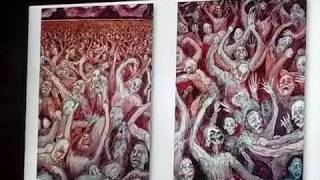
So now I want to talk about what I've been doing in the last, I'd say, 9 months or so. These 2 pieces. I decided I wanted to put a lot of time into one piece. I was producing quite a lot of work which I'd spend, say, between 5 and 10 hours on, building up quite a body of stuff. And I had the desire to, for whatever reason, to plough more hours into something. I thought these kind of things fit with the theme. Now, how I came up with this picture, it was very spontaneous. This is a tiny sketch from a sort of padlock sketchbook, and I was sitting in Hyde Park, I think, just waiting for a friend to turn up. I started sketching some people, dogs, whatever, and wasn't too happy with it, and I thought, okay, I'll take a new page. I just started drawing, and there's a figure there, and then I filled in this space around it, and this appeared, like, not consciously really, just sort of manifested from some maybe subconscious place. It's kind of mysterious to me. This image came about, and I knew at that point point that I had to paint this. I had to make it more than just a little sketch. So I got all of some bigger canvases. I'd say they're about this wide. They're not massive, but they're big enough. And I started working. I don't normally do the, like, taking people through how I work, or like showing before and after or any of that, normally just finished pieces. But today I am going to do that and just show you like how it came about. That was the first thing that's really different about it was that I was working upright, and I don't normally do that. It's normally all on the floor, but at the moment I'm living in like a one-room studio flat and there's just not that much space. When I put this thing on the floor, I'm kind of straddling it, and there's like nowhere to really move. So I propped it up and thought, I'll have a go at doing something where I can't have stuff flying around. So that was the very beginning, and I started putting in— the other difference was I was using drawing, well, more drawing, and charcoal to mark things out, whereas I wouldn't normally start with any kind of figure. I just work straight on with paint. I don't really do guide drawings or underdrawings, but this was different in the fact that I did. And I discovered things about the material that I really liked. Sort of a way I could do a charcoal line and put paint on top of it, and the charcoal would melt into the paint and create gradients of tone. So that's when I filled in this crowd. I wanted there to be detail in the crowd. I wanted there to be sort of stories within this picture. And there's lots of little different things. Wherever you look, there was something else going on, another story playing out, some kind of drama. So this took a long time, drawing out all these little people. And found there was a sort repetition in some of the figures across the crowd. But I tried to sort of do this stuff— well, I wouldn't even call it trying, it's just the way it happened. And these guys at the top of the picture are just kind of mannequins of the stage. And here's where I started putting putting more white paint and mixing it with the charcoal. And then I could really bring out some of the characters of these smaller figures and sort of get them involved in their own drama.
Just a bit more.
Started painting clouds as well. It's quite— I always like etchings, old etchings by Sajura or Holbein, and the way they draw these clouds, these big curves, lots of lines. Now I wasn't drawing like that, but the way I painted them was definitely referring to So at this point I still hadn't put any color on apart from the orange background. I don't know how many hours in we are now, but probably around 30 or so hours. It was something of a marathon to doing it. And there were certainly points where I wanted to give up and say, this is taking too long, like, what's the point? But I just couldn't put it down, you know, like, I'd say that and then just come back to it a day or two later, like, like a necessity, like an addiction. So I started preparing clouds in this coffin coat and thought it would look good if they were kind of like some kind of beast, like a dragon, horrible, some kind of ambiguous beast in the sky kind of bearing down on the whole thing. So here we've got clouds filled in, and I decided to give these guys at the top objects to hold. Now that was not my original intention at all. Again, this is a thing that arose because of the time I was giving it. It just occurred to me one day in the process that perhaps these guys should be holding these bits of armor, and I think they are offering, offering these bits of armor to our central figure. And now I start working with the color. Started working more architecturally. Didn't really have that in, in prep paints prior to this, kind of curtains, banisters, balconies. Any of that would be very, very vague, whereas in this one it was far more concrete, a lot sturdier, and a lot less vague. So here's some close-ups of the crowd. Now, to me, it's kind of a depiction of hell, of chaos, of not a very nice place. But also there's people reveling in there. It could almost be a party. It could be a crowd at a gig, like a concert. There's all sorts of Lots of drama going on in there, people wound up, and some of them are looking at the central figure, kind of judging him, some of them are angry at him, some of them are cheering him on, and some of them are wrapped up in their own dramas and aren't paying any attention to what's going on at all. Now, you may have noticed that there's a set of wings down the bottom on this podium. They were quite a struggle to, like, hue out. So at this point, I just eradicated them completely in an attempt to gain some clarity, and then spent quite a few days looking at wings, making studies of them, and just thinking about what a wing is. It's basically like a hat. Same bones as the hand, but elongated. So this, this is them in, in process. I've started doing some blue. First I went to dark maroon, and then I brought up at least some colder in there, so I brought out some blue. I tend to mix all my colors and then kind of maybe modify them a bit if they need to be, but generally it's the same set of colors.
This makes me laugh a bit more.
So I came up with with the idea that the wings have been taken from this being and are resting on the floor. And they can either take their wings and put them back on and take the armor and the sword that they've been offered and fly away, or they can go go back into the crowd. I think it's about judgment really in this piece. Class. This is now the finished piece. So now I'll just show you a few pictures of the finished thing. I also used some gold in there just to get a more kind of regal look to it and refer to kind of lots of kind of 15th century work with— they use loads of gold in there. It's something I don't see as much these days. So that's some detail of a figure in the crowd. I wanted to fill it with these little stories, these little dramas. I didn't really want any place to be a sort of play. There are a few bits, some curtains, which aren't so dramatic, but generally I wanted all of the figures to sort of say something, to convey emotion. And I wanted sort of a feeling of being overwhelmed. This crowd stretching back into the distance, into infinity. Sort of like a crushing pressure. Climaxing where this pedestal is, everyone pushing against it.
Pardon?
Sorry. Like people fighting, screaming, shouting, and consoling each other as well. And yeah, there's some quite terrible Stools.
Jess.
Sorry, Jess. Do you want to just give her that stool in front of you? So I must have worked on this 5 or 6 times, layer upon layer. And in total, it probably took me about 140 hours. Maybe more, maybe less. I did have a tally, but I just can't tell sometimes what's worth and what's not. I like working with underlying textures of the paint. So you can see here there's kind of this curve. I'm interested in the patterns that kind of underlie life because we do recognize patterns everywhere, and they are inevitable.
Everything.
It's not something I explicitly emphasize, but it's something that occurs to me when I look back at my work. These are some of the garden wheels along the balcony. Pretty shy. I had quite a lot of fun just mucking about, horrible little faces, building up a lot of texture on them as well. So this is one of the guys at the top holding these winged boots which the protagonist is supposedly going to fly up with, if they so choose. So that it makes sense. This helmet with eyes on it. I had a particular struggle with the face of this angel. And I still can't really tell whether she is serenely standing there or if she's very intensely staring into the distance. I like the ambiguity. And there we again have to finish up. I think it's important to stress the ambiguity in the work. There's no hard and fast meaning to it. You can infer it's about being judged for whatever reason, and it's about choice as well. It's quite positive in a way if he's being offered all these items. Yeah, yeah, because I think it's quite an arresting painting. People may not, may not see a positive thing initially.
Yeah.
So after I painted this, I thought I'd plough on. I wonder if I can make something but like with the same impact in half the time, because as I was working like standing up, I did feel more constrained. It's not as free as I usually am in my work. It's a lot tighter, and I thought, well, maybe maybe I can loosen it up and paint something, paint something quicker and see what happens, see what happens if I do another version. So I did that and the result was this picture. And this was possibly under half the time. It was kind of a spontaneous decision, so I wasn't documenting it as much. This is it on my bedroom floor, and I've been locked for a year. Oh, and again, I went back to working on the floor for, for part of it. And it was so very liberating about being loose with it after all this control I'd had to exert. And being much more spontaneous in the marks I was using to create figures. All this is a lot more abstract. And this is the crowd. I don't know if you can make out any faces in there at the moment, but It's basically a lot of looping marks. I felt I could use a lot more spontaneity. If something appeals to me, then I'm just going to do it and not worry about being precious or ruining hours of work. Just being— letting go of any kind of preciousness. I didn't want to be afraid to wreck the thing. If that happens, then it happens. But I wanted to push it to, like, that edge before it goes over and falls off the precipice. I particularly enjoyed doing these figures at the top. So initially, even at this stage, I feel they've got— in contrast to the previous painting, I feel there's more emotion in their faces, and they have more individuality.
Individual character.
So I started applying white to the crown, trying to bring out some facial features. And it was painted a lot. It was so much more free, there was less intention on the individual members of the crowd. I would just go from face to face, putting it in, doing the next one, doing the next one. And then I started glazing over it and working into it with charcoal to make it darker. Eventually it looked like this. Now, I'd also put gargoyles on this one, but I wasn't really happy with the balcony or the gargoyles themselves, and I decided to give them bodies. Turned into these kind of fantastical dancing figures. Now whether they're giants or not, I don't know, but they're— I think they're kind of between this like chaos, chaotic crowd at the bottom, and then the kind of the divine stuff at the top. And they're kind of between the two worlds, almost holding it up.
Be like.
So I got it to this point, and I wasn't, I wasn't entirely happy with it, and, but I didn't quite know where to take it next. So I didn't like the wings, so I really attacked the thing with scourer and brushes, set it on the floor, and, um, kind of worked over the whole thing in one go rather than in little individual areas, trying to bring the thing together. And eventually, I say eventually, but it's quite quick, I decided to black out the top of it to make it more nocturnal and to give the figure white, more white, just making more, more of a space, more of a sense of an open space, more immediacy with my impasto paint. And that's, that's the finished article. That's how it turned out. And it got to a place where I felt satisfied with it. So here's some details of the crowd. You may notice it's quite different to the one in the previous picture. I still wanted to carry out these individual dramas and plays between the figures in there.
on the top.
And these ones aren't holding anything. They instead, they're all gesturing with their hands in a different, in different ways. You need to have an eye on the hands.
Yeah.
A little bit of Velázquez there. Yeah, yeah. Oh yeah, and Bacon, Screaming Pope. Oh yeah, yeah. Frank's faith in the sort of contrast between the two pieces. Yeah, I think particularly in these periods along the top, well, I do look at a lot of Bacon's work. In fact, I read— I was reading a memoir of his around the same time as doing it, so definitely a big influence. Yeah, and that's them side by side. And I'm tempted to do another one, just to see what would happen if I did attempt to do it again. Would it be even faster? Or would I want to spend more time on it? I am working on another piece of this scale, but it's not the same format. Appeals to me about revisiting the same format, trying to paint the same picture again, but trying to evolve the way I'm painting it. It's interesting because it's like you kind of, um, seeing them two side by side, it's kind of, um, kind of a sort of like recontextualized The image? So by working faster? Yeah, yeah, exactly. And personally, I prefer the image I did faster. I mean, I don't deny that I do like parts of the other one, but it feels more genuine for me. This one I did faster was more— it was more in the methods I like to use. Anyone got questions? Uh, I've actually— I know you told us not to, you know, ask too much about the meaning of it. Oh no, it's about being judged and so on. But I just noticed something in this one which is similar in the picture you showed us at the beginning of the presentation, which is when, when they're naked, they're also very modest and they're covering themselves up.
Yeah.
I wonder if that represents something, some meaning behind that. I think there's some kind of humility in standing before this kind of panel which is judging me. But also standing in front of this crowd that could be throwing things, because they are vulnerable. I wanted to stress their vulnerability. Is that an idea that could be played with? Or could have the figure sort of doing this or whatever. That would change a lot. It would change it, yeah.
I feel like they're being stripped from their skin, the left-hand one compared to the right.
Stripped from their skin? Yeah. So there's obviously a Blake influence as well. Yeah, yes, especially when you look at the wings. Yeah, did you think at all— you said those characters, the larger characters on the speedier piece, were holding up the divine signs away from the ragged beneath?
Underneath.
Now, is it pumping them up, or is it just keeping them away, keeping them away from the crowds and the riffraff below? Well, that's interesting. I haven't— I didn't think of that. I thought they were supporting this panel, um, not necessarily willingly. That's just the role they're playing, because I, I looked at it them. It's sort of like— I assume that the thing is holding up the pile of those chains there. Okay, sort of like against their will. Yeah, it does, it does look like they could have their arms like hanging loose, something like that. A lot of arms just hanging up in the air. See, I like that there's two and a half patience about it. Because yeah, one could say they were hanging there, or one could say they're holding it up, or they're holding it away from this crowd. Like, it is ambiguous. I think the mystery is quite important. I don't think there's— I don't think there's enough mystery history about today, which is very certain things. Well, people don't really know. So I think having a sense of not knowing is very important to the work, not only in its interpretation of meaning, but in the way I make it. I don't know how it's going to turn out. And if I've got an image in my mind how I want something to look, you can just guarantee it will not look anything like that. Trying to adhere to some kind of perfect image in my head, it's just not the way I work. It's rather something I find in the process of making. It's like the act of creating creation comes first, and then afterwards, then I can try and explain what I've done.
Are you making a kind of loose comment about the way that it is today that everyone puts themselves out there and they're actually quite vulnerable, and really in front of all sorts of audiences? I'm talking through, like, based stuff like X Factor, but then also —people doing constant selfies and the idea of just throwing themselves out there. I mean, can you— are you thinking a bit about that? Oh, absolutely.
Especially about this kind of talent show thing. Yeah. Like, you are kind of— they are kind of sat in front of this huge crowd and this panel of a few powerful, important individuals.
And also with the wings sort of being ripped off, I mean, there's a bit— That's pretty much what people are doing, really. They're putting themselves out there. They can be torn apart, or it can be liftoff for them.
So yeah, it's that kind of thing going on. Beautiful. Well, yeah, I think that's definitely part of it.
And are you yourself religious or not?
No, no, I was raised, I was raised in the church. I probably went to church until I was about 15, and then just didn't want to go anymore.
Do you think you'll return, or—
I don't think I'll start going back to church again. I love buildings, and I love, like, I love the stories, but I couldn't see myself being practicing Christianity. I went through kind of a militant atheist phase reading all those Dawkins and Hitchens and all that, and I think it's great work, but also I don't think anyone can tell you if there's an afterlife. I don't think anyone can sort of— no one knows for sure, like, so I wouldn't say I'm religious, but I think Maybe I've got a kind of fundamentally religious mind, just the way I see the world, just because that was the way I was raised and it's kind of a pattern that my brain seeks out to see stuff in that kind of terminology.
Any other questions? Are you influenced by Bosch?
Yes, absolutely.
In the crowd scenes particularly.
Yeah, I mean, when I was talking about wanting there to be drama in every little bit of the crowd, when you look at Bosch's paintings, there's just stuff going on everywhere, and it's so bizarre and unusual and unexpected things you see in those paintings. And you can look at those, you can look at Bosch for days. And reflecting on what certain things mean, if they mean anything at all.
Yeah, because you see that with the crowd scenes there, that you can just look and look and you see something different on the faces. And yeah, it just really reminded me of it.
There's always something different to see each time. Yeah, I wanted something someone could look at for a long time that wasn't a kind of quick to consume, bite of digital stuff. Something someone could like sit down in a chair and look at for some period of time.
And how important is composition to you? Because you've got very, very strong composition with the, you know, circle at the bottom and then that's reflected at the top. And on the one to the left, the one that you took less time on, you've got a very sort of deliberate halfway mark. The other one is not quite so strong, but how important is composition to you?
Well, with these pieces it was very important. If I was spending less time on a piece, I'd try and place the figure where— like somewhere pleasing. But with these ones, as I knew I was going to be like spending lots of time on it, composition was very important. Because it's kind of fundamental to the makeup of it and to emphasize certain weights and that kind of thing. I mean, I really wanted these to be on a golden ratio.
Yeah, I was just wondering if that was in your mind.
Yeah, I mean, I got that ratio of canvas specifically. Yeah, yeah. So yeah, it's very important. Good, great. Well, thank you guys. Thanks for listening.