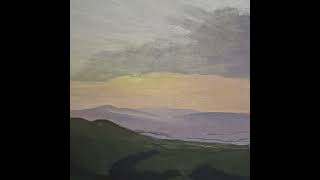
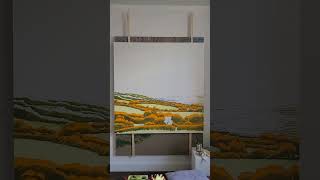
In this studio walkthrough, the artist presents a recently sold oil-on-canvas landscape titled 'Eggardon Hill', measuring 1 m × 40 cm. The painting, previously in a poor frame, was reframed and had its edges painted to maintain the illusion of depth, using the artist’s characteristic tray (box) frames that give a floating effect. The work was created over two sessions spaced about a year apart, a process the artist describes as common: an initial, uncertain start followed by a later, more reckless layer that adds contrast and energy. The palette features violets, pinks, and peaches set against greens, forming melodic purple hills, rough woodland, and a disappearing‑then‑reappearing horizon typical of Eggardon Hill. The sky is rendered with loose, expressive marks. The original mottled layer is visible beneath a more expressive second layer, illustrating the blend and contrast of approaches that give the painting its character. The artist reflects on the lesson of not overworking a piece, allowing it to develop organically, and notes the buyer lives nearby in Bannister, enabling future visits.
Chapters
Okay, this is a little painting, 1 meter by 40 centimeters, oil on canvas. I've just sold, so it's going tomorrow. So I thought I would do a quick video just to remember it and It's been sat in my studio for a couple of years and someone came in and yeah, basically really loved it, and so they have bought it. And it was actually, it was in a bad frame, so I reframed it and I have touched up the edges. With my paintings, I don't like to leave a white edge because it sort of stops the illusion of the landscape, so I tend to paint the edges, and then I have these— they're called trays— but these box frames, so they sort of float in this space. And yeah, I think it looks very nice. And yeah, it's going off to a new home, and Yeah, let's just give it another little walkthrough. So, um, quite a simple painting. I remember actually I worked on this over 2 sessions, and they were about probably about a year between sessions, which quite often happens with my paintings. I'll start it not quite sure what the painting's about, where it's going. And then at some point I'll return to it, perhaps in a slightly reckless mood, and work on another layer, and then it— something happens. And it kind of makes sense. I kind of like how it's quite different to a lot of my work. It's quite original, some of the, uh, the forms in it, some of the marks. The color palette's really interesting as well, these kind of violets, pinks, peaches against the green. And then these, these marks in the actual landscape, that sort of, uh, melodic purple hills, and then the sort of rougher green woodland there. And then this sense you often get with Eggedyn Hill of the sort of disappearing horizon. So you can sort of see the horizon reappears halfway through the painting and then fades off. And then up above The skies are quite loose, quite an interesting range of marks up there, deliberately giving it quite an expressive feeling. And then these mottled bits, these are actually the original layer And then the more expressive parts are the second layer. So you can see how the energy of these two approaches blend with each other, or in fact they sort of contrast with each other really. And perhaps that's what gives the painting its, its character. It's definitely a lesson in not overworking a painting, really allowing a painting to be what it wants to be. So yeah, so luckily it's quite nearby, it's in Bannister. So I'm sure I'll be able to go and have a look at it again in the future. Anyway, there we are. Thanks.