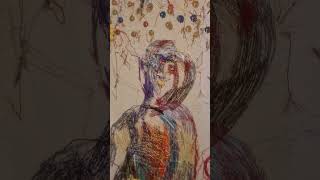
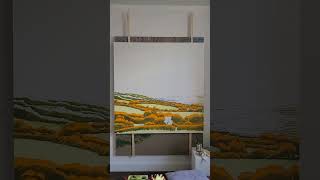
An artist describes his drip figures, oil paintings that layer abstract dripping over figurative forms. After five years of pure abstraction inspired by Gerhard Richter, he moved to Dorset and merged the two approaches, finding that the process gave his figures vulnerability and presence. He shows works measuring 100 by 40 centimeters and has larger versions in progress.
Chapters
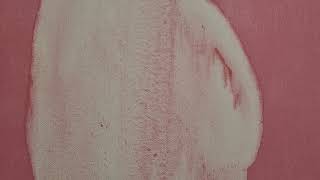
Oh yeah, so I put up my— some of my drip figures in my gallery yesterday. You can see the size of them there. They're 100 by 40 centimeters, oil on canvas. And I did actually record another video, but it was on Instagram, and of course immediately they they didn't really promote it because, shock horror, it's nudes, even though they're very abstracted. But yeah, so these, these were basically some of the first. This one here, I think these two were the very first drip figures I made. And this technique basically comes from my abstract process. So they are basically made with a similar technique to how I used to make abstract paintings. When I went to London originally, I was a figurative painter, and I just wasn't really very happy with the sort of lack of originality, I guess, of my paintings. And so I then saw an exhibition by Gerhard Richter, which completely blew my mind, and I became entirely abstract for 5 years in London. And I used to make paintings by dripping the paint and layering it up, and I really learned a lot about paint and how to use paint and how to move paint. And it was only actually when I moved to Dorset and I couldn't paint abstract anymore, I found that there was a sort of edge in London, an edginess that had informed my abstract work. And there was no edge in Dorset, everything was just bucolic. And so my abstract paintings just looked decorative, and I didn't want them to be decorative. I want, I wanted them to have a sense of meaning and character, I guess. But then I suddenly realized that I could actually use my abstract technique on the figure, and it was a real revelation. So I also make larger versions of these, but these are kind of fun because these are, you know, they're kind of quite a manageable size. And so they're relatively easy. I also make life-size ones, but of course then you've got to prepare a 6-foot canvas and there's a lot more preparation involved. So these are, yeah, they're, they're really good fun to make, and it's a very precarious process. You know, these are— because the process is an abstract process, so at all times the painting surface is changing, moving, and vulnerable. But that's the whole point as well. It's, you know, the abstract process kind of echoes the human condition, you could say. And it's interesting with these paintings as well, just because of the different response I get to them. I mean, art is so subjective, you know. Some people love these, find them, you know, very beautiful. Other people, you know, think they're a bit scary, or unnerving. So yeah, it's fascinating. And because there is an element of loss of control, things happen that I might not want to happen, but which I allow to happen. You know, it's basically about allowing the process to happen. Because I was a process painter, so you're allowing a lot of accidents, and it's like controlled accident, I guess, is how you could describe it. And yeah, I mean, I really love them. I think they achieve what I was frustrated that my landscape— sorry, my figures paintings weren't achieving. For me, they achieve a sense of presence, a sense of human vulnerability and beauty. So yeah, it's actually just really nice to put them up together. I do have more. I'll be putting on another exhibition of the more, the multicolour ones I've been doing, and also some of the larger life-size ones. But yeah, that's a nice little show that I've just organised.