Interview with Bristol artist Ruth Piper
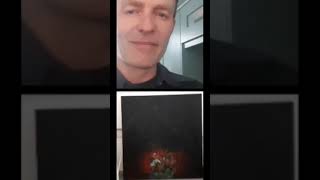
Ruth Piper, a Bristol painter, shows her studio and discusses works like The Hut and Waterfall, which hide skulls and respond to landscapes from her travels. She builds depth with large voids and Payne's Grey, layering handmade acrylics to balance empty space with detail.
Chapters
Join the actual chat, invite again. Right, here we go.
Let's see, will this work? Yes, yes, here I am. Actually, I found— well, I thought I— I know I've got a record button. Well, it's gone now though. Oh well, okay.
Great, well, no, brilliant, Ruth. Hello.
Hello.
It's working, we're on Bripport Open Studios. Obviously you're showing with Bripport Contemporary, but this is what is working at the moment, so this is fine. And, okay, so I'll just quickly just sort of say what's going on. So you've got a viewing room at, uh, Bridport Contemporary at the moment, which is on Artsy. Uh, it's like an online exhibition, and we're really excited about that. We've got 9 of your paintings on there, and it's a virtual show. So the actual paintings are in your studio, aren't they? Most of them?
They are, most of them, yes.
And how many have you got on display in your studio?
At the moment you can see 1, 2, 3, 4, 5 at the moment, but I can get others out because they're stacked up.
Okay, brilliant. Well, should we just start with what is on show? And so this is BV Studios in Bristol where you're based.
Yes.
And I've been to some of your open events, really lovely place, isn't it? So yeah.
Yeah, we hope to have another one this year now. We're gonna have one, I think, in April next year. Yes.
Brilliant.
Another open studio, which is great.
Okay, well, do you want to turn the camera around and give us a little tour? That'd be great.
I can, let's just try that.
Okay.
Yep, okay, so this is what it's like when I walk in, in the morning. A few early paintings on card here. There's my books and stuff. And some old, oh well, a few years ago, 3D pieces.
Right.
And then this one, it looks a bit dark to me. Yeah. It's very difficult, they're always so difficult to see. I'm wondering actually if I turn the lights off, might be better.
Yeah, try that.
Yeah, because they're fluorescent, so— Is that any better?
Not much, but, um, it's quite dark. They're dark paintings. Yeah, yeah, yeah.
Playing on a dark painting.
And how big's that one?
That one's roughly 3 foot by 3 foot. And that's called, that's called The Hut.
And there is a little hut in there, isn't there, somewhere?
There is, there's a little hut. See if we can— there it is. Yeah. 'With a Light in the Window.' It's actually a little derelict hut from a photograph that I took while I was doing a residency in Cape Cornwall in 2017. And then there's— oh, here's some, some of those that— yeah, you're not showing any of these, but those are the takeaway boxes that I've been making. And then I've got this one that's called Standoff. Actually, the further back I get, the darker it gets.
Why is that one called Standoff?
Well, because it's got— somebody said to me after I done it, that actually the foliage looked threatening.
Right.
It's scary foliage. And I sort of looked and I thought, yes, actually it is. And there's, there's kind of, there's foliage either side, there's some down at the bottom, and it's like, it's like it's a bit of a standoff between the foliage. Yes, the plants. The Triffids, whatever they're called.
I had a different impression, Ruth. I felt it was actually quite comforting that you could, you could crawl in there and like sleep, you know, or hide. So I had a completely different impression to it, but yeah.
Yeah, I like that. I like that too. Yeah. Because I think it is a bit of a hideaway.
Yeah.
And yeah, and it's a bit of a shelter and it's almost like a nest as well. And you could say that those plants are guarding the entrance.
Yeah.
So once you get in there, you, you're safe.
That's right.
Yeah, they don't want to stay out in the open for too long. Yeah, um, and then this one— there's this one which is, um, this one's stasis. It takes a— can't get it to get far enough away from that one, so just push it here. Here. Yeah, put it there. So let's see if I can get away from it. Oh yeah, that's quite a good place for it actually.
Oh, lovely.
Yeah, that's the, um, just like somehow it's like it's just a bit of debris floating in water, and I find that one quite quite calm actually and serene.
I do, I do, yeah.
Yeah, and that one, that one actually I painted that quite fast and I sort of managed to stop. I suddenly thought, oh, I think that's done. Yeah, so that was, that was quite a fast one, yeah. And then there's this one, actually I'll put them there because that shows that They show well there, don't they? So there's another one. Oh, this is my— this is a bit sad, this one, I think. I don't know. I feel it's a bit sad. It's like, it's lonely in the woods, being lonely. Oh, sorry about the background noise. That's somebody's, that's Stuart Geddes. Oh yeah. He's got, he's just turned his tap on.
We can't hear it, don't worry.
Good.
So this one is called Waterfall or something, is that right?
Yes, it's called the Waterfall.
Good. And to me it also looks— shall I say?
Yeah.
To me it also looks a bit like a bonfire, but like a water bonfire, like—
Yeah, yeah, yeah, um, but it's also got, if you look closely at it, it's got sort of, um, I don't know, it's got kind of, I think it's got skulls in it, in the water.
Yeah, yeah.
And yeah, and it kind of looks a bit— they've got moss on them and yeah, and there's this figure, isn't there, that looks a bit like— well, it could look— looks a bit like a horse or a— I don't know.
I really like it, I really like it. You haven't painted much water, have you? I know of, or have you?
No, but it does appear in sometimes, and oh yes, well, there is, there's actually, you haven't, you haven't got that one, it's somewhere, it's actually hanging somewhere else at the moment.
Right.
There's some, there's some watery bits, um, and then actually this one I'm working on at the moment is Oh, that's looking a bit watery to me. It looks a bit like— I don't know why it looks so horrible on that wall. Look, yeah, I started this one the other day. Um, this one, yeah, that looks very watery to me at the moment.
Yeah, lovely.
Water. I don't know if it's, if it'll stay like that, but we'll see.
Can you go in a bit closer?
Yeah, can do. Trouble is it gets darker the closer I get in, but yeah, there's a sort of a fish-like thing there.
It's breaking up a bit, which is annoying because it's, it looks really nice.
That's a shame. Yeah. But it's early days for this one.
All right, so, and I mean, how long is a piece of string? But I imagine some of these you must work on for quite some time, yeah?
Yeah, some of them take a while, they can take several weeks, several weeks, or I don't often leave them, I keep working on them until they come right. Yeah. But sometimes I might leave it and go and work on something else.
Yeah.
And then come back to it, so turn it to the wall and don't look at it for a while.
Yeah. So tell us about this one.
This is— this was— I painted this when the fires were burning in Australia.
Right.
Because my sister lives in Australia, she lives in Queensland. And I mean, they're probably— there's a lot of water around there, so they're more vulnerable to flooding. But this really caught my imagination, and it was just another thing that is another sort of thing that's really bad thing that's happening in the world, I guess, you know, violence and floods. And I was thinking a lot about that. At the time. And so that's like a sort of a fire going on. And then here's The Road, which was, was one of the ones I painted quite early on.
Oh yeah.
And a friend of mine just written to me and said that he really likes this one. He said, did you— were you inspired by the book called The Road? And then of course they made a film, it's called McCarthy.
Yeah, yeah.
And yes, that was in my head. Only after, only after halfway through painting it though, it started to look like that, and so then I just sort of went with that.
I like, yeah, I like this idea you have in some of your paintings of less is more, you know, you have quite big empty spaces. Is that, is that something that you —deliberately do? Did you stumble upon it? Is it— yeah, do you have any thoughts about that?
Well, I think that I— I think it takes— it's taken me a while to allow that to happen, if you like, because I think it can be quite— it can be quite scary, like leaving great big spaces where there's nothing. Yeah. But actually what you can— there are, there is stuff there, but it's not necessarily apparent or visible unless you look at them for a, you know, longer. So there is always sort of ghosting going on because I've always got something that I've painted over, or I don't know, there's a wash going over it. And then it appears. But also I think that those sort of, those empty spaces can also be quite friendly, if you like, and I think that's because of the Payne's Grey that I use, which is not really black, and it's much more, it's more towards blue actually, but it's a lovely soft black. And some of the other blacks can be very— they can shut you out, you know, they block you, whereas I think Payne's Grey kind of invites you in almost. I completely agree, Ruth.
I use Payne's Grey a lot and I find it's really nice for mixing greens as well.
Yeah, it is. Because you can use the paint spray to sort of, I don't know, you get a more— you can tone down the green, can't you? Yeah. If it's too vivid, you can desaturate it. Really?
Yeah, almost.
Yeah, desaturate it. So that's quite useful. Yeah. Yeah. And the spaces, I don't know, it has to be There's some little ones here. Oh yeah. Yeah, there's a little one there that you probably recognize.
Are they still on canvas or are they on card or what are they on?
This is watercolour paper. Oh right. This is still acrylic. Right. Yeah, I like to use— I've often, I mean, I started painting with watercolour when I first started to paint many, many years ago, and I've always loved that kind of layering, washing. So I started to do that with the acrylic paint, you know, use it very thinly, almost staining, like blue, but then sometimes the paint gets thicker on you know, on a top layer. Yes.
Can we, can you zoom in a bit on them?
Yep. Yeah, lovely. And so it's actually quite difficult to get close. Yeah, that's okay. They get really dark.
So your materials, Ruth, is it mainly acrylic? Do you use watercolour, oil?
Well, I stopped using oil some years ago because I like to do layering, yeah, and it takes— especially when it's winter, it gets too cold and it takes too long to dry, yeah. And also there was the whole thing about, you know, washing your brushes in turpentine. Yeah, yeah. You know, it's, it's not very nice stuff, and I used to have to thin it. I used turpentine to thin it because I didn't want to shine. Yeah. So, um, that was tricky as well, and, um, it was just easier to, um, go to acrylic, really. Because you can use it very thinly like watercolour. I mean, I know you can do that with oil as well. Yeah. But I don't know, it somehow, it felt as if it was more my medium. And I do sometimes, I still do watercolours in my sketchbook because watercolour lends itself to smaller pieces. Yeah. But I don't know, I always end up using the acrylic. I'm using actually What I use is Wallace Seymour paints, which are handmade. I buy them in Bristol Fine Art, and they're all handmade, and they've got lots of pigment in. Yeah, yeah. And they're very translucent, so I use a mixture of those and and the thicker acrylics which are heavy body acrylics. I use some of— I use that as well sometimes, and I just mix them up as I go along. Yeah. I don't know, I just— everything gets mixed. Yeah, yeah. I'm not very keen with my paints actually. I tend to stick my brush in where I the next colour, you know.
Can you zoom up on one of the labels of the handmade acrylics? Aha, Wallace Seymour, oh brilliant.
Wallace Seymour, yeah, it's lovely paint actually, I love it and it's very powerful. And once— and some of the colours, when you put them on the canvas, you can never get rid of it. It's like, you know, it comes through, it comes through all the layers, which is what I like, especially pink or red. It really comes through the next layer, right? So yeah, they're very strong. Yeah, interesting. I really— I— yeah.
So what are you looking for now?
I'm just looking, I'm just trying to see if I've got— no, that's all I've got here at the moment. There's a smaller new piece here which is a There's a little bird on it. Oh yeah. Yeah, it's like a little bird on a rock over a— actually, that's watery— over a river, I think. That's quite small, that's sort of 51 by 41.
So you, you live in Bristol, but you say you go on sort of walks Yeah, around the lane. I'm very, yeah, I'm very local.
I tend to walk locally and I tend to look at, you know, just the hedgerows and anything that catches my eye. And especially at the moment, I really like all the dead leaves and the tree and the, all the leaves that are folding up on the trees and falling off, you know. There's, you know, in the, in the common, on the common, there's some beautiful horse chestnut trees which are now, all the leaves have, not all the leaves have fallen off, so they're all sort of crinkled and curled up and brown, but they're still on the tree. And I always think that, you know, when people, when traditionally when, if you're doing a landscape or painting a tree, people paint them without leaves or with leaves in the summer. There's you don't often see paintings of the transitional phase. Yeah, yeah. I mean, you do, you know, it's lovely when the new shoots are coming through, but I also like this time when everything's dying back. I agree. And you get really, you get really interesting shapes, don't you? And, um, curling leaves and colours.
And the colours, yeah, just amazing at the moment.
Yeah, so yeah, that yellow yellow with the leaves have got brown spots on. Yeah, no, it's really nice at the moment.
Yeah, great. So, um, are there a couple more you can pull out from, um, anywhere?
No, because I've got— I've actually got some at home, right? Um, And then there's some at the Bishop's Eye in Wells, there's 8 over there.
So the Bishop's Eye, so I don't know where that is, is it easy to find? It's in Wells.
Right. It's in Wells in Somerset. Right. It's quite close to Glastonbury and Yeah, it's not very far from Bristol, about 45-minute drive, I suppose. And it's in the old— it's part of the old abbey. And yeah, I've got— I think I've got 8 pieces over there. Oh wow, okay. Yeah, it's got— I think actually you've got one, the big one, the very big one that I did. Right. I think you've got one of those, yeah. Yeah, yeah. And that's over there at the moment. But that's coming down at the end of November.
Right, okay, great. Well, of course, people can see all of these pieces on our Artsy viewing room, so I'll just explain. So yeah, it's our Bridport Contemporary Gallery IG account, so just @bridportcontemporary, and then if you click on the link that will take you to our Artsy page. And yeah, you can, you can have a look at all these paintings and zoom into them.
And yeah, yeah, it's actually, I mean, it looks great. Somebody said to me the other day that they thought they were in, they were, it was in an actual exhibition, like an actual room, because I think it looks very authentic, doesn't it? You see the floorboards and the skirting boards and Yeah, so I think it's really clever and I think, yeah, they look great.
I think so, yeah, we're really enjoying it. Yeah, yeah, so, yeah, great, well, lovely, I mean, that's really lovely to see around your studio, Ruth, finally, and well done.
Yeah, it's a bit cold, it's a bit cold today. Is it? Yeah, actually it's probably about 14 degrees, which is okay. You've got your thermals on? I've got lots of clothes on, yeah. But I don't put my, I don't put my padded overalls on until it gets to, until it gets to 8 degrees, so I hold off so I've got something in reserve.
Yeah, brilliant. Well, okay, well, lovely. Well, I'll let you get back to work, and hopefully, hopefully I can record this video and then we can repost it on Ripley's Contemporary and stuff, and then— so, right, I did. Fingers crossed. And lovely.
Okay, good luck with the Good luck with the techy stuff. Thanks, Ruth. Yeah, nice to see you. Thanks. See you soon. Bye-bye. Bye.