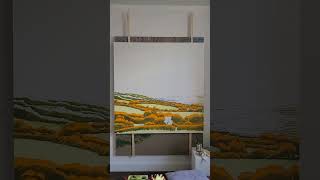
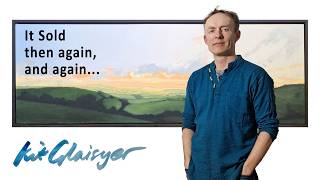
Kit Glaisyer paints landscapes by combining field research with studio collage. He walks sites like Eggedon Hill repeatedly, photographs them, then edits and combines images in the studio, changing skies and removing elements until the composition conveys the feeling he wants. Multiple glazes build the final work slowly.
Chapters
I think my landscape painting really started when I was a child growing up in North Dorset, going out watercolour painting with my father. And my mother used to do figurative watercolours, and so my technique is very much a combination of my father's more rational approach, my mother's more romantic approach. I like to interpret I always analyze the landscape before I paint it. For instance, Eggedon Hill, which is a project I'm about to start, and I'll go out there regularly whenever the light is interesting just to really explore the area. So I take a lot of photographs, I do a lot of walking, I do some sketching, and sort of waiting for those special moments really, just where the light will come through All my paintings have been particular moments. My young tree on Lewiston Hill, that was based on the setting sun in spring which sets behind this tree, and whenever the light was great, I'd just go up there and I'd wait for these moments and I'd photograph them and do plein air paintings. I started as a plein air painter, and I think it's absolutely crucial that landscape painters, figurative painters, actually do have that experience of working from life, but I really want to do a painting that isn't that rushed. Often after I've taken many, many photographs, I'll collage elements that I like, I'll remove elements, I'll lighten them, darken, I might completely change the sky of a painting, I might combine several different days or even weeks, whatever makes a composition that has a feeling that I want it to have. One of the reasons why my paintings take quite a long time to make is they're all built up of glazes of paint. Very often with my paintings, when I'm trying to get an idea for how the painting's going to be, it will be quite a complicated scene, and gradually I'll remove things that aren't essential, or which even actually do disrupt the painting. I actually held off painting the landscape for a while because I sort of knew the level I'd want to take it to, and it wasn't really viable for me to sort of you know, spend months on a single painting, which is what I do now. I went to London in the '90s and I became an abstract painter there. I had a few years of exploring different ideas, and I was coming back from London, and just as I was coming over the Bride Valley, there was this beautiful mist. I realized in order to actually capture that feeling, I'd have to spend quite a lot of time on these paintings. I actually sold one of these pieces, I remember, at an exhibition, and the buyer then commissioned the first of my cinematic landscape paintings, and I've never looked back, as they say. The cinematic is to do with my love of cinema, really. It's a fascinating medium because it's so involving for the viewer, and that is exactly what I want to do with my paintings. We've all had moments where we've stood somewhere and we've seen a view that has just moved us so deeply, and it might only go on for a minute or two or shorter, and it's those moments that I'm trying to paint.