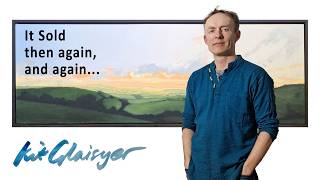
Kit Glaisyer - Studio & Gallery Tour
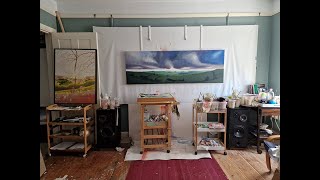
Artist Kit Glaisyer builds paintings over eight months using thin oil glazes, starting with plein-air sketches and photography in West Dorset, then compositing references in Photoshop before layering the work in his studio. He uses Michael Harding oils and listens to the painting as it evolves, letting client conversations shape the mood and atmosphere.
Chapters
This is my studio in Bridport, and I've got lots of works on the go in here. The way I paint is building up glazes of oil paint, so the paintings take a long time to make, and every layer you have to let it dry. And then you admire it or criticize it over the next few days and weeks, and then you come back. So I'm constantly moving between paintings, and yeah, it's all about the mood really. It's all about the atmosphere I want to convey. Because I'm in West Dorset, there's some really beautiful parts of the landscape that I can go out to quite quickly, and depending on the weather, I'll go out there and I'll sketch and I'll take photographs and do some plein air painting if the weather's okay. Then I come back to the studio and I collage stuff, and I use Photoshop as well. I sort of bring elements from photographs and sketches together. I get an idea of the sort of the feeling of the painting that I want. And then once I've got that, then I'll start. It could be a small piece or a great big piece, and often I'll start with a sketch, and then I'll gradually build up layers of paint and Yeah, just let the painting evolve, really listen to the painting, see where the painting wants to go. Sometimes I sort of assert, reassert what I want the painting to do, particularly with a commission where you've discussed ideas with the buyer. And that often gives me the opportunity to make some really highly accomplished work that goes to a level of detail that I might not normally go to, which is quite fun. The thing with painting is it's nice to really let the paint provide a lot of the narrative, just the way the paint's put on. It doesn't— it means you don't have to be too elaborate or photo-real. You can really just get into the subtleties of pigment on canvas, luminosity. I started with watercolor painting, and my oil painting technique is very much still based on that. So you, you start with a a white ground and then you have thin glazes of paint so the light shines through the ground. Of course, if it's a darker painting, you want a dark ground so that the light doesn't shine through. And then you've got different surfaces, so you've got a matte or a satin or a gloss finish depending on, again, the mood that you want. I try to keep my materials quite simple at the moment. It just tends to be really good quality oil paint, often Michael Harding. I really like And just, uh, I don't tend to use any mediums at the moment. It's more just turps or Zest-It and perhaps linseed oil if I want that particular quality. Linseed oil tends to give it a viscosity which is quite nice, but particularly with a painting that's taken you 8 months to make You can't put the linseed oil on too early because with subsequent layers it can crack. So if I do use linseed oil, it tends to be later on. I really don't rush my paintings. They all take as long as they need to take, and I tend to live with them, just come back and look at them and listen to them and see what needs to be done. And I also like to bring people into the studio. People often love to see the work in progress. They sometimes buy it when it's in progress, which I like as well, because it's— that's the thing with painting again, it's got that immediacy to it. People often like to see the hand of the artist and the expressiveness of the mark. But I also do like, like I said, to have the option to make more highly realized works as well, where, you know, you might really get into the subtleties of light and atmospherics that do require a lot of preparation and building up of layers. It's always a delight to show people my gallery and my studio. And yeah, people sometimes just buy off the wall, off the easel, or we discuss commissions, which is great fun. Sometimes the commissions are around where they live or where they grew up. I like commissions because they often take me to places I'd never normally go. This is actually a follow-up painting to a commission I did near Whitchurch, Clennacorum. It's just a view next to the buyer's house, somewhere I never would have gone if I hadn't had this commission. So I really enjoy that. In this case, the original painting, I remember it was, it was a really misty autumn August. And so I'd go and visit and I'd sketch and I'd look for good compositional places to work from, but it was just dull, dull weather. And then I remember in— maybe September, yeah, I think— and then in early October there was a rainstorm and it cleared the air. And I was in Bridport, so I drove over to Whitchurch immediately and I was running around in the rain, taking photographs, trying to capture some of the colours. And then those photographs, then I collage them and come up with ideas and discuss them with the client. And then you work out the mood that they want and what they like about my other work. So I get an idea of something where we're both really inspired by the subject matter. That's really it. I couldn't make a painting that I wasn't inspired by. And then once we've worked out what we both like, then I get started. I normally, I normally ask for about 8 months, just because I know that's the timescale I sort of need to be happy with the painting, to sit with it and to know that it accomplishes something unique and has the right feeling to it. It just takes me that long. Some artists, it's really quick. With me, yeah, for a finished painting, it needs to be about 8 months. Of course, I do plein air paintings as well, which are also great fun. But they're very much, yeah, they're a few hours, a few very intense hours of sitting somewhere and just trying to respond to that moment. I have my own kind of unique approach to painting which I try to honour, and I'm really pleased with this body of work I've now created. I've got a new book coming out as well at the moment, which is very exciting. Which is a collection of my commissions and personal paintings from the last 15 years. So that's a— yeah, it's a good sort of portfolio of my recent work and also a kind of, I guess, a chapter end, so that I'm looking to the next chapter. At the moment, I've been really inspired by views from Egerton Hill, which is in West Dorset. And that just keeps amazing me, that view. I go up there most days throughout different seasons, different times of day. It's just, it's stunning. Sometimes it's really gentle and quiet, and other times it's dramatic and you have storms. You can see the storms moving in from the west. And so that's what's got me excited at the moment. And then in time there'll be something else. Perhaps a commission will suggest another location, or I'll discover it, or I'll find somewhere else in the UK that really excites me. It's really all about following that passion and that interest in just the beauty of atmospherics, really, the the beauty of this country, of the weather we have, the light we have. I think particularly down in Bridport, we're by the sea, so the sea light reflection, I don't know, it creates something particular that I can really relate to. I grew up in Dorset as well, so these are very much combination of my childhood and, and my adulthood. That sense as a child of just being surrounded by nature and not really needing any more entertainment than that. I grew up without a television, so nature was my entertainment, and I really held on to that. And when I moved back to Bridport a few years ago, I really appreciated that I had something special to bring because of my lifelong experience of living in the countryside. So I really hope you enjoy my work. Visit my website. You know, look at my book, watch films I've done, visit my exhibitions, and of course come and visit my studio, and we can talk about something that you might like. And like I say, I always love those conversations, so please get in touch. Thank you.