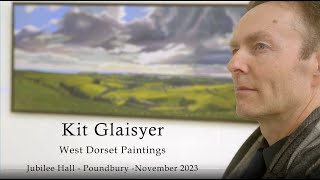
In this artist talk, Kit Glaisyer explains the purpose of his current exhibition, emphasizing the need for a large, dedicated space to display his monumental West Dorset landscape paintings, some up to ten feet wide. He reflects on humanity’s relationship with nature, describing how everyday natural phenomena—sunrise, fresh air, colour—are often taken for granted, and how his work aims to capture and share those fleeting moments. Glaisyer highlights the unique atmospheric qualities of West Dorset, especially the sea‑derived light and subtle weather effects, and how these differentiate the region from other parts of the country. He discusses several series, notably the Eggedon series, which began as a quick project but expanded over years, with the first painting taking two years to complete; later works in the series become looser, improvisational extensions of the original. He stresses that all seasons offer distinct, often understated moments worth painting, citing a nondescript, cloudy day on Colmers Hill as a challenging yet beautiful subject. Specific works such as “Light in the Valley” and large‑scale Egerton Hill sunsets illustrate his compositional strategy of dark foregrounds opening to luminous, dramatic skies. Glaisyer explains his oil‑painting technique—building glazes over months, layering, and allowing visible brushwork and drips—to achieve subtle colour shifts and texture. He argues that the sheer size of his canvases (8‑10 ft) immerses viewers, making them feel present within the landscape. Throughout, he conveys a sense of purpose and enthusiasm for creating paintings that evoke awe, preserve the fleeting beauty of nature, and invite viewers to experience moments they might otherwise miss.
Chapters
I think this exhibition is, for me, it's just a great opportunity to show works in a lovely space, really. And particularly when you've got a 10-foot painting, you You obviously need a pretty large space to show it with space around and really to let every painting shine in its own way. I feel that our relationship with nature, with the landscape, with our environment is obviously crucial. Nature provides everything that we need to survive. But also just the experience that we have on a daily basis. You know, the sun rises and the air is fresh and the colours are beautiful, and these things are things that people can take for granted, and we should never take them for granted. We're surrounded by such splendour and awe, and if I go and stand on a where anyone goes and stands on a hill and watches a beautiful moment, they might be the only person in the world experiencing that. But at least as an artist, I can then create that so that other people can experience it. And I feel very driven to do that. It feels like my purpose. The way I feel about it is that You can go anywhere in the country and you're going to get, like I say, superficial differences. And I think sometimes it's nice to be in one place and to really get down to the subtlety of what does make somewhere unique, particularly of West Dorset. I think because of the sea and the reflected light and the atmospherics, because of the sea, it creates something very particular. I remember particularly as a child growing up, we didn't have a TV or a computer in the house, so it was just sat around the fire with the howling winds outside. And for me, a stormy day is actually far more interesting to paint than a nice sunny day. So I'm delighted. And just also by the range of Subject matter that I'm given throughout the seasons, it's great. Nature just gives me everything that I need. My paintings of Eggedon in particular, I just thought that would be a relatively quick series of works, but as I got into it, it just grew and grew and grew. These two are midsummer summer's day about 5 years ago, and I've done a whole series just based on this one day. And for some reason, particular days have seemed to have particular resonance for a painting. The first in this series took me 2 years to complete, so I, I have to really work out what the the palettes and building up all the layers and just getting the right configuration. And then once I've achieved that, then I can riff on it. So both of these paintings are like improvisations based on something that I've already accomplished. So they're a lot looser than the original. The original got quite tightly painted because I was trying to achieve something. And now that I've achieved it, then I can paint it in a looser, more impressionistic sort of manner. I'm not really attracted to a particular season. I think they all have something totally unique to them. And one of the challenges of making paintings the way I do is I want to often capture very nondescript moments. But they're just as special as a spectacular moment. And so the seasons, you know, when it's winter, you get some wonderful effects. I think it's interesting, I've got a painting in this show and it's of Colmers Hill, and it's a very kind of— I always say to people, it's quite a nondescript day. It's one of those days where it's got a lot of cloud and It's almost a monochrome day, and that's very challenging often to paint because it's not boring at all. And somehow you have to show the interest in that moment because there is such beauty in those wonderfully subtle moments. Now this one here is Light in the Valley, and it shows one of my favorite themes in a painting, which is to have quite a dark foreground looking into light beyond, and obviously with something interesting happening in the sky. I don't paint many paintings where there's just a blue sky with not many clouds. It's not very interesting as a painting. But obviously it's nice to still have elements of blue within it. This also has some greys in it because obviously there are a lot of greys in the sky, but then they're balanced with the pinks and the rather lovely kind of lime greens in the landscape. The views from Egerton Hill are very important to me. What I love about Egerton is there's a lot of variety that you get there, and you get just some stunning effects like these two sunsets here. And really, one of the things I'm trying to do with these paintings is to try to push the envelope, really, to almost make them slightly overwhelming, because that is the effect that you have When you're watching a moment like this, it is— it's stunning. Oil paint obviously is different to reality, but it has qualities that can evoke or echo reality, if you like. So you can use particularly vibrant hues to create a strong effect in the viewer. So this is a painting that I Yeah, it's a very popular painting. It's quite dramatic. It's got a lot of drama, dark and light in it. I like a painting when there's a lot of different things happening. So here we've got the light in the valley and we've got the rainstorms in the distance and we've got the brooding skies and the light coming out and just that sense of experiencing something quite awe-inspiring really. That's also why it's good to paint on an 8-foot canvas because it then really surrounds the viewer and yeah, give them a sense of, you know, I want them to feel that they're actually there possible, standing there on their own. That's an 8-foot one, and now we've got a 10-foot Eggedon again. I'm going to keep making them larger and larger because the landscape just deserves this sort of scale. In this case, I'm always looking for interesting moments and this was one in particular where there was this very dramatic moment with the sun emerging and the light rays streaming across the landscape. And so it can be quite an expressive painting, and it's fun at this size as well to paint in quite a loose manner. From far away, it might look quite realistic, but then as you get closer, You can really see the brushwork and the quite a messy surface, if you like, and all the drips and the scuffs of the paintbrush, which I really enjoy. It's always a balance between the flourish of the brush mark as well as utilizing the the sort of material qualities of oil paint that time can achieve. So with oil paint, you can build up glazes of color over, in my case, several months often, and just get the absolute subtlety that you want. And that's what I— so every commission I do, for instance, I want it to be the very best painting, the very best capturing of that moment possible, and that's why I feel so excited about doing this work.