Artist Linzi Light makes paintings and collages about hands, tools, and labor. She uses aged surfaces and sanded textures to explore the dignity of work and critique how workers are marginalized in capitalist society. Her upcoming exhibitions on Creamer Street may feature projected liquid-light imagery.
Chapters
No, I don't want to go home.
Okay, okay, we're on.
Oh, are we?
Yeah, we're on. Let's do it. So, come on, what's going on here? Come on, tell us quickly.
Very quickly?
Very quickly, yeah.
What is going on here? You just got me on the chart. Have you actually started then?
Yes.
Oh, for God's sake. This is my work, isn't it? It's about hands doing things, and I have no idea. Kit, I can't do this film.
Okay. That was a good start. I mean, yeah.
Actually, that was a start because I wasn't really caring. I could have said anything.
That's right. Artist interviews are like this. You know, the artist is going, "Don't film me now, I'm not interested." But for them, it's the best bits.
Don't tell me you're still filming then now, are you?
Yeah, of course.
Oh, damn it. Okay, well, I better be quick because we've only got 10 minutes, haven't we?
Yeah, exactly.
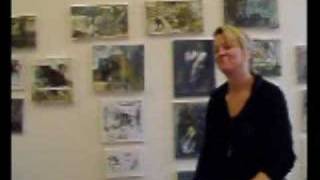
Yeah, yeah, yeah, this is the new stuff that I'm doing. That's right. It's long hands meeting making and doing and basically sanding back the surface. Sometimes there's stuff that they're referential about painting. They're like, you get paintbrushes painting the surface, so it's talking about the paint and the surface itself. But really beyond that, the subject matter is actually about the worker fundamentally, and about how the worker has really been, you know, maligned. And, uh, what's the word? There isn't— there isn't— I can't—
I can't But you've done these large paintings as well, haven't you? This is, this is your latest work. It's quite just smaller, but you've been doing these larger ones as well.
Yes, various hands, people making things and doing people making things about how industry is no longer and how people don't make things any longer.
Yeah.
And so it's looking at that, and that's why they sort of age it. It's something of the old world in a sense. Surface is aged. But yeah, I'm really interested in tools and using tools and making things, and that's what I do. That's what I do.
Yeah, great.
And I'm just using collage and things at the moment, which is good fun, and just experimenting with the surface a bit more. But, um, what else can I tell you? Hands, fundamentally hands. Cut the body down into parts now, and now we're just left with the hands. And the hands do everything, everything for us, you know. Hands are important.
But you're enjoying this new work, aren't you? You're getting your teeth in.
I am, yeah, yeah, it's good. It's going pretty well so far. Leading the way. And there's the cup of tea, you see. Every great British builder, worker will relate to the cup of tea. There's the tea break right there. Which actually is very much part of a working day for most tradespeople in this country. I should have actually the sun, I should have that in there next to the cup of tea as well.
It was Picasso, wasn't it, who used to dress in like boiler suits and overalls, and him and Braque were the sort of working artists, remember that? So you're sort of on that one, you are with the workers.
Absolutely. Yes. I'm for the workers. I'm anti-capitalism but for the workers because I think in this culture that the worker is completely taken advantage of.
Yeah, yeah.
And I think we've got to rectify that really, bring back some integrity to the workforce and people and give power back to the people. Not let the governments, like I said, take advantage and make the worker pay out the letters to live in this country and to be taxed as heavily as people are. It's completely wrong. And having all industry disappear out of this country is completely wrong as well. I mean, everything's outsourced out and now you can only sit in front of computers. People don't even know how to put up shelves, for instance.
I don't.
No, well, it's not that easy, is it?
They always go wonky, don't they?
They do go wonky if you don't use your level. You've got to be on the level. That's right. You know, but, so yeah, it's just knocking on the door and addressing some of those things. I love DIY. That's why I paint.
That's right, you do.
Yeah, I'm a DIYer myself. I like building and I like using tools and I think tools are amazing. You know, without tools, where would we be?
But also, I like your hands because in some of your paintings, which people can see on the site, it's almost as if each hand is a different being or something. So this idea again of Sometimes they're collaborating and sometimes they're almost fighting with each other.
Working against each other.
So it's like the Jekyll and Hyde as well, and how we work against ourselves.
It's the left and right brain also.
That's right.
We are definitely split. Yeah. And we're lucky enough to have two of them. That's right. They do sometimes work in tandem or alone. These hands are working happily alone. Maybe they'll come together and work in tandem with other hands. Again eventually. But I've got in mind actually some more with your arms which are going to be almost like Ferris wheel arms, just utilizing that imagery and making other objects out of the hands perhaps. That's something I'm thinking about too. Yeah.
Great. Well, let me see. I mean, is there anything else you'd like to say or— There are, aren't there?
Yeah.
Well, we'll be a bit more organized next time.
Okay.
Yeah, I'm just off to the East End actually to check out some shows myself. Oh, good one. Where are you going to? Byner Street, around that way.
There's one on Creamer Street tonight, there's an opening actually. Is there? I can't remember the name, but she uses that photo liquid light. Really? Which could be interesting because that's another means of starting using that and projecting images onto the surface. Cool.