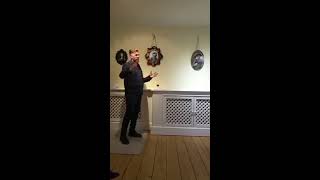
Luke Mitchell describes his residency at the Royal West of England Academy, where he combined daguerreotype techniques with portrait miniatures using large-format cameras and a painted studio backdrop inspired by Monet. He framed the academicians as modern Knights of the Round Table, creating detailed images designed for private homes rather than gallery walls.
Chapters
He used to be president of the Royal Academy in Bristol, and I got to know him a little bit. I was doing a residency there, so I applied to do a residency at the RWA. It was kind of the first thing I attempted to do as an artist, and they were like, yeah, great, we'd love to do it. Oh God, like, what am I going to do? So I ended up devising this thing where I would kind of combine daguerreotypes and portrait miniatures and kind of for the purpose of, right, where do I want these things to end up? Because you can make lots and lots and lots of stuff and it can sit in your living room or it can be in a studio, but I wanted at that point for things to go out and be doing things in the world. I wanted them to be in people's houses, I wanted them to be in places of significance. So the idea I pitched really was like, I'll come in, photograph all your academicians who are played like the Knights of the Round Table basically in the Royal Academies, and then I'll kind of give them a little something for their homes, and there can be an exhibition at the gallery, and it'll kind of all be about them. It was a time where they would very much celebrate their academicians. So I went and did that, and they gave me a big studio, and I'm thinking, how am I going to convince them that I'm kind of legitimate, like I'm worthy of this stuff? I've written it down on paper, but now I've kind of got to do the actual thing. So I looked at the postcards that they sell in the shop, and one was of Monet. So I was like, great, I'll just Google Monet's studio, get a bunch of stuff that looks like that, and put it in there. So when they walk into the room, they go, oh yeah, of course, of course we're supposed to be here. You can't argue with the people you're kind of selling in the shop because you think they're artists. That's kind of what you're holding on to. So I made this big studio, and everyone came in. I made an enormous 5 by 2 meter oil painting, which is the background for this. I have my big film camera. It's the 5x4 and 10x8 cameras that have the— they call it a dark slide. It's a plate that goes into the back and it shoots pictures. It's going to be a 35mm, it's like this big. 5x4 is about this, and then, you know, 10x8, it's like the most common photo frame. That's the size of the film, so when you put that into a scanner and it kind of It's kind of the thing, you can make them as big as you want. You can put it on the side of this building and it'll still look beautifully sharp. So I shot all of those and there would kind of be me and then them and then the oil painting, so I could go in and maybe— so this is just out of focus, this is painting in the background. So I can go in and think, all right, he's got a little bit of purple there, I'll put some purple behind it to make it seem like it's more it's all constructed for him. And I think this is kind of one of the most successful ones that came out of it. I was really, really quite pleased with this one. He just, he's one of the loveliest people I've ever met in my life, but he looks fierce here to the point where, you know, violence, you know, he has that kind of storm in his eyes. You think that you're like, whoa, I don't know. And so slightly moving, I want to talk