Michael Falzoni exhibition in Bath
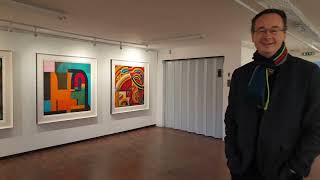
Artist Michael Falzone talks about his exhibition at Black Tor Studio in Bath, where he shows 20-30 works made with unconventional watercolor techniques: mixing his own pigments, layering with sanding and burnishing to create abstract geometric forms. He studied Indian miniature painting for five years and believes high-quality materials convey an energy that changes as viewers spend time with the pieces.
Chapters
Right, so we're at Michael Falzone's exhibition in Bath. Is this Black Tor Studio? That's right. And so we've got a really lovely exhibition here of— I don't know, how many works are there? About 20, 30? You can see there's some smaller ones here and some really lovely series of large ones there. And here's the artist, Michael. Hello, Michael. Good morning.
Nice fresh day today, Mark.
That's right. Yeah, wiping the snow. Is it snow or frost off the bonnet here? So yeah, this is great. So, um, well, first of all, how long have you been at this, um, workshop?
So I've been here for 10 years now.
10 years, right.
And I think next year I'll be having a nice big 10-year celebration.
Great.
After COVID's hopefully passed on a bit.
Absolutely, yeah.
You'll be very welcome to come Look forward to that.
And then this is great because this is like a, uh, yeah, it's like a communal space, isn't it, where you can put on events and exhibitions?
Yeah, so there's about 20 artists with studios here, or we all share communal areas. Yeah, we have areas for printmaking and framing, and then this is a nice gallery space. Yeah, so yeah, very happy to be here and lovely to be in central Bath.
That's right, yeah, we're just off, um, uh, what's that square? Kingsmead Square?
Queen Square.
Queen Square, yeah. Oh, that's right, Queen Square. Yeah, so, so yeah, it's a bit of a rabbit warren. So, but, um, yeah, if you're in Bath, then, um, you can hit Michael up on, uh, what is it, @michaelfalzone on Instagram.
Michael Falzone Art. Yes, anytime you want to pop by, I can be here to show you the work.
Yeah, brilliant. So yeah, so these obviously really interesting kind of geometric abstractions, and yeah, it'd be interesting just to hear a little bit about your background.
So these are watercolor on paper. Right. Obviously not a very traditional way of using watercolor, and I do tend to mix my own paints using pigments and binders. And I use a method of layering up with sanding and burnishing and washing in between layers because I don't really have a fixed idea when I start the paintings what I want them to look like.
Improvisations, are they?
Yeah, so it's very intuitive. I'd probably start with a grid or a basic algorithmic system of colors, and then I go intuitive on top and just try and puzzle out the shapes and build up the image, hopefully to a point where I feel it locks into place and it's working to hold its own space.
Yeah, interesting. So, um, just on your background quickly, are you— you were born around here, were you? Or, um, so I'm from Bournemouth, on the south coast of England originally.
Um, I went to school down in Dorset and did my foundation down in Bournemouth.
Yeah.
And then I came up to Bath to study at the Bath College, which is now Bath Spa University. I took my degree in fine art painting. With psychoanalysis as my subsection.
Oh, interesting.
Yeah, and then after graduation I went over to India to study Indian miniature painting, and I stayed over there for about 4 and a half, 5 years.
Right.
And really enjoyed having a teacher who actually sat with me every day and taught me technique, and it was a very meditative time. I was into meditation and painting, and we sat all day doing these really miniature, tiny, tiny detailed watercolor paintings. So I think I did bring a lot of that back with me. Yeah, even though I was interested in similar type of work when I was at college here before, I think a lot of the watercolor techniques and the idea of saturating the surface with color Every detail matters in the relationship between the forms and the shapes and colors. I think it was really influenced by a lot of the Indian miniatures. Yeah. Um, although I love the Western tradition and I love Western abstraction and that whole school of art right from back in the early days of early abstraction, um, I— yeah, for me, the journey especially the materials, I think, has been influenced by my India trip.
Yeah, yeah. And you were talking earlier about, um, sort of alchemical elements.
And, um, yeah, especially with the more monotone drawings and the ink drawings where I'm doing a lot of circles, um, and I'm joining a lot of points together with lines of ink. Right. That really stemmed from my interest in alchemical etchings when I was at college, and permutations and combinations, basic cybernetics of variations of points. Yeah, I like etching. I do sometimes do etching, although less now than I used to, but I just love the process of ink. I love paper, I love the materials. I'm just fascinated by the patterns that are produced even though I'm only using straight lines. So I suppose it's all about relationships, relationships between points, between shapes, distance.
So, Simon, what is alchemical etching then?
Well, you might be better off researching that and reading lots of books on it because it's quite a vast topic.
Okay.
I mean, to me it was basically about trying to find something beyond the mundane, right?
Yeah.
So rather than everyday life, it was about expanding my own consciousness and becoming more aware of what was happening inside myself and outside myself in a way that was less mundane and more spiritual, um more open-minded. And I think the alchemists were hiding a lot of their knowledge in their works because of persecution and all that stuff at the time, right? So I think there's quite a lot of hidden knowledge in those. Yeah, in those prints. But something about the imagery always fascinated me, um, the way it's not easily understood, the almost occult nature of it. It's very symbolic and it's It's obviously about a whole system of knowledge which isn't obvious, and I've always been fascinated by that, by kind of secrets or hidden knowledge, or yeah, there's actually a lot more going on than we're normally aware of. And I guess that's what all my work's about, it's about trying to capture that essence of something else, something more.
Yeah. And so, I mean, you still meditate, I take it? You still—
Yes, I still meditate every day.
Yeah.
I find that's an important part of my daily routine. Keep myself in tune, balanced, and yeah, it makes me feel good, feel more connected to to everything, maybe, but I might be okay.
And I suppose that the idea is that people who own one of these pieces, they're going to be kind of imbued with that sense of contemplation and meditation. And I think—
I mean, I would recommend everyone tries to own art in their hand, have handmade objects in their house, Yeah, I mean, obviously I recommend one of my pieces of work, but also other artists' work. I mean, I found having art in my home adds so much more than just a picture. You get a whole— I mean, there's years and years of work behind most artists' pictures, and they invite a lot of their searching and their soul-searching and their love of life and color and shape and form and all of that stuff. Into their work. So as soon as you hang it on the wall in your home, yeah, you're kind of every day you're getting the energy from that particular work. So I would definitely recommend trying to have handmade art in your home if you can.
Oh yeah, I agree, you can't beat it. There's something, yeah, beyond rational description, isn't there? I think so, yeah.
And then, yeah, I guess with my With my work particularly, I am always trying to capture an essence of energy that is meant to come from the work.
Yeah.
So that's why I'm so particular about the materials I use. I always try to use very pure pigments and binders and highest quality paper, because I just feel that the more elements and pure elements that are used to make the work it all comes back out in the feeling that you get from it.
Yeah.
So I'm quite a stickler for— I make all the frames myself, I use traditional methods of just making gesso, so it's all very pure chalks and glues. And so to me, that's a very important part of the work because I want the viewer to feel the real pure energy coming from the pieces.
Yeah, well, they're certainly very pure and very intense and uplifting. Yeah, yeah, really, really lovely show, Michael.
Thank you. Thank you for coming.
Yeah, well, it's— we were delighted, yeah, when we put up the show and it just, yeah, just all really came together really very easily, very quickly. And yeah, hopefully everyone will enjoy looking at the works online. And you can obviously— there's quite a lot of works, and there's some smaller ones as well, and you really just need to give each work a bit of time, don't you?
And Yeah, I mean, I do, I do feel they are the type of works that you do need to spend time with them. I mean, obviously they have an impact, an immediate impact as well. I've enjoyed taking them home and hanging them on my own wall.
Yeah.
And spending time with them. Even for me, you know, I make them myself, I'm still amazed how over the weeks they grow and they change and your relationship with them developed. So yeah, I do think it— I think time is part of the— one of the main elements of, of the work I do is, is about time. I invest a lot of time into them, but they're also kind of about time in a way, the mysterious nature of time. Yeah, time doesn't exist. I was reading the other day, time is a 'You are a human construct.' Yeah. I don't know what that means, but apparently it's all happening at once, and future and past are just illusions. Wow.
Well, yeah. Wonderful. Thank you for that. That's a good way to start the day, I think. Great. Well, thank you for your time, Michael. Thanks for coming.
See you soon. Wonderful.