What I've Learned About Customer Retention After 20,000+ Students

Kyri Nahlis shares three retention principles from working with 20,000+ students: surveys lie, so watch behavior instead; replace manual support with automated systems; and constantly show clients their future progress. Strong retention cuts acquisition pressure and fuels referrals and sustainable growth.
Chapters
There's probably one principle that has given my business more stability compared to anything else in the entire world. And after working with over 20,000 students across all types of info products and education programs you can imagine, from B2B education to high-ticket coaching to low-ticket communities, I have learned that one thing stands above them all, and that is retention is everything. Now listen, retention has saved my business during the worst moments when nothing else whatsoever seemed to work. And today I'm going to share with you 3 principles that I've never seen anyone talk about ever before that I have discovered after working with over 20,000 students. These have been a lifeline for not only my own business but also my clients' businesses in the darkest moments and the darkest hours they faced as a business owner. I've worked with clients who run coaching programs in multi-million-dollar organizations, which is B2B training, or high-ticket coaching programs in the make money online market where each student spends $15,000 for a place in the program. And some of these programs have between 150 and 500 students. So retaining someone who can pay that much is so important because the lifetime value of that customer can be ridiculous. I've also worked in mid-ticket programs with people who have like 25 to 150 students, and these programs can be anywhere from between, you know, um, $500 a month all the way to $1,000 a month. And I've also worked on low-ticket programs. So the principles in this video can apply to basically any kind of community, coaching program, or consulting business. Business anywhere. What I'm about to share is not theory. This comes from real experience in real businesses. And what's more, in my own agency, I've managed to maintain a near-perfect 12-month lifetime value for each of my clients, which is almost unheard of in the agency space where churn is between 3 or 4 months. I don't really know many people other than some of my friends who are like 10 out of 10 in agency, who retain clients for more than 10 months. It's very difficult, but some of my clients have stayed with me for almost a year, and that's because I embody these principles and I have a great service. And you can use these principles in an info product. So quick story. Let me tell you about one of the worst moments in my business. Leads weren't closing, sales was tough, and it seemed as though basically the marketplace, I just couldn't get marketing to work. None of the channels were pumping as they used to work. And this is an experience probably every single business has faced where just nothing seems to be working. It felt like the business was on the edge of collapse. However, we survived because, not because we, you know, we got a lucky lead or we found some new marketing channel, but because of the ability to retain clients we already had. And more than that, the ability we had to not just retain clients, but ascend them in our value ladder. Retention was our safety net and it allowed us to keep cash flowing even when everything else wasn't working. And this is what most people don't really understand. And this is why most coaching programs are in the feast or famine cycle. It's because they can't retain clients. And because they can't retain clients, they're always trying to chase the next golden egg, you know. This is the true mental freedom that retention gives you. It gives you the ability to stay afloat without the constant stress of new clients. And client acquisition is so hard. So why would you not want to retain everyone you spent hours working on acquiring them, you know? Imagine signing 5 clients knowing that you can keep them for over a year without having to chase any new leads. It gives you an immense ability to plan for the future because you're building a real business with real customers who love you. And if you can plan for the future, your business will grow at a rate that you've never seen before. But it's very hard to plan for the future when you are constantly stressed about replacing people who have just left your service, you know, like a leaky bucket. So this is the power of a strong retention strategy. And especially what most people get wrong about retention in info products, the typical advice, if you Google how to retain people, you're gonna hear 3 main things. And these are all correct, by the way, but they're very superficial, very high level, high level in a sense that anyone could, you could ChatGPT this. First thing, having a good onboarding goes without saying, but very obvious. The second thing, gamification. Everyone talks about that nowadays, especially since school has gotten more popular. Yes, it works. Yes, I use it in my courses. The third thing, course layout, the way you structure your course, highly important too. But don't get me wrong, these things matter greatly, but they're surface-level tactics. Real retention, the kind that keeps clients paying for years, requires a deeper understanding of human psychology and business systems that I'm go— I'm about to tell you based on my real experience. Onboarding is great, but it's like just the beginning. Gamification works, but it won't fix churn. And a great course layout, even if well designed, won't make people feel they're invested in the long term to stay with you. These are tactics, they're not principles, they're not base things that will keep someone with you for years. I'm going to give you my 3 uncommon retention strategies that you can place in your business today. And as I said, these aren't theory, these work. These are not taken from anywhere. I have learned these myself after working with over 20,000 students. Number 1 is feedback is a lie. You might be thinking, how is feedback a lie? You might be thinking, what are you talking about? Everyone talks about how customer feedback is the greatest thing in the world. Of course it is, but the way most people use feedback and the way most people interpret feedback is wrong, and it actually is harmful to their business. We've all been told that feedback is the key to improving retention and improving your product, but here's the truth: most feedback as traditionally gathered is wrong, and it is a lie. People don't fill out surveys with 100% honesty. They either tell you what they think you want to hear, or they don't fill them out whatsoever, or they rush it. And most of the time, They're rushing a feedback process just to get it done. And that is a big reason why it isn't useful. Yes, you're getting some valuable insights, but a lot of the time what you're really getting is noise. And this is because what really matters in a culture program isn't these feedback forms. It's actually how are they using your product? What is the behavior that they're exhibiting that can actually tell you more about your service than some silly words on a page? That's where the true truth is. Let me give you an example. Behavior is the biggest way of monitoring feedback. I had a client who had about 200 students in their program. And these people, it was yearly, so 200 a year. However, the program wasn't getting any referrals. So I dug a little bit deeper into this and I asked them, how comes all your feedback forms are like 10 out of 10, but you're not growing, you're not growing via word of mouth. You're not generating any referrals that you're not getting yourself. So to me, as a marketer and a product guy, it was obvious that something was wrong, but the feedback forms weren't reflecting that. I asked them, I spoke to them. The reason they lied in the feedback forms is, one, they weren't anonymous, and I'll get into that in a second. But two, they were— had fear of annoying the guru in charge. So they lied on the feedback forms, even though the product sucked. The form wasn't anonymous, and this meant that they weren't getting authentic feedback. Now, don't take this lesson the wrong way. Forms don't have to be anonymous, but you need to foster a culture within your program where students feel comfortable telling the truth, even rewarded for telling the truth, if I'm being honest with you. Additionally, the best feedback comes from talking to customers directly and not just relying on another form. If you note down questions students ask you as they're using your program, that will tell you what is missing from your course. If they are asking you something, it means something somewhere is unclear. Let me say that again. If someone is asking you a question in your— as in a support email, in one of your coaching calls, anywhere, it means something somewhere in the course is unclear. And it's a great indication for you that it may be something that you need to add to the course or you need to make more obvious within the course if the course already exists. The second point is, this is major. This is, this is point 2. The second point is productized systems over people and cultures. So a mistake people I see who rely on this way too much is they rely on their support staff, their coaches, their people far too much. Let me dig into this. The truth is, if you rely on your coaches and support staff to prop up your business, it is just a crutch and it is showcasing that there's major problems that need to be fixed. What you need are productized systems that can run without manual intervention. The words manual intervention are critical here. The more manual intervention needed, the greater the drag on the operations of a business. This means the more customers you bring in, the drag increases, creating bottlenecks and constraints within the business which prevent growth. Now, one of the funny things here is one of the biggest benefits of selling info is the ability to scale with less operational drag than compared to, say, the agency space. You can pump 1,000 students in a well-designed info product and the drag doesn't really increase that much. If you've got 1,000 clients in an agency, your drag is going to be astronomical. The problem comes though when these culture programs prop up the program with human interaction. This means the drag re-emerges and this is a reactive force to maintain and retain people's experience. Support in a program is always reactive in nature. When was the last time you spoke to Amazon when you bought something? Um, I have a microphone here, right? I didn't speak to Amazon once during this entire purchase period. That's because you only speak to support or a coach when something goes wrong or you're confused about something. And that is a major point. When you create a system that doesn't allow one person or a team of people You eliminate huge risk of churn because the system can stand on its own without the crutch of a human being doing manual intervention needed. Systems are scalable and can be improved continuously. And a lot of cultural programs rely on what I called heroics, or a coach to prop up the system. And as I said before, this incurs drag. You cannot pump 1,000 extra students every month into the business if a human being is manually fixing the product. And customer problems every 5 minutes. It's just impossible. You will never scale to a certain degree. It needs to be productized. The user journey needs to be laid out step by step so nothing is left to chance. So this is how the biggest programs in our space work. Every single big program works in a productized manner. If you have ever wanted more than 50 students at any one time, you need to productize. If you're happy staying small, fine, keep it manual. If you wanna grow to, you know, the 100K a month mark, you have to productize. You can hit 100K a month without a productized coaching program. I've seen it. However, you will be stressed to a level you have never seen before. So productize sooner rather than later. And this last one is gold, and you should probably think about ways to implement this as soon as possible, okay? So one of the most overlooked retention strategies is what I call teasing the future. Let me say it again, teasing the future, okay? So it's all about framing every client interaction in the context of the long term. People like to be led, and when people understand what's coming next, they stick around. So think about it like this. People are more likely to stay with you when they know the road ahead, and you have to constantly and consistently future frame the value they're getting from you to make someone stay with you. For an example, in my programs that I run, every interaction with a student is forward-looking. So when a student completes a module or they celebrate a win, we don't just celebrate that win. We make sure to identify what is next and make them excited to know that we know what's next for them. So they're not worried about having to avoid some secret problem that's going to occur. No, we know what's going to occur. And that gives a lot of faith in the coach. And that is a major retention strategy. So this keeps them engaged and excited about their progress. And a good example where you can do this tactically is in the onboarding call. When we in the onboarding call, we explain the current steps obviously, but then we also future frame the interaction. They know that we know that there's an entire path that lays ahead for them and they're not just paying us once and then they're gonna figure it out on their own. No, we know what the problems are going to be and we say it in the onboarding call. If you were teaching a cold email lead generation course, you'd obviously tell them the way to install the cold email system first, But also you'd mention that eventually they're going to need help with sales because, you know, Codeemo leads to sales. And then maybe after sales you might talk about operations, but you have to let them know that you're going to be there to help too, so they don't have to like go to another coach because they're just going to go and find someone else anyways. So you might as well tell them that you know the problem they're going to face, and it gives them confidence in your ability. People need a guide or like a wise man to help them. Every human being loves that. That is what students love. They will stay if you become their guide and they have confidence in your ability to see the future. Okay, if they see you as a person that can like see the road ahead of them before it happens, they— and see the road ahead of them before it happens, before they even see it themselves, they're gonna love you forever. And it's funny, like most businesses focus 90% of their energy on client acquisition. And look, I get why. Getting new clients is essential for business. However, retention is often seen as an afterthought. Like, most people invest so much money and time into getting the clients, they kind of forget, hey, we should actually spend just as much time retaining this client. And that's a huge mistake that they don't, because acquisition is probably the most important thing in a business. It's also the most expensive thing in the business though. And once you've cracked retention though, it means that you now have less pressure on acquisition, because retention is such a major driver of growth, especially for info products, where the cost of client acquisition increases probably month for month. Like, it always gets more expensive to acquire clients within the info space. Think about it like this. If you can keep your clients for 12 months or more, you don't need as many ones coming in to sustain your business. If they stay with you longer, you can solve more problems for them, get them better results, get better case studies, get better testimonials, and then you just grow faster because they stay with you longer and you help them more. Retention is a true growth engine, and every client you retain is one less you have to spend money to replace. And every client you retain is one you can ascend through your backend system and make pure profit. People forget about that too. It's not just about keeping clients though. It's also about making clients become champions for your product to bring you in clients via referrals and word of mouth so that eventually advertising becomes redundant. And look, the biggest entrepreneurs in the world agree with this take. Like, I don't care if your favorite internet guru talks about marketing and sales all day. Your favorite guru is less wealthy than Elon Musk and Jeff Bezos. And even the people at the peak of our industry, Sam Ovens and people like Alex Hormozi, they talk about product all the time. It's the number one driver of growth in your business because fundamentally it is the thing that you're selling to. All this marketing exists to get people to your product. If the product isn't absolutely breathtaking, you're losing out on so much organic growth for absolutely no reason. And let me leave you with a few lasting principles, okay? So true retention comes from consistently reminding clients of their progress and the future benefit of working with you that they will receive. Remember, teasing the future is imperative to client retention. Stop relying on flawed feedback systems. Build systems that, that work more than just the people in the business and always tease the future. I hope this video helped. If it did, leave a comment down below. I will read all of them and I'll make videos based on feedback that you personally suggest. Thank you for watching.
More from Kyri

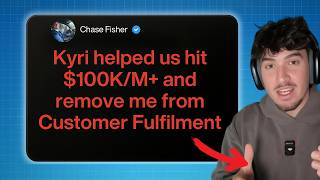
How Chase Fired Himself From Fulfillment in His $150K/M+ Program (Case Study)