The One With the Cheapest Landed Cost That Cost You More
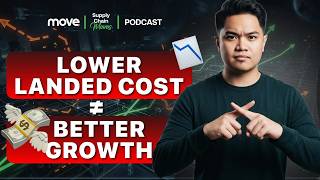
In this solo episode, Omar, Growth Partner at Moov, warns brands about the common mistake of over‑optimizing for landed cost—tariffs, DDP quotes, freight rates—when making supply‑chain decisions. He explains that while low landed‑cost numbers look attractive, they often hide hidden risks such as supplier inconsistency, poor visibility, limited scalability, and higher operational overhead that only surface as a brand grows. Using an anonymous client case, Omar shows how focusing solely on the cheapest all‑in number leads to compounding costs, delayed shipments, and fragile operations. He then offers a framework for a healthier approach: treat landed cost as one input, separate cheap from efficient, be cautious with DDP, evaluate suppliers for stage‑fit, and pursue larger margin levers like packaging redesign, MOQ planning, SKU simplification, and inventory optimization. The core message is to build a supply chain that supports stable, profitable growth rather than merely protecting margin with the lowest upfront cost.
Chapters
Hey guys, it's me again, Omar, Growth Partner here at Moov. And today I want to talk about something I see all the time, especially right now with so many brands getting laser-focused on tariffs, DDP quotes, freight rates, and all-in landed cost. To be clear, I get it. Those numbers matter. If duties go up, if freight gets messy, if your DDP quote suddenly looks worse than expected, of course you're definitely going to care. You should care, but here's the mistake. A lot of brands become so focused on landed cost, especially tariffs and DDP, that they start making decisions around the cheapest landed number on paper while missing the much bigger risks behind it, and that usually does not hurt right away. It hurts later. It hurts when the volume picks up. It hurts when the launches get tighter. It hurts when the stock costs more, and it costs when the supply starts missing, and it hurts when your backend is too fragile for the growth you work so hard to create. So in this episode, I want to talk about mistake number 4. Obsessing over landed cost. Oh, so why does it feel smart? Why tariffs and DDP can pull you into this trap. How it gets more expensive later and what to focus on instead if you actually want profitable, stable growth. So let's get into it. So what's the mistake? The mistake is not caring about landed cost. The mistake is over-prioritizing it. It's making landed cost the main filter for your supply chain decisions. It's when every conversation becomes, how do we get the duty lower? How do we get reduced freight? Or can we find a cheaper DDP option? Or can we switch geographies to save on tariff exposure? Can we get the supplier quote down? Or even we've heard, can we get this all-in number lower? And listen, on the surface, that sounds responsible, especially right now with everything going on in, in the world, especially in in the Middle East, and a lot of founders are looking at tariffs and thinking this is the biggest threat to margin. Super duper common and something that we always hear, hear at Moov. A lot of our operators are comparing DDP quotes and thinking, okay, this is where we need to get more disciplined. A lot of brands are actively trying to move out of one country to test a new country or restructure how they import, because the landed cost picture has changed. And that's definitely real. But here's where people get caught. They start treating landed cost like it tells the whole story, and definitely it doesn't. Because landed cost is just one number and the business cost is much bigger. Landed cost might tell you what it costs to get the product to your warehouse, but it does not tell you what it costs if the supplier is inconsistent, if the quality is shaky, if the lead time keeps moving, if the communication is slow, and if you have to chase every single update. And all of that is a trap because landed cost feels precise. It feels like the mature number, and it feels like the thing smart operators should optimize. So founders naturally gravitate towards it, and they'll compare Supplier A and Supplier B, and they'll compare China versus Vietnam versus somewhere else, and they'll compare DDP versus FOB. Tariff exposure as well gets compared and other freight options. And that's when we make a decision mostly based on what looks cheapest on paper. That's what gets missed, especially around that number. How dependable is the supplier and how strong is the production process? And how much visibility do you actually have? How scalable is the setup? So these are just questions that you need to think about. And this is what gets expensive later, because when you're small, you can survive a lot of messes and you can jump just because you can jump in yourself. You can chase supplies, you can absorb a delayed order, you can fix an issue manually, you can scramble when something gets stuck. And of course you can tolerate weak systems because the business is still small. Enough to patch things up. It's annoying but survivable. But as your brand grows, that same mess gets a lot more expensive. And this is where obsessing over tariffs, DDP, and landed cost can really backfire. Let's say you decide to switch suppliers mostly because the tariff math looks better, or you move production mainly because the duty picture changed. Or you chose a DDP setup because the quote feels simpler and the landed number looked cleaner. Again, none of those decisions are automatically wrong. The problem is when that became— that becomes the main reason. Because a lower tariff country is not automatically a better fit supplier base. A cleaner DDP quote does not automatically mean better control. A lower landed cost does not automatically mean lower total business cost. Sometimes it just means that you pick the easiest number to compare. And meanwhile, the harder questions got ignored. Questions such as, can they actually deliver consistently? Or can they hit the volume that you need later? Or is the quality stable? Is the packaging execution clean? Or can they even handle pressure during my growth as a company? So these are just questions that you need to really, really think about. If customers get messy or timelines shift or forecasts change, how well does this setup actually hold up? And that's what actually matters because what happens later is never just about the tariff savings. I wanna, for example, what happens later is that the cheap option starts leaking money in other places. You have, you save on landed cost, but you lose on speed. You save on duties but lose on consistency. You save on freight but end up paying the emergency recovery later. And you chose DDP because it looks easier but ended up with less visibility and more confusion when things go off track. And you move to a cheaper setup but create a supply chain that needs way more babysitting. And that's, that's when the cost actually compounds. And that's the real issue. At small scale, these problems can hide. At larger scale, they get louder because now your launches matter more. Your inventory gets bigger. Your cash flow pressure is higher. Your customer expectations are also higher and your marketing is more coordinated. And definitely your team is going to be busier and every mistake affects more revenue. Now, a weak supply chain is not just inconvenient, it's expensive. And most of the time it doesn't show up as one dramatic bill. It shows up as a leakage, a delayed shipment here, a customs issue there, a bad batch that slows down everything, and then a supplier that needs constant chasing, and then a team that constantly reacting instead of planning. And that's the compounding effect. And this is why I always say early stage brands often over-optimize for visible costs and underweight invisible risk. Tariffs are visible, DDP quotes are visible, freight rates are visible, unit cost is visible, but risk is quieter until it isn't. Let me make this real with an example. So we worked with a brand, I'll keep it anonymous, that was feeling the pressure a lot of brands are feeling right now. So margins were getting tighter, they were paying close attention to duties, they were looking hard at freight. And they were questioning where production should sit. And a lot of the internal conversation was going around getting the landed cost down, which again, fair enough, this is a real reason. So when we looked deeper, it became clear that the landed cost had started to dominate the way that they made decisions. They really have, they were heavily focused on quote comparisons, heavily focused on the duty impact. Heavily focused on DDP looking better than other structures, heavily focused on getting the all-in cost lower, and they were underweighting other things that mattered more for the stage they were actually in. Supplier responsiveness, production consistency, scalability, communication, operational fit, and how much support the suppliers actually provided. And for example, how easy as well, or how hard it is to manage the actual relationship. On paper, some of these lower cost options actually looked attractive, but in practice they came with more friction, longer back and forth, less predictability, more follow-up, yada yada yada. You guys know what that's gonna be like. So that's what happened. Then what Moov did is the team spent more time around supply chain than they actually should have. They were constantly checking in, constantly adjusting plans, constantly trying to stay ahead. Of possible delays. And as the business pushed towards bigger growth moments, that tension became more obvious. So a stronger sales month did not feel exciting for the owner. It felt risky 'cause more demand meant more exposure to a shaky system. And that is when the conversation had to change. The question could no longer be just how do we lower landed cost? It had become what kind of supply chain actually supports this next stage of this business? And this is a very, very different question, maybe because the right answer is not the lowest tariff route. Maybe it is the supplier with a better communication. Maybe it's a slightly higher cost partner who gives you a cleaner execution, and maybe it's a different freight structure. Maybe it's not DDP versus FOB as a blanket rule, but understanding which setup gives you the right mix of control, visibility, and predictability for your stage. And that's definitely when the shift matters because once the brand started looking at the total business impact, not just landed cost, the decisions got better. Not always cheaper on paper, but better for the business, less friction, better confidence, cleaner planning, fewer surprises basically. And that is usually what growing brands need. So what should you do instead? So first, care about landed cost, but zoom out. Do not ignore tariffs, do not ignore DDP, do not ignore duties, freight, or quote structure, but do not let those become the only story. Use landed cost as part of the decision, not the decision. Second, separate cheap from efficient. Those are not always the same thing. A lower landed cost might be cheaper. It is efficient if it only works operationally. If it creates delays, confusion, quality risk, constant follow-up, or poor visibility, it may not be efficient at all. It may just be cheaper upfront. Third, be careful with DDP. If you are using it mainly because it looks simple, DDP can absolutely make sense in the right situation. It can simplify things, it can reduce coordination, and it can work well for certain brands and certain stages. But it should not be chosen just because it hides complexity and it gives you one clean number. You still need to ask, what visibility do we have? How are delays handled and who owns what, or how predictability with that vendor or with that freight forwarder. And if something goes wrong, how quickly do we get answers? If we are buying convenience or are we giving up too much control, that's what matters. Because sometimes brands who chose DDP because it's, it felt easier, that's when they really are just outsourcing visibility without fully realizing it. And number 4, of course, evaluate supplier decision based on stage fit, not just tariff logic. And this is huge right now. I see brands wanting to move geographies quickly because of tariff pressure, and sometimes that is the right call, but sometimes those are so focused on tariff savings that they ignore whether the new supplier base is actually a good fit. Can this factory actually make the product well? Can they scale? Can they communicate clearly? Can they support the level of quality that we need? Or do they have the right system? So these are just a couple of questions that we really, really need to be thinking about at the back of our heads when we're looking at these type of things. So number 5, look at the bigger margin levers. Sometimes brands who are trying to save 50 cents through landed cost optimization while leaving much bigger wins untouched, packaging redesign, MOQ planning, order timing, freight, Planning, container fill, SKU simplification, inventory planning, reducing emergency shipments, blah, blah, blah, blah, blah, blah. You guys have heard of it over and over again. Those are often bigger and healthier gains than just obsessing over tariffs or squeezing one quote. And then finally, think about your supply chain as something that should support growth, not just protect margin. Yes, margin matters, but What you really want is profitable growth with stability. You want a supply chain that helps you move faster, launch cleaner, plan better, and scale without constant panic. And that is worth a lot. Now, let me give you some permission here. You do not need to chase the absolute lowest landed cost right now. You don't need to rebuild as well your whole supply chain every time tariff headlines shift, or you do not need to treat DDP like magic solution just because it looks clean. And because at your stage, the better question should— is usually not how do I get this as low as possible? It is going to be 100, 90%, let's say 90% of the time, it's going to be how do I build this so it is stable, scalable, and still commercially healthy? And that is a way better lens. And if you optimize cost on top of a fragile system, You're just making a fragile system a little cheaper, and that's not the win that people think it is. So if I could leave you with one thing, it would be this. Do not just ask what this costs to land. Ask what it costs to run, what it costs to manage, what it costs when something slips, or what this will cost at 2 times the volume, or what this is gonna cost when your team is busier. Because these mistakes, these are the mistakes you make now and it may not hurt until you are a lot bigger. And when that's exactly why it's worth catching early. And it is, it's definitely one that felt a little too familiar. That's probably a good thing. And it means that you're looking at your business with the right level of honesty. And in the next episode, I'm just going to be walking through another mistake that's going to feel harmless earlier on, but definitely going to create a lot of pain later. That is building your supply chain around reaction instead of planning. And this is the one that catches a lot of brands too. So yeah, thank you so much for listening. I'll definitely catch you guys in the next one.
More from Lara






Your Best Seller Sells Out on Day One of BFCM. What’s the Plan? #bfcm #inventorysystems #ecommerce



Your Best Seller Sells Out on Day One of BFCM. Then What? #bfcm #inventorytracking

Don't Know Where Your Raw Materials Come From? Start Here #sourcingagent #supplychainplanning