Building A Business With Military Precision
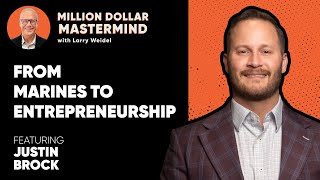
A Million Dollar Mastermind podcast episode in which Larry Weidel interviews Justin Brock about his journey from the U.S. Marines into direct sales and digital marketing. Brock recounts how military discipline and the crucible of boot camp built attention-to-detail and grit, how early success using Facebook ads amplified his Medicare sales, and how he scaled by hiring and systematizing lead flow—eventually achieving a partial exit (51% at a $70M enterprise valuation). The conversation also covers hiring philosophy (Patrick Lencioni’s smart/hungry/humble), team gamification, ongoing learning (podcasts, masterminds), and why building transferable systems enables faster repeatable growth.
Welcome to this edition of the million Dollar Mastermind podcast. This is where we pick the brains of high achievers from all walks of life and get their hard earned real world insights on winning. I'm your host, Larry Wydell. I'm talking with Justin Brock. Hello, Justin.
Hello, Larry. Thank you for having me.
Let's talk about winning. Justin.
I'm ready to win.
Yeah, I don't know about you. You probably a monster athlete at high school and had all kind of college offers and almost went to the pros and things like that. But for, for me, I was barely to get through and be able to get on the team and start. And that was because I went to small schools. But the main lesson I got, winning is better than losing.
Definitely. Definitely. Yeah.
And once you get the taste of it, you don't want to give it up. So you don't have to be a professional athlete to be able to win.
So no, no, I'd say business or, or sales and marketing became my sport. I was always a, I'm a great sports spectator, mediocre athlete myself.
You know, I wish somebody had told me business was competition and it was like sports because I always had a great disdain for, for business. But until, until somebody turned the light bulb on for me and so what did you, growing up, did you have a competitive spirit? Were you in, you know what, what fired you up?
I loved basketball. I was in a music guy, so I was a guitar player. I play in bands. I wouldn't say I was really that competitive, honestly. I went, I did go into the Marine Corps when I was 18, but I was just kind of searching for, I would say purpose or adventure or something like that, but I wasn't, I tell people this all the time is actually getting into direct to consumer sales initially in realizing for the first time ever that the harder that I worked, the more I was rewarded. That kind of woke up my competitive spirit a little bit. So I was in my mid-20s before I really feel like I got competitive.
Yeah. And so what did you get in terms of fundamentals informing who you are before that? What did you get from school and the military and things like that?
Yeah, so I would say school. I don't feel like I got a whole lot out of school. I went to small schools too. I mean, Mrs. Rural Mississippi. You know, I wouldn't want to speak poorly to any of them, but you know, it's the rite of passage. You got to do something with that time while you're figuring things out. But the military, I definitely did Learn some things in the military, you, you were held to a high standard. So attention to detail was a big thing that I think I picked up in the military. The importance of, of truly looking at details that wouldn't have mattered to me, and I didn't think they mattered. And being held under the microscope there, being professional and the customs and courtesies of it, and then just kind of being held to a career path where you, you can't leave. Because up until that point, every job I would get, you know, I'd. I'd go into a job, I'd do a great job, but then I just kind of hop around and if there was something holding, like, if I wanted to do something, like, I remember one time I was working at Lowe's before I went to the Marine Corps. I wanted to go to a music festival and they wouldn't let me off, so I quit. And, you know, because it was like, this is Lowe's. I don't plan on making a career out of this. I'm not, I'm not going to let it stand in the way of what I want to do. But the Marine Corps, you couldn't do that, right? That was the first time for a long period of time that they locked you in and you had to stay focused. And so I think in that process of staying focused, I did find a lot of. I've always been the way where when I worked, I enjoyed working. I never had a job that I didn't enjoy to some degree. You'd find that kind of locked in. I remember busting tables and I was like, I want to be the best guy busting tables. So it was, I wanted to do good, but I never felt the true reward until I got out of the Marine Corps and started in sales. It was just like, wow, okay. Now when I work hard, like it, it comes back to me, not to someone else, right? It was me that benefited the most. And so that, that was, it awoke a different side in my, in my brain. It kind of woke it up.
I feel like, well, we send kids to college and they come back with these hundred thousand dollar debts and some piece of paper, can't get a job. And they never really learn to work. They never really learn. One of the big lies about hidden, hidden things about education is not only is everybody in there teaching ultra liberal indoctrination to the poor kids who go to college and they don't really realize it. It's like me, I listen to NPR radio for years. This is great. And then, then I finally Realized, oh, this is, this is like coming out of Moscow. I mean, they're so liberal, you know, no offense, guys.
No, no, but you don't, you get.
Indoctrinated, you don't even know what's happening. And then you come with a big, you know, but the big education at some point about your life is like, listen, son, you got to be responsible if things are going to be. It's up to you. And nobody cares about your whining. We all got things to whine about. And billionaires, billionaires cry, too, because they got bigger problems than you, but they do something about it.
That's right. And you have to, you get to the point where, you know, are we competing for the top sob story? Because, yeah, there's always going to be somebody with that's more of a victim of their circumstance than I am. My life wasn't perfect, but it certainly wasn't the worst life. And there, and most of the people that I see that are trying to play that pity card didn't have the worst life. They're, they're paraphrasing like these things and it's like, yeah, buddy, that's what everybody has to go through. Oh, your parents were hard to get along with. So what, you know, grow the hell up and what are you going to do about it?
Yeah, yeah, that. Welcome to life. And so the thing is that a lot of times it's the serious things, the big things that happen, that kind of, it's like, it's almost like branding. It's almost like branding cattle. You have a brand on you, and a lot of our early searing experiences kind of brand us for life. And at the time, it hurts like crazy. But you don't know that setting you up for success. When you got in, I'm sure all the kids getting off the bus, going to Marine boot camp. You were in the Marines, right?
Yes, sir.
Yeah. So how long or how deep in before you got your wake up call? And what. Do you remember how it came to you?
Yes. So it was, it came in. I thought the wake up call was when we got off the bus. It's a Parris Island. You get off the bus, you stand on the yellow footprints and they come out and they're yelling at you and all that, and that's what they show in the documentaries. But then you enter this thing called forming days. And the first three days are forming days, and in those days, they're, they're getting you vaccinations, they're doing your medical records, they're Basically doing all that stuff so that they can really pass you into boot camp. And then you get your real drill instructors. And so after those forming days, you have this time where you go, you've just done your initial strength test, so you're going and you've ran and you've done pull ups, you've done that and you come back and your PT closed and they sit you on the quarter deck and everybody's supposed to sit on the quarter deck and in comes this guy you've never seen before is the senior drill instructor and he is giving a speech. And it's the same speech for every one of them. And then they bring in these guys called the kill hats and the drill hats. And they. My experience was they were beet red and profusely sweating and looked like they had just pounded energy drinks and steroids and man. And they would. When once he turned them loose and they started, that was the point that I was like, oh shit, what have I done? And at 18, you know, it's different now, you know when you're. Yeah, I'm 36 now. 36, going through it would be different because you're just a different face. But when you're 18, you're still a kid. You're a kid. And when that ha. And that's why they want you to be young because honestly it's, it's easier for them to train you as at a blank slate than when they get. So like we had a couple guys get kicked out when I was in boot camp. They were, it was mostly the guys that were like 25, 26, 27, they were, they were stuck in this bad pattern, right? But if you get that 18 year old, they could break them and then when they break you, they can rebuild you. But that breaking point was these guys came in and they scared. I mean, I remember country boys that grew up on farms, tears streaming down their face and they taking like polyurethane plastic, what do you call them, canteens and they'd slam them down on the ground and they're shattering and it was like it just turned into pure and utter chaos. And now looking back on it, I'm so glad that I went through it. I love, I love the, the experience of it. But going through those times where you know, you just, they break you down to where you'll do whatever they tell you to and then they begin to build your confidence back up and after you've been through it, that it's a process that they have to get you beat down to really rebuild your identity. Yeah. And it's a beautiful thing, really. I actually regret that more kids don't go through it because I think I needed it, and it was great for me in the long run.
Yeah. One thing you said, just jumped out. Stuck in bad patterns. When we're stuck in bad patterns, we do not appreciate somebody situation or somebody who comes along disrupting our bad patterns. But until. Until those bad patterns get disruptive, you get. Get out of that bad pattern rut. You're not, you know, you're going to be a loser, and you're always going to lose. And you're always.
Those guys, you have to let them, especially when they get into those patterns. And it happens at different ages for people. But the 20s is a rough period for people because there's so many people out there. I hired a guy. We have about 52 employees. I hired this one guy, he comes in and his damn dad was telling him, don't take your 20s too serious. Just have fun and all this stuff. And I'm like, it's such. Because really, the 20s is the time that if you can learn how to get serious in your early 20s, maybe I don't have a family at that point. It is such. This at such a compounding time where you can make so much progress in the right direction. But so many people say, oh, enjoy your 20s. And then by the time they're 30, they're like, oh, I got to get serious. Well, now they might have a kid or two kids or a wife. It's a hell of a lot harder to get serious when you're having to feed people and you haven't done shit with the last 10 years. Yeah, I see that all the time. And I. I've even put some content out there where I've tried to say things like that. You quit listening to this. Go get. Go make some money. Necessarily be rich, but get your baseline covered. Enjoy your 40s and your 50s and your 60s. 20s and 30s for me is like, get your ducks in a row, Take care of your lives, make something happen because you got energy, and enjoy those other times, you know, and hell, that's. I don't. Nobody listens though, right?
Yeah. You can have a few years of good times in your 20s, or you can compress timeframes, put some good hard work together, and have decades of good times in your future.
And they're better times because now you can afford to do things that you would never have been able to do in your early 20s.
And it's important to know when you're in your 20s, the good times that you think you're enjoying right now is crap compared to the good times that are out there, the places you can go, the people you can meet, things you could do. And so to think that I'm going to, you know, going to get drunk on the weekend and go to a nightclub or go to a concert or get polluted or something and woo, you know. Yeah, wake up and. Because the idea is once you start doing things, good things happen, number one, like you said, even. Even the jobs you had. Busing table. I did some busing of tables when I was in high school. The thing is that you learn things. And I learned about systems from bussing tables because a restaurant owner came over to me, Gino, up and out the Hamptons, Gino came over and he goes, larry, let me show you how to bus a table. For some reason, he took me under his way. Let me show you how to bus a table. He said, take your hand, go around the table once, get the big dishes, get the plates. He said, next time, go around, get the glasses. Next time around, get all the silverware. Now go to the next table. And he said, look at this clown over here. He's over here. He gets a glass, this guy, he gets a plate, picks up a couple of forks. He says he's going to be there an hour and a half. And that's where I first learned about systems. And so you learn things, you get a confidence, but the confidence that comes from accomplishment, regardless if you made a million dollars from it or not, confidence that comes from accomplishment is really something that fuels your confidence and your faith in yourself to try new things and to be able to make big income and take on big responsibility in the future. So you're in the military, and when did you start to, to get some. What was a turning point in your confidence in there?
Would you say so? I mean, several times. But in the military, let's say the confidence in. At Parris island, they have an EGA ceremony where you, you, they. This whole time they're building up this point. When you pass the crucible, you get. They do an eagle, globe and anchor ceremony, and you get your eagle, globe and anchor. It's after the warriors breakfast. And it's, you know, they have this whole process. Right. But before that, I think at the tipping point of the crucible, when you, when you would see other guys drop out and you're keeping on going and you would just. It just kind of like emerged slowly. It wasn't like a Huge breaking point. But when they put that eagle globe and anchor in your hand, you think, I'm going to make it out of here. I'm going to. I'm going to do this. And. And then it's funny, man. You get out of boot camp and they break you back down, and they're like, oh, that was nothing. Now you got to go to combat training. And so they make you small again, but you're. You. It's this compounding effect. The same thing when, when I started selling, it was the first time someone buys from you. You think, wow, people will buy from me. And there's like this destiny there. And then the first time you. You say, I'm going to get into marketing. And then you run an ad and someone responds to it. Ad, you design, you set it up, you learn how to do it. Somebody responds and calls you and wants what you were advertising. It's like somehow this realization that there's not really any difference than in the. The most wealthy people in the world and all the processes are created. You can create those same processes yourselves. You can accomplish all these things that other people accomplish. Other people aren't inherently better. I mean, obviously there's some people that just have raw talent in certain areas, but technically, most people are all playing with similar hands. And it's just the people that show up and try shit that actually make progress and try it again and again and again.
I haven't been fair to you, Justin, in terms of letting people know yet who you are. You've come out of. You grew up, you've had. Came out of the Marines and started, got into a bunch of businesses, got into sales, got in financial services. We're going to talk about that. But have been very successful. And not only with yourself, but with being able to build teams and build companies that are still out there. And you've got. What are the things, the accomplishments that you're most proud of that you would have never thought coming up, like, wow, I didn't know I was. I was going to be able to do that, man.
Most notably recently, we did have an exit, a partial exit event where we were able to sell the company. It's kind of an enterprise, so a few different companies, but working together. And enterprise values is at $70 million. Earlier this year, we sold 51% of that value to 70 million. And when I started, when I got out of the Marine Corps, I was just trying to make $60,000 a year. But at each level, this kind of new horizon would open, and it's A beautiful thing about business is some people I think think you have to come into business with like this grandiose idea. But my idea of what was possible would just evolve one layer at a time and then you'd see something someone else was doing and you're like, well if they can do that, I can do that. And then see the next level. If they can do that, I can do that. And, and so recently getting that valuation and seeing like the reality of that level of money exchange hands and it doesn't, it didn't stop there because now in my head it's like now I feel like I could build these companies faster in similar sectors of the same one. I did retain my 49% equity because I believe we'll end up making double what we made on the first half on the second half by growing it. But that's been kind of that ultimate thing. But in the process, you know, building a team and having a culture where people work for me that they actually are prosperous and making more money than they made elsewhere, but also happy and, and being able to kind of instill in those people like that teamwork makes the dream work mentality. Especially in a small town like Tupelo where I feel like there's not a lot of great opportunity. It's been really rewarding to see that and that's something I didn't know that I would even care that much about, but a huge win. Other people benefit from the things that you're doing, not just yourself. It's been pretty, pretty eye opening experience for us. That next thing that I think has just been extremely vital in our, in kind of my. The way I perceive our success is that sale was great, but in the process we built an awesome team. We have a, a slew of 1099 contractors that work with us and a great brand in our sector. But the 50 employees, 50 plus employees that work in our offices that have an opportunity to work somewhere that they enjoy making more money than they've made in the past. That's been a rewarding experience for me to see that I, I didn't realize I would enjoy so much.
Talk me about now. You know, one thing is you pick these things up in the military. They don't even realize it, but it's like the idea of progressing up the ladder. It's always obvious who the sergeant one level above you, you might be a just soldier than a sergeant. And then I forget all the different levels. Staff sergeant, Master Sergeant Senior. And then you're. It's real easy to look at that and say, I'm working harder than they are. Yeah, they're not that bright.
I saw that several times.
And so you're almost forced to. If you've got your eyes open, you're almost forced to. I think the fact that you can see it tells you you need to move up. Because there's certain people don't. Don't see it, or when they do see it, they don't. What it doesn't bother them as much as it bothers people like us.
Yeah, so it's kind of like the military. We use the word like on our sales team, for instance, we gamify the sales. So there's always like scoreboards where it's. If you see that John is in the call center and he's got 12 sales and you're Tucker and you've got six and you think, why the hell does John have more than me? He's an idiot. You know, they do that in the military. You know, their entire rank structure and billet structure is, is very gamified. And you don't really think about it because in the typical corporate world, yes, there's raises and titles and all that, but until you get to like the upper echelon where you're at like C suites and director positions, you don't start thinking about it of like climbing the ladder at the lower level when you're like in an entry level position. But in the, the military, it's ladder climbing right from the start. It's private, private first class, Lance corporal, Corporal, Sergeant, staff sergeant, gunnery Sergeant. And when, when you're looking at, yeah, I would have people, I got out as a sergeant, you know, came in as a private and then and got out as a sergeant. And when I would see people ahead of me that I was like Jesus or, or even my peers that like, I just knew I was so much better than I was. Like, I have to put distance between me and this guy because he's an idiot or he's lazy. And then, you know, it also did help. I did have leaders when I was in the military. And I probably really haven't thought about it before how much it helped, but I had, there were officers, I worked closely with officers. I was an operator. So I would do a lot of like scheduling and training and documenting those processes. And I would work under the operations officer who was a major, and then he had some captains and lieutenants that worked for him and that commonly the majors that I worked for would bring me in even when I was pretty young in that in the military and tell me that, you know, that they saw that I was had capability of leadership even above the enlisted guys that were over me at the time. And so it started making me think like it's not that you didn't think that already, but you wondered if you were just full of shit and then they would kind of give you that, that push to be like, no, you're, you're definitely got more potential than some of these guys. And so it was nice to have someone objectively believe that you were capable too. So.
Yeah. And so for young people getting ready to go in the military, think about areas you can get in that will give you that kind of exposure to the brass and also to skills like you're at operations planning. I know my father was in the Air Force and he was in logistics and he dealt with the generals all the time. And those skills, the skills and the experiences and also the contacts.
Yeah. A lot of people when they're choosing a job, obviously you have your infantry side and a lot of people are thinking that way. And then, and then some people are looking at the job that directly translates to the real world. But like the thing about logistics and operations is it might not be that on the outside there's like this exact verbatim job title that's the same.
Yeah.
But conceptually on operations you're learning people skills and managerial skills and that attention to detail and, and planning, like really, really planning. So I do think it was helpful. There were times in the military I thought when I was thinking more job oriented, like how would I, how would this apply to the real world? Because there wasn't similar job, but it actually is the most applicable in business because it's all of those same things. Managing people and making sure that there's a process.
For those of you who are sick and tired of fooling around and are dead serious about wanting to move up fast, I've got something especially for you. I've combined the best insights from over 40 years in business and making $70 million in income and compressed them into a free webinar. That's right. It's a free resource if you want to find out exactly, exactly what the concepts are that I use in coaching million dollar earners. Register now@widelawnwinning.com you'll discover the five part framework used by so many to reach their financial, personal and professional goals. You can find that link in this episode's show Notes. So when you got out, what appeal to you? Were you just looking for an income and how did you get, what was your first year like out of this military?
Yeah, so I, I got recruited into insurance sales. And thankfully the niche I got recruited into was the Medicare world. And basically it was here's a bunch of direct mail lead cards where people had filled out requested information and you're going to get in the car and drive 45 miles this way and 45 miles that way and knock on doors and put on your, put on your tie and comb your hair and try to get them to let you in the house so you can talk about Medicare plans. And that year was, would have been rough. I was, I would say by the typical standards, I was good at it. But I also knew, like pretty quickly I was like, there's gotta be a better way than me, you know, selling three or four policies a week, knocking on doors, getting yelled at sometimes. And some people were very nice. It wasn't like I was, I was going in and genuinely trying to figure out how I could help put them in a better place. But there was, of course, a lot of reluctance to that. And it is a grind, but you got to do what you got to do. And that's, I think that is a defining point is a lot of people, they want to skip into a level that like straight away that maybe you do need to put that sweat equity, you know, in or get to the grindstone and see the people eyeball to eyeball in that process, start at that base level. So I'm glad that I started there. It also helped me gain respect. Now when I hire salespeople and I put them in a telephonic role they're doing on the phone and they're like, man, this is brutal. They all know that the guy that owns the place started out driving around knocking on doors and getting dog sicked on them. So it's definitely. The phone can be brutal, but it's not face to face. So it's not the same way. So it's a little bit more safeguarded. But that first year taught me that I needed to figure out a way to get in front of more people. And actually what happened was I, I was on one of those appointments and it was probably 10 or 11 months in and I met someone whose husband and on one of the appointments I went on, whose husband was a retiree from a large company, and that large company was going to lose their, all losing their coverage. And he wanted me to come speak to their retiree union. Paraphrasing a little bit, but I went and spoke to them and there were 72 people there. And I wrote a whole bunch of policies off of this group because they were all like, we like this guy, this young man who's a Marine. And you know, they liked all that. And so I helped a bunch as AT&T retiree union. And when I helped all them, I thought, how in the world can I get in front of 72 people again that actually want my help versus this one? And 1 and 1 and 1. And so it started making me think a little bit bigger of how can I amplify that. And that's when I started really, really studying marketing and. And how to use marketing to get in front of more people.
What would you say is the most. You look back meant the most to you, to your development, to kind of prepare you to take advantage of that when it came along. I mean, were you listening to tapes? Were you doing any extra kind of sales training? Do they have it in the company? What were you doing to keep yourself going? Because that is a grind.
Yeah. So I was. I commonly say I was driving around in a fully unloaded car, Corolla, manual, windows, cloth seats, the works. But I had a. One of those AUX tape deck players where you could put it in and like listen to MP3s and. And podcasts. So I was downloading podcast episodes and listening to them on the road. Some of the early ones that everybody is listening to is the ones where they reference University on Wheels as a Zig Ziglar. He talked about the university on wheels. So I was listening to Zig and then. But then I would get into finding kind of niche specific people, like in the life insurance world that were talking about things that I was like, okay, this makes sense. It's very close to what I'm doing. But. And I mean, it started out with like organizational podcasts, like time organizational, but getting into just listening to on the Road podcast. And then I found this podcast called the Art of Paid Traffic. I think he's changed the name of it now, but basically it was just this guy talking about Facebook ads back in 2013, 14, when they first monetized the platform. And that's when I. My first segue into like learning how to be a marketer was Facebook, but it came from podcasts I was learning on podcasts. So that's why I like doing podcasts now is hopefully, hopefully podcasts will help people. Like it helped me.
Yeah, Giving back. That's why we do it. And you know, I've heard people say like, my. My car was my university and you could choose, you could choose your professors and you could choose your curriculum. You can make it very focused of what you want to hear. And so how did you start to put your company together?
Yeah, so what happened was I started marketing on Facebook and I had some great success. Right away. I thought I was a genius marketer. Turns out it was, it was at a period where there was not a lot of competition in the demographics I was targeting. And so I was having a lot of success. But I was getting my phone ringing heavily, running some dental ads and some other things. And it got to the point where I was getting so many phone calls that I couldn't sell all of the policies. And up until that point, I had already thought like a salesman. I thought, okay, I'm a salesman now, I'm a marketer, but I'm, I'm still just an individual, one person. But I thought the only way that I can scale this is to start bringing other people in. And so then we went out and, and started like hiring agents to work with us. And these agents would assign their commissions to me, but I would handle all the lead flow for them and then I would pay them a reduced commission based on me doing all the marketing. And then that kind of started to create that nucleus of that structure and it. And turned into a small agency. Probably a couple of years into that. We had eight or nine employees working out of an office. We opened up an office. It was like a 2200 square foot little retail space where we had a couple of admin and the rest of us agents in there. And we were driving traffic to the office, mostly still through Facebook. We use some traditional media like television or direct mail. And it just started growing that way. Of course, the profit started to grow exponentially just by that compounding effect. That's kind of how it started there. There have been some other nuances since then of like other, other verticals that we've gotten into, but really it just came from saying I could either, I could have either spent less money on ads and just kind of took what I get and made what I wanted, but I just wanted to keep growing. I just had this, I don't know where, where this came from, but now I always tell people, if you're not growing, you're dying. You gotta, you got, you can't, your business can't just sit there and, and be stagnant. Like, if you, you have to continue to let it grow, it's designed to grow. And so that's, that's why I started hiring People.
Well, a couple of points I'd like to, to pass on and to make for people listening. And they're wanting to move up. They're wanting, you know, maybe they're working inside of a corporation, but the idea is to learn what you can do it as well as you can. But get your eye on moving up somewhere. You can move up at another company. Keep learning, keep moving up, keep the pressure on in your career. Don't wait for things to come to you because at every step that creates more possibilities for you. And so as you did, the staggering thing I'd like you to think about and comment on is probably hundreds and hundreds of thousands of young people come into the market every year and they get a job in one area of sales or another. Like you. I don't know if it's selling books or they sell encyclopedias door to door anymore, potsdips however they're selling. But they're, you know, direct sales. And to go out there and direct sales, financial services, whatever, hundreds of thousands start. And we've all seen these offices where they have 40 to 50 new recruits every week.
Yeah. Because they have to burn through them because the failure rate is so high.
And so from that ocean you emerge.
Yeah.
It's kind of staggering. Isn't.
Is it? So I think it's Napoleon Hill's book where they talk about the premise three feet from gold. Most people are thinking about short sales as a short term career. And there's a lot of people that have made a lot of money just as a salesperson. I know some guys that are recruiters or individual insurance salespeople that will make a million a year with no employees. And what they did is persisted. They, they stayed at it long enough. I mean, obviously it's, you know, there's ways that you can, you can make it happen faster than others. Of course, how aggressive am I, how many contacts am I making, how many relationships I'm making? But to be frank, I know plenty of people that are not that great, but they're in it long enough and they're making 250, $300,000 a year. But when you think of sales as a short term thing, it is not. When I first started, it was, if I wouldn't have had that big win 11 months in, I would have probably made $40,000 that year. 45,000. Busting my ass. That right there probably put me a little bit further than that. That helped me out. But the thing is, the harder you work and the more people you see, the luckier you'll get because you're, you're putting in that time in those contacts. And I think thankfully, by content and trying to go to events where I got around other people doing big things, I believed that those big things were happening. And by believing that those big things were happening, it gave me the perseverance to make it through those times.
And so the thing, Justin looking about the uniqueness of how you propelled yourself from just being the successful salesperson and had a lot to do with marketing. I mean, it was marketing, right? Because what triggered you getting more people involved was you figured out the marketing funnel and how, how to fill that up to where there was not enough hours in the day for you to get to all the leads that were coming in. So that seems to be the big marker, the big trigger point. And how did you talk about again, how you figured that out, how you made that happen or did you even realize that was such a big thing that you were doing?
I think I definitely did. And early on, when I started having a lot of success with, with paid traffic or digital marketing, I started making relationships, going to top producer events with other people and, and they, we would talk about marketing. And I quickly realized that I was, I was probably doing better at, at digital marketing than anyone in the space at the time. Now it's come to the point where there's a lot of people doing it and so it's much more competitive. But I was one of the early adapters. In fact, when I first started running Facebook ads for the 65 plus community as part of the, as the demographic, people would tell me, oh, people over 65 aren't on Facebook. I knew that was a lie because my grandmother at the time was in her late 80s or mid-80s and she was, she was on there asking me for farmville bucks every day. So she was like, she's clearly on there. 5, 30 in the morning. Every morning I'm getting Farmville notifications on Facebook from my grandmother. So I knew that wasn't true and I knew she couldn't be the only one. So it gave me the confidence to go out and try it. And yeah, I mean, once the phone started ringing, because when you get an insurance sales, nobody's asking you to sell them insurance. You're having to ask them to let you sell them insurance or to let you at least pitch the product or at least review what they have so you could see if you could do better. When you run ads and you start getting people calling you saying, hey, I saw you on Facebook and I'd like you to help me with my Medicare plan. And then when that happens enough times where you knew it wasn't a fluke, you know you were on to something. But the compounding effect of being able to help so many people and allowing the Internet to build the trust back then really manifested in the, the commission starting to roll in. Once the commission started to build, I knew I was on to something. I do think that next echelon was the ability to create a high efficiency team out of it. But of course, without the marketing, I just don't think you can do that.
You know, the thing is about salespeople, that great salespeople, it is like athletics. It's like Michael Jordan would not be a great NBA coach. The fact that Larry Bird did it, you notice that Magic Johnson didn't stay a coach very long. We knew that wasn't going to last. But Larry, Larry Bird actually pulled it off for a while. But very few, it's different skills, you know what I'm saying? And for you to go from sales to a high level salesperson to a high level sales manager is unique combination of skills. But you have to develop those skills. One thing you got to learn to have more patience.
Yeah, absolutely. Yeah. You start realizing that not all people are created equal. You know that. But nothing will, nothing will really manifest that knowledge into a more clear painting than managing a lot of people and trying to put them all in the same types of positions. And the good thing is not everyone has to be the same to do well. And not everyone has to be the top performer. There's going to be people that just have every now and then. If we, If I hire 10 agents tomorrow, a couple months in, one of them will emerge as the most badass guy there. That just happens every time. And then a couple of them will quit, right? And then, and then a few of them will be above average, and then a few of them will be average or below average. That's just. It happens every time. It's the same, the same mix. But one person always, you know, just turns into that, that alpha. And most of the time it's grit, it's, it's there, the chip on their shoulder. I mean, if I find a guy with a good chip on his shoulder that wants to prove to somebody he's worth something, they'll just go to great lengths to do it.
How do you find out if they've got a chip on their shoulder?
Man, I think you really just have to hire. So when we hire, we'll hire based on Our, it's really just a perceived like. Or is this person smart, hungry and humble? We hire based on Patrick Lencioni's principles. And the ultimate team player.
Yeah.
And. Or it's or the ideal team player. And he says smart, hungry and humble. So we're looking for people that are intelligent enough to have a good conversation that are hungry for more than they're getting out of life. Not like crazy hungry, because it can be. I'm like, okay, that's not, you're probably not going to get that here. You need to go start your own business. But then humble somebody that can, they can, you know, present themselves as not like some bombastic person we hire based on that, but the person with the chip on their shoulder you identify after they're already hired. I don't know that I could identify them ahead of time. And as a matter of fact, I probably weed out some people that have chips on their shoulders in the interview process because what you don't want, and this because I've made this mistake is hiring the ultimate salesman. Because the ultimate salesman is fine if they don't work in my office, but the ultimate, the ultimate salesperson is, is typically not always a great team player. And they can create a rough cult.
Prima donna, unfortunately.
Primajuana. Yeah, that's, that's what happens. There's a book by Chet Holmes called the Ultimate Sales Machine and he talks about hiring like these insane, you know, sales studs that have egos that are hard to keep in check. And the thing is they will sell a lot, but if you put them on a team, they will always try to steer that ship in the direction of what benefits them versus the team. And that's not a, that's not what you want.
And sooner or later they're going to make a demand that you just can't put up with. You know what I'm saying? They're going to, they're going to test you, test you, test you and they're gonna. But a lot of times you get a lot of production out of them before that.
That's why I have to, I have to tell some of my long term employees at this point that I've had since the beginning. They'll identify these people at a time. They're like, they'll kind of tell me or make some kind of comment about it. And I've had one of them that's especially, she's very smart and she picks up on these people early on and I have to keep telling them, like, just ride the wave. Yeah, Just ride the wave. We don't have to make any, you know, any rash decisions right now. Just ride the wave and, you know, if we have to deal with it when it comes, we'll deal with it.
Yeah. Well, one way of quickly finding out who's got a chip on the shoulder is get them in, get them trained, get them started, and then have the first contest and then have. And then have a recognition thing where you make a big deal out of whoever won.
Oh, yeah, yeah. Those people that want that have the chips on the shoulder, they like accolades, awards. And I did, too. I mean, I think I had a chip on my shoulder early on in a. I enjoyed the awards. Eventually, the new wears off of that, and you're just like, now I'm just chasing. I'm chasing revenue.
So you create, but what you can do is you wind up creating a chip on their shoulder towards producing. If it's not there, you can crystallize it. You know, I used to have. Whoever finished second in the contest, I'd make a big deal out of it. Like, he won, and unbelievable. Blah, blah, blah. Come on up soundstage and everybody, you know, and. And I said, he almost. Once he's up there, I say almost. Almost took first place. But I got him up here because I'm so proud of him. I want to let him help me introduce the guy who won.
That's good. Need to start doing that. Yeah, I'm gonna steal.
You could create some of that chip on the shoulder with Reiki. That's how contests and all.
You brought up Jordan earlier. I'm sure you've seen some of the footage from, like, the Last Dance documentary where he talks about some of the stories that he would pretty much make up to create additional chips on his order to give him that competitive ed always. Yeah.
And what I love about that series was at the end. Most people don't pay any attention to the end, but at the end, he addresses the people that are critical of him. He says very quietly, calmly, says, I know a lot of y' all think that I'm just mean and was too tough of my teammates and, you know, it didn't need to be that rough and everything. And everything. And he said, I know, and, well, you feel that way, and that's fine. He said, I understand it. But he said, that's because you've never won anything.
Yeah, that's right. I love that clip. Yeah. When he says. He says, that's you, because you've never won anything. Yeah, I love.
But that's true. And so the thing is folks, do you want to win anything or not? Now talk about, let's compress the timeframes from when you started hiring people to when you made this sale. You know, you had something big enough to actually sell. How long was that?
So I took offers on the sale with a smaller. It took about five years before people would buy it, but I just wasn't at the number that I wanted. And so it was really from the first hire to the day that we sold was about eight and a half years. Now I wasn't, in the first few years, I wasn't even thinking about selling the business. I didn't even know what selling a business was. I, it was like a foreign concept to me at that point. But what happened was a few years in, a friend of mine that I had met on some top producer trips was a little bit further along with me and he was out of Austin, Texas and he sold his business. And then I heard the number, $50 million and I thought, holy hell, hello. You know, people, people will pay that much money for what we're doing, for what we're building here, you know. And then he walked away from it day one. Now I didn't do that. I sold half and then stayed. But it was an interesting concept. And so then I started learning about EBITDA and, and different industry multiples and those concepts. So basically.
Yeah, explain that because that doesn't come up. Yeah, that doesn't come up that often on this.
Yeah. So when I started looking at, you know, when people price businesses, they're looking at earnings and earnings is EBITDA earnings before interest, taxes, depreciation and amortization. And when people, when you start looking at that, you can find out different industries have different multiples and financial services actually can have a really strong multiples depending especially if they have renewal based income. And so in ours, you know, it's at the top, it's like 18x. So that's like the top platform companies. But you know, in the middle we're talking about 10, 11x at where we were based on our size. So you start thinking you can basically, you know, get, if you could get 10 years worth of your earnings for your business tomorrow and earnings, you know, it's closely relative to net revenue is a little bit different. But if you're like, let's say I netted $5 million last year and somebody said I'll give you 10 years worth of that tomorrow for your business. But then there's then the concept of the fact that you don't. You're paying capital gains tax on that earnings too. So if you're at a 37% federal tax bracket and capital gains is 20, so yes, you're getting 10 years worth of it, but you're also paying almost half the taxes. So it's almost, it's almost like you're getting an extra few couple of years out of that tax break too. So it can be, it can get to the point where it's difficult to turn down. And you, you now ego can enter the equation because when you start building something great, you're thinking, you know, I don't want to sell this. I'll build it bigger and bigger and bigger. But you know, everybody has a point where they think, I better lock in some of this success for my family. Unless they have no family and their ego is all they're married to, then, then maybe they never sell.
Right.
But you know, you start getting those offers, it's difficult to turn some of them down.
You made the statement that you got excited from learning the things you learn in this process. And you said one of the reasons rationales for selling was I see how this works now, and I see some other industries, some other places I could put this to work and maybe build it half the time. Talk about that.
Yeah. So different businesses or different verticals or niches or whatever you want to call it, they all have different problems. Some. Sometimes you have a problem with finding people, sometimes you have a problem with marketing, sometimes you have a problem with margins or inventory, or there's just different types of problems based on different niches. But once you understand that these problems can all be solved through technology and digital marketing and all these different concepts, then you could take the knowledge you learned on one vertical and it might not be a hundred percent applied to another, but it's, let's call it 80, 90%. All I have to do is then go in and fill in those few gaps. And I could do things faster because my first several years I was just learning this stuff, right? Like I was learning about having key man dependency issues or having, having a replicable charted process or all these different things. Like if I was going into a business now, in the future, starting a whole new one, I would start out with a lot of fundamental things. And it's not that I recommend everyone do that, because when you don't know what you don't know, you just got to go out there and do some. You got to make the money come in. But now that I wouldn't be well.
It'S making money coming in yourself on the front end that shows you how to develop your systems and your processes and that's right. But it also teaches you how to teach them.
That's right, that's right. Yeah. And so, and now like if I was going to go and start a different vertical in the future or a different business, I don't need the money off of the business either. So there's not as much haste involved in me going out and creating the revenue necessarily. I can take a little bit of time to make sure I have the right fundamentals in place so that I could, when I start pumping the revenue, it's scalable, fast, and I have a process. And of course, like Mike Tyson says, everybody's got a plan until they get punched in the face. Well, once I get punched with something, okay, let's figure that out, rebound and keep scaling. But basically the concept would be if I was going to go into another vertical, I would have a five year plan to turn around and be able to sell that business. Because that's, that's now I see myself as having the ability to go in and build those businesses and then sell them again. And it might be that I build one eventually and don't want to sell it, but I would build it to sell. And then if you build the business with the idea that you're going to sell it, you're probably building a business that operates without you. And so at some point, if I can't sell it, at least I've built a good business that can then operate without me so that I can start to build in that mid level management or that executive that runs it. And I just sit around, sit back as the investor, which is really what everybody's trying to get to. Right. It's right having your money for you. So I'm never gonna stop doing stuff like this though. Cause I enjoy that part of it. I do. I do enjoy trying to help other people learn those concepts faster.
For you, you talked about from TIE to tie company, different kinds sales events or award trips or things like that, where you're off with peers from other parts of the country. Where's your ongoing learning come from, would you say? Continuing it just listening to tapes, podcasts, read books and solving problems as they come up one by one.
I would say there's always a little bit of early on. It's funny that you asked this because the other day someone asked me how often I listen to podcasts now. And I think that I'll listen to very specific Content now, like I'll. If I, if there's something I want to learn, I will go find exactly that and list to it. So I'm not as much now listening to long form and content, although I did in the beginning. And I think a lot of that's because you didn't know what you're looking for. You needed to listen to a lot of content to find those things that you were looking for. But then the next level for me, I think was going to a lot of networking events. And look, I'll be the first to admit there's a lot of events that aren't great. But if you just understand that when you go to the event, it's not as much always about what's on stage or who, what they're selling, it's about meeting the other people there and learning from those people. So I would go to industry events or even if they weren't exactly in the industry, like I might have been Medicare, health insurance focused, but I'd go to a life insurance industry event or an annuity like FINRA Financial Services, Financial Advisor events. And what I was really looking for was marketing ideas and operational ideas. And eventually I started looking for private equity groups and building those contacts. And I built a lot of friendships with people that we would then share information. And so now a lot of people can skip that and they can do things like join a mastermind, join, take a course, join a mastermind. And not all masterminds and courses are created equal, but they're extremely valuable. What I was having to do back then, it felt like, was build my own mastermind, one person at a time. And I still have these friendships. A bunch of these guys now have sold their businesses. It's funny, like, how many of the friends that I made back then at these events were all kind of chasing the same thing. And now several of us have actually sold our businesses. Several of us sold 100% of the business, but we were all on that journey together. Yeah, if you go, I go to any other circle. It's pretty rare that somebody sold a business, right? But in the circle that we built ourselves, a bunch of us did it because we all began to work towards the same goal, right? So it's amazing how if you can build yourself a circle of people aiming towards something, how far you all pull each other in the same direction.
And I don't think on the way up you realize how common an idea that is in all areas of life. Like, for me, I bore quickly. So I'm interested in a Thousand things. And I've been involved in a thousand things in my life, but I'll always. My formula is to find the absolute best I can find and go pick their brain and go get the best equipment, the best advice, the best person and if possible get one on one time with. It's amazing how many people that you can get to give you, you know, and if you can't get them to give you the time, arrange a consult for a relatively small amount of money, you can get almost the top of just about any world and in an hour you can get again if you hit them with a pepper with the specific questions you can get probably all the advice you can use for the next year or something. But people, if you're fishing, you know, you're Mississippi, you're fishing and hunting where you're going to get your best, you know, the, the guys in the best store, you're not going to go to the crappiest gun store or fishing store, you're going to go to the best. The guys have been doing it for 30 years. They know the, where all the honey holes are and you know, masterminds, a similar type thing. And, but do that in business. The idea is do that in business, right?
And there's this myth that people that have, have found immense success or have some sort of number that seems big to someone. Like somebody would look at ours and they might think like, oh well, Justin made $35 million this year or whatever that is. Like, why would he talk to me? First of all, to me that's like first bite at the apple, like there's all these other days. But second of all, I get such a great amount of satisfaction of helping other people and talking about it and doing things like this that it's not, it's not like somebody makes a lot of money and they just go sit on the beach forever. I can only sit on the beach a day or two before I get bored out of my mind and want to go do something else. And so I, I just think if, just because someone is willing to give you advice doesn't mean that advice isn't valuable. It's. Some people enjoy that part of it. And, and you're right, I mean after we, after we had that liquidity event in March of this year, I spent $260,000 on masterminds and personal coaching from people that were, that, you know, have done things that I not, it's not all money related. Some of them had built online presences that were much larger than mine. Some of Them had done that, but then also had exited businesses for 150 million. So it was always like, what can I learn by getting around these people and joining these, these masterminds that they were paid.
So let's review that for just a minute. You make the sale, you know, it's coming in, it's behind you now. And then what did you do? You started looking, started saying, now I've got some resources and I've got a little more time maybe and I want to learn more. So how did you go about finding the people that again in your niche that you were, would really be the most help to you?
So I went at this time and I. And this. Maybe I felt like I was pretty. I had become a whale in my niche as far as an individual goes with some businesses in it that were larger than ours. But there weren't really people that I was, I knew of that I could learn much from other than the people that I already get information from because we have a friendship at this point. So I actually went broader and just started looking for people that I had followed online or just some of the big personalities out there that had masterminds. And we joined one called BMLP that meets a few times a year in person, does monthly classes online, has a curriculum. But one of the cool things is you join this community of business owners that the business owners that are in it are, you know, doing 50, 60, 70, $100 million a year in revenue. And so the members of the Mastermind are just as valuable as the people leading the Mastermind to build relationships. You know, they all know something that you don't know. Like there's just so many things to learn. They all know something and, and they're so willing to share because most of them aren't competing with one another anyway. They'll be in completely different. There'll be landscape architects and H Vac companies and accounting firms and all kinds of stuff. I had one guy who was a private plane broker and I've learned a lot about that from him. Just like the way his process and stuff and. But you learn from these people and, and you never know. Sometimes you'll learn some things that you might not ever use, and then other times you'll learn things that are just directly, practically applicable, but it also becomes a group of your friends because who the hell else? You know, once you reach certain levels, every level of success that you reach, you know, you have to develop friendships with people that understand that.
Right.
You know, I live in a community that's There's a lot of surgeons in my neighborhood and I love surgeons. If I need a good surgeon, I'm glad I have friends that are surgeons that I think are good, but we don't speak the same language. Not that they're not very successful people and good, great people. But, you know, being a business owner and selling a business and doing all that, it puts you in this different, this different category. And sometimes you got to go out and find those communities. They're not always going to be right in your backyard. So that's why I do it, that it's always learning. It's, what am I going to do? Hire a therapist? You know, they're not going to be able to teach me anything. Most of the time I need.
I think that's why a lot of these super famous celebrity, entertainer, whatever, they got the therapist because they don't have people they can talk with, interact with. They don't. And the great thing about being an entrepreneur and business, when you get an idea, you can try it. But I've got my thing about why billionaires bitch. Because the ones that have sold out, they're smarter than the rest of us because otherwise they wouldn't have been able to become a billionaire. However they did it, they obviously, if they weren't before on the way up, once they got there, by that time they were probably pretty smart. And they see things and they want, when you see things, you want to fix it because it bothers you more than other people. It's like that means, oh yeah, but if you sold out. Bill Gates went back to his office the day after he sold out and work around his office and everything. And he, he was in there getting some papers together and shuffling the returning phone calls and he heard the guys he had left in charge talking outside of his door, some new ideas and everything. And it was something he had been involved in up until the day before. And so he wanted to go, he went out and he said, there's one thing about what you're talking about, bum, bum, bum, bum, bum is another thing you might think about. And he gave him a couple other ideas. He went back in his office and he said, I could tell they just roll their eyes like I'm, I'm history. I could care less what I felt. They're in charge now.
That's the way it is. I mean, I think I've heard similar, similar kind of story. I mean, you think about all those, all the documentaries you watch about like Steve Jobs and, and getting the way he came out of Apple and came back in and. And then Tim Cook taking it over and everything. It's the same thing. And I, I do enjoy reading about those paths of those people and aspiring to that, because I just feel like for people that accomplish great things in pursuit of that next hurdle or task or project becomes the purpose. And it drives you. It gives you the happiness, the sense of fulfillment. That's what you're always chasing, this idea that somebody's going to make money and then go and sit somewhere and do nothing. I haven't found people that make an exceptional amount of money, typically, especially if they. If they earned it and they built something to do it, they want to build the next thing or they want to do, like they need some kind of purpose or project. Even the billionaires you're talking about, a lot of times they, they start some kind of huge foundation like the Bill and Melinda Gates foundation or so many of these presidents and things. Like, they don't just go sit around and do nothing.
Well, it's a thing about, you need to give it, and it's what you've done. Well with this, and I'm sure many other things, is you put yourself in position to continue to stay inspired, because the easiest thing is to get bored and get into a rut and get better, or you just kind of grind to a halt. Unfortunately, if you're in a leadership position, there's no way of stopping that from spreading to your organization. So you're darn well better make sure if you're in charge of something, if people actually see you, hear your voice, look at your face, see your eyes, you darn well better be inspired about life and excited about what you're doing, because you're either going to inspire people or you're going to drag them down and there's just no way to hide it. The saddest people say, well, I. They haven't tried. Not good right now, but, you know, I'm keeping. Nobody knows. No, it's like everybody knows.
Everybody knows.
Everybody always knows if there's something wrong. You know what I'm saying? And so keep doing things. This is why I would encourage you going Forward at your 36 years old, and I'm 76. Okay.
Yeah.
I would encourage you to follow your instincts and don't let yourself feel. Ever feel guilty for taking time to do whatever in the world it is you get in your mind that you want to do that you think would be fun. You think it would be a change, it'd be interesting, it would be fun. Whatever you think that is, do it. And you don't have to tell anybody. Tell them if you want. But, you know, if you get criticized for it, they just don't know what they're talking about. But the byproduct of whatever it is is it renews you and so trust you keep trusting your instincts because they've.
They've worked out pretty good so far, I'm telling you. And I. And I think, like, even having conversations like this and just getting around people who can help, that's why I'm such a big believer in getting around the right people and digesting the right information, keeping yourself in a positive head space, thinking about the future. And then there's so much good information out there and good, you know, leaders out there that they can help you not have to go through the hurdles of the past. Because I can imagine, like so many people in history that have dealt with things that now there's information on readily available on how to speed past that and get on to the next level without having to go through it in a more difficult way. So I appreciate that too, because, yeah, there's times where it's. Like I told my wife the other day, we could live anywhere right now. We can do. We can. The way we run the business, the way we can do, like, why do I feel you feel this, like, this inherent desire to be like, oh, I have to stay in this one location, I have to do these different things. But no, like, we can go and experience anything in life, so why would we wait? Obviously take care of my responsibilities, but we've built ourselves in a position where we can take care of those responsibilities while also living life to the fullest and doing it both at the same time.
Right.
So.
Right. It's only. You're only limited by how you. What you can figure out. The more you figure out, the more you can enjoy. And so you don't have to stay, you don't have to be limited. And congratulations on your accomplishments. I think that it's going to be fun to see what happens to you going forward because you're getting exposed to more and more great ideas and that should come out somewhere that's gonna. Somewhere down the road that's probably gonna come out in some other kind of accomplishment where you're putting. Creating something, putting other great people to work, accomplishing other great things. And so proud of you and appreciate you taking the time. I always give my guests chance to give the last word. And so what would you say that you'd like people to walk away from this, that, as a last thought.
Yeah. Well, just like you just said, you're only limited by what you can figure out. And so every step of the way so far, what. What I have been able to accomplish has been just kind of looking at the world 10ft in front of me and that horizon just keep going, you know, outwards. So tackle that goal that's right in front of you. And in the process, don't be afraid to move that goal post further down the road. Because I truly believe that progress towards something bigger than yourself over time is really what life's all about. It's not about X number of dollars or this award or that award. It's about figuring things out, helping other people. If you want to keep a little score with money and different things on the side, that is helpful. But make it about that process. And if you guys get a chance, you can check out some of my stuff on justinbrock.com okay?
That's where they'll find it, right? Dustinbrock.com hey, thanks so much, Justin. This has been great.
Thank you, Larry.
Thank you for listening to this episode of the Million Dollar Mastermind podcast. Commit to your personal and professional evolution with our free training video. It's designed not just as an educational session, but as a training transformative journey for those bold enough to aim for the stars. This isn't just any webinar. It's a roadmap to achieving the extraordinary. It's tailored for those who dare to dream big. And yes, it is completely free. Join us in a network of ambitious professionals ready to take their careers to new heights. Secure your spot now@whitelawnwinning.com and let's unlock your potential together. Thanks for being part of this community.
More from Larry









Rick Jordan on Self-Engineered Proximity, Cyber Security Moats, and Truth-Based Leadership

Fire Fast or Fail Slow: Kevin Brittingham Reveals the One Rule That Built a $100M Empire
