Episode #550 - Moving In The Right Direction with Dennis Yu
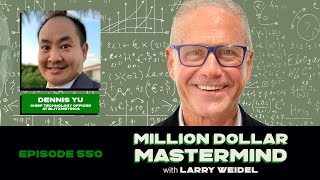
Dennis Yu talks about his path from learning English at age 6 to building data systems at American Airlines, Yahoo, and Facebook. He credits mentorship and Toastmasters for developing public speaking skills, and stresses that moving change in big organizations requires both political strategy and data-driven metrics.
Welcome to this edition of the Million Dollar Mastermind podcast. This is where we pick the brains of high achievers from all walks of life and get their hard earned real world insights on ready. I'm your host, Larry Wydell. How did you get. You said I was just a guy who was in the right place at the right time. You know, when all this was, you know, randomly fall into the right place at the right time. For example, like we've had had a fellow and he worked with Jeff Bezos, you know, in artificial intelligences his second year out of Stanford. But, you know, he worked with him for like 12 years every day. And the thing is, like, well, he actually studied artificial intelligence and majored in it and, you know, he had the credentials to get that position.
You know, it wasn't random. Yeah, I know it wasn't random.
And so what got, what do you think got you moving in the right direction? What kind of things were you curious about, interested in, attracted to?
So I didn't speak English until I was 6, so. So math was my thing. I competed in math contests. I'm an Asian, so I'm like naturally good at math. I had a perfect SAT in math, and someone who, who was the CEO of American Airlines kind of took interest in me as a mentor and he taught me and opened up opportunities. And when American Airlines wanted to build their website in the mid-90s, he naturally said, well, Dennis should be the one. So that's what I did. And I learned how to work with large data systems. So Sabre, which back then and still is today, I think the world's largest commercial data system, I'd integrate that with the frequent flyer system, which is all the people who have miles. That's, that's called Adams, the customer system for American Airlines. And then integrated with the website that we're building. So I had to integrate really, really large data sets 25 plus years ago. And because of what happened at American Airlines, that just happened to put me in the right spot with Yahoo. Because when I was an American, I had to buy traffic, I had to manage a huge email list of several million people. I had to manage all these different applications of things that you could do on the website, like check your miles and buy a ticket and give us your hotel preferences and, you know, check your frequent or your, you know, the car rental partnerships, redeem miles, all these sorts of things. And so that couldn't have happened unless a mentor believed in me. But then what could have happened before that was I had to get good at math in Order for a mentor to see, like, oh, this guy's actually good at math and building websites. So I built a number of websites before I then went to American, and American then led to Yahoo, which is sort of like the big data prize of them all. Like, it made a lot of sense for me to go. Like, I've always been headed towards wherever the most data is. So. And after Yahoo, I worked on Facebook data because Facebook then had arguably more data.
Wow. Now when you get, you know, you come. It's one thing to get anointed. You know, come in, we'll have Dennis do it. But you got to perform and you got to put teams together.
Yeah.
And probably not everybody was voting for Dennis. You know, I know how corporations work.
A lot of politics, but I can always go to the big boss. Yeah.
And so it gave you an incredible advantage. But, you know, the jealousies, the old people, you know, the old, you know, inside the big corporation, you always have people that have been there forever, and a lot of them are riding it out. They don't want to make big technological changes until they retire because they know it's going to be a big thing, and they just, you know, they're going to fight against all of that stuff. But you have to get people. You know, it's not one thing to have the math skills. It's another thing to have the people skills.
Yeah.
What did you learn about and what surprised you about the necessity for getting the people skills working in your favor?
I was a great academic. I was great at test taking and essays and getting straight A's. But then when I got into the real world, I thought that being competent was enough. And then I later realized, I thought, you know, like, I wanted to work at Nike. When I came out of high school, I was idealistic, right? And I thought, Nike, what is what. What do you think Nike is? If you're, you know, 17 years old, you think it's a bunch of athletes having fun. You don't think of corporations and managers and cubicles and, you know, forms and security and legal. And so I was just massively just disappointed because when I hit the corporate world, I was thinking like, oh, American Airlines, we get to talk about flying planes all the time. No, we're in. We're in offices having meetings, and there's politics. I have so many knives in the back of my back. Right. And I realized 90% of it is in building relationships and only 10% of it is competency, which just puzzles the.
Heck out of that. Please say that again. Please Say that again.
Yeah. 90% of it is relationships and 10% of it is competency. So it wasn't until I learned how to communicate that my career started going the right way. So I get this. You probably did this too, Larry. I did Toastmasters. That's how I learned to speak. Yeah, I was so scared of speaking if, if the phone would ring on my desk, I wouldn't answer it because I wouldn't know what to do. I was so scared of it, I wouldn't talk in meetings because I don't know what to say. I was just. I didn't want to talk. I wanted to hide behind email and reports and things like that. So the biggest change for me in the last 20 years is learning how to communicate publicly, having the courage to be on a podcast like this and not be worried about people judging me or whatnot. But the EQ and management skills I would argue was. Has been way more important to me than being technically competent. But if I wasn't technically competent, then I couldn't have had these other things happen.
And just. So if it'll make you feel any better, I know multimillion dollar earners, in part, they're members of big organizations that at conventions where the convention, the bulk of the people there will be on their own team. They have such a shyness about their personal. They're afraid to go out of their room. You know, they got a force at a convention that they're a hero, everybody works, but they're afraid to get out there. And so that is a real problem. But the fact that you faced up to it and found. How do you even find out about Toastmasters?
A friend recommended it, coworker of mine.
And so was that, that a struggle for you? Did you say, okay, I'll go this afternoon? Did you just have to think about it, check it out.
I was scared to death of public speaking. I think most people are initially, if they want to be honest about it.
Right.
And it was only a few months after that that I gave the closing keynote at a conference with 2,000 people. So imagine I have no public speaking experience. I don't know what I'm doing. I can't even talk in a room of three people in a conference room because I'm forgetting what to say and I'm nervous. And then I have to scroll out on stage in front of 2,000 people. They're playing the walk up music. There's my face is on the giant screen behind me. I have to deliver a one hour presentation that motivates A whole group of software executives. I think I did okay. And people came. I thought. I don't know, I was nervous, so I wasn't really sure. But so many people came up and said, dude, you killed it. I had a standing ovation. So I thought I could probably do this thing.
Yeah. And so do you remember what you talked about, what the subject was?
It was the future of CRM. So CRM is Customer Relationship Marketing. Yeah, it's the idea. So I gave the example of, you know, back then, if you complain to the airline, let's say that you are on a flight, you opened up the overhead bin and a bag fell on your head, right? And you got mad. So then what do you do? You go to the reservations desk there and you complain, right? Did they check in? You complain like, hey, you know, I'm mad. And what do they do? If you're smart, you know that they can award you 2,000 miles without needing to escalate to a manager, Right. That's discretionary. But you can also call. You can call the 1-800-433-70300 or whatever it is for American Airlines, and they'll give you 2,000 miles. But you can also write in to customer relations. And so all these different departments, they don't talk to each other. You can send a message like an email through the website and complain, hey, a bag fell on my head. I'm an important traveler. A bag fell on my head. Give me some miles, because I'm a loyal customer. So you could probably get 10,000 miles because each of these departments are not communicating with each other. Because what happens is that each of these guys has a separate system. So there's a system for the phone calls. There's a system for email. There's a system for what happens at the airport. There's system. All these different systems, and they don't talk to each other. So we need to do in order to provide a great customer experience is. So, Larry, if you call me, if you call American Airlines on the phone and you tell me something about that, you really like to go to, you know, sunny destinations because you like the beach, right? And I track that. Then anytime you engage with me in any of the. On the plane or at the airport or an email or maybe you get a monthly statement saying this is what your status is and how many miles you're. That. That communication on any channel should reflect anything that we learned from any other channel. So all of these need to tie back to a central database to be able to personalize how we treat you. So if you look at, I stayed at the Ritz last night and they have fantastic service. Not just because they train their people really well, but, you know, they have systems to remember who you are and what your preferences are. So then when you stay at another Ritz, they're going to remember that you like soft pillows or that you like to have extra towels or just some kind of thing. And so you just feel super special when they remember details like that about you. So I was talking about how we can build systems to enable that.
Yeah, and so well done to get a standing ovation on, you know, a topic that is not naturally infused with a lot of humor and laughs, you know. But so, yeah, when, when you point out the thing that I was wanting to get at earlier, like the different divisions, different. They have their own little empires inside corporations. And that's what, back when corporations were getting their own websites, that's when the battle inside the corporations really unfolded. Where the battle for real estate, you know, on the home page, you know, the different departments, you know, it was like, it was like Europe back when they're medieval, the knights are going back and they're fighting each other, you know, for, for land. You know, this is, you know, this is my castle and all the fiefdoms. Yeah, fiefdoms, that's a word. And silos, you know, but, but you know, all of that, you know, because they're, they want to look good to the boss, you know, they, you know, they don't want to be, you know, pushed to the side by some other department. And so you see why they do that. But it gets to be. You talk about politics, you know, this is election day. Politics is on everybody's mind. Yet there's no more vicious politics of people fighting for their own jobs and their teams inside these corporations. And you go in. But I've always thought, you know, what I, what I found was that I learned this, I did. I figured this out early in the game that the computer guys were like the green Berets of the corporation. If you needed something. When anybody needs a special project done from the CEO, all the way down, if you get a special project, you gotta call in special forces and that's the computer guys. And so I made it my job to become first name basis with all of those guys. And as a result, I got a lot of my projects done way in advance of a CEO because they just like me better, you know.
Because you were nice to them.
Yeah, be nice to them. And it was like, and when I first went over to their building, you know, I'm in the field, you know, in sales. And when I went over there, it was like Marco Polo, you know, in, in a foreign land. They said, you know, we've heard about you, we've seen your name for years. You know, we've never actually knew that we would see you in person or, or any of your kind, you know, any of this.
I feel like an alien, yeah, like.
An alien inside the computer building. But when you come up with things, you know, you get, you deal with the facts, you put it together, you, you analyze it. We're not up for debate anymore. We've got the data, we've analyzed it, things need to be done. Now you go back over to this entrenched bureaucratic world where they're not interested in making that, how do you go? And to be honest, it's not always smart to make wholesale changes overnight because there's the unintended consequences, time effect. How did you get your first education and learn about the, you know, best ways, best practices of implementing these kinds of changes that, you know, really make everybody's life better, you know, so it's.
A two pronged strategy. So the first prong is political. So whenever I want to get something done, I always get the buy in of the big boss because the big boss wants to do it. It's a lot easier than trying to talk to a coworker and a manager and a director and a vp. It's power flows down. So you can never try to convince your way all the way up. That's just too many meetings someone's going to. The minute someone above you kills your idea, it basically dies. So you always start top down, as high as possible, all the way down. The other side of this is you want to have some kind of logical thing. So I just told you before about metrics, analysis, action, using the data, drawing the conclusion of what's going on. And then here's the recommendation of therefore, what do we need to do? So what I would do to manipulate the situation for any decision I wanted to make was listen to this Larry. So if I want to spend another $5 million to buy servers, then I have to justify that. And that's because our website is running slow, because we need to add more servers, because our traffic is going up, because it'll cost us this much in sales by not having more machines to be able to allow our, I'm simplifying, but to allow our website to run faster. And then here's the stats showing that our current servers are running slow and here's how many people are coming to our website and here's how long it takes for the web pages to load. And here's how much our projection is for what our traffic's going to look like. So if I go metrics, here's all my stats and performance to analysis. We are already almost at, we're at 85% capacity and in six months we're going to run out of space. So we need to double our server load because our growth is at this level. The action is, therefore we need to order six Sun E10000 systems with 32 CPUs and 32 gigs of RAM each to be able to keep up with our server load. Right? Right. So I found kind of as the computer guy, the data guy, here's the insight. Whoever controls the data, whoever's closest to the data is in the best position to be able to provide the analysis. Right? Because they're the closest to the data. If you know how to communicate about the data, if you know how to communicate the data, you can then make recommendations. Because if you're analyzing the data, no one can challenge you because you've got the data. But from the recommend, you know, from the analysis, I can bridge that straight to the recommendation. So if there's any action that I want, I can always back that into the analysis and then find the data to be able to support that. And thus no one could ever challenge me in any situation, at any company that I've been at, because I'm the one closest to the data. And how is anybody, unless they're competent at pulling data as good as I am, because I know how to manage huge databases, nobody can challenge me because that's how I win. Right. I can always trace it back to the data, produce the charts. If I have the political skill and I have the data, I win in this left brain and right, if I do just one or the other, I'm dead.
Thanks for listening to the Million Dollar Mastermind. If you felt there were any valuable takeaways from this episode, please take a minute and leave us a five star review. Your feedback is important and really helps us get the word out to a wider audience. Remember, we have a valuable webinar that is absolutely, absolutely free. Register for it right now@whitealawnwinning.com thanks for listening.
More from Larry









Rick Jordan on Self-Engineered Proximity, Cyber Security Moats, and Truth-Based Leadership

Fire Fast or Fail Slow: Kevin Brittingham Reveals the One Rule That Built a $100M Empire
