Episode #566 - Scaling A Business Through Proactivity with Ari Meisel
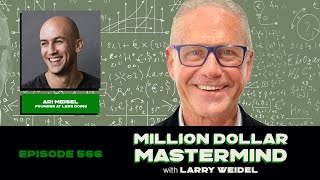
Ari Meisel on turning a health crisis into a productivity system. He automated and outsourced his way to becoming replaceable as a founder, then had to overcome the psychological barriers that made him resist delegating in the first place.
Welcome to this edition of the Million Dollar Mastermind podcast. This is where we pick the brains of high achievers from all walks of life and get their hard earned real world insights on winning. I'm your host, Larry Wydell.
Would it be safe to say that when you're in construction, you gotta be proactive because you have deadlines, you gotta get things done, and if anybody drops the ball at the deadline point, the only person anyone looks at is you, you know, it's your fault. And so you gotta be very proactive at getting the right people, staying on schedule, getting things done, having the right materials. And so being proactive as a way of life did. When you get knocked on your can from this, and this is an important thing for the people who listen to this podcast to hear is you cannot assume you're going to be healthy your entire life, that you're not going to have something weird, a stroke. You can minimize the chances. But I talked to a cardiac surgeon this summer and he said there was a runner who had done five marathons in the previous six months and he had a blockage and so they had to do open heart surgery on this guy who was extremely fit. So you cannot just say, I'm going to eat right, I'm going to do the right things and I'll be exempt. None of us can be, you know, like Grant Wall, I don't know if you heard that, but the guy who wrote for Sports Illustrated, he's a big soccer player.
Yeah, that's very sad.
He looks a lot like you, by the way. And you know, he, he just, you know, they said it was something slow growing, a slow growing aneurysm inside of his head. And his brother accused the Qataris of poisoning him for his political views and this, that, the other, you know, you have all these things that come up and they say, oh, my bad, it was just, it was something that, and they said if there had been oxygen on the scene, any kind of thing, admitted he was still gone, you know, because it was internal. And so we don't know that we can avoid facing things in life, but you can be proactive once you recover from the gut punch. You know, I don't know. You know, like you said, you're incapacitated with heavy doses of drugs to kind of shock you back and get you on the right track. But as soon as you get the least bit of energy, you can start being proactive and getting yourself out of the hole. And how, what, what did, what steps did you do to start being proactive? With your health, but also in your business. Like, I need an income here, you know?
Yeah. So I should point out that one of the things in my journey is I also became an emt. So I currently do some volunteer work and some contract work as an emt, which I love. It's a very, very big passion of mine. But that the purpose of that was sort of to get me to have a little bit more academic understanding of sort of medicine and how the body works and whatnot. So that was something proactive that I did for my health and for my family to be. To have that skillset. And so for my business, what I did was I started. I. I was presented with this extreme restriction on my time. And so I had to figure out ways that I could optimize, automate, and outsource all the things that I was doing in order to actually get them done, because I just didn't have the time or the energy initially. And so I just started. Just as I experiment with my body, I experimented with productivity techniques. There were all sorts of new tools and things that were coming out at the time, and I was just using things in different ways, and people started to notice. And I was writing blog posts, which then turned into classes that I was teaching in person at the time, and then those turned into books, and eventually coaching and consulting and speaking, all those different things. So it was really that idea of. And eventually that became what was called a replaceable founder. So how do we make ourselves as replaceable as possible? Because one way or another, you get replaced.
And how did that thought occur to you? Well, I'll tell you, to reinforce that thing. If you're building a business, the thing to understand it only becomes a business when it can operate at high efficiency with you not there. And so the idea from the beginning of starting your business is to replace yourself so that you don't have to be there, that you know that you have a business, that you actually have a business, rather than you created a job for yourself. And.
And so I always say, owning your own job.
Yeah, owning your own job. You know, the Michael Gerber e Myth idea. But how did this. How did that come to you? And how did that impact you when you first got that thought clear in your head?
So I actually had a professor in Wharton who used to say, don't ever be irreplaceable, because if you can't be replaced, you can't be promoted. And that always stuck with me. And I love that expression. And so for me, it was like, well, if I Don't. If I'm not here, not operating up, pushing, my hands aren't on scene. The business runs through alt. So I have to make myself more replaceable, which there's a whole technical and logistical aspect to that, but there's a huge psychological kind of ego aspect in that. But I deal with clients all the time becoming more replaceable because then they, like, what's their value then? Which is. It's. It's farcical when people get in that mode, but it happens all the time. So it was. It was just that idea of extreme restriction. And the example I always like to Give is like, MacGyver, you know, so you look like somebody who might have been a MacGyver fan.
Yeah. So not. Not by choice, by necessity. Yeah, there you go.
So nobody ever said to Angus, hey, man, look, go across the street to the Home Depot, grab whatever you need, come back over here, and we got to take this building down. It was always like, here's a paper clip and a piece of a life vest. Like, you need to blow up this building, and you would do it. So to me, that restriction is what breeds innovation. So I would create. In the case of the Crohn's, I had a legitimate uncontrollable restriction on my time. But I took that into other aspects of my life, my business. Like, well, what if we could do this in an hour as opposed to three hours? What if we could do this with a hundred dollars instead of $300? Like, what would that require? Even if it sounded crazy, you know, what would that require? And a lot of times it worked out.
Yeah, you see that all through art, too, to develop the. By the way, that's David Oliveira calling now, who I was telling you about earlier. The thing is that you get to where you have limitations and you can waste time worrying about that. But the truth of it is, in all of the creative worlds, they encourage people to give, you know, to artificially restrict yourself. I'm only going to work on this size paper. I'm going to work on this medium, and I'm going to see what I come up with. This, you know, two colors, monochrome. Or I'm, you know, I'm only going to work with oils and in photography, it's like, I'm only going to have one lens, you know, leave one camera, one lens. I'm going to go for a month, and I'm going to restrict myself to, like, a 50 millimeter lens and then see what I can come up with, rather than taking all of this baggage in fact, my brother worked for 40 years with Tom Petty at the Heartbreakers. And, you know, they were purists with all of the analog stuff and everything and not a lot of gimmicks. And he told me one time that Mike Campbell, the lead guitarist, the one who came up with that, you know, the lead for American Girl, and by the way, he's the. He's. He's the lead guitarist for Fleetwood Mac now. But he showed up at a. He told me about a recording gig. He was helping somebody out. He showed up with just his guitar and one pedal and a guy from one of the other bands that we've all heard of. He showed up with basically three roadies, trunks full of stuff, you know, took an hour and a half to lay everything out. And for the same three minute, two minute little blip, you know, and Campbell just walks in with a guitar and one pedal and knocks it off and steals a show. And so if you're forced, you know, you can get yourself all caught up in the peripherals and not miss the point of the content. You know, what you're trying to get done and make sure that pops. And so what do you do when. With the people who can't let go? Because that starts. I think that starts with people are in corporate structures and they're afraid that if I train so and so to do my job, then they're going to let me go, I'm going to lose my job. And so I've got to make myself irreplaceable. But you can't really grow in life if you make yourself like that. You never will be promoted. And so great insight from the Wharton Professor. Where does, where did that. How do you get people past that point emotionally if they're founders?
It kind of depends on the person. It kind of depends on their situation. And so you have a few different sort of personalities there. There's the people who just don't know there's another way to do it, which I see that all the time. And they're a little easier there. It's more like, hey, look, you can do it this way. And they're like, whoa, okay, great. That's the easy one. Then there are the ones that it's a real issue for them and like, it's their business, their baby, they have to be there, blah, blah. That is, that's when I have to become like more of a therapist, honestly, and start to really dig into why they feel that way. And it's usually. Some entrepreneurs are usually psychologically damaged people. I'LL just say that right now.
Yeah.
And so, and a lot of times they're taking out their psychological damage on their team and their company. I often say that as I, the more and more that I do this, the longer I do this, the more I feel like my work is about protecting the entrepreneur's team from the entrepreneur's mind. And so.
Repeat that please.
I find that a lot of the work that I do with my clients and the teams are working with is that, that I'm focused on ways to protect the entrepreneur's team from the entrepreneur's mind. You know, there's a, there's an old joke which is, you know, why don't, why don't cowboys skydive? Because it scares the crap out of their horses. Yeah, right, Right. So, and that's the thing is like, that's the entrepreneur's team. In many cases, entrepreneurs have, you know, they think every idea is the best idea they've ever had and then they send people in all sorts of different directions and it creates stress and anxiety. It's a, it's horrible. And this is like, I mean, there are some entrepreneurs who are incredible thinkers. There are very, very few entrepreneurs who are good at running businesses. Very few. Yeah. And again, I have worked with probably well over 2,000 different companies. And so this is based on anecdotal evidence, but quite a bit of anecdotal evidence. So. And that's fine because they still have a huge amount of value. They just recognize what it is. So sometimes it's a small shift in that way, just sort of getting people to see that the damage that they're doing in some cases, or the lack of innovation, they're actually providing their business and sort of a better value, the grass is greener kind of approach. And then the third kind are the ones who have. And it's still sort of a psychology thing, but a lot of it's like a trust issue. So it's slightly different than the ego issue. There's the trust issue whether they don't believe that either they've been actually hurt by someone or something, they've been stolen from whatever it might be, or they just get into this state and it's not an ego thing again, but where they believe that the thing that they do is so specialized and so high level that there's just nobody else that could possibly do it. And that's just, it's very self limiting at that point. Right. Because a, I would argue that if you can't teach something, you don't actually have mastery of it, right? So if you say you can't teach it, then you probably haven't mastered either, which means there probably is somebody who has. And then the other part of that is that we can do more things nowadays. There's people that can, and there's software that can do things that for years we needed a person to do and spend their time doing. And it's just not the case anymore.
Thanks for listening to the Million Dollar Mastermind. If you felt there were any valuable takeaways from this episode, please take a minute and leave us a five star review. Your feedback is important and really helps.
Us get the word out to a wider audience.
Remember, we have a valuable webinar that is is absolutely free. Register for it right now@whiteallonwinning.com thanks for listening.
More from Larry









Rick Jordan on Self-Engineered Proximity, Cyber Security Moats, and Truth-Based Leadership

Fire Fast or Fail Slow: Kevin Brittingham Reveals the One Rule That Built a $100M Empire
