Episode #575 - Being Value-Driven With A Positive Mindset with Jennifer Kem
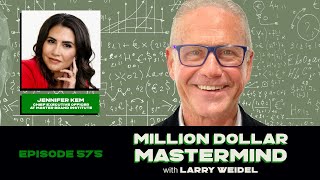
Jennifer Kem talks about pivoting from corporate after a promotion fell through, launching a women's underwear brand that hit $10M in sales in a year, losing it in the 2008 recession, and rebuilding as a consultant and founder of Master Brand. She emphasizes enrollment, hiring ops talent, and planning exits strategically rather than jumping impulsively.
Questions this video answers
Episode #575 - Being Value-Driven With A Positive Mindset with Jennifer Kem
January 18, 2023
About $10 million in sales within a year.
She referenced a $400,000 salary plus bonus.
She created a nine-month plan to exit the company.
Welcome to this edition of the Million Dollar Mastermind podcast. This is where we pick the brains of high achievers from all walks of life and get their hard earned real world insights on winning. I'm your host, Larry Wydell.
I do believe you did get a, you know, master's PhD in a lot of fields. Politics, Sales. You had to be a master salesperson.
Oh, yes, Enrollment. I say, yeah, you get in the.
Seat, you know, in the boardroom. The trouble with these idiots is they all think they're smart. They're a bunch of generals and they think they're smarter than you. And they're, they're condescending in their, their ignorance and they think, you know, you're telling them stuff. They know it all, you know, and when they start spewing it out, that's when you find out how ignorant they really are. But they think they're smarter than you and they've got all these other things. And to be able to sell a project, you know, sell to get budgeting, you know, to get the money, the, you know, deal with the finance people and all.
Oh, yeah. I mean, God, I mean, literally, what I interface with the CEO, with the cfo, you know, CFO is all they care about is, you know, EBITDA and P and L, and it's kind of like, yes, and you're making an investment. This is an innovation. We want to be a leader in this. And so it was. I love what you said. I think that your number one skill to be successful in life, period, is your mastery of enrollment. Meaning we are always enrolling people into what we want. Right. Even as young kids, as toddlers, you have children, your kids are so good at enrollment, they are constantly figuring out ways to present it so that you'll do their bidding. Right? And the same is true in business. You know, if you become a master of enrollment, you can get people to work on harder projects. You can get the financial resources, you can negotiate better pay. You can. So enrollment, to me, and it's in my book, it's a chapter in my book of, like, if you become a master of enrollment, you're going to love your life. Like, again, like, even whatever, your realtor, you know, your dream home or whatever enrollment is.
What's the biggest thing you learned about becoming a master of enrollment, would you say? Because that's, that's huge. I mean, I can't, I can't emphasize and endorse that more. Go ahead.
Yeah. And I, you know what? I realized that people had an aversion to the word sales, right? And I remember in the corporate world getting into this heated debate with the director of sales. Actually, she was my. She was my biggest adversary in this project because, you know, we were changing the products that they could sell and the way they were commissioned. And great salespeople love money, right? And I had to enroll her. And I realized, you know what? This was literally the conversation. I said, you know, you're in the business of sales, but what you're really in the business of is enrollment. And what I want you to see me as is I'm trying to enroll you into the bigger vision, how you play a role in the future with this company or any other company. And so that was. That's a literally the real conversation. When you ask me, like, how did I master it, that conversation with the director of sales and making her see that her mastery of enrollment was a skill that she could to ascend her own way. And she was like, oh, dang. Like, that's a great way to see it, you know, And I think. I don't know. I mean, a lot of times I think, because I try to find the words people can handle, you're pre selling.
The heck out of your book, you.
Know, that.
That'S what I do for.
A living, you know, Jennifer Kim, I.
Don'T know if we know the name.
Of the book yet, but, you know, I didn't know this is the direction this is going to go, but I know it's going to be powerful. But, you know, powerful lessons and powerful book come from people who've done powerful things. Not powerful professors, you know, who have studied and taught all things. They don't know that people that have.
Absolutely, yes. I mean, the doers. The world. Successful. Successful people are doers. Ultimately.
Like, that's very hard to get someone like you to write a book. You know, the thing is, like, when I wrote my book, it was like, I need to do it, because people like me don't write books like this, you know, and, you know, you don't get a chance to hear it. And the great thing about this, the podcast idea came up later where you could just get people to kind of COVID it live and you can hear the emotion in their own voice. But this is kind of stuff that you usually have to figure out on your own, except getting bits and pieces from other people. But let's go on now. You left. You obviously did well at that. Where did you get the idea? Time to move on. No more C. No more C suite, no more chasing the CEO. I just Got to do my own thing. And then you. Lingerie, of all things.
I know. Well, okay, so it's an interesting transition. So, number one, I implemented that project against all odds. It was a success. That project alone has now made billions of dollars for that company. And I think it's great. I'm proud of the work and I'm proud of the people I got to work with. And I was promised a promotion if I took this project on.
Right.
I had somebody who was filling my job as head of business to business, and I wanted to see him promoted into my role. And I was supposed to get ascended. Well, while I was busy working my buns off and making all that stuff happen and getting smarter for sure. Based on what you said, my counterpart in B2C was playing golf with our boss every weekend or every day, really. And I. That was a big lesson for me that it's not just about the work and the doing. It's about being around the people who have influence. Right. And I learned that hard lesson when promotion time came up and he got my job instead of me. And I back to values driven. I talked about that was a big violation of my values. And I was like, wait a minute. So you work hard, you create epic results, you've created all these relationships. I mean, people would admire me a lot, and they still admire me a lot for being able to know and focus on the right relationships. I'm not the person who's going to be like, I'm not an extrovert. I'm more strategic. Like, who? What's that strategic connection that will help move this thing forward. And the one thing I was missing was golf. Like, I wasn't hanging out with my boss. Right. And, and so, you know, I. Instead of getting mad, I mean, I was irritated. I was not going to lie.
Can I say this for you, Jennifer? I think we all have a plan that was set up for us, and I think things happen for a purpose. And I think that double cross, because basically that was a double cross.
I haven't heard that term in a long time. And I love that. I, I love that term.
And I think the loss to the company is the extra billions you could have made for them, you know, and the lost billions that whoever the golfer was, you know, I don't even know how that went, but I know that probably didn't work out.
It didn't work out. He left a year later. And I want to say that I'm still friends with my old boss and him and, and, and they're so jealous of my life, Larry, because I have so much more freedom and autonomy than they do. And, and so to your point, I love that. I absolutely believe there was a master plan for me. And my, my thing was just keep smelling forward. Meaning like, you know, have the, you know, the instinct. Yeah, this instinct and intuition to go out. I can trust the next step, even though it's scary. Like it's super scary, you know, And I remember that moment. Yeah, the moment I, that moment of being told he was going to get the job I was promised. I said, I'm going to make a nine month plan to exit this company. So that's another piece. I think a lot of people hear the sexy story about, oh, entrepreneurship. Just like say, eff it and jump off the ledge and go, whatever. I'm not built like that. Other people fine. But for me, it was like I had two young kids at the time. I had a family to feed. I. And so I said, look, I'm going to create a nine month plan to exit. And I did that. Now, if I were to rewind, what I know is I could have probably exited in 90 days instead of nine months. But I didn't know any better. So what I did is I saved my. And I had no reason to leave, Larry. I had a $400,000 salary plus bonus. I had a corner office with a disco ball in it, and I had a parking spot that had my name on it. And I had all these trophies of life that said, Jen's successful, she's only 31. You know, all the things, right? I had a beautiful executive home, my two kids were in private school. But I was like, wait a minute, I'm. I realized in that moment that I had no control over my future. I only had, you know, obviously, because the hard work didn't allow me to control my future. It just told me that I'd have to quit and leave. And I didn't want to leave because I loved my team, but I knew I had to do something. So that's what happened. Then how did I get into women's underwear? It's such a weird transition.
For those of you who are sick and tired of fooling around and are dead serious about wanting to move, move up fast. I've got something especially for you. I've combined the best insights from over 40 years in business and making $70 million in income and compressed them into a free webinar. That's right. It's a free resource if you want to find out exactly what the concepts are that I use in coaching million dollar earners. Register now@widelonwinning.com you'll discover the five part framework used by so many to reach their financial, personal and professional goals. You can find that link in this episode's show.
Notes the thing is to emphasize the thing is, first of all, a lot of times the things that happen are unrelated to like salary position. It's to get you to move in a direction you wouldn't have gone otherwise. Has to be something that cuts you to the bone, cuts you to the soul. It's a violation of your, of what? It's like, no, no, no. They raised me to a million, you know, give me another title. But they, you know, they didn't give me, I don't care what they do two parking. But no, you know, you stab me, you double cross me.
No.
And it has to be something like that that cuts you to the bone to cause you to make significant changes in our life. And so you don't feel like that at the time, you know, you're ready to kill people. But a lot of times the things that happen to us, we would have only done it if it had been that hurt. That, if it hurt that bad. You know, it was like personal.
Oh yeah, it was very, I felt, I felt it was personal. I gave up so much time with my kids those two years I was on that project. You know, I worked day and night. I had to get other reinforcements in my personal life. So my personal life didn't feel successful. My, my business life felt successful. My personal life. And you know, I know this show is about, I think, whole success and for me that was the big lesson I learned was like, I'm trading off my personal happiness to. And that doesn't work for me.
The other thing that I like to point out to you is that you did right, which we don't all learn this right away, but never give up your strength when you're making a change. You've got your strength, your foundation you're standing on. Don't get provoked into just jumping off the edge of the building. You know what I'm saying? If you want to, you're in this building. You want to be in the skyscraper across the street. You may be so furious, you just want to jump, but it's just like, no, go find the stairs in the elevator, go down to the street, walk the street and then climb the elevator over there. Be rational about your transition. Don't throw your strength away. Hold your strength. And you did a great job.
Hollywood and social media yeah, Hollywood and social media do a lot of that. Romancing of that, like, effort. Let's jump. But in the real world, especially if you have other responsibilities, you know, you can still be radical. Because this was radical for me to decide to leave the corporate world where I felt safe and secure. And even if I got passed up for the promotion, I can tell you I knew I could, like, again, recruiters could have called me at that point. I probably would have moved on to another company, right? But what I realized was, again, no control over my future. So what happened was I used to fly from Honolulu to Dallas quite frequently, like, every. Every month. And I was, in my mind, I was like, what kind of thing should I do? And I knew I was leaving, but I just didn't know what I was going to do. I didn't know what kind of business I wanted to create. And so what I do, as somebody who's. I'm a brand futurist, I can see the future because all I do is study how people behave and how the market moves. And I started noticing coming back from Dallas that all the women on the plane had a bag that they had that was their carry on, and it was the pink bag. It was a Victoria's Secret bag. And I realized that moment, I was like, all the women who live here don't have a place to buy undergarments. Now, I didn't have a background in this at all, but I'm looking for, if you want to be successful, you have to build something people want.
That's.
That's, like, ultimately it. If people don't want it, there's no money there. There's no opportunity there. So for me, I was like, I'll try that. And it's crazy because again, I hope what you've heard is every single time I've made a big pivot, I was naive to some degree, right? I was like, oh, I've never done this before. But I chose a business that I thought, oh, I can expand that because I know how to build a brand. I know how to launch a product to market. I can create buzz under it. Now, I had also some environmental positives which were like, Oprah Winfrey still had her show. She started doing this whole series on Bern Nordstrom. She's the one. If any of you are familiar with the Spanx brand. Sarah Blakely, she's a billionaire. Oprah's the reason she's a billionaire, because she highlighted her. And this was all in 2005, 2006. So anyway, I decided to start My own brand selling underwear. And within a year, we were already doing $10 million in sales. And I was expanding because there's a.
Lot of complicated things involved in that that you can't get into. But did you just. The things you didn't know how to do from creating, manufacturing, storing, you know that. How did you. How did you get that information and get that on board to where you could make and your marketing campaign, you know, to get.
Yeah, yeah, yeah. Well, I think. Okay, so I'm writing this in my book, and I'm not seeding on purpose. This is literally. I, you know, there's two things that make a brand. And most people talk about ideas. Yeah, sure, your ideas make a brand. But you know what? The second thing, and just as important, if not more important is, is people. People make the brand great. And so what I learned in the corporate world, I was like, I need to get somebody good at operations because that's not my skill set. That wasn't my gift, Right. So I hired somebody in ops, and that's how I was able to scale and move so fast. And I think a lot of people don't. Creatives and visionaries. There's a point in my career where I had to be organized. But the truth is, most of us that are visionaries are not organized people. We need people, people who enjoy mobilizing those ideas and turning them into real things. So the answer is, I got a great operations person, and that's how we built it to $10 million within a year. Because I know how to make something exciting and make money. That's like one of my gifts. I understand how to create that kind of value exchange. And then you need the second person who's really great at making sure that the brand promise is delivered, which means fulfillment, you know, all the things. And then you need a good finance person, because if you don't know your money, then you're going to screw it up. And that's kind of was my Achilles heel is I. I didn't hire the right finance person. And then the recession came in 2008, and I lost everything. So I went from, you know, a outlier story of somebody who went into entrepreneurship and was successful right away to completely losing it on 2008 because I was in, you know, Great Recession of 2008. I was in the two industries that got smashed. You know, got smashed, which is retail and real estate. And at the time, there was no PPP or bailout for small business only. There was only a bailout for big businesses. And that was another violation in my life. Like, I was like, this is screwed. Like, why are, why are we not helping Main Street? Because. And I had never worked on Main Street. I always worked on the Wall street side, you know, and it gave me a huge awakening, like, oh, well, I can go and influence that in a way better. So it's how I became my company now, which is, you know, I realized that I could go back and be a consultant in what I knew, which a lot of people. It's a great way to create autonomy. And everybody knows if you work in the corporate world, they respect consultants more than employees, unfortunately. And I did that. And then I created. Then everybody wanted my services because Verizon was like, you know, I was, I was leading all their special projects. And then. So then I started working for Oracle at Microsoft on a consultancy basis. And then kind of the rest is history. So since 2009 until now, at the time of this recording, my company, which is called Master Brand, you know, started as a consultancy and then now turned into like multi. We're a media company really. Now we do education, training. You know, we help entrepreneurs specifically learn how to use corporate structure so that they move faster. Because there's also this, a lie out there on the market that you don't have, you know, corporate like, you know, drags you down. I'm like, no, actually I learned from corporate how to go fast. And I think that that's another myth that's out there especially for entrepreneurs. And I think they can do it on their own. And I'm like, you need an ops person. You need to make your first investment in staff to be an ops person, because you suck at organization. And what you need to really work on is your leadership of these people. Because if you work on the leadership of these people, then you can create anything you want.
Thanks for listening to the Million Dollar Mastermind. If you felt there were any valuable takeaways from this episode, please take a minute. Leave us a five star review. Your feedback is important and really helps us get the word out to a wider audience. Remember, we have a valuable webinar that is absolutely free. Register for it right now@whiteallonwinning.com thanks for listening.
More from Larry









Rick Jordan on Self-Engineered Proximity, Cyber Security Moats, and Truth-Based Leadership

Fire Fast or Fail Slow: Kevin Brittingham Reveals the One Rule That Built a $100M Empire
