Episode #595 - Will AI Change Our Lives? With Manuj Aggarawal, Founder of TetraNoodle Technologies
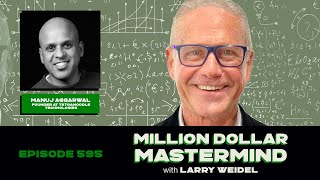
Manuj Aggarawal built an AI education tool that cut college dropout rates by recommending the right courses. It caught the attention of Barack Obama and Bill Gates. He also uses AI for marketing and sees a future of abundance powered by AI and blockchain.
Welcome to this edition of the Million Dollar Mastermind podcast. This is where we pick the brains of high achievers from all walks of life and get their hard earned real world insights on winning. I'm your host, Larry Wydell.
I want to shift gears right now and talk about when you went to Vancouver, how old were you?
I was like 22.
And you followed the female, right?
Yes, that's right.
Yeah. And when you got to Vancouver, one of the shocks, I guess that hit you was this assimilation is going to take an effort. Was that right?
Absolutely.
What are some things that happened to you right off the bat that made you realize, I'm going to have to figure out how to fit in and, you know, where, you know, you can't be effective if your culture is getting in the way. And so talk about that.
Yeah, so a few things I remember, you know, I like, you know, I didn't realize there's a, you know, there's a, like there's a cult, you know, Okay, I don't want to, I don't want to offend anybody. So I want to use my words very carefully here. I didn't know that there's a, there's a culture of white culture and there's a, you know, immigrant culture and then there is another culture of natives. Right?
Yeah.
And then when people started talking about, you know, these different cultures, I was like, man, like, I didn't even realize that even before the so called native Canadians, there was another class of people here already. So that creates even more like complications. And then in many conversations again, you know, I know I don't want to offend anybody. Some people referred them as Indians. I was like, I'm an Indian, you know, like, what is that? What does that, what does that really mean? Like, you know, I don't understand. And so, so that was very confusing to me. And then the next thing what happened was like, you know, first of all, most people didn't pay attention to what I was saying or, you know, I was like a new immigrant. But then slowly they started saying, oh, you know, this guy knows few things, so let's invite him into some meetings. He can provide some value. And so I remember going into the boardrooms and they were like, you know, planning about all this and as I said earlier, they'll make a joke about something and I will be confused, like, what did they just say? And they'll be laughing at it. And then I was like, okay, they must have some internal joke. Then I realized that, hey, that was an important thing for Me to note because that was something about work and project, and that was not just a joke. They were laughing about it, but it was an important piece of information that I completely missed.
Yeah.
And I really need to understand this, otherwise I'll be flying blind, you know. So then those are the things that triggered my curiosity and, you know, just learning about, okay, you know, who are all these people? How do they. What do they believe and how do they talk to each other? And the challenge was that I got a pushback from my own communities. Like, what the hell? Why are you trying to learn their own. Their ways? Like, you know, just. Why don't you just stay in your own lane? And I was like, no, I mean, how. How do I, how do I make a mark? And they're like, hey, you already make, you know, you. You. You got a house, you got a car. What else? What else do you want? Yeah, I'm like, no, there is more out there, man. Like, you know, there's more out there. So it has been a huge challenge to just be on your own and. And trying to learn because you get pushback from everywhere, that you don't come into my lane or the. Or my own community says, hey, don't go into their lane. It's just. It's just been a very interesting experience.
If it's any consolation to you, we go through the same thing. You know, if you're like, don't. Don't. You know, you know, you're. You're not like you were. You know, you. You know, you. You're trying to fit in over there. You know, why did you move. Why did you move over to that side of town?
Yeah.
You know, was this not good enough for you or what? You know, and so people are always trying to hold you down because it makes them uncomfortable when you move up. You know, they can't understand it, but on the other hand, they're not supposed to understand it.
Yeah, exactly. Yeah. That's what I found eventually. I was like, I was just stressing over nothing because, you know, I. They just don't see what I am seeing. And that. That's. That's what it breaks down to. So, yeah, I mean, you learn after you get there, but before you are there, you're always anxious, what am I doing wrong? You know?
Well, part of the thing that I would tell you that that's part of your job as to get them to where through you, they can learn and they can see things that they never would have seen or thought is a possibility. We have some People in our company that from like Columbia that came to the United States, no one in their family had ever been to college. You know, high school was the limit. And because, you know, one of them came over here and was successful, all of a sudden now, you know, went to college here and became successful in business. And all, all of a sudden now all of the grandchildren and cousins in that community, now they're, plus they would never leave Columbia. But now they're, you know, they're touring Europe and they're going around the world and they're going, they're all thinking of colleges and a lot of them coming to the United States. It's just because of one person made that breakthrough and they didn't see it. And so in terms of making a positive impact in the global thing, that's great. But, but the fact that, you know that you can, through your own example, make an impact and open eyes into your own community, that can be life changing and that can be generational changes right there. Take the lid off and get some light in there where they can see possibility, basically. What do they see? They see possibilities that are there that right now they're not seeing them. And so let me ask you again now. The, the, did you have a job when you moved here? Was there a job already?
So what I did was, you know, because I was, you know, I got access to the Internet six months before I came to Canada. So those six months I consumed in applying for jobs from there. So I had a couple of meetings already set up before I landed that didn't really result in, into a job opportunity, but it told me that I'm on the right path, that hey, you know, even before I landed, somebody is willing to, you know, give me their time and listen to me. So I was on the right path. So I just kept doing whatever I was doing, applying for more jobs. I got first job within two months.
Yeah. And so you made the scouting trips. It kind of gave you information on what else you needed to know to prepare to be successful here. Let me ask you this. When you said you went three years ago and you said, I started applying AI to my situation, let the world know I exist, what things did you do with AI?
See, the thing is that with the marketing and getting your message out there, the first block we have is how, what do we communicate? What do we say to people that will resonate? And most of us are not gifted writers or gifted eloquent speech writers or whatever it is. Right? Right. AI can first of all solve that problem. Right so first, okay, even before that you said targeted marketing. First of all, it can help you figure out who's your target audience, what do they want to talk about, what do they want to hear? And us humans, we are not capable of doing all this. Like we, we cannot get in. We cannot, we have to be in that circle to be able to hear them, to say, oh, okay, now I know what you're talking about. But AI and data can help us figure out, okay, these are the things they want to talk about. Now you can craft the message using AI. And now the thing is, you as a human being, even if you are the most efficient salesperson, you can make maybe 60 calls a day, 70 calls a day, 80 calls a day. With AI, I can talk to 1,000 people in an hour, no problem. A million people in an hour, no problem. Right. So the amplification and the, and the precision that you can get with this kind of technology. That is why I said if people don't embrace it now, in five years, they're going to be like, you know, they're going to be behind.
For those of you who are sick and tired of fooling around and are dead serious about wanting to move up fast, I've got something especially for you. I've combined the best insights from over 40 years in business and making $70 million in income and compressed them into a free webinar. That's right, it's a free resource. If you want to find out exactly what, what the concepts are that I use in coaching million dollar earners, Register now@widelawnwinning.com you'll discover the five part framework used by so many to reach their financial, personal and professional goals. You can find that link in this episode's Show Notes.
Now, when you say AI can help you craft your message, what do you do? Get an app that's an AI app. And because you see those on Instagram all the time now, advertising, you know, help you write blogs. Now I've got a bad attitude about that because there's so much phony information out there by people who have no clue. But what they do is they, you know, they type in on Google a search for, you know, how to sharpen knives or something. This whole thing, and it's basically generic information.
Exactly, exactly.
And so how do you get specialized? You know, this, this was, that's, that's what I always think when I see AI is going to help you write your blog. AI is going to help you solve your content creation situations. Like, well, maybe if I wanted Pablum, you know, if I want cereal, I didn't really want anything. Yeah, yeah, but then that I'm going to be represented to the world as nonsense, you know?
Yeah. See, that's where, you know, the top 1 or 2% people are separated from the rest. Right. So when I think about all of this, it's more about the human connection. You know, a blog, if you break it down, what is it? It's you trying to portray your personality, and you want to portray your personality in a way that resonates with the other person. Right? So what I focus on is how do I tell my story? You know, just like all these elements of me back working in a factory, you know, you know, looking at these magazines, these are the components of the storytelling that resonate with people because they see their own struggle, they see their own, you know, their own past in all these little things. Right. So AI is it will do whatever you want it to do. If you say, hey, write me a blog, it will write you a generic blog. But what we do is we say, okay, let me know you as a person. Who are you as a person? First, what are your special qualities? What is your story? And now how do I want to project it to the right people that will resonate with your story. And that's where the AI can do a beautiful job, but you really need to have that mindset first. You need to have that just like what we were talking about. Everybody is involved in the grunt work, the low level, but once you cross the threshold, you say, hey, there is a different world out there. You think differently. And once you get into that mindset, now, AI can amplify that and accelerate that in a way that no other technology can.
You know, I know that is where things are going, and it's just a matter of figuring out how to get there as quickly as possible. Let me ask you about this. How far along were you with your relationship with the female? Were you married before you came, or were you still pursuing her, dating her?
No, no, we got married, then we came here. But unfortunately, that relationship ended. I mean, almost three years ago, so.
Oh, I was going to ask you if. I was going to ask you if that was worth the move. But anyway, she. She was. She was very helpful in getting you here, I guess.
Yeah, yeah, yeah. I mean, you know, there is no regret. Like every relationship is. Is a lesson that you learn in life. So every relationship has its own expiry date, I guess. And yeah, it expired, but I got a lot of learning about myself. You Know, a lot of, you know, I got my beautiful kids, which that has changed my life. So I cannot say anything wrong about it. But. But yeah, that was, that's the story.
Now, when you look forward to from where you are now, what excites you, what possibilities excite you the most for projects that you can do, adventures, you know, that you can.
You know what is the most exciting thing is I see an era of extreme abundance. Extreme abundance where everybody can afford everything that their heart desires. And that I believe will happen within the next five decades. And the reason is because if you see as an experienced person, 80 to 90% of the economy is basically doing things to produce the 10% of the value that we consume, meaning all the banking infrastructure, all the insurance infrastructure, all the stuff that needs to happen because we are inefficient, we don't trust each other. The institutions are there to just control our own emotions to produce the value like the things that we want to consume. And that's how the economy is set up. You see what I'm saying, right? So when AI takes over, when blockchain comes in full force, all that 90%, the cost of the goods will vanish, right?
And why is that?
Because the robot is not going to ask for the same salaries, it's not going to ask for the same level of health care. So the cost of the goods that will be produced will go drastically down. And then what will happen is everybody will be able to afford what they can. But on the other hand, we will have lot more time to spend on the things that we really care for. Meaning we will have more human connection, we will have more creative jobs. We will have more jobs to listen to each other. Like today, you can actually earn at least $100 an hour just listening to somebody. Because people are so lonely. You go on these job boards, fiverr and all that, there are people who will take $100 just to listen to you. You know, really.
That'S a little bit overwhelming. $100 an hour. Wow.
So, you know, that's what I see in the future. That's what excites me. So that's why I say AI is such a technology that has the power to change the way we actually think about how we live. And like, you know, so, so imagine a world where you don't raise kids to say, hey, you need to go to college so that you can get a job. They'll say, hey, you know, find the best passion that you enjoy and focus on that. And the rest will fall into place automatically.
Let Me ask you this. You write two bestselling technical books and you get the attention of Barack Obama and Bill Gates. Was that for the patents? That was for your courses. Was that for the books? What was that?
So that was a technology that we built for helping students not drop out of colleges, because 30% of the students, they drop out of the university or college degree within the first two years. And the reason is because it's linked to what I just said. The reason is because they find out that whatever they enrolled in is of no interest to them or is too difficult for them. But they've got into that degree program because their friends forced them, their family forced them, their career counselor forced them. And so with technology, we can say, okay, who are you as a person? Let me recommend the right course to you, just like Netflix recommends shows to us. And I can recommend the right course to you, and you will do very well and you will be able to complete your degree program. And so that program was so successful that President Obama mentioned it in his speech multiple times. And actually, Bill Gates invested in that project.
And so one of these courses, you've got 75 courses. 75 courses, 180,000 students. What are all these courses about?
It was all about teaching technology to people. These are very hardcore technical skills. Again, this was the first phase of my three year journey. I created those 75 courses in about 12 months. And so it was all about teaching technology and teaching engineers how to apply the technology in the real world. Because I noticed that even when they go to university, they get such a outdated information and they get like theoretical information that when they come out in the real world, they have a shock, they have a culture shock, like, okay, how do I apply what I learned? My thing is, because I learned on the job, I have no fancy degrees or anything like that. I'm like, okay, I want to teach you how you can learn to produce value in the world. Not just like, learn some books and say, okay, I'm a technical person now.
Where did you get the idea for these courses? And what was your first course?
So, you know, again, the story behind that is 2018. I lost my mom, she was in India, and my whole family is in India. So I wanted to change my life and business such that I can travel back home. And so I was looking for an opportunity to build a business around it. And that's when education came along. And my first course was about Jenkins. It's a technical platform to help people automate things in their projects. And so I found a platform where people are looking for these courses. Then I used my skills to figure out, okay, what is missing here, what is not already there, which is popular among among people to learn. And then I created a course on that. And then, and then I started building more and more and more and more.
Yeah, pretty amazing.
Thanks for listening to the Million Dollar Mastermind. If you felt there were any valuable takeaways from this episode, please take a minute. Leave us a five star review. Your feedback is important and really helps us get the word out to a wider audience. Remember, we have a valuable webinar that is absolutely free. Register for it right now at whiteallonwinning. Com. Thanks for listening.
More from Larry









Rick Jordan on Self-Engineered Proximity, Cyber Security Moats, and Truth-Based Leadership

Fire Fast or Fail Slow: Kevin Brittingham Reveals the One Rule That Built a $100M Empire
