Episode #601 - Being a Financial Rockstar with Simon Ree, Founder of Tao of Trading
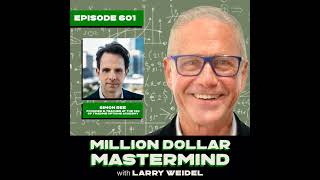
Simon Ree, who spent 14 years at Goldman Sachs in Sydney, talks about surviving the tech wreck and 2008 financial crisis. He compares leading a team to being in a band: you need ownership, deep expertise in your niche, and to make yourself indispensable.
Welcome to this edition of the Million Dollar Mastermind podcast. This is where we pick the brains of high achievers from all walks of life and get their hard earned real world insights on winning. I'm your host, Larry Wydell. Good morning in Singapore to Simon Re. Hello, Simon.
Good morning, Larry.
Yes, that's quite a long, this might be my longest distance interview here, especially recently, and I'm in Aspen and you're in Singapore and we're going to talk about winning. And so you've had a lot of experiences in your life, a lot of things. But let's go and say how did you wind up at a pretty young age as in 2006, I have here as the executive director at Goldman Sachs and must have done well in that position, stayed there from 96 to 2010. And so was that in New York or was that in Singapore? Where, where was that?
That was in Australia. That was in Sydney, actually.
Okay, and how did you wind up, how old were you at that time?
So I, I guess I, I was 20, 27, I think when I joined and I must have been in my late 39 when I, when I left.
And so executive director, Goldman Sachs. Talk about how you wound up in that position and what, what kind of motivations did you have about your life and things that interested you. That's a pretty unique position.
So it all start. Well, I mean, it started in high school. My second last year of high school was 1987, which was the year of the great stock market crash. And I was studying economics as one of my high school units. And I found the whole thing fascinating. I was sort of transfixed by the whole stock market crash, the news that was coming from it. And I just kind of got a little bit addicted. I didn't have any money in the market at the time. I was too young. But I just found the whole thing fascinating. And I thought one day I want to be working in the stock market. This is just too interesting for me. And so that was where the seed was planted in my second last year of high school. And then I was, you know, finished high school, I got a couple of offers to study, you know, finance or economics or commerce at university. And I spoke to one of my mentors. I didn't know whether to study economics or whether to study commerce. And he said to me, look, they, they don't give out PhDs in commerce. They don't give out Nobel prizes in commerce. You should study economics. It's, it's more of a real discipline. So I, I did that But I found I was probably more fascinated by the finance units more so than the economics units. So I did a combination of economics and finance and then started working in the banking industry. And my first job out of university was working as a credit analyst. Well, actually working as a futures broker. I did that for about six to nine months. This was in 1991, which was bottom of a recession, a fairly deep global recession at the time and, and it was a tough way to earn a living. So I managed to get a job as a corporate credit analyst at one of the major banks in Australia. Did that for three and a half years. Learned how to pull apart a balance sheet and that sort of thing. But I still wanted to be involved in the stock market. So I kept knocking on the doors and eventually Goldman Sachs opened their door to me and I got a foot in the door and made full use of it and couldn't, couldn't have been happier at the time. But it wasn't completely straightforward because my other dream was to be a lead guitarist in a rock band. And I was a pretty good guitar player at the time. And I was also, you know, I was playing in a, in an up and coming local band and we were doing pretty well. We recorded a CD and a, and an EP and there was pressure on me from my bandmates to kind of take that to the next level as well. And it got to the stage where I was, I guess I was 31, 32 years old, felt old at the time and I just didn't have the energy to pursue both. And I had to make a choice. Well, do I take the safe option and pursue the career in finance or do I take the risky option and try and become a rock star? And of course I took safe option. Sanity prevailed, as did advice from parents and mentors and that sort of thing.
I'm sure your parents really breathed a sigh of relief and so is. What kind of reputation does Goldman Sachs have in Australia? Was that a big firm? Was that a prestigious firm?
Did that?
Was that important to get with a company like that rather than just to get in the industry?
Look, I was with them sort of prior or certainly prior to the global financial crisis. They were really the employer of choice. They were seen as really one of the best houses you could work for or be associated with at that time. They were winning a lot of business and they had a very good reputation.
And you were executive director with Goldman Sachs during two major worldwide recessions. Talk about that. What's the pressure like being in that situation?
I mean the tech wreck was that was obviously 2000 to 2002. The NASDAQ got beaten up and markets were volatile and it wasn't a major recession. It was more. The actual economic impact of that was relatively mild. It was more the stock market impact. And that was kind of exciting and it had scary moments, but it wasn't. We weren't going through a period where there were massive layoffs and where there was genuine fear about the future. The finance industry, the banking industry, 2008, 2009 was quite different in that regard. That was a proper recession. People were genuinely concerned about the banking sector, how many banks would survive. We'd already seen Bear Stearns and Lehman effectively go to the wall. It looked like AIG was next and if AIG hadn't gotten bailed out, Goldman Sachs was possibly next. So that was a scary time. Job losses were horrendous right across the industry. I mean, being employed in a bank during that time. It was a case of every day you'd be sitting at your desk and someone next to you or someone a couple desks over would receive a phone call and then they'd, you know, they burst into tears or security would arrive at their desk with a big cardboard box and you know, people were just getting cut left, right and center. It was a really, really brutal environment. Working 14, 16 hour days back to back. Yeah, it was, it was a very stressful environment.
And then you're left with their empty desks to remind you.
Yeah.
That they're not there anymore.
And then what was great was the senior managers were, you know, we came into early 2009 and you know, they were joking about it. Oh, ha ha ha. Looks like we let too many people go. But we're going to have to rehire now. You know, just, just numbers on a spreadsheet. Didn't realize destroying people's lives in the process.
Yeah. Was reaching that point in your life, the pressures of the market going down, how much does that increase the pressure on you in your role? Because you know, past a certain point you're limited in how you can respond. Now if the company runs out of money, they keep the most valuable people. How did you make yourself, how do you work in that environment to keep your, make yourself as valuable as possible and not get knocked out and also, you know, do your job as executive director. It seems like the spotlight would be clearly on you to deliver things in spite of the market.
I think you've just got to make yourself indispensable. I had a niche. I was the head Of a team. We were an important team, the market's desk. And we knew what was going on better than most other people in terms of what was happening in derivative markets in real life and how that was impacting our risk. So yeah, I guess that the thing is, have your niche, have your area of expertise and exploit it. Make yourself indispensable.
How did you learn? I've got to make myself indispensable. When did that dawn on you?
Look, I think in an environment like Goldman, you're always, it's very competitive, all right? And they do not suffer fools. They are an employer of choice. And there's always people smarter than you, younger than you, brighter than you, hungrier than you, more ambitious than you, trying to, you know, trying to get in or trying to take your job. So I don't know, I sort of found that I was always, just, always had a little bit of paranoia. Always looking over my shoulder a little bit. I found it was almost part of the culture.
Now as you. What were the worst time that you went through there?
Well, I mean, the worst time is seeing, seeing clients lose money. Nobody likes to see that. And in an event like 2008, it's almost unavoidable. It was an event that really swamped the entire global financial system for months and months on end. And I remember thinking, well, we all thought back when Bear Stearns failed that perhaps that was it, perhaps the worst was over and that the market actually put in a, a pretty decent rally in the couple of months past that we all kind of heaved a huge sigh of relief. But then there was further deterioration in the credit markets. And then of course, Lehman failed in September of 2008. And then between September and December 2008, it felt like the market fell every single day. It was just harrowing, it was incredibly stressful, it was incredibly upsetting watching clients lose money. And I mean, I lost a life changing sum of money myself that year because I drunk the Wall Street Kool Aid big time. I've been listening to the guys who I thought were the smartest, brightest guys in the room, the Goldman Sachs analysts, and I'd been buying the dip all the way down and I'd lost a ton of money myself.
Now when you're going through a crisis like that as executive director, you got a team, right? How many people were on your team?
8.
And they're looking to you for support, leadership. You can't, you know, you can't show weakness or fear or whatever. They're going to, they're going to pull A lot of their confidence from you as a leader. How much did you learn about staying strong in the face of defeat? Basically, you know, things not going well from the. Your music career, you know, because you're not always. Every venue you play, every gig is not, you know, a standing ovation at the end, you know, so.
Very true.
How did you, how did you develop it? What kind of lessons did you carry over from that? That maybe, you know, was part of your core that gave you a toughness.
When you're playing in a band, you've got four, four or five musicians on stage. You've all got your own important roles that you must deliver. All right? Nobody is subservient to anyone else. Everybody is very responsible for the role that they fill. And those roles are kind of pre agreed in the rehearsal room before you get on stage. What I used to do with my team is literally get them to tell me what they were going to do. I would get them to pretty much take a high degree of ownership in their business plan and their strategy and I'd give them guidance in it, but I wouldn't give them a list of instructions. I would ask them to tell me what they were going to deliver for me and for the team, which gave them a huge amount of buy in and ownership of it. And I think if somebody's setting a goal for themselves that you agree with, they're far more willing to reach that goal than if you tell them to do something, you hand them a goal and tell them to go and do it. And so I had a team and I was very, very fortunate to have some incredibly bright, energetic people in my team. And it was humbling to me to watch them literally run through brick walls. For me, the things that we achieved, the obstacles that we overcame, and the amount of hard work and drive that they showed was just absolutely humbling. I felt almost unworthy of them.
Now what kind of project would they have and what kind of things would they do that really amazed you showed initiative and drive and whatever.
You wouldn't believe how much of the global financial system back then, it probably hasn't changed a lot today is held together by Excel spreadsheets. Um, so we had a, an Excel spreadsheet that we used as part of our risk monitoring. Or it was how. It wasn't how we, it was how we monitored risk, but it was more how we summarized risk to senior management. And for example, I wanted the spreadsheet to do certain things that it wasn't doing. And I had a young member of the team. Her name was Yvette and she just said, oh look, I think we can build something like that using vba. I said, oh, yeah? Well that's great. I don't know vba. She goes, neither do I, but I'll teach myself and I'll build it for you. And she went away and two weeks later, not only had she learned vba, but she had built this amazing kick ass spreadsheet that did everything I wanted and more. And it was just very minimal guidance. I just kind of said to her, I wish we had a spreadsheet that did this. And she came back two weeks later with something really wonderful. It blew me away.
Thanks for listening to the Million Dollar Mastermind. If you felt there were any valuable takeaways from this episode, please take a minute. Leave us a five star review. Your feedback is important and really helps us get the word out to a wider audience. Remember, we have a valuable webinar that is absolutely free. Register for it right now@whiteallonwinning.com thanks for listening.
More from Larry









Rick Jordan on Self-Engineered Proximity, Cyber Security Moats, and Truth-Based Leadership

Fire Fast or Fail Slow: Kevin Brittingham Reveals the One Rule That Built a $100M Empire
