Episode #607 - Manage People, Not Investments with Jonathan DeYoe, Senior VP of EP Wealth Advisors
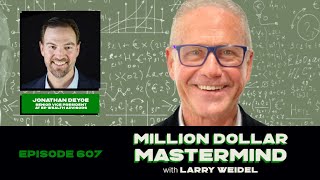
A podcast interview (Episode #607) with Jonathan DeYoe, Senior VP at EP Wealth Advisors, about building and eventually merging his advisory firm. DeYoe recounts starting alone, hiring his first assistant (mid-2000s), growing the firm rapidly (citing ~30% annual growth for eight years), losing a key $75M client during a merger phase, and ultimately deciding to merge after his brother (planned CEO hire) drowned in June 2021. He emphasizes a countercultural philosophy: he "manages people, not investments," favoring simple, low-cost, diversified investing and financial planning. He authored Mindful Money (2017) and references a second book due in 2023; he also hosts a podcast to share practical, grounded financial advice.
Questions this video answers
June 2021
Mindful Money, 2017
Coming out in 2023 ("this year" in the March 2023 episode)
Approximately $350M–$380M (guest's stated range: "0 to 350, 380 million, whatever it was")
$75 million
Welcome to this edition of the million Dollar Mastermind podcast. This is where we pick the brains of high achievers from all walks of life and get their hard earned real world insights on winning. I'm your host Larry Wydell.
It happens with, you know, when we were out there in the beginning stages opening up a new area, I remember one guy was out helping him sell, you know and I was training and he went to his best friend next door. He rode to work with him every day, every day and they work together every day. They coach football together, best friends, hunting, everything. And so he went over, he get involved in the business part time basis, went over and run the play through for his family. Saved him a ton on their insurance and everything and five times more coverage and cut the thing down. It was a 20 year price as a 20 year renewal type term insurance that was sold there and the rest went into mutual funds. And so the insurance part, we wrote it up and then we went back to deliver the policy and the guy didn't want it. He said, well I talked to my insurance agent and he sold me an annual renewable term and it's literally 10 cents cheaper per month, 10 cents this year. And I said did he tell you that this one is one that's not going to go up for 20 years and that one is going to go up 19 years, it's going to increase because it's an annual renewable. Did he explain that part? No, but all I know is it's 10 cents and you know every penny counts and it's like it's, those things are kind of good for you because you get a, you, you realize early on it doesn't matter what happened, you know, if it that had happened or not happened, it didn't make a difference in your life, did it?
It did, yeah. Not the money, the money certainly didn't.
But yeah, the money doesn't make a difference.
Thing that hurt.
Yeah, yeah it hurts. But it's in terms of from a business standpoint it's like life goes on. And I want to point out one thing to you right now, to everybody that I don't do a lot because we do on here. Talk about the price you have to pay and you have negative things happen early on in the business. Steal yourself for failures because the failures is when you're, you're motivated to learn. You know, you kind of wake you up and turn your antenna on and then make you make choices about what I'm going to do going forward. All that's good. But the thing about in starting your firm, you had a pretty good idea of how to move forward. You move forward with a vengeance. Now what happens is, if you'll do that, folks, listen, you know, if you'll do that in your business, you're still going to have some disaster. Some will be excruciating, like cutting off your arm. Some, you know, a lot of, a lot of them will be millions of temporary disappointments, but some of them will be catastrophic. You know, things that happen in Turkey, the, the, the double seven and a half megaton whatever, earthquake, earthquake. These things happen in our lives. I mean, it's out of control. But most of what we face are millions of temporary stinging, you know, like a gnat us or something, disappointment. But here's the thing. If you work on track with a proven success record, you're going to start, you're going to accumulate successes and those daily successes will give you the motivation, not only just income, but from a, you know, attitude thing, to be able to absorb those hits that are always going to come. You're always going to get hit. But when you're moving forward and having successes, lots of yeses are coming. The no's don't see, you know, little no's, big no's, you know, they don't seem to matter because you can see other yeses coming and you're able to endure and they become, you know, minor bumps in the road. You don't even notice really, you know, and so even though you're going to have those things, if you stay leaning forward on the attack, doing the right things, you're going to have so many good things happen that those don't really, you don't really notice them that much. And would you agree with that?
Oh, absolutely. You just, you, you keep, you keep moving forward, people. So I, when I, my, my starting class at, at Dean Waiter, there's 400 of us. And after like the first year, there's 75 of us. After the second year, there's probably four of us, like we. And people ask me like, how did you do it? And I was like, I was too stupid to fail. I just, I just, I didn't overthink it. I didn't get worried about what was happening. I just, they said, here's the program, follow the program, just do the thing. And I made the dials, I just KE and yeah, stings, slings, arrows, it all just comes at you. But water off a duck's back, go to the next thing, you're going to hear no a lot. You're going to hear you're going to bumps in the road, you're going to get struck down. This probably happened six years ago. So in the process of going from 0 to 350, 380 million, whatever it was. When I merged, I lost a 75 million client. I lost the biggest client I've ever had. In that process, that stung, that was painful. And I think about that often, like what would happen or what went wrong, why did it happen? At the end of the day, it doesn't matter. It stung for a year. By the next year I was back up again. It's just a short term thing.
Yeah, yeah. And it's great for people to hear that. I appreciate you sharing it. Let's, let's talk about the arc of this thing did turn into a company. And so I have a company in the beginning, but you turned it into a company. And at what point did you realize, I have a company here? You know, this is an actual company.
I, I didn't, I never realized it. So I had somebody tell me this. They said, okay, I was seeking coaching and I didn't have an assistant. Like it was just me. And I had probably 50 million at the time. I probably had, you know, 50, 60 clients, something like that. Just run around like a chicken with my head cut off. I had no idea, just this, that the other thing, just constant action, constant motion, never, never knowing exactly what I should be doing, just doing a lot of things. And I went, I said, I need some coaching. So I found this coach and I said, you know what? I need you to help me. He goes, I'm not going to help you. Why wouldn't you help me? I need help me. He goes, you gotta, you, I can't help you until you hire somebody. You've got to have somebody that you can delegate some of the stuff to and then I can help you focus on what you should focus on. I went out and I hired somebody. And that's my first. After the first year of having somebody work with me, that's when I think I realized I had a company. And that was probably, well, 2008, 2006 maybe right in that range. And it took me probably four more years to hire two more people, then hire another person. And then in 2021, I had eight people in the firm when we finally merged.
For those of you who are sick and tired of fooling around and are dead serious about wanting to move up fast, I've got something especially for you. I've combined the best insights from over 40 years in business. And making $70 million in income and compressed them into a free webinar. That's right. It's a free resource. If you want to find out exactly what the concepts are that I use in coaching million dollar earners, Register now@widelonwinning.com you'll discover the five part framework used by so many to reach their financial, personal and professional goals. You can find that link in this episode's show Notes.
Yeah, and that's how you be cut. You learn. Business is from the ground up. You know, you get one. Even when I went to North Carolina to open up my expansion operation and was totally broke for extended period of time, I still had a part time lady come in four hours, three days a week because I was just not going to spend my time on those things. You can't, you know, you've got, if you spend your mind, you know, your, your, your time, any of your time on minimum wage type activities, which we all get stuck at that from time to time. But if, if you don't off start offlo those minimum wage, repetitive skill type, you know, filing, calling, routine stuff, you're going to be anchored to the ground. And every time you can. The way to think about delegation is like you're hot air balloon with a lot of ropes tying you to the ground. And you can get, the more of those things that you do in your life that you can turn over to someone else, the freer you get to go higher and higher. And so you got to free yourself up because there's only one you. You're the center, whatever your company is, you're the center of the nuclear reactor. You know, you got to be thinking, you got to be, you know, aware of things, you got to notice things. And so you grow into that is the point that I'm making. Yes. Did you get complacent during the 20 years or were you, what, what kind of stays did you go through? Because that's, that's happens, that's the arc. You get to work hard, you get success and you start to cool it a little bit. There's a fine line between mediocrity and success. And there's a fine line between doing well and there's, and growing, right? But to me, the line between if you're over the line because none of us are perfect. To me, the line where you can say to yourself, I'm doing enough of the right things if I'm growing. Because that's how a leader's got to judge themselves. Am I doing enough of the right Things for the company to grow. Then I know that I'm delivering for the company. But the tendency is to get caught up in all the stuff because the tyranny, the urgent, you allow yourself to get complacent and you don't start checking things as much. You don't start, you don't have your pedal, your foot on the accelerator as hard as it was. Not because you're lazy, you're sidetracked.
And.
We start to kind of the arc, the growth arc kind of goes like that. And then you start, get used to that. That's a dangerous thing. You go through that.
We never, in the 20 years I ran the firm, we never stopped growing. I mean we had one year that was a really bad, well, two years that were really bad years. But that one was market related one was that loss of that large client. But we grew and grew and grew and grew. We grew 30% a year for eight years in a row. I was on lots of fastest grow company lists in the Bay Area. So we grew and grew, grew and I never slowed the growth. That being said, I got complacent and I started focusing. Probably five years before I merged, I had the first conversation with somebody saying I need to have executive help. I need to have somebody. I need to take some of this executive role off of my table, my plate and give it to somebody else that can actually run. I don't know from tech stack, we had to start talking about tech stack and HR issues and I don't know from those two things. So I needed somebody else to help me with those two things. And then something about digital marketing. I don't think about digital marketing. So I actually came to the point where I was going to and this is the biggest hiccup in my entire career. I came to the point where I was going to hire a CEO and my brother who died in 2021. In June of 2021, he got an MBA at California. He ran marketing departments for financial services firms. He ran a technology group at a credit card company. He ran a technology group at a debit unbanked company. So he knows how to work the digital marketing world. He knows how to manage people. He's had mass. He had teams in his companies bigger than my company. He's brilliant. And I was like, hey Dave, how about you be my CEO? And so for a couple years we started thinking about how that would work. We were called do wealth management. Two brothers, two dos. Wealth management company. Oh, it'd be fantastic. He was on board, I was on Board. We were waiting until March of 2021 when he vested in his last tranche of stock. And In June of 2021, he drowned in the Pacific Ocean.
Wow. I'm very sorry to hear that.
Thank you. And it killed me by the end of 2021, knowing that I can't do tech stack, I can't do hr, I can't do all this stuff. That's the thing that really moved me to merge. I had intended to hire a CEO, bring somebody that I trusted, bring somebody that I loved, and grow this thing together because I didn't want to do all these other things. But now I get to be a partner at a large organization. My team is taken care of, my family's taken care of, my clients are all taken care of. If something happens to me, everyone is fine. And I could no longer stomach that risk to everybody. And the weight of it on me after I lost my brother was like, I couldn't do it anymore. So I'm happily a partner and an advisor. I work with clients now face to face. I love that. That's what I wanted to do. All the other stuff is now handled. I still, you know, interface. We talk about it, but it's. It's everyone. Everyone is protected. Everyone is in good shape. And it's a. It's a beautiful thing now.
And in that role, you still have your energy and your curiosity and your drive, and you have used that to write. Keep moving forward with writing. You wrote a book, is that right?
Yep. First book was in 2017. Second book is coming out this year.
And why did you write the book? What gives you the right to write a book?
Well, it's a really interesting question. We all have a right to write a book. And I get that, the humorous point of there. But at the same time, I have a philosophy in the financial services world that makes me countercultural. I believe in something that most people selling investment products don't believe in. And what that is, is I don't believe I add any value in investment selection. Well, Jonathan, why do people pay you for investing if you don't add any value in investment selection? It's not about investment selection. And I had a client in a client event that we were doing an economic presentation come up and say, jonathan, I finally get it. You don't manage investments. I said, you're right. What do I manage? He goes, you manage people. I said, that's right. I manage people. I don't know what's going to happen next. I don't know if we're going to have a recession. I don't know how deep the recession is going to be. I don't know if inflation is going to go away. I don't know how fast it's going to go away. I don't know any of those things. No one knows any of those things. I'm just going to be honest about it. Or do you know, you're about to say, you know.
No, I was going to say. You just said it. I was just going to add. And no one knows. Yeah, right. No one knows. So I don't pretend like I know.
Most advisors do. Most advisors make those decisions based on their ability to predict the future, which is.
You know. And that's how they split newsletters, you know. Exactly.
It's dumb.
Yeah. But here's a hilarious thing on that subject while we're on it, like Motley Fool, I'm sure. Great company. Whatever. They have kickoff, I think 20, 20 January. One stock you've got to own for the next decade. Okay, nndm. Okay. You've got, you know, at the end of the whole thing. Nndm.
All right.
The end of February, they had magazine or something, they put out a thing and it said the top 10 stocks that you must buy this year. And then it had a little thing at the bottom and none of them are in ndm. I thought, what the heck, you know, what happened to the stock of the decade? It did last 30 days.
And just.
For funsies, you know, these guys will send you. There's something that'll happen. People are investing in this thing. There's a new revolutionary thing. It's the whole world is going to set on fire. And you know, and you know, you know, click this link and we'll tell you all about it. And then click to another link and then another video and another link. I've done that so many times just to chase the dogs down. And you know what? They never reveal the stuff dog. No, they don't always. It's always a blatant. Come on. That there's no dog at the end of the rainbow. You know what I'm saying? It's just like I found this. But people are shameless, you know. And so you have a different approach. You write it.
Yeah. So the book Mindful Money has. It has this. The first section is all about sort of debunking the myths. It's. This is the stuff we grow up learning about. And this is the stuff that we think. Think. And this is the stuff that Wall street tells us. That's Just not true. And there's like eight items non specifically. There's just a bunch of stuff, a bunch of crap that we learned that's not the case. The middle section of the book is there's academic research, volumes of academic research. There are thousands of years of spiritual people who tell us what it is that makes life worth living. We know where well being comes from. We know where happiness derives. We get it. Relationships, health. We get it. We know exactly what it is. And that's. So the middle section, book, we talk about that. The last section of the book, the whole point of the book is to help people who don't have access create a financial plan based on stuff that they can actually manage and control and then get ahead in life financially. So that last section of the book is really the seven steps, eight steps to creating your own personal financial plan. If you just follow the book and the exercise at the end of every chapter in the book, at the end of the book, you have a basic rudimentary financial plan. You paid 15 bucks for it. It's an inexpensive way to do it. The next book is how to invest money, and it's How I Invest Money. It's the simplest. Low time cost, simple access rebalance, asset allocation, diversification. We're not trying to pick the fast thing. We're not trying to whether guess on Bitcoin or guess on what happens next. It's the simplest method to do it that anybody can employ and talk about.
Your podcast, has that been a positive experience for you?
Yeah, I enjoy the podcast. I did a recording yesterday. It's interesting in that I've never done it before. It's something that's brand new, having these kind of conversations. I do enjoy it. It's not easy finding really good guests. Like, that's. That's the part that's a surprise. It's not easy finding really good guests.
Well, there. It depends on what your subject is, you know, but the financial world seems like you seem like, what do you look for in a guest? Maybe somebody's listening and they would. They would call you up and say, I want to get on.
So the. The thing that my brother and I wanted to do was we wanted to take the advice and the messaging that I have that's countercultural. And we wanted to dispense it more broadly, wanted to have an impact on more people. So when he died, I merged the firm. The podcast is really about. The goal of the podcast was to kind of fill that backfill for what I can't do without him. And that is find a way to help people make on the ground financial decisions that are easy for them, that make sense, that work that can move the needle, not focus on a bunch of which is why I share your sort of anger at the people that are selling crap that aren't going to help people. Like people on the web that here's my Follow my process in real estate or whatever and I'll make you a millionaire. That drives me batty because it sucks in people that really want it and have good intentions and really want to do it, but they can't do it and it doesn't work anyway. So that upsets me a great deal. So it's just really down to earth advice to help people make better decisions.
Thanks for listening to the Million Dollar Mastermind. If you felt there were any valuable takeaways from this episode, please take a minute and leave us a five star review. Your feedback is important and really helps us get the word out to a wider audience. Remember, we have a valuable webinar that is absolutely free. Register for it right now@whiteallonwinning.com thanks for listening.
More from Larry









Rick Jordan on Self-Engineered Proximity, Cyber Security Moats, and Truth-Based Leadership

Fire Fast or Fail Slow: Kevin Brittingham Reveals the One Rule That Built a $100M Empire
