Episode #610 - It All Starts With A Vision with Derral Eves, Co-Founder at The Chosen
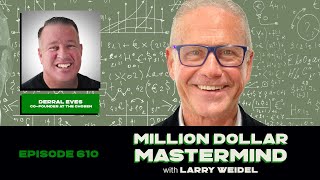
Derral Eves, co-founder of The Chosen, explains how a clear vision attracts and motivates teams. He separates visionaries from implementers, each essential to success, and uses a disciplined system: annual 3-year goals refined into SMART goals, activated January 1st.
Welcome to this edition of the Million Dollar Mastermind podcast. This is where we pick the brains of high achievers from all walks of life and get their hard earned real world insights on winning. I'm your host, Larry Wydell.
As you have success, develop contacts, experience, being able to pass that on or make that available to your children, even if they're not interested in it, it gives them a broader information base to make decisions about themselves rather than, you know, you can say, here's what that looks like all the way up at the top, you know, here's what if you do that well, here, here's the top game designer, you know, and you know, this, you know, they can get, you know, so much of success in life is being able to have a role model a role. Successful role models in areas that you are attracted to, where you can kind of, kind of see how they do it. You can model it, you can internalize it. You don't have to have every single little thing explained to you. But then you can get on there and say, like, it thought I loved it, onto something else, you know, and that may happen, may not, but it's the same thing. Where this applies in business is we've all been in business where we've had super talented people. We just love them, we were, but we think they're smarter than we are, you know, good lord, you know, we get them trained, through the basics, man, what they're going to do. And then he turned out to be duds. And what you find out, what you find out, the earlier you find this out is there is a God and you're not him. You know what I'm saying? It's just like you can't make somebody want something more than they really want it. You know, God can maybe do that, but you can't do that. And so if they want, you know, you can feed, you know, you can lead a horse to water, you can't make him drink. You can give him salt, but you can't make him drink, you know, and so some people are just not, don't have that motivation, but you give them the chance. But as soon as you realize you can't control that you've done your job, you can move on and you don't get down on people.
Let me address that because believe it or not, that's a subject that strikes a chord with me because I think a lot of people feel that it's like, okay, I need to get the right team to really pull off whatever project that we're doing. I mean, that's all we need is the right team. And I will 1 million percent disagree with that. And I want to, I want to tell you why. It all starts with the vision. If you sell the right vision, it will, it will attract the right team.
Yeah.
And if you, if the why isn't necessarily, oh, you're going to have a stable job, oh, you're going to have benefits, oh, you're going to get a percentage of the company, oh, you're going to get this. But the why's bigger than that. Then it's easier to attract the right type of team. And I think it's like at the end of the day, when you present your vision and you're consistent with your branding and your vision and your purpose, then everything makes sense. You literally have guardrails on the direction where you're going. Because what people want, what people want, and I know this for in every aspect, people want to do something of value and they want to be heard and they want to be appreciated. But being heard and appreciated is different. For every person. You're going to need to figure out their love languages of how to be heard and how to be appreciated. I added someone that one of the things that I always do is I have a personal assistant. And that personal assistant ends up running one of my companies. They just do. Because if they know how I think and they can anticipate me, I want them running one of my companies. Right. Well, their language wasn't an extra zero on their, you know, on their, on their bank statement or anything like that. They just wanted to be recognized on things that they love and they're obsessed with Apple. And I'm like, new Apple Watch came out. Guess what? Hey, you did a great job. Here's an Apple Watch. I know you like Apple. You know, I really do appreciate you. It like it went a million miles further than giving them a $20,000 a year raise. And you'd think, wait, $20,000 they can buy their own Apple Watch. Well, no, it's being thoughtful on who's helping you build your vision. And so I think it comes back down to every organization needs someone that is that visionary saying, hey, here's where we're going and here's how we're going to get there. And this is how all the pieces get together. Now, I don't know all the little details, but we're going to figure it out together because we're going to do this and we're going to take it and go a lot further. And. And I Think that's what weeds out the people that just are looking to clock in and clock out, because then they can get behind something bigger than a paycheck. They can get behind something bigger than just something that's providing for their needs. It's something that they can feel accomplished. And as you take on the world, as you do the things that you're trying to innovate, or do they already drink the Kool Aid? They're a part of it, and they're lifting you up, and you're lifting them up, and it's. That's how we move the needle. So I know that you probably feel the same way, and I think it's just more, you know, positioning. But I just do believe some of the biggest things of why people fail is they don't have a vision, mission, or purpose statement, and they don't do specific goals and create a plan to achieve the goals of where they're going. They just says, oh, we want to do this, and all we need is more sales. Well, no, you. You don't need more sales. You know, that's not always the case. You just need to be more profitable, you know, and sometimes that's to, you know, have better systems of communication or what have you. And so, all in all, you know, I think, you know, if I was mentoring someone, it's like, literally figure out what you're. What you want, figure out that finish line, Figure out your vision, your mission, and your purpose. And if it's just to be richer, then, then get. Go deeper. Because, like, if you really want to make an impact and you really want to impact the world in a certain way, and, and, and, and the world can see that they want that impact because there's a problem and there's a solution. That's when you're going to have ultimate success. And it's just more being consistent on your goals that will take you closer and closer to where you would like to be.
Well, and it's easy to do that when you're. You've taken the time to figure out where you want to be and you're super excited about it yourself. You know, it's like very few people forget it's Christmas Day, you know, so if you have things in your life, they're so excited, they're like Christmas to you. You're not going to forget it, you know, and a way I've heard that described, Darrell before about the vision, everything you have a vision, a dream big enough to include the people around you. You know, it's just not like it's going to get me there. And then you just, you're blind to the rest of. But. And then you can sell that to them, but they can see themselves achieving great things and, and not being limited, like they're under your, your shadow, you know, so the other one, one practice.
That I do, and I think this is quite relevant for the conversation, the podcast. But every July, I like to slow down a little bit. That's when we usually do our family reunions on both sides and we take a couple family trips. And so I'm working, but not completely engaged like I am throughout the year. And what I try to do is I try to take that whole month to have clarity on one question. Where do I want to be in three years? And I spent all July and start thinking, where do I want to be three years with my relationships with my family? Where do I want to be three years with my relationship with God? Where do I want to be in three years with this specific company? Where do we need to be? And I don't really look further than that. I really look, okay, that's where I want to be in three years. And I really try to figure out what would be the most adequate place for the relationships to be, or where I want to be or what I want to do. And I set that as a tentative goal. And I go through a process where I want to refine that goal to make sure that if you're familiar with smart goals, it's a smart goal. And I just want to make sure that it's very simple, it's attainable and time bound and, you know, measurable, the whole thing. But I think the thing for me.
Though is why smart goals take, take, take a minute to explain, Mark.
Yes, Smart. Smart goals is, is a way to measure that, that you're being very specific about what you want. So it's, it's if I can remember the acronym. So it's specific. You got to be very specific of what it is. Usually one sentence, time bound, so that if you don't put a time on it, then it's just a dream. You have to say, I want this by three years or whatever. So it's attainable. So there's certain goals that people put out there. They're like, oh, I want to walk on water and whatever. And is it really attainable? Is it really obtainable? Right? And then realistic, that's where you have to do a litmus test. And then the last is time bound. So, like, you know that, you know, it's it's an interesting concept, but I try to just see, can I actually pull this off? And then two, what does that actually look like? And so I usually talk it over with a few people, say hey, this is what I'm thinking about doing and get their feedback because they're going to be my accountability partner, my wife, and so on. And by the end of July, I pretty much have all my goals pretty much solidified. Then In August through December 31, I'm fine tuning a action plan. And the action plan is, what's all the obstacles that are going to keep me from achieving this goal? What are all the things that I'm going to need or people I need to connect to achieve this goal? And I start putting that down and then I start mapping out what the next three years is going to look like. And that's a really interesting process because if you wake up every morning for five months and all you're doing is thinking about how you're going to achieve that goal and you're thinking about what you're going to do and you're creating a plan for it, you might say, well, you're wasting a lot of time, but I'll get to that in a second. And then after that process of every day and come January 1, January 1, that three year goal becomes activated. So almost six months after it was kind of formulated, it becomes activated. And I now have a plan for the next three years of how to accomplish that. Now here's what's interesting, Larry. If you do this long enough, my three year goal is activated, then my previous three year goal becomes my two year goal, my previous two year goal becomes my one year goal, my previous one year goal becomes my six month goal. And the six month goal is now what I'm doing. And I already have it mapped out, I literally have it all mapped out exactly what I need to do. And I can honestly say that that type of goal setting has helped me push the needle far greater than anything else because I'm focusing in on the problem, how am I going to achieve this? And if you focus in on it enough, the solution presents itself when you really analyze it deep and you can move faster. And a lot of the three year goals I can get, I used to get them immediately and I'm like, okay, then it wasn't really thought out, I need to really put it down because maybe that should have been something that I can get along to get something bigger. That's a three year goal. So that's what I do every year And I've been doing that for, wow since I was 12. And it just got more refined as I got older. But it definitely helped hardwire me in to really thinking big and looking to move the needle and transform the world. And so in every perspective, like, even one of the accomplishments that I have is like a lifetime that people would love. But honestly, every little thing is like a stepping stone to something else. Because I think the way that I'm projecting and planning that goal helps me get the other goal that I really want. And so there's a. There's kind of a path, and so it's kind of like a staircase up of where I want to be.
Yeah. And like, with goals, it's not like they're separate. Everything's connected, folks. And the thing is that I always like to think of goals as a bouquet of flowers. It's not just, I've got this flower today and that flower, and then I'll do it. No, a bouquet. And you can have lots of bouquets because there's lots of areas of our lives and we should have goals there. If you got five kids, you should, you know, in a spouse, she should have goals, you know, for, you know, for fun things and profitable thing, productive things in all those areas. As you were talking.
Yeah.
I couldn't help but think about, you know, you're explaining, you know, how you go about accomplishing things. And I'm sure you have had people say this. I've been reminded of, you know, going through a training session, boom, boom, boom, Laying out exactly how people do it, and then they get to the end. He said, yeah, but how did you do it? You know, when you. How do you actually do it? I said, that's what I've been talking about. Yeah.
For the last, like, last little bit. Yeah, yeah, yeah. I feel the same way.
Why do you think I went through that? I'm writing a book, you know. Yeah, but when you. And I'm sure this, you know, this idea about teamwork and vision and everything, the antithesis of having the vision is the guy, one of the regional leaders who called me late at night at my house one time 40 years ago, and he said, you know, my people just don't motivate me. I took the phone and I just hung up, you know?
Yeah, you're like, click.
Yeah, Maybe, maybe, maybe you don't motivate them. Who's supposed to be the motivator of this group? You know, who's the leader, who's in charge, who can change things? But I just Click. Now, as you started on this, you said the thing with teamwork, it struck a nerve. And I'm sure that relates to the fact that you work with so many people that are in the process of formulating and getting, becoming fine tuned razor sharp. And the difference between razor sharp is like an ax and a sledgehammer. You can work like a dog pounding the sledgehammer against the tree, and all you got to do is annoy the tree and wear yourself out. But if you take the time to put an edge on it, you can chop that tree down in a relatively short period of time just by having a focus and an edge to a purpose behind what you're doing. And I'm sure you go through this, you've been through it hundreds of times, and I guess that's probably why this has become such a big thing and for you to communicate to people. Would you say that's the case?
Yeah, I would. Because I find that if there's a goal and a vision, there's passion. And passion's what's needed to withstand the hard times.
Right.
You have to be passionate about it. And there has to be a why that's bigger than the struggles that you're facing at that, at that time. And so for me, it's really, really important. And when there's people that are probably listening to this podcast that might say, well, I'm not a visionary, I'm an implementer. Every good implementer saddles themself to a visionary. And I'm an implementer, but not to the level of an operator. I need to have an operator in my life. I need to have multiple operators because they need to be detail driven on the fine tuning. I'm more big vision, caching strategy. Here's the whole thing. And I can get into the specifics, into the fine minutiae, but I operate better at a bigger scale and then have them figure out the small little details to how to go from there. And so that's why great partnerships should be who's the visionary, who's the vision, who's the implementer? Um, and can you have two visionaries? And I think you can. It just needs to be the one vision. You know, it's like, how do they compliment each other on that vision and what's the full purpose and then who's actually implementing? And I think if you have more visionaries in the department, that's where friction comes from, because their vision or your vision, you know, and so that's, that's a, that's a thing that I think companies struggle with. But for, for me, I would say, yeah, yeah. Anyone that's looking to make disruption in the world and really impact it in a way, they really need to hone in on that. Because once you have that clarity, it just gives you the fuel in the tank to really, really impact the world properly when it's tough. Because it is. It's not easy being an entrepreneur. It's not easy doing the things in business. There's a lot of complexities and it can weigh us down and so you have to have a why to withstand. If not, then you either stall out or you disconnect.
Thanks for listening to the Million Dollar Mastermind. If you felt there were any valuable takeaways from this episode, please take a minute. Leave us a five star review. Your feedback is important and really helps us get the word out to a wider audience. Remember, we have a valuable webinar that is absolute, absolutely free. Register for it right now@whiteallonwinning.com thanks for listening.
More from Larry









Rick Jordan on Self-Engineered Proximity, Cyber Security Moats, and Truth-Based Leadership

Fire Fast or Fail Slow: Kevin Brittingham Reveals the One Rule That Built a $100M Empire
