Episode #621 - Sales vs Marketing: What’s The Difference? with Tom Hunt, Founder and CEO at Fame
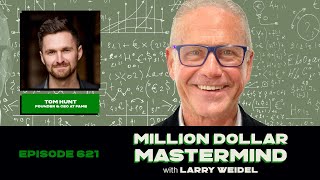
A recorded interview on the Million Dollar Mastermind podcast (Episode #621) in which host Larry Weidel interviews Tom Hunt, founder and CEO of Fame — a company that starts and grows business podcasts for B2B brands. Tom describes Fame’s services (guest booking, multi-format production, promotion), its origin (spun out from a successful internal podcast at a B2B software company), growth (about 3.5 years in business and ~70 clients), and his personal entrepreneurial journey (transition from chemistry and consulting into online marketing and multiple startup attempts). The conversation also covers practical advice on learning by doing, the difference between one-to-many marketing and one-to-one sales, and how passion and financial motivation can combine to drive persistence.
Welcome to this edition of the million Dollar Mastermind podcast. This is where we pick the brains of high achievers from all walks of life and get their hard earned real world insights on winning. I'm your host, Larry Wydell.
Hello, everyone. I'm talking today with a superstar out of the uk, an anomaly. And I want to investigate that because you have a highly motivated entrepreneurial person in the uk and I didn't think there were any of those left.
Yeah, yeah, exactly.
So, hello, Tom Hunt.
Hey, Larry. It's a pleasure to be on a show that I've actually been listening to for a while now, not just because we produce it.
Yeah. And thanks for the great job. Everybody needs to know the professionalism that has been put that have upgraded, I guess is a good way over the last six, seven, eight months is in no small way due to your influence. And you guys have just been a pleasure to work with. So thank you very much. You know, I'm very particular about the kind of guests and I drive your people nuts about getting high quality guests, but I always want them to know that I'm really happy with the work you do, so. And that comes from you. You know, you make it happen. So thank you very much.
No, I appreciate that. And I think maybe some of the stuff we talk about today may come back to that, what you're saying then. But let's see where we go.
Well, let's see where we go and what I thought, first of all, you know, you're the founder and CEO of Fame. It's Fame is the company that does these things. I don't know what all fame does. What all does fame do?
So we do one thing which is start and grow podcasts typically, or business podcasts typically for B2B brands, sometimes just for businesses. And so what that actually means is that businesses or B2B businesses will pay us each month and we'll help find the guests, as you mentioned, hopefully getting the guests right. We then produce the audio, video, written, image assets and then we also promote the shows. So we do that in exchange for getting paid every month.
Yeah, and it's made my life a whole a lot easier in doing these because I used to take notes. You know, we did it in our office and our staff, none of us were trained.
And.
I would take, you know, I would start off with someone. I had this idea that I did not want the episodes to be long and so I would start. Plus, I don't like things to be planned. They're better if they're spontaneous and so once we started talking, we get into a groove, and I'd start to get an idea of what could be the theme for at least that episode. And I'd be writing bullet points down while I was thinking of the next questions. And it was very taxing. And plus, the staff couldn't read my notes. So I'm worse than a doctor in terms of.
I actually remember because when we started working together, there was a few episodes that you'd done the notes for, and I was like. Because I think I was handling you guys at the start, I was like, we'll take that on. So I got the screenshots of notes, and I was like, wow, this is going to be tricky. But we managed it. But then the improvement was that now you don't take notes, and then we pick out the things and then write that into the descriptions, et cetera.
Well, as you're a podcaster, you know, the thing is that you're in. You know, your attention needs to be on who you're talking to, because a lot of times they'll say things in passing that has, you know, you know, decades of experience and efforts to get to where they made that statement, you know, and they'll just toss it off. But if you're not listening, and you never catch them all, but a lot of times, just because you can, you know, you're paying attention, you can catch those things and say, let's talk about that for a minute, and then it unfolds, you get some incredible content you wouldn't get if you're busy writing bullet points down.
Exactly.
So thank you for that. Now, when I looked at this thing. So that's what fame is. And how long has fame been in business?
Three and a half years.
Three and a half years. And why did you take on this responsibility, this. This idea mainly, you know, was it an outgrowth of you doing your own podcast, or did that come later?
So I, at the time of starting Famer, I was head of marketing at a B2B software company. We started a podcast. I was the host in, like, long story short, it was very profitable for their business. So, A, we were building relationships with guests that became customers, and then, B, we got the timing right on the topic, and so we were able to, like, get in. In there as it was growing, and though our company became relatively famous in that. In that world of sales. And then. So that's why it was very profitable for the business. So then I left. They became the first client of fame. And then all fame is. Is just us Taking that process we were building in house and then implementing it, improving it over three and a half years to now we have roughly 70 clients.
Okay. That's. That's mushroomed dramatically. And, you know, the sky's the limit because podcast is not it. We're not going to be running out of ideas for people to have podcasts and, you know, people of insight with things to share that people want to hear. So the sky's the limit on how far you can go. And you do have. I just, you know, you have other businesses. You have. You know, we'll get into, like, BCast, and I'm really, really interested in your AI tool for coming up with, you know, the. The notes and things like that, but probably to do this correctly so people can relate to you. Where. Where did all of this initiative and drive and curiosity about this kind of work come from? You know, like, what led you to where you're doing a B2B podcast, you know, with this other company, and you're the. You're the guy who, you know, we need a podcast, and, you know, it turns out you're the guy who did it. So these things don't happen by accident.
Yeah. So we have to rewind maybe 10 years. So you know how some, like, entrepreneurs have the story of they're like 7 years old and they're going around like, selling newspapers or whatever. They're like a born entrepreneur. That wasn't.
Yeah, that was.
Yeah, exactly. Right. And what were you doing when you were seven for your first business, Larry? Was it something like selling sweets or something?
Selling TV Guides?
Sick, Howard. Really?
Eight years old, I saw an ad and a TV Guide I sent off. At eight years old, I sent off the information and I set up my own route. I had 50 houses in the neighborhood, and I would get $0.15 cash money from them. Every week, I'd send $0.11 in an envelope to the TV Guide company. I would keep $0.04. I would make $2 a.
Wow, that's crazy, isn't it? I mean, the point here is that I got to age 22, and I had never done anything entrepreneurial. And so instead of being, like, driven to wanting to sell things or doing entrepreneurial stuff, I was driven away from the other option, which is being employed.
Ah.
So I do a master's degree, four year studying chemistry, realized I don't really, like, I don't want to be stuck in a lab on my own for the rest of my life. So then I then essentially go and spend four years in management consulting. Which part of It I liked, but it just wasn't like for me. I didn't feel like, is this it to life? Do I do this for 30 years and then retire? So then I was like, if I can't be employed, what else am I going to do? I'm also really like the Internet. So you then have two options. You either learn how to code or you learn how to sell things online. So if we really have to summarize the last 10 years, because I've really been in the entrepreneur world for around 10 years now, is I've just been learning how to sell things through the Internet. In the seven years between realizing this and spending all of my time doing it and getting the job as the head of marketing at that software company we were discussing, there's probably about 15 different things I tried and we could probably say failed at like what?
Like what?
My favorite one, Larry, was a male leggings business. So you know how you see people running like in leggings. This was before then 2012. So we go on and we'll link to this below. We have the Dragon. We went on Dragonstone, which is Shark Tank in the US and so we created a male leggings brand, started selling them on the Internet and then started selling a few Gone. Dragon's Den then sold quite a lot, didn't get investment and then eventually shut the business down because we weren't selling that many.
You see a lot of those legging and T shirt type companies show up in these news feeds and everything and then they, you know, with a lot of advertisement then they disappear. So I guess that happens to a lot of people in that clothing business.
Yeah, exactly. Like we weren't really super passionate about making amazing leggings. It was always like if me and my two best friends, it was like side projects. They weren't like fully into it.
Yeah.
And so there's this wasteland of failed online businesses. And so I'm like 30, roughly 30 years old, maybe 29, and I just have all this, these bits of time. You didn't really have any cash coming in. So I'm like, I'll go and work at this company that my friend runs as head of marketing because I know how to sell stuff. Right. And so that's where that's that we get to the head of marketing.
How'd you learn how to sell stuff?
Yeah. So when I say selling things online, my distinction between sales and marketing is marketing is you're just selling one to many. Sales is one to one. And I would actually say that prior to starting fame, I in my sales skills one to one, which I know you're an expert at, Larry. Well, I don't think we're that good at all, but my marketing skills, so selling one to many I think did get quite good because all I was trying to do was sell one to many using ads or using sales pages. So eventually copywriting. And so how did I get good at that? I did a shitload of courses. And then I also just did a lot of practice, like my whole life, those seven years, I didn't really do anything else. I was just mutt. All I was doing with working on these businesses.
Well, the great thing about the online thing and doing the sales letters and things like that is the feedback tells you, you know, what works and what didn't work.
Right away very fast. Yeah.
And so, but much of business, much of life works the same way. If people will pay attention, you know, to what's happening, you know, it's like, you know, it's like being a comedian. You know, a comedian worked years to get a good solid 45 minute set that they can kill with, you know, and they do that by feedback. You know, they get an idea and then they get on stage. You know, they won't sit and study for hours. They get an idea and they get on stage. You know, there's so much of this works out. I don't want to get sidetracked, but you know that thing that they did with the Beatles at the Abbey Road session where I think it's in the second one, about halfway through, George Harrison comes in and this is when he was in a good mood, which didn't seem to be that often since they treated him like crap most of the time. But he came in and he was playing something in the way, you know, vada vuva, you know, and he said, Paul, he said, what do you. He said, what should I. What should come after that? He's, you know, and he, you know, I've been stuck on this for, for three months trying to figure out this, that and the other. And you know, Paul mumbles some stuff off. But then Lennon said something that just kind of, I'm sure went over everybody's head. He said, well, just say. He said, sing it again and see what comes out of your mouth. And said, keep singing it and keep seeing what different things come out of your mouth until something comes out that you like, you know. And he says, you know, you, you get there by doing it, you know, you give your subconscious a chance to work rather Than focus on, I don't know what to do with, I don't know what. Well, do it anyway and let your subconscious comes up. And he came up with these beautiful lines. One of the greatest songs of all times, because I think, because John Lennon told him, just keep singing it and see what comes up.
Yeah, I think that's a great analogy to what I was doing for seven years. Just keep trying and see what comes out.
We could help a lot of people right now, Tom, by putting some light on the subject of people say, follow your passion. Write down what you're excited and I believe, follow your curiosity, follow the things that attract your attention and things you get. Because if you, you find something to do that you like, you get excited about, it's easier to put the discipline in because you enjoy. You get better and better at it. You get enjoyment from doing it, but also you'll make the extra effort because that's where extraordinary success comes from, is extra intense effort over long periods of time. So you got to like it a little bit. But this whole idea, you'll have people come in and say, you've been told, follow your passion. And that's the worst advice you could ever get because you can overdo that advice to where I like to polish oyster shells. I just love the color. I want to spend my life. Yeah, great. Not a big market on that. And so Mark Cuban all along has said, you know, refine that by saying, find something you can get passionate at that you can make money at.
Yeah.
You know, you can get excited about, you can fall in love with, and you can make a lot of money at, you know, develop a skill. And so that's really what you were kind of trying to. Trying to do or in the process of doing. Would you say that if. What would your. How would you. How would you describe that process about finding something? Because you're obviously passionate about what you're doing now. So talk. I think you can help a lot of people buy some comments on following your passion or finding your passion.
Yeah. So just as you're saying that, I think one thing to do before we get to that point is that if you're trying to make something work, either you're trying to make a business work or you're trying to make money, then the one thing that matters is you make something that is better than the competitors, better than other people. That's the first thing. And so in order to get to that point, you have to put in a lot of effort. And so that can be driven by passion. For the thing or it can just be driven by the fact that you want to make a lot of money or you want to build a business. Right. So it can be either or a combination of those two things. And so I think for me, I was fortunate that when I was trying, I was driven by making money. When I was trying to do that, I actually did start to love and enjoy the process of influencing one to many. For example, marketing, Right. And so I didn't know I had that. So I was starting to, although I was getting good, I was like, yeah, I'm actually starting to enjoy this. So then I got driven. I'm still, I'm driven by the two things. A, like building a business that works and making money. And then B, the enjoyment of the process of influencing people one to many. And so at fame, we obviously do that to our potential customers, but then we help our clients do that for them. And so I think I'm driven by both. But you don't have to be, you know, I don't think you have to be passionate. I don't think you have to really want to make a load of money because you can just combine them or have either.
Thanks for listening to the Million Dollar Mastermind. If you felt there were any valuable takeaways from this episode, please take a minute. Leave us a five star review. Your feedback is important and really helps us get the word out to to a wider audience. Remember, we have a valuable webinar that is absolutely free. Register for it right now@whiteallonwinning.com thanks for listening.
More from Larry









Rick Jordan on Self-Engineered Proximity, Cyber Security Moats, and Truth-Based Leadership

Fire Fast or Fail Slow: Kevin Brittingham Reveals the One Rule That Built a $100M Empire
