Episode #629 - Discovering Your Career Path with Victor Menasce, Senior Partner at Y Street Capital
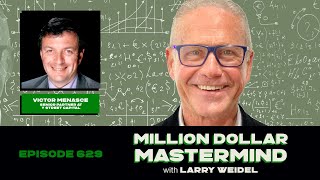
Victor Menasce designed microprocessors at Nortel that routed major phone traffic, then shifted to real estate investing in 2009. He now runs a 12-person team with five partners, crediting his architect mother and inventor grandfather for his entrepreneurial bent.
Questions this video answers
2009
About 52% of phone calls in North America
About 12% worldwide
Three patents (name appears on three patents; owned by employer)
About 12 people (core team of five partners; average daily call ~12 people)
Welcome to this edition of the Million Dollar Mastermind podcast. This is where we pick the brains of high achievers from all walks of life and get their hard earned real world insights on winning. I'm your host, Larry Wydell.
I'm talking with Victor Menashe and he's at the site of what hopefully is going to be a brand new exciting restaurant. And it is a horse, the leftover of a horse stable right now, the place I've spent a lot of time over the years and hopefully we're going to find out some of the adventures that Victor has gotten into in his life. But Victor could. Congratulations on your success and in real estate we want to hear about all of those things. But at one time when you started out, I'm really fascinated by, and you're probably sick of talking about it, but you started out as an engineer and you actually were pretty good at it. You came up with a chip that I think, why don't I let you tell the story. You work for Bell Northern Research and why don't you tell the story?
Sure. Well, great to be here and thanks for having me. Yeah. My path into real estate investing was definitely not the typical career path. I started out as an engineer designing microprocessors and my first projects were in fact designing chips that control the phone network. So about 52% of the phone calls in North America and probably 12% of the phone calls worldwide were routed through a chip that I designed. And for about a decade. Wow. So I ran, you know, rose through the, through the ranks at Bell Northern Research and Nortel, which was the parent company. And we, you know, built these systems worldwide, transitioned from there into a startup company that was also involved in CoreLogic chipsets for microprocessors and then eventually took that company public. From there went to another company that where we literally acquired IBM's embedded microprocessor division. So gre that business by about 100% over a three and a half year period. So spent a lot of my career in the microprocessor design industry where we were doing things from cellular base stations at Nokia, Siemens, Motorola wireless access points for Cisco, Cisco routers, Apple WI fi access points, the chip in the Patriot missile, I mean, all kinds of weird and wonderful applications all over the world. And about the year was about 2009, when something was happening around then, you might remember it in real estate. And I was traveling back and forth to Tokyo every two weeks. We were building a new cellular network in Japan with a number four carrier in Japan and It was burning me out physically. That 12 hour time zone change and the 13 hour trip to Narita airport every few days was just punishing. And so I decided to take a hard left turn in my career and move into the world of investing on a full time basis. So that was the shift that took place in 2009 and it was a good time to make that shift. A good time to be playing offense in real estate. Not a great time to be playing defense, but a great time to be playing offense. And it was very forgiving market conditions. It wallpapered over a lot of mistakes and we made plenty.
Yeah.
So it was a, it was a good time to make that transition. I've been at it really now, today, full time in development. We have a sizable team and building apartments, senior housing, storage, we do a lot of land development all across both the United States and Canada.
And so I mean you're talking about raising hundreds of millions of dollars for different ventures, corporate buyout, real estate projects, things like that. How big is your team right now?
So today we're 12. And so it's not huge, but it's not tiny either. The core team is five partners and we have staff and interns and other associate partners on various projects. So our average staff meeting call every day we're about 12 people on the call.
Uh huh. Now let's talk about when you're, you know, for people who don't know, when you work as an engineer with a big company, when you design something, that's not your patent, is it?
No, no. In fact, when you join a big company like Nortel. Well, not Nortel, doesn't exist anymore, but any company of that scale. Yeah. You're going to sign as part of your employment agreement an assignment of patents. So whatever patents you acquire, you are going to assign those to your, to your employer. So while your name might be on the patent, as my name is on three patents, I don't own them, I just have my name on them. And in that case Nortel owned them.
Yeah. And hopefully that had a positive influence on your annual year end bonus when you get half of the world using your chip, but nothing like owning it yourself. Did that go through your head?
You know, that's the difference between being a business owner and being an employee. Yeah, right. You as an employee, you've got some upside but no downside.
Yeah.
And as a business owner you've it, it all rests on your shoulders. Yeah.
So how did you, how did you come up into the engineering world and get, get in that Position, you know what, what were some of the first leanings you had and first steps you made? Because that was probably a pretty good position, you know, that you were in when you were in that able to even design.
Oh, absolutely, yeah. I mean, it was a great, great phase in my career. Absolutely. And I knew from the time that I was a teenager, if you would ask me when I was 12, 13, 14 years old, what do I want to be when I grow up, I would have said, yes, I want to be an electrical engineer. Now, I really didn't know what that meant. It just sounded cool. In retrospect, I really didn't know what it meant. But it was a really great, great career and enjoyed it tremendously. It was something I knew I wanted to do right from a very early age.
Was this just something magnetic in the air or did you know some electrical engineers or what? How did that thought get in your mind? Because the thought that I would have had in my mind at 13 or 14 years of all the things I don't want to be is an engineer and especially an electrical engineer. I can't get ohms and watts and calculate. I can even get the basic, simplest kindergarten formula straight in my head.
It's funny, it's something that's absolutely second nature for me. It just feels like it fits. Now my mother was an architect, so it's not like I had it in the family or anything like that. My father was a dentist, so nothing there either to connect the dots. But my mother was self taught as a, as a structural engineer. So she was actually the second woman in history to graduate in architecture from Cornell University in New York. And she designed some landmark buildings in Manhattan. So I had that legacy. I had the legacy of my grandfather holding about 60 patents, who I actually never met him really, but it was ingrained in me early on from a very early age that, you know, here was your grandfather, look at all the things that he did, look at all his inventions. And you know, I still have a drawer full of 60 some patents of his. Wow. In my files. And that's cool. So that ingrained in me the notion that I could do anything. And that just got instilled in me from a very early age.
And so as you're coming up, it's a matter do well in school. Not a lot of entrepreneurial challenges there. Did you get any taste of the entrepreneurial life early on or was that just later?
Absolutely. As a teenager I ran a stage lighting company and I used to do sound reinforcement. I DJed for all kinds of weddings and dances and all that sort of thing, but did a lot of sound reinforcement for theater and rock and roll. Toured a lot with some admittedly big name acts. So, like who?
Who would we know?
Did some special effects for Rush, did stage sound for Christa Berg, did stage sound for Harmonium. We were the opening act for Supertramp. Who else? Gary U.S. bonds. Oh, yeah, a bunch of different. Yeah, bunch of different bands.
You were in the mix.
Yeah. Organized the Canada Day festivities for the city of Halifax for two years at age 18, which is nuts when I think about it.
Who would you.
Why would, why would you ever entrust, like the national festivities for a reasonably major city to an 18 year old? Like, it makes no sense. But anyway.
For those of you who are sick and tired of fooling around and are dead serious about wanting to move up fast, I've got something especially for you. I've combined the best insights from over 40 years in business and making $70 million in income and compressed them into a free webinar.
That's right.
It's a free resource. If you want to find out exactly what the concepts are that I use in coaching million dollar earners, Register now@widelonwinning.com you'll discover the five part framework used by so many to reach their financial, personal and professional goals. You can find that link in this episode's show notes. And so when you got out of.
School, you know, I did go to Georgia Tech and, you know, have a lot of engineers as my friends. And one of them, who, one of the brainiacs, he said he went in and his reward for getting, you know, top honors and top grades was, he.
Said.
I got on the job and for the first six months they gave me a job that within probably a half hour you could train any monkey on the planet to do. And I'm wondering, why did I put myself through all this education? But they'll train you for what they want you to do. I guess they just want you to know you've got the aptitude and the fundamentals down.
It's a little bit luck of the draw. I saw many people come out of good schools, come into the same organization and end up in roles that, quite frankly, were dreadful. And I was just very lucky. Within three weeks of starting my first job out of university, I got loaned to Motorola to work on one of their microprocessor chips. Oh, really?
Really?
Yeah. I was shuttling back and forth between Austin, Texas and Liberty Corner, New Jersey, working on one of the companionships for one of their latest microprocessors. So I literally got thrown in the deep end. Now we were a research department within the company, so we had a little bit more latitude to play, which was kind of cool. And it just was a great opportunity to learn and be immersed in an environment where I was working with, frankly, some of the best in the world right from the very day that I started. So that was an extraordinary opportunity.
You bring up an interesting point that would probably be useful for us to highlight, which is in many ways what you see in professional sports is what happens in the real world when people get out of, you know, they matriculate out of, out of college and they get in with their first company. A lot of your success, you know, like if you're a quarterback or running back or whatever, a lot of it, your success is going to, you know, if you play for a pass happy coach and you're a great running back, not the great place for you to be. You know, as much as if you're with a star wide receiver or quarterback, you know, you want to put ball down the field. And so you, in other words, you didn't want to be. You're not going to be Tom Brady probably, if Lombardi is your coach, because we're going to, he's going to be running that slant off tackle over and over again, you know. And so a lot of it has to do with getting with the right people and if people should be proactive. Like if you are back in that situation with what you know now and that did not work out, you see the kind of success you could have in the right environment. But knowing what you know now, had you not gotten into that kind of environment, the thing to have told yourself is, it's not me, it's the fit. And I need to keep my eyes open and look for a better fit, don't you think?
The way I think about it is you really need three things to be successful. And the world tends to. And you see this in real estate all the time. The first thing that people will tell you is you need to get an education. So come to my weekend boot camp, $197 and I'll guarantee you salvation. And you go to that three day boot camp and they say, great, you've got all the knowledge, but if that were the ticket, then you could look to Google for answers and that would be enough, right? It's not. So then number two, you've got this second group of folks that are saying, oh, you need mindset that you're messed up in the head, you got to get some mindse.
Yeah.
So then you've got the whole mindset crew. And if that. And absolutely you need that as well. You need the emotional fortitude to figure out how to get through things when times are tough. But that too is not the ticket. It really is that third element that is the game changer. It's getting in the right environment. And you see it in, like you mentioned the sports analogy. I mean, why do all of the elite figure skaters in the world train here in Canada? They have ice in Japan, you know, like, so what is it about that, you know, why would I go to the gym? I've got a spin bike at home. Why would I get in the car, drive 15 minutes to the gym, go in a room with 30 spin bikes with an instructor at the front?
Yeah.
It's not that I need them to tell me how to operate the bike.
Right, right. Well, you know, I've got a therapist in Aspen and she has three kids, two boys, one daughter. And they're both like, superb in hockey. Had the aptitude and love for it. And it wasn't long before they graduate, wasn't long before she and her husband are driving them to the better schools and leagues in Denver, which is a four plus hour drive. It's not long before they're staying there. It's not long before the kids are in Toronto, the boys are in Toronto, and then eventually they're in Switzerland. And now the girl is following along in that, she's the youngest, following along in that path. But they're doing it exactly for what you say, because there's no substitute for getting in the environment where people take it serious. They know what they're talking about, they have the resources, there's a lot of support, things that have to be around too, people that, that, you know, subcontractors, et cetera. And when you get in the right environment, you plug into all of those things and that does. There's no shortcuts, but that does allow you to not get diverted, you know, and take bad turns or get stalled out as much as when you. The road is paved and you got a whole lot of people running on it. And so what were some of the things that, you know, at 18, you had that experience of running things for the city? How quick did you move up and find yourself in moving up ahead of the herd in responsibility and opportunity once you got in the real world?
I, I've always experienced that most of my life. And I think some of it has to do with, with my upbringing, which. So when I was a, when I was a young child, at 5 years of age, my mother was diagnosed with cancer for the first time when I was 5, and she died on my 18th birthday. So. Yeah. And, and so what I knew growing up was a sick mom. And so a lot of responsibility was put on me from a very, very early age. And even when I was going through high school, my parents, you know, they knew that. I mean, we didn't know, but they knew that her time was limited. So they would travel the world like they would disappear for 90, 110 days on the Queen Elizabeth on the round the world cruise, and my sister and I would be left at home alone, going to school, cooking for ourselves. I mean, think about it, it's nuts. You're a 16 year old, you leave a 16 and a 14 year old at home alone for four months.
Oh, no, right.
I couldn't imagine it, but that was actually my upbringing. So we learned how to be responsible at an early age. And I mean, was I robbed of my childhood? Maybe a little bit, but I learned that responsibility at an early age, so I never shied away from it. Yeah.
And what do you think when you came in the door? What was in your mind when you got that? I mean, was this the dream company? I mean, did, was it known? How did you, how did you check that out? You're in school, you want to get, you know, you want to have some success, you want to be with in the right place. How did you check it out?
What I did in my senior year, I knew that I wanted to be involved in microprocessor design. So for my senior year project, I designed together with a study partner, we designed a microprocessor as our senior year thesis project, which was a huge undertaking. Just head and shoulders above whatever anyone else in the class did. And the head of our department mentioned it to the recruiter from Bell Northern Research who happened to be on campus, and he was there to interview graduate students. And he said, yeah, but there's a couple of undergrads I'd like you to meet. And so we met with him and a week later we were being flown to Ottawa. I was being flown to Ottawa to come meet with this particular department. And then a week later I had a job offer in my hands at what frankly was my dream job. I could not have architected it any better. I really couldn't have.
And so you show up on the scene now, what, what did you do to hit the ground running?
I think what I had just done almost in some ways, years of preparation for it, in the sense that a lot of the leading edge research was coming out of either Berkeley or Stanford University, and I had read all of the papers from Dave Patterson or John Hennessy, who later went on became president of Stanford University and just really was in tune with the latest research. So I could go in even as a newbie as a rookie, but really almost at a peer level with the others in the department. So that I think was was part of it.
Thanks for listening to the Million Dollar Mastermind. If you felt there were any valuable takeaways from this episode, please take a minute. Leave us a five star review. Your feedback is important and really helps us get the word out to a wider audience. Remember, we have a valuable webinar that is absolutely free. Register for it right now@whiteallonwinning.com thanks for listening.
More from Larry









Rick Jordan on Self-Engineered Proximity, Cyber Security Moats, and Truth-Based Leadership

Fire Fast or Fail Slow: Kevin Brittingham Reveals the One Rule That Built a $100M Empire
