Episode #642 - The Accidental Entrepreneur with Tanya Dalton, Founder & CEO at Inkwell Press
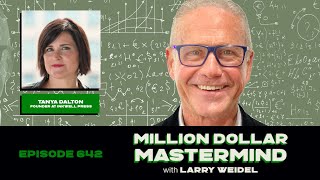
This content was created by Larry Weidel. This content was uploaded by Larry Weidel. This is a YouTube podcast episode (Episode #642: "The Accidental Entrepreneur with Tanya Dalton, Founder & CEO at Inkwell Press") published 2023-05-30. The transcript records a conversation between the host (introduced as Larry Wydell; also labeled in the transcript as "Larry Weidel") and guest Tanya Dalton. They discuss business prioritization and the Pareto principle—identifying the "vital few" customers and products to focus on, simplifying offerings to improve margins and operations—and illustrate points with examples from Inkwell Press product decisions and a restaurant that succeeds by offering a single core dish.
Chapters
Welcome to this edition of the Million Dollar Mastermind podcast. This is where we pick the brains of high achievers from all walks of life and get their hard earned real world insights on winning. I'm your host, Larry Wydell.
Well, how do you do figure out in business and how do you figure out things that are the most important? Because there's a lot of things that are very important. And the good one, one phrase that I heard early on I've used my entire career is the good is the enemy of the best. And that's where this falls into. And it's like there's only, we all have to deal with the accepting that there's 24 hours in the day and we're on a moving planet and so things are not going to be perfect. You live your life in cycles and it's not unlimited. So it does matter what you do, you don't have unlimited energy. That's one reason about allowing the negative people or the people who drop the ball in key areas in your life or create problems. It's like a radio station. You cannot listen to the radio station with static. You know, you're either going to get rid of the static or you're going to turn it off or you're going to switch it onto a channel you can hear. And that's the way it is in business. You can't run your business with people who create static or suppliers that create static. You know, you're either going to get, it's going to cause you to give the business up or cause you to go into another business or something like they got to go, you know, for one thing or another, one way or another, they got to go. So you learn to draw the line. How do you go about the process of learning how to draw that line? What do you want to keep in and what's got to go out?
Yeah, well, it's that age old question of how do you prioritize when everything's a priority?
Right.
But if you treat everything like it's a priority, it means nothing's a priority. So how do you get really clear on that? And it's really easy to get caught up in needing to have all the products, needing to have all the customers. It's funny, I actually just wrote, I'm a Forbes contributor and I just wrote an article about this for Forbes this past week and I talked about one of my very favorite things and I shot a video for Forbes about this is using Pareto principle.
Yeah.
Which people oftentimes call the 80, 20 rule, and it's not really the 80, 20 rule, but it's, it follows that same concept or that idea. Pareto principle tells us it's the vital few that, that make the biggest difference and make the biggest impact. And a lot of times what we do when it comes to our business is that we want to be the top and the best. So we want to treat all of our customers the same, right? When the truth is there's a vital few. There's maybe 15% of your customers that attribute to 80% of your revenue, right? Or maybe there are 10% of your customers that attribute to eighty percent. But it's figuring out what is the vital few, what are the fewer things that are really making a difference and then doubling down on those relationships with your clients, with those clients, treating them like they're the priority. It's not to say you're going to ignore all the other ones, but it means leaning more into that as a priority. Same thing with your offerings or your services. Whether you have products or you're a service based company. A lot of times we try to offer everything so we can be everything to everyone. And if we dive into it, and a really easy way to do this is just to go into your back end of your website. Most of us have it tied in with QuickBooks or we're on Shopify. And you can very easily pull a report and have that report rank in order all your products or all your offerings or your services rank them in how much revenue they bring in. What you're going to start to see is there's just a few that are responsible for the majority of that revenue. Yet we spend so much time on all those other, the trivial many, all those other offerings and services simply because we think we're supposed to. And the truth is, if we get rid of those other things, if we find some joy in missing out on some of those services and products and we lean into these, the vital few, the, the smaller number of products that are making the biggest difference, that's when we're able to do less while making more money, while, while having more time, freedom, more financial freedom and all of that. So really understanding what's your vital few, what are the big things that make the difference, it's going to be a small percentage. So Pareto principle applies in all areas with your customers, with your revenue, with projects, a lot of times we spend 80% of our time chasing after the small, tiny details when really it's just, you know, 15, 20% of the project. Those tasks that's what's going to make a difference. And so really diving into that vital field.
So take it another level now, blog writer. Take that into business world. Applying those. Those things.
Yeah. So first of all, you're making hard choices.
You're making hard choices.
So you are making hard choices.
Talk us through some of the hard choices you found yourself making that worked out to your advantage.
Yeah. Well, I can tell you about a mistake I made because that'll help you understand. I mean, you know, talking about this one was not a $45,000 mistake, but still a mistake. I thought for a while that we needed to have all different offerings of our products. So I wanted big products and small products and different sizes and different shapes and different iterations. Because we sell through Inkwell Press, we sell all different kinds of planners. Daily planners, weekly planners. So one year I decided we're going to go all out. We're going to have all these different versions of the weekly planner. Because some people would say, hey, I want a smaller planner. And other people would say, I want a big planner. Or I want a medium sized planner. I want a red planner, I want a blue planner. We had more offerings. I think we, like, tripled the number of things that we were offering on our website. So we had all these products. We get to the end of the year, and guess what? I made the exact same amount of money with four times the headache, four times the stress, four times the money I had to put up front. Right. Because you have to pay for the products before you're even selling the products. When in truth, if I had focused in on the vital few and I had said, listen, we're only offering these fewer products, I would have probably made more money. My profit margin would have been much greater. So it's easy to get caught up in this. It's really easy to get caught up in the idea that we want to be. We want everyone to be our customer. When the truth is. Because that's. That's a hard thing to take hold of.
Yeah.
Is that not everybody is your customer. And that's okay. I think that's when we end up having a lot of services or a lot of offerings. Right?
Yeah. And that's the thing that I guess it's unavoidable with cars and toaster ovens and this and the other. You have to keep up with the competition. You come up with a new feature. You know, I got this feature that feature people, most of the time, people could get, I drive nice cars. I won't get in. But I drive nice cars. Not as the ultimate, but I drive nice cars and trucks and this. And I don't know what they do, you know what I'm saying? It's like, and I'm a man, you know, I use this stuff, you know, I take my trucks up in the mountains and you know, I go here and go there. But other than having to know, you know, how to get into four wheel drive and, you know, a few things, I don't. Greatest sound system and you can adjust the volume and you know, I have to wait till someone drives, you know, rides with me. And they get in there. You're like my younger son or either one of my sons. They get in there, hey, you got air conditioned seats. They're like, oh, really?
And no idea.
And then it takes me, they have to ride with me about 10 times before I finally remember how to turn those things on, you know, so when they're not there. But most people could care less about the features. But you can get caught up in that where, you know, I'm going to be left behind if I don't, you know. You know, I guess the way to stay up with the competition. Feature, feature, feature, feature. Bores them to death.
Yeah, that's the mistake we make. That's a mistake we make a lot of times with our products, with our goals. We look around at what everybody else is doing and we're like, oh, they're doing this, we should be doing that too. We look around at what the competition is doing and instead of really focusing in on what our ideal customer really wants, we get caught up in what everybody else is doing. So this goes back again to that whole concept of Pareto principle. Diving into who are your vital few, who are your best customers, your ideal avatars, the customers that you absolutely love working with, who love working with you, who buy your product, who are not just returning customers, but loyal customers. There's a big distinction between the two of them. Who are those loyal customers? And then when you understand that vital few of your customers, what is it they want? What are the features that are important to them? Because you know what? Then you're going to attract more of those ideal clients. So stop looking at what your customers or your competition is offering. It doesn't matter. They may not be talking to your ideal customer avatar. Think about who your customers are, tap into them and create more of what they want. And that's how you create a win win. And that's, that's how you don't get caught up with having all the Things and all the bells and the whistles.
And I think you have good and bad in example of this in the restaurant world. My son and I were up in New York in April, and there's a place called Skirt, I think it's called Skirt. And you go in concrete floors, bench seating, long bench things. You just have to, you know, get on the bench. They serve water, tea, maybe coffee. They serve unlimited salad, french fries, bread. They don't unlimited bread, but they. They have a plate. You can order some bruschetta or something like that. The rest of it is skirt steak. Skirt steak, that's it.
You know, and I bet it's probably the best damn skirt steak because that's.
All they do is fabulous. And we were talking to a guy across, you know, we're sitting next to us, and he was in from. He was a professor in from la. And he had spoken a conference early that day. He said I wanted. He said I wanted to eat here last night, but the line was all the way around the block. And so when I came. Came in early tonight and I saw there wasn't a line, I immediately be lined over. But, you know, my. And my son was eating. He said, you know, if they had one of these in Greensboro High Point, he said, I'd be eating there three times a week, you know, and so maybe look for a skirt to be in your neighborhood soon. But it can't be that expensive to open. But just cutting it down to the basics like that is.
That's an operations dream. I mean, it really is. You look at these restaurants that offer 5,5 million plates. You look at something like Cheesecake Factory. That's an operational nightmare. It really is. And making sure that everything is fresh and in stock and all of those things. And what I think is interesting is this. He wanted to eat there the night before, right? The line was around the building because everyone knows you want skirt steak, this is where you want to go. And so it's that whole idea and that concept of doubling down on what you're good at and the customer experiments.
Was fast, you know, because they, you.
Know, because they're not worrying about like, hey, is the pasta ready? Is we gotta time this with the lobster? I mean, it's again, an operations dream. Clearly doing well. I think this is exact. I love that example because that's exactly what we're talking about here. That's not trying to be everything to everyone. It's like, this is what we do. We offer skirt steak, and it's going to be really good because this is what we do.
Thanks for listening to the Million Dollar Mastermind. If you felt there were any valuable takeaways from this episode, please take a minute and leave us a five star review. Your feedback is important and really helps us get the word out to a wider audience. Remember, we have a valuable webinar that is absolutely, absolutely free. Register for it right now@whiteallonwinning.com thanks for listening.
More from Larry









Rick Jordan on Self-Engineered Proximity, Cyber Security Moats, and Truth-Based Leadership

Fire Fast or Fail Slow: Kevin Brittingham Reveals the One Rule That Built a $100M Empire
