Episode #643 - Prioritizing The Essentials with Tanya Dalton, Founder & CEO at Inkwell Press
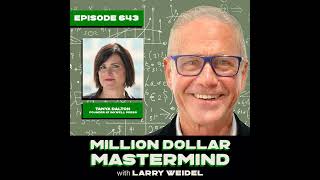
Tanya Dalton, founder of Inkwell Press, explains how to do less but what matters. She uses quarterly OKRs and a six-week reporting cycle called RCQs (Results, Challenges, Questions) to keep teams aligned, and automates routines like teaching kids laundry on Tuesdays. Her hiring rule: slow to hire, quick to fire.
Chapters
Welcome to this edition of the million Dollar Mastermind podcast. This is where we pick the brains of high achievers from all walks of life and get their hard earned real world insights on ready. I'm your host, Larry Wydell.
And so there's lessons. You know, the thing is, that's a concept that may be useful to you, but it's up to you as an entrepreneur, decide when to expand, when to, you know, when to pull in. And there is times, there is a lot of logic in at the right time for a company to be having a new beachhead, a new thing to like, freshen up. Like you moving to Asheville, you know, to stir the pot, change things up. But if you're moving 50 times a year, not as beneficial. You know, you're always traveling, you know, you're always introducing something, you know, so you need time to absorb these changes and all. And so as you went in, you started your business with what. What is the. I really didn't understand Inkwell Press, but you help, first of all, you help people do less while achieving maximum success. How can you have a company doing that? How does the company do that?
Well, really what I do is Inkwell.
Press is the name of your company, right?
That's the name of my company. I'm the founder of Inkwell Press. And I started that with that whole idea that I wanted to teach people how to, how to be more productive. Truly, with that definition of productivity, we talked about not about doing more, doing what's most important. And I knew that I wanted to have the tools so they could do it. I think a lot of people talk about like, oh, you could do these things. And people are like, great, now I'm ready to take action, but how do I do that? And so I wanted people to have the tools in order to apply a lot of what I talk about in my podcast, in my books, in all these different ways. And so that's really why I wanted to start Inkwell Press. It's really this marriage too, of what my strengths are. And that's why I started my business. I really focused in on what are my superpowers.
What are your superpowers?
Yeah, well, one of my superpowers is being productive operations. Those kinds of things just come very naturally to me.
Why are you more productive? Why do you have a knack for productivity?
You know, I think sometimes there are things that we're just naturally gifted with, so I think there's some of that. But I think I took a lot of those lessons. I learned, you Know, like when I was stirring that pot of spaghetti and trying to do all the things, and I very actively started applying it. But I've always had an affinity for productivity, for operations, for understanding how things work and breaking them down and streamlining them. I think for me that's something I'm really passionate about. So I knew I had that as a superpower.
I knew that first of all, you looked at it as a thing to, you know, it's a thing because I think a huge percentage of the population goes through life and they don't even think about productivity. They think about doing a job. They think about, you know, getting this done, getting, you know, this task done in terms of being productive, in terms of thinking like an entrepreneur, you know, or like a commission salesperson, you know, how quick can I get all this done, you know, you know, if I can get this 10 done in an hour versus, you know, all day to do that, I can, you know, dramatically explode my income. That's entrepreneurial type, commission salesperson type thinking. But not everybody thinks that way is they're just growing up and how they look at tasks, you know, it's one thing to look at that as a sales, but to look at tasks and how to, you know, I'm stirring the pot, you know, how can I, you know, maybe I can get my 4 year old to stir the pot while I go over here and do this or something, you know?
Yeah, yeah. I mean, that's a whole nother conversation you can get into because I taught how to delegate to my children when they were young.
Okay.
Oh yeah. I outsourced laundry.
How did I know? How did I know that?
I don't do anyone's laundry. I don't even do my own laundry anymore.
Explain that. Explain that.
Yeah, well, I love, I love things like automations and automations. To me it sounds like it involves technology, but doesn't necessarily. Automations are things that you happen automatically so you don't have to think about them. So in my home life when my kids were little, especially Tuesdays was laundry day for my kids. Laundry. So, you know, one of the things that causes a lot of stress is laundry. Of all the things, right? Oh, we have no clothes, we're out of underwear. It causes a lot of stress.
You gotta watch them, you gotta fold.
Them too, you know, fold them too, right? But I set up this automation where Tuesday was laundry day. So on Tuesday mornings when my kids were little, I'd say, okay, it's Tuesday. What is Tuesday? They'd say laundry day. So okay, they got a little older. It's Tuesday. They knew it was laundry day. I bought them hampers that they could bring down the stairs. So they had their hampers, they brought them downstairs. And then I said, okay, it's Tuesday, laundry day. They got a little older, got them to start sorting their clothes, Sorting the clothes into darks and lights. And could I have done it faster? Absolutely, I could have done it faster. But the point was I was investing in them. That's my team at home. Right. My kids are part of that team. So I sat there, I'd watch them. Yep. Eventually they got a hold of it. All right, next step, time to sort the laundry. It's Tuesday, laundry day. They bring their hampers downstairs, they sort the laundry, they put it into the washing machine, and then eventually they're putting it in the dryer and then they're folding their clothes. And this is why, when my kids were little, I no longer did laundry. Like from the age of 10, my kids were doing their own laundry. My son's now in college at High Point University, and guess what? No question about whether he could do his own laundry. He totally felt competent. So I was giving him the tools to be an independent adult while I was giving myself the tools to. To be free of focusing on laundry. Right. It's a win, win. And that's what delegation is. It's empowering others to step into their own greatness.
Ah, that is fantastic. I think a lot of light bulbs have gone on with people listening there, and a lot of this has. And by the way, my son lives in High Point. He's got a place that backs up to the lake. High Point Lake.
I love that. I love that. Yeah. We are big fans of High Point, a university run by an entrepreneur. So.
Okay, and so as you moved through this thing, how did you. Your. How did you develop those strengths and expand on them?
That's a good question. I think. Honestly, I think reflection is one of the best tools you can use. And it's free. Everyone can do it. I plug in and I pre schedule four times throughout the year time for reflection, projection and action, which is kind of. Those are the steps for goal setting for me is reflection, projection and action, and really making sure that at least once a quarter I am sitting down and giving myself a half day to stop and reflect back. Now when I'm reflecting, I'm not beating myself up, but I am looking at what were the wins, what were the losses, what went well, what was terrible, what do I not want to repeat again? Because Truthfully, when you know what you don't want, it's more powerful than knowing what you do. So when I look at the things I have not done well, the mistakes I've made, the accidents that happened, the bad hires, the bad fires, all of those things, I can grow from that. So. So actively taking the time to stop and assess where I am, how am I doing? Do I like where I am? That's a big question. Do I like where I am? Do I want to stay on the same path we're on, or do I want to shift trajectories? I think that's what's allowed me to really lean into. What are my powers, because I'm regularly stopping and I'm checking in with myself. How am I doing? How's my team doing? How's this team member doing? How are we moving together as a group? Because that's what a team is. A lot of times we hear that concept of getting everybody on the bus. I don't believe it's a bus. It's a boat. Because if it's a bus, you know who's driving that bus? You are. And everybody else is just sitting in the back, right? Yeah, the boat. And everybody has an oar, and you're getting them to pull the oars and pulling in the same direction. You're the one in the back of the boat going left or right and helping them make sure they're turning the oars the right way. So I'm checking, are we all turning our oars the same way? Do I like where our focus is? That's when I set our quarterly objectives. Once a quarter, I sit down, I do my reflection, then I'm thinking to myself, okay, these are our top priorities for the quarter ahead. Okay, if these are our top priorities, These are your OKRs, your objective and key results. What are the things I want to see from each team member to make sure that we're all rowing the boat in the same direction? And it's going to be different from people in my marketing group versus people in operations versus people in the warehouse versus Right. So we're making sure that we're all aligned. That's my job as the leader, as the CEO, or what I like to say, the cvo. Cvo? The Chief Visionary Officer. My job is to go up and out, and I need to look and I need to see the big picture. If I'm down in the trees, all I can see are trees. I got to get the forest view. So I'm zooming out. I'm Taking a look. This is what it looked like in the past. This is where I want us to go. Then I come back and I report to my team. This is where we're all moving together. And that's how you create synergy and alignment. That's how you make sure that you're moving forward in the direction you actually want to go. So I think that's, you know, in a nutshell, how I know what my powers are and how I can lean more into them because I'm actively checking in on a regular basis.
Great answer, great insight. Tell me about good hires and bad hires. What did you do hiring?
You're going to have both. You're going to have both. But I'm a big believer as many people are in slow to hire, quick to fire because I've made the mistake of slow to fire. And then, you know, one poison apple poisons the whole group or whatever, wherever the saying is. I think one of the biggest mistakes people make when it comes to hiring is they're just so relieved that someone said yes to this position that they're willing to overlook the things that they're not doing well. And then they become afraid to fire because they think, well, who am I going to get to do this right? This is why again, stopping and doing that reflection activity is so important because I'm reflecting, how's my team doing? How are we moving forward? But I think one of the big mistakes people make when it comes to good or bad hires is on you. How are you onboarding them? Do they understand the culture that you're trying to create? Do they understand where you're all rowing the boat? Do they understand the expectations? And making sure that that is really clearly laid out I think is really important. Anytime that I am onboarding somebody, we go through a six weeks process called RCQs. So I can walk you through it if you want.
Yes. Yeah, I won't wait for your blog in Forbes. We'll go ahead and get it.
I'm sure I'll write an article for Forbes at some point about this because I do really, it's, it's so insightful. The RCQs. So R stands for results, challenges and Q is questions. So results, challenges and questions, RCQs. When someone starts with me for the first week or the first two weeks, they give me one R, one C and one Q. So one result, one challenge, one question. And then in weeks three and four, they're going to give me two results. They can give me up to two challenges and up to two questions weeks five and six. I want to see three results. They can give me up to three questions and three challenges. But the point of the RCQs is this. They have to email me their RCQs at 4:00 clock any day that they're working. So if they're part time, it's on the days that they're working. They email me at 4 o'. Clock. This is my result for the day. These are my challenges, These are my questions. What I'm looking for is the things that are challenges for them in week one or two, have they built upon them in weeks three and four, five and six, that those are now results that they're creating. Right, right. Am I seeing that we're getting some growth here? Are they asking good and interesting questions? Because this is a really good way to start tapping into who are going to be your managers. Who are the people that you think you're going to want long term? They're the ones asking interesting questions.
Yeah.
Hey, I'd like to know the thought process behind this system that we have in the warehouse. I want to understand they're not the ones who are asking silly questions. Right. So by seeing every day the results, their challenges and their questions, the other thing that starts to happen is I see the gaps in my onboarding process. If they're asking me, let's say it's a warehouse worker and their challenge for the day is I couldn't find the stapler. Okay. That's an onboarding process issue. Clearly we need to make sure that they understand where all of the tools are located and if they don't see them, where they're stored or those kinds of things. So you start to see these gaps in your onboarding that you can then start to fill and make sure you don't have them in the future.
Yeah.
So the RCQs for me are so important that you can miss them one time and send them to me late. Send them to me late two times you're fired. And I tell them that it's that important.
What would, what would a result when you, what are you referring to when you say a result?
Yeah. So. So for the week one and two, it's a result. And then three and four, two results in weeks five and six, Three I want to see. What did you accomplish today? What is the results of your job today? So when they first start off, it might be. Well, I went through the employee handbook. Right. But as they start to go in weeks three and four, you want to see. Okay, I applied those strategies and so I did these things. Okay, so today I went through, let's say it's a marketing person. I went through and I looked at all the Facebook ads that we've done and I've made some suggestions. That would be your result. Right. Or I have what are. What is something they've accomplished. So it's basically what's your point of pride for today? Yeah, because what I want to see is and I don't want to have to keep checking in with them. That's why they email it to me. And if they have a question, I'll say, okay, let's take 10 minutes. The next day, either I will explain it or one of the managers will explain it to them. Let's get your question answered and then we can move on.
Thanks for listening to the Million Dollar Mastermind. If you felt there were any valuable takeaways from this episode, please take a minute and leave us a five star review. Your feedback is important and really helps us get the word out to a wider audience. Remember, we have a valuable webinar that is absolutely free. Register for it right now at whiteallowinning.
Com.
Thanks for listening.
More from Larry









Rick Jordan on Self-Engineered Proximity, Cyber Security Moats, and Truth-Based Leadership

Fire Fast or Fail Slow: Kevin Brittingham Reveals the One Rule That Built a $100M Empire
