Episode #653 - Building An Entrepreneurial Mindset with Joseph Santana, Chairman of CDO PowerCircle
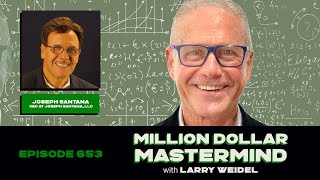
Joseph Santana, chairman of CDO PowerCircle, discusses his career at Siemens and founding a diversity-focused business network. He shares how to build intrapreneurial leadership programs and adapt to workforce change, including the rise of tools like ChatGPT.
Chapters
Welcome to this edition of the Million Dollar Mastermind podcast. This is where we pick the brains of high achievers from all walks of life and get their hard earned real world insights on ready. I'm your host, Larry Wydell. I'm talking with Joseph Santana.
Hello, Joseph, how are you?
Larry, it's great to have you on my podcast. And this is different than you being on your podcast.
Yes, I like being on this other side of the microphone, so to speak.
The pressure's off.
That's right.
And so talk to people about what you think in business. What is the thing, that accomplishment that you're most proud of that maybe you would have never imagined you would have been able to do once you started out in business?
Yeah. So years ago I was an outsourcing executive, which means that my job was to find ways to drive cheaper, faster and better services to my clients. And I worked for this little company called Siemens with about a million people scattered all around the world. And during that time, one of the things that I discovered was that my sales group was doing a bang up job of selling more and more business, but we weren't able to keep up with the bench that we needed of leaders in order to fill that business. So just if you know anything about outsourcing, if you cannot put a leader in place to take over that new account, you might just lose it to the runner up because the client wants to get going right away. And so I started to look back at my bench and look at what was going on around me. And what I found was that we had a system that was set up that worked perfectly for most of the men that came to the technical side. It didn't work as well for the women that were coming over to the administrative side. So our system was designed to train the men on the administrative side so that they could be well rounded and become a top leader. There was no corresponding system for the administrative people that were coming in or the women that were coming in. The they were credentialized smart, but they just didn't have that side. I made one small change and that small change was I went back to my HR organization and said, hey, put in a corresponding training program or another module that's for this particular group so that we can bring them up to speed as well. The net result was at the end of the year was a 17% increase in profit and year over year, double digit increases in profit. And that's when I got religion. That's when I realized, hey, you know what, if you figure out Ways to utilize this new workforce more broadly, more widely and more effectively. It's going to turn into revenue for your company.
And how did that play out in the real world? How did that play out? Did you notice? What were things that just stuck out to you other than the numbers once it was done?
Well, one of the things that stuck out to me was, hey, I was hanging on to more talent, which I needed. You know that in this game, especially in the outsourcing game, what you're selling is your people's talent, talent and smarts. So I was getting more talent. I wasn't getting just talent from one side of the equation, I was getting it from both. And the other thing that stuck out to me was I began to become a detective that looked at my operation and asked myself, what areas do I have that I'm underutilizing? Because I'm not set up to fully support whatever group of people it is or whatever operation it is. And as a result, that's why I gradually transitioned over and started doing the work I started doing in the area that I currently run my business.
And that set you up. I guess that puts you in a position where you had unique insights, where you went out. Now you're chairman of the CDO Power Circle and talk about what that is.
Yeah, so that's an association of people. They're called Chief Diversity Officers. But the reason why I started this association was because most of the groups that existed before, and I had been part of some of those groups, in fact, I helped certain companies develop some of their groups, but most of them were boxed into this whole celebrating holidays, putting up pretty little icons on their website during certain times of the year to celebrate different types of. And I did not see how that alone was going to drive some kind of a business benefit. And moving deeper into the 21st century, I saw that there was a need to be able to address that because the workforce is changing and organizations big and small have to be able to attract workers from that workforce and also be able to address that market. So I brought this group together as a group that's very business focused in terms of what they do. So they're bringing benefits to different people that are in the organization, but they're doing it in such a way that that it helps the organization to be more effective in securing clients, securing business and securing top talent.
Now, how did you get started in business and work your way up the ladder to where you are running a 300 person employee multimillion dollar wing of Siemens? Where was Siemens Located at that time.
At that time, my office was located in New York City, so I had the New York City territor. And that was that particular area. Yeah. So if you, if you look at my career, Larry, it's kind of a zigzag is the best way that I can describe it. So I went to school and studied finance. So by. By education, I was an accountant. But then back in the, you know, back in, I would say, like the 80s and so forth, I could see that technology was taking over a lot of the accounting roles. So I used to work on Wall street and we used to do all types of reports that required a lot of bookkeeping and accounting people to track different securities and different buckets. And I literally could see that all this was being put into automated systems. And in fact, I participated as an advisor on committees to help the programmers to design systems that would take over some of that work. But I also realized that I was phasing out a lot of jobs in my particular area, and I enjoyed the work in the systems area so much because I could see that it was. It was the future. So I moved from that accounting field and I became a systems analyst that automated all types of, you know, practices and processes. And I did it for a couple of brokerage houses. From there, I moved again when I saw that most of the work that was being done in technology, the stuff that I was enjoying doing was being outsourced now to vendors. And more and more organizations were focusing in on their core and they were taking these things like it and so forth, and they were putting them out there to business practice, outsourcing companies. And so again, what I did was I pivoted and I moved into business process outsourcing of it. That was what Siemens was doing at the time. I started out managing one of their accounts, which happened to be a brokerage house, Morgan Stanley. And then from there I ended up heading the group and all of the operations in the New York, New Jersey, northern area.
So you were. Would it be fair to say you developed a niche for systems and then that turned into outsourcing these systems because you were doing it inside companies, but then you were seeing what was happening to the industry and you didn't want to be behind the curve.
Correct, Larry?
Correct. That's the way the future was going. Yes.
And I think, and I think that what I was doing back then, and I think I do it somewhat instinctively because I've always been interested in looking out and seeing where things are going and repositioning. I think that gives people a tremendous advantage. But I think that what I was doing back then, which was good for me, is actually vital for people today. If you're a young entrepreneur today or you're in a business or you're working for a large corporation, you have to be looking out five or 10 years in terms of where things are going, because things are moving so fast. I'll give you a quick example. Think about a year ago, just a year ago, around this time, who was talking about ChatGPT? No one. All of a sudden it just exploded on the scene. Now here's the thing. ChatGPT3 implies it was a ChatGPT2 and a ChatGPT1. So that means that all of this stuff was in the works and was being developed and people were just going on about it until all of a sudden in November, it exploded on the scene. Professionals today and business owners cannot afford to let things explode on the scene. They have to have their hand on the pulse. And part of that pulse is if we look at our organizations in terms of where the people are coming from that we're hiring, the populations that we're selling our products and services to, they're changing dramatically at a dramatic speed. And right now, organizations that are more in tune with that change are selling and are realizing revenue in excess of 34%. They're showing 19% better innovation revenue by understanding who they're selling to and where they're getting their people from. Organizations that delay doing that or that delay looking ahead and preparing for the future, they may find themselves behind the eight ball with not enough time to make that shift. So what I did back then, which was a good thing to do, I think today is a vital thing to do.
Yeah, you did it for yourself, basically. Correct.
For those of you who are sick and tired of fooling around and are dead serious about wanting to move up fast, I've got something especially for you. I've combined the best insights from over 40 years in business and making $70 million in income and compressed them into a free webinar. That's right. It's a free resource. If you want to find out exactly what the concepts are that I use in coaching million dollar earners, register now at wdell on winning.com you'll discover the five part framework used by so many to reach their financial, personal and professional goals, you can find that link in this episode's show.
Notes. At what point, what do you remember as your driving motivations as a young man coming up and looking at the job market, thinking about Your future? What were things that excited you, that you looked for? And how did you evaluate the marketplace out there? What did you think you could be good at? What did you think I just don't want to do? I just don't like that.
You know, it's interesting, Larry, you're asking me that question now. So in retrospect, I'm a lot smarter than I was back then. So if you asked me that question years ago, I would sort of wonder, well, you know, not sure, but I'm going in this direction. But looking back and looking at the dots that connect my trajectory and the direction I've been going in, if I look back, I realize that there were two things that always excited me a lot. One was I always liked to be the person who was involved in the next new thing. I was always looking for how to develop the next solution, how to do something different. So that's something that's always been a driver. And then the other has been an equally strong appetite for a certain degree of independence. And what I mean by that is that the roles that I was most attracted to in organizations were roles that gave me the most autonomy. So usually, like, for example, when I was the head of outsourcing, my boss was, like, miles away, and we met maybe once every couple of quarters to talk about how my profitability was doing. And so long as my numbers were good, it didn't matter how I got there. Exactly. So I had complete autonomy. So I think those two factors have been the driving factor in my personal career.
And you, you point out that you can build if you look for the right situation. There are places where you can work for a big corporation, but you can build your own company within a company, inside there by being in the leadership role, working your way up to where you're in one of those arenas that you have to move fast. You got to make a lot of decisions. And it's probably maybe a little specialized for the CEOs and people up at the planning group level to want to get buried in the minutia, and they just let Joseph do it.
That's right. That's right. And, you know, interesting enough, I mean, for me, it was exciting to do that. But I think today, again, organizations need people like that. They need intrapreneurs. They need people who are entrepreneurial but are inside the organization. Because today it's not about, you know, let's look at yesterday's best practices. Today it's about, let's look forward at what's coming, and let's come up with a clever solution to either make lemonade out of a lemon or seize an opportunity faster than anybody else is going to do it. So it's all about that forward, you know, driving, looking at the windshield, not the rear view mirror.
And for people who want to be an entrepreneur, but see it's so far down the road and they're going to have to transition into that, one good way to move in that direction is to look for a place where you can be an intrapreneur. Because inside that you have a lot of opportunities to meet people, to get experiences, to do things that if you were self funding or starting up from scratch, you probably would take you a while to get to where you could pick up that kind of experience. And those kind of experience and contacts are invaluable when you get out there on your own.
Absolutely, absolutely. It's really important to make those contacts, get those experiences. The other thing is you're literally playing with someone else's money as you're learning because you're going to make mistakes. I mean everybody, that's how you learn. If you don't walk out on the edge, you don't know how far you can go. So you're going to make mistakes, but you learn by applying yourself to your job as an entrepreneur. And I think that there are more places where you can do that than most people would think. For one thing, a lot of times one of the things that I believe is really important is rather than trying to fit yourself into a job and say, this is the job now let me shave off all my edges and fit into this square hole. I think it's better to look at a job and look at your totality and ask yourself, what can I uniquely bring to this role that I can only bring to this role because I am this combination of skill sets that might be different from someone else's. So you and I might get the same job, but Larry will do it one way because Larry is gifted in certain areas that I am not and I'll do it in another way. And by doing that, I'm developing a better, more efficient, powerful, successful version of myself using all my skills. And eventually then if you do go out on your own and you strike out and start doing something really entrepreneurial, where you start a new business, you'll do it with more of a totality of yourself and you won't be a me too company that's doing something someone else is doing because you're Larry and you're unique and you've brought all of yourself into this.
Well, you are never going to be great trying to be somebody else, and you're never going to be great stifling yourself. And there's a point at which you got to say, I got to be me, and.
I've got to be the great me.
I can't be the average me. But if I'm going to be great, I've got to be myself. And you got to take some chances. Where did you find yourself taking chances? Early on, you're in a position where you've got 300 people to keep up with. That's kind of crazy inside a multinational corporation. And what is that like for you as a guy who just used to be you, and all of a sudden now you've got all of these moving parts inside significant companies and significant roles. Significant things are changing inside these companies. A lot of responsibilities, zero back to you. And so what's that like dealing with that emotionally?
Well, you know, dealing with it emotionally, it depends on the person. Like, I'm the kind of person who gets excited by things like that, whereas some people get scared. Right. But that you can. You can harness that you can harness those feelings and you can use them to propel you forward.
So.
So, in short, one of the things that I realize in my different careers that I've had and the different roles that I've had as I've been moving through, is that in order to be effective in a new role, it's not just about learn a couple of skills and execute entirely the way you would have years ago. You literally have to reinvent yourself. You have to ask yourself, who do I have to be in order to be successful in this role? What do I already have that I bring from past experience and what do I need to add? Because it's something brand new. So I did that in that role. And I really focused a lot because there were a lot of people I really focused a lot on how do I develop rock star managers, how do I develop people that I can really count on who I know will take care of the 20 or 30 people they have, who in turn will be taken care of by. By the next layer so that I can then focus on what I need to focus on. Because there's no way that I can run this orchestra by running to each instrument and playing each one by myself. So I have to find ways of building up all my players and all the other people who manage those players. And yeah, fortunately, I was surrounded by some pretty smart people who were able to take on those roles and then later on, when I went into the other area that I went into later on, which is what I built my business on later on, this whole area of building up organizations and people who can make them effective in attracting that new workforce and developing and deploying that new workforce. When I did that, I realized once again, and this is over a decade and a half ago, I had to reinvent myself again. I had to create another version of myself again. And this time I took into this new recipe of ingredients to rebuild myself. My experience as a business person, plus my experience and knowledge in the area of futurism and being a futurist and being able to read the different tea leaves and prepare for all the different possibilities and the outcomes, added that to then the understanding of how it is that by leveraging people you can address markets. And then that's where my association, I think, stands as being different and unique in what it offers and what it does compared to others. Because it is a combination of all those different talents and gifts. And again, very similar to when I was at Siemens and I had that large crew. I needed to develop really strong managers. In this particular case, what I needed to do is I needed to be selective about who I brought into my association. I needed to pick people to bring in who had the capacity to grow, develop and be able to accomplish the things that needed to be accomplished to make a difference. So I couldn't just have an association where if someone was breathing, you know, if someone could fog a mirror and they were in that particular field and they gave me a check, they were in. So we are selective about who we accept for that reason because by having that selectivity, we have that strong team.
Thanks for listening to the Million Dollar Mastermind. If you felt there were any valuable takeaways from this episode, please take a minute. Leave us a five star review. Your feedback is important and really helps us get the word out to a wider audience. Remember, we have a valuable webinar that is absolutely free. Register for it right now@whiteallowinning.com thanks for listening.
More from Larry









Rick Jordan on Self-Engineered Proximity, Cyber Security Moats, and Truth-Based Leadership

Fire Fast or Fail Slow: Kevin Brittingham Reveals the One Rule That Built a $100M Empire
