Episode #654 - Unleashing Team Potential with Joseph Santana, Chairman of CDO PowerCircle
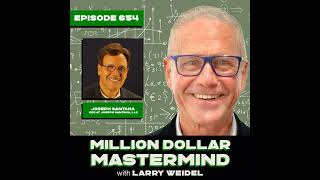
This is a transcript of a podcast interview (Million Dollar Mastermind) where host Larry Weidel interviews Joseph Santana about leadership, talent development, and the strategic business case for diversity, equity, and inclusion. Santana emphasizes building ‘rock star’ managers (coaching over mentoring), discovering career passion through pivotal projects (his automation liaison role), and updating organizational policies to leverage a 21st-century diverse workforce. He also describes founding the CDO PowerCircle—a chief diversity officer association that helps member companies adapt policies and attract/retain talent—arguing DEI must produce operational changes, not just PR gestures.
Chapters
Welcome to this edition of the Million Dollar Mastermind podcast. This is where we pick the brains of high achievers from all walks of life and get their hard earned real world insights on winning. I'm your host, Larry Wydell.
It's a funny thing, you have to have a certain toughness about yourself to where you won't be, allow yourself to be bullied into being other than who you are and where you'll go slink around and try and bend and accommodate everybody. But the other side of it, you've got to have a certain humility factor where you're humble enough to say, if this is going to work, I've got to change, I got to make some adjustments. And usually those adjustments work out well in other areas of your life too. It's probably an adjustment you needed to make anyway. That's the thing, the challenge of taking on more and more responsibility with more and more people, different personalities you have to deal with and allow them to make the mistakes, allow them to be themselves, you know, and not be threatened by that. But that idea of starting off with the thought that I've got to build rock star managers if I'm going to do what I want to do is, you know, that's really a powerful concept because without that you can spend all the time and this, you know, you're going to talk to people different, you're going to train them different, your attention to detail is going to be different. If you're trying to build a rock star type person who is going to be able to duplicate you, represent you in a way that you don't have to be worried about it all the time. So where did that idea come from? Is that a Siemens idea or is that a Joseph Santana idea?
Yeah, you know. Well, I think it's a Joseph Santana idea and I'll tell you why. Because I think I've always seen that there is a need to have people who are simply effective if you have people that are not effective. And I saw so many examples of people that I worked with. So I'll say it was inspired by good bosses. I had good bosses and I saw some of my good bosses, how much they could get done and do it with a plum, as it were. Whereas I saw others that were trying to accomplish things and running around with their hair on fire and literally not accomplishing half as much. And the big difference was always the people that were most effective in developing and attracting and developing the better people always were the most effective. And it takes a little bit of confidence and it takes a little bit of trust. Also. You have to trust other people, as you said before, you have to allow them to be themselves and to make their mistakes and learn from them. You have to be more of a coach than a mentor. You could be a mentor, but you.
Also have to be more of a coach.
Because as a mentor, what I'm trying to do is I'm trying to get the other person to learn from my experience. But as a coach, I realize that I'm not in possession of all the available, possible, greatest skills that exist in the world. There are people out there that have skills that I don't have or have them to a degree that's much more developed than mine or has much more potential.
So.
So I have to be able to tap into that. Just like a good coach can sit on the sidelines and tap into their player and make them play the best game. A game that the coach, if he suited up or she suited up, couldn't go out there and play. You have to have that combination of that confidence. But I would say my final answer to that question is that it came from me, but it came from the inspiration of the good leaders that I had the good fortune of meeting and, and some of the bad leaders. And I just saw, wow, he's killing himself and he's not achieving that much. He seems to be doing this well. What is he doing and how can I replicate that?
Yeah, you talked about early on, and it's a way of looking at the dots of our career. What would you say the first big dot in your trajectory of getting started? What's the first dot you would say?
Well, you know, interesting for me, the first dot was when I started working years ago on that automation project that I mentioned. I was an accountant. I was one of the many different accountants. I did reports where we assess things like what's the company's risk if it holds on to a certain security. And the first dot for me was when I was appointed to work on this project as a liaison with the programmers and the systems designers. It seemed like a punishment at first because I had a plate full of work and now I was being given this other thing to do. But I realized my boss had a lot of confidence in me and that's why he picked me for this. And as I started to spend time talking with them and working with them and putting different solutions together, I realized that I had a passion for this. I didn't realize that before. And I think that that passion made me give this more than 100% because I was really engaged with this effort. And that's one of the things that attracted me into moving into that space completely over time. But one of the other discoveries there, why I call that a big dot, is because I realized the power of that passion. When I really care about something and when I'm really enthused about it, I get up in the morning and I can't wait to get started. It just, it energizes me. It gives me energy when I do something that is necessary or if I perform a role that is necessary, because it's part of my job description, but it does not excite me. That depletes my energy. And so as soon as I realized that, I started hunting for all the different things that I could do that would engage that passion because I knew that was the path.
Yeah. And that informs choices you make, decisions you make and allows you to choose places where you will be more productive because you're smart enough to realize this doesn't create static for me. This doesn't wear me down. This inspires me. This is where I need to be. And of course, you perform at a higher level. Talk about the diversity equity and the DEI inclusion type thing, because for the uninitiated, it can sound like, oh, that's just trying to have one of these and one of those and just being politically correct. And what is the real rubber meets the road truth behind the DEI effort.
So here is where the rubber meets the road. If you look at any chart of demographics and you start from, let's say, people 60 to 70, and then you look at 50 to 60 and. And you look at 40 to 50 and so on, and you keep going down the line. What you'll notice is that with every generation, it's becoming more diverse. The number of people that are from various groups that were formerly smaller percentages are becoming larger percentages. And the U.S. census Bureau just here in the United States, says that by the year 2045, collectively, what used to be those small percentages will be the majority. Now, what does that mean for a business? For a business, that means the pool of people that you will be trying to attract talent from, and the pool of people that will become the market that you're selling your products and services to will be different than the pool of people that you had in the past. So 21st century group is going to look very different from the 20th century group. And in order for organizations to be effective, effective in bringing that pool in and leveraging that pool, they need to be able to Update practices that they have within the organization. So I'll give you a quick example. Years ago, if you had a, let's say, for example, a salesperson, and they went out and they took a client out and they came back and they put in an expense report, their drinks and their dinner would be expensed today. And those were probably all the expenses that person had. It was generally a male with a wife and the wife took care of the kids, so everything was fine. Today you have more working women and you also have more men taking on more responsibility for children. And yet many of the policies and organizations have not been updated for that reality, so that no one today, most companies can expense, let's say for example, a babysitter so that they can go meet with a client, they can expense their martini and expense the whole dinner, but that one little charge for that babysitter, that is not expensable, right? So that policy is perfect for the 20th century workforce, doesn't work as well for the workforce today. And if you have that policy in place, and let's say, for example, you end up hiring a workforce now where you've got more men and more women that have child care responsibilities. And let's say 30% of the men that you have don't have child care responsibility and some of the women don't have children either. They have no childcare responsibilities. You literally have only 30 or 40% of your workforce that can actually dedicate more time and energy into selling because the other 60 or 50% can't unless they can find a babysitter, which, by the way, they can't expense later on. So you see, as we move forward, forward, what becomes important about DEI is not just having one of these and one of those. And in the past, that was pretty much what it had become. In all honesty, if you look back at the past, what HR organizations were doing is trying to do compliance and trying to do good faith. But today, what it's becoming is vital to an organization that wants to bring in a workforce. A 21st century workforce made up of all these different people that are different from the workforce of the 20th century, fully equipped them to be as productive as possible for the company by engaging them as fully as possible and then being able to engage a clientele which is also made up of that new population, different tastes, reacts differently to different things. And that if organizations don't understand that, then they begin to lose market share. As a good friend of mine likes to say, when you lose mind share, you lose market share.
And now, as you're working. This is a message that you take to this association now, an association consisting of member associations. I don't understand that. The CDO power circle, but it generated nearly three quarters of a trillion in US dollars in revenue with almost 1 million employees. So you have a lot of influence in there. But how does that go? How does that work?
So essentially, the people that are the representatives of the companies that are our members are the chief diversity officers.
Now, you started this thing, too. Let me interrupt you like. Yes, you get an idea.
Right, right. Joseph gets an idea.
And all of a sudden now you've got almost, you know, influencing companies that are affiliated with this thing. Over 1 million employees, 3/4 of a trillion in revenue. And it all started with Joe said, I got an idea.
Yeah, exactly. Yeah, Larry, you hit it right on the head. That's exactly what happened. But here's the idea. I looked at this from various angles and I looked at the different practices that were going on, and I said, you know what? I know from my experience, the experience that I had where I made those changes, and I was able to more fully utilize my groove, which is from the inside. I mean, which is from the inside.
It's in the inside. There's nobody going to come and say, no, Joseph, you don't know what you're talking about. Because you do know what you're talking about.
So, yes, I did it. I did it right now. I looked at this and I realized, wow, this has a lot of power. And then I got involved in it. And then as I got involved in it, I started looking at it.
You're saying you're in it.
Diversity and equity and inclusion. I got involved in diversity, equity and inclusion, and I started working in different areas of the company. And we were able to produce a couple of other results that were quite interesting that had financial impact. But then when I started looking at what. What organizations were the association organizations were talking about and what a lot of these groups were talking about, I realized that what they were talking about was generally fluffy stuff that might look nice, it might be a great PR stunt, but it wasn't going to produce the kind of results that, you know, that would make a difference to an organization. So I'll give you an example. You could celebrate in March, you could celebrate women's, you know, Women's International or women's history. You could celebrate women's history in March. And you can have all kinds of nice things on your website and. And you can have people come up and give speeches and all that is Nice. And it gives people a warm, fuzzy feeling. But unless you make fundamental changes in your organization that enable all the women that are there to do their best and be as productive as possible, it's not going to impact your bottom line. It's not going to impact your full time equivalent output from each one of those people that you have working for you. It looks nice on the surface, but. But it's not going to change anything. And I think that one of the things, Larry, that inspired me to start this new association is that what I looked around me and a lot of these organizations were saying, well, we need to hire more women, we need to hire more veterans, more African Americans, we need to hire this. But the organization wasn't changing fundamentally in any way like I did with my team, to be able to fully leverage these people. So I said, this is literally like taking elephants and shoving them into a house built for a giraffe. The floor is not meant to support them. The walls are too narrow. Right. You want to bring elephants into that house, you need to rebuild that house to make it effective for that elephant. And that's the same thing that I'm saying right now, once you make those fundamental changes in your organization. And let's say one of my members is Froedtered Health, a hospital out in Wisconsin. They literally leveraged the people that they have in the organization to better understand their clients, to better understand the patients that are coming to them, and to be able to message the way that they do outreach and provide medicine. They also use it as a way of attracting the best talent. In fact, this hospital, while organizations were crying about the great resignation and all the talent they were losing, these people were hiring those people that these other companies were losing. And that's going to happen more and more en masse as we move deeper and deeper into this 24, 21st century, where organizations that are not designed properly to leverage that 21st century workforce or serve that 21st century marketplace are going to find themselves losing clients and losing talented people to the ones that are better equipped.
And so to the point is to have an association where you help companies make adjustments that will allow them to attract better people, more people in the market that are out there looking today that have different backgrounds and everything than in the past, and also to allow them to be more productive. Right? Correct.
Correct. And that's important because one of the problems in an organization who does not allow people to be more productive will face is a they're not getting the most out of the people that they're getting in. And B, they're going to lose people. People are going to leave because talented people don't want to stay somewhere where they don't feel fully utilized. They don't feel like they can be all that they want to be. And they don't see this leading into a path that their investment in themselves was made originally to achieve. So don't leave. So the organization ends up becoming a revolving door and it's got nice little, you know, nice little messaging and so forth, but the inside can't hold and it can't leverage.
Thanks for listening to the Million Dollar Mastermind. If you felt there were any valuable takeaways from this episode, please take a minute and leave us a five star review. Your feedback is important and really helps us get the word out to a wider audience. Remember, we have a valuable webinar that is absolutely free. Register for it right now@whiteallonwinning.com thanks for listening.
More from Larry









Rick Jordan on Self-Engineered Proximity, Cyber Security Moats, and Truth-Based Leadership

Fire Fast or Fail Slow: Kevin Brittingham Reveals the One Rule That Built a $100M Empire
