Episode #658 - Mastering Your Future with Sief Khafagi, Co-Founder and CEO of Techvestor
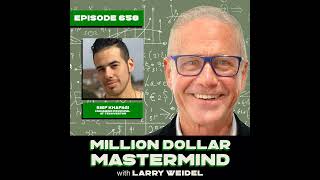
Sief Khafagi, CEO of Techvestor, shares lessons from five years at Facebook where he scaled teams and learned that top talent is worth overpaying for. He started as a movie theater worker and bank teller, studied health communication after his father's Alzheimer's diagnosis, and now advises on hiring and leadership in an AI-disrupted world.
Chapters
Welcome to this edition of the Million Dollar Mastermind podcast. This is where we pick the brains of high achievers from all walks of life and get their hard earned real world insights on winning. I'm your host, Larry Wydell.
When did you get the idea of. When did it dawn on you that you were pretty good at interviewing? And what about that? The right way and the wrong way to do it occurred to you in that time when that idea crystallized?
Honestly, I was just helping friends kind of break into it, and then their friends were like, hey, can you walk me through this? Or I want to do that. Even till this day, anyone who reaches out to me for interviewing advice or experience, that I know, right? Because I don't think you lose those things. But it was just data, you know, it's just every job I ever interviewed for, I had the opportunity to work there if I wanted it. And having that privilege is a really powerful mechanism in your life where you can kind of control your own future. Oftentimes, it's not about people. Oftentimes forget that. It's not about the end goal. It's about having the opportunity to have a shot at it. Right? And by being good at this skill set, when I was younger, it allowed me to at least choose, right, if I wanted to go work at this company and give myself the opportunity to succeed there. Most people envision themselves succeeding at X Company, when in reality it's harder to actually get the opportunity to succeed there, let alone success itself.
Well, you must have. Must have been obvious you were good at this because to have friends asking you for advice and so what do you think or what did you tell them? I mean, when they're asking, you know, the first one or two people start asking you about what to do, do you remember what you told them?
Yeah. You know, one of the first things I tell people is absolutely be yourself, be authentic. You know, your energy matters, right? With who you're talking to and understand the concept of matching. And when I talk about matching, I talk about when I walk into a room and I see who my interviewer is. At times you need to match energy, and at times you need to also be opposite of their energy. And how do you pick up on who and what and what to do? In fact, you probably face this every day when you're doing a podcast. If someone in front of you is incredibly energetic, right? That's both good and bad. You have to somehow taper it to where you might not be able to be as energetic as they are, because then it's going to throw off the tone and complexity and conversation of your podcast to where it's not going to envision what you want for your brand. Now, on the opposite end, if they're incredibly unenergetic, you might have to bring up more energy out of yourself. Right. To in fact, keep on par with the type of experience you want your listeners to have. So how do you recognize that and do so in real time?
Yeah, well, those are the types of things. You know, the thing about that is, you know, for me, it's like all sales, you saw as many objections in advance with who you let yourself get in front of. And that's why as far as I can control it, I only get in front of super successful people because they're a different breed. And even if I get one that's like super hyper, I'm thinking of one right now. But what I do is I just let the suckers run because usually you're just pouring out more good stuff, you know, and all I would have to do from time to time is maybe steer or repeat. They go over the words too fast where I know people are kind of break and kind of restate what they had to make sure it doesn't get lost. But no, I mean, it's fun for me when I get high energy people. And most of the people I get are high energy. So it has to be if you're going to run, if you're going to do anything big, you're going to have to run a team 100%.
And it comes with a lot of low times and a lot of high times. And you have to be the sounding board of reasons.
You're the center of the nuclear reactor. And so things revolve around you. And you try and set things up where they revolve, delegate it through systems to where they run by themselves most of the time. And you're like the eye of the hurricane. But when something goes haywire, you got to jump in there. But you got to make sure things are the plates are all spinning. You don't have to spin every plate. You got to make sure all the plates are spinning. And that takes a lot of energy. But that's what when you're hiring, that's why energy is so important. If you're going to go in and try and get a position there is to bring energy because it's important for you to know it takes energy to run anything. And the people that are running it now are hiring you because they need help. And that energy is part of the help they need. I used to do this. This sounds cruel, but when I ran a sales organization, I used to tell everybody, you're either a producer or a parasite. And unfortunately, I'm not good enough to do your work for you. I can't carry you on my back. So if you're going to be here and you're going to ask questions and take a seat and breathe our air in our office, you got to make a contribution because we're not good enough to cover for you. And so the thing that you recognized early on and allowed you to start. I'm surprised when you went to San Diego State, a little bit surprised that maybe you didn't have other jobs that you were doing while you were in school. Oh, I did. Don't get me wrong.
Yeah. You know, I was going back. I worked at a movie theater. I was a bank teller. What else did I do? I drove for uber for, like, two weeks. Right. the time, I was definitely someone who was about the hustle and bustle life at the time. And granted, I mean, I was on a full ride, but I still needed to pay for myself and put myself through college. It was a move away from home and those types of things and set myself up in a position. Right. I graduated college without any debt in any sort of capacity, and I was there pursuing a career that I think I had wanted, but it was an affirmed emotional reason. And until this day, I don't think I ever talk about my degree. There's zero applicability to what I do in today's world or any other job.
What was your degree and why were you attracted to it?
So I went to school for health communication, and basically that is the. How medical information is communicated within the medical infrastructure from doctor to doctor, those types of things, and how it affects patients. The reason that was important to me at the time is when I was graduating high school, my dad was diagnosed with Alzheimer's in a pretty severe case. And it was such a surprise to us that I was very angry as to how and why this wasn't cocked.
Yeah.
And it felt like it was overnight. Right. And I have this photo with my dad on the day I graduated high school. And what I remember from that day is at times he got my name right, and at times he got my name wrong. Right. And that. That's my memory of graduating high school. And that pissed me off because I don't. And he was someone who regularly went to the doctor, did his thing.
Right.
And no one caught that he might be at risk of Alzheimer's, and if he was, could we have done something about it? So I went to school to try to better understand how to prevent that from happening again and change the world, because I was a very pissed off individual at the time. So I went and I understood a lot of how to communicate within systems. Right. That's definitely what I learned. But obviously today I don't work in the medical field and I admire those who do because it's definitely not for the faint of heart.
What did you learn? What was the big lesson you learned about communication inside those big organizations?
Everything's for profit.
Run that by me again.
Everything's for profit. I think we live in a world in the us it's probably the same in every other country as well. But we live in a world where humans are oftentimes the product. And unfortunately, we live in a world also where care is not the same for every person, for every demographic, for every age group, for every location. There's a lot of things that break down because of inability of access to resources and certain softwares and speed of technology and all these things. And I don't blame the people in the system, I blame the system itself.
Yeah, well, there's a lot I would love to get into on that, but let's just say inside you got into the biggest monolith out there, One of the biggest monolith out there, and global behemoths. And what's funny is they're so big. How much was he fined by the European thing for something about a billion dollar fine. Billion. Three fines recently.
Yep. Billion.
Three, yeah. This week?
Yep, this week.
Slap on the wrist for him. A billion. Okay. It's just the idea of the scale of that thing every now and then, you know, like they lay off people, like 10,000 people or something. The scale of these big organizations. Of course people are going to get caught in the meat grinder and all, but rather than get chewed up, it's another thing to excel and continue to move up. I'll tell you this about a big corporation. It's better to be at the top than the bottom. If you're going to get ground up, there's a lot of times you get ground up and thrown out. But there's nice severance and there's benefits they do for the top people that they don't do for everybody else. So how did you propel yourself up and how long did it take to where you've got your engineering organization there?
Yeah, I think when I joined Facebook, I joined as an individual Contributor and very quickly grew into management where I faced different challenges. I was in this organization where damn near every person was smarter than me. But then I was tasked at the age of 24, 25, to manage and lead people who were twice my age and twice as experienced as I was. And man, I've seen things where people threw keyboards across conference rooms because they couldn't understand why this kid did things. And I wasn't necessarily the only person in that position, but these were the stories that I heard when I was there. And it's really difficult because you're talking about like at a time when these super high growth company that was like all eyes on it, right? In terms of what they were doing, beloved in many ways. And we had to hire and recruit. I think when I joined the team was like stub sub a few hundred people and you know, like, take it to a few thousand over the next few years. And that's really hard. You're not only convincing people to come work for Facebook who are two, three decades more experienced than you in more ways than one. On a personal and a professional level. It's like, come work for Facebook Boston, come work for Facebook Dublin, come work for Facebook Los Angeles. Right? It's like, move your entire life and come drink this kool Aid. And so we going back to that conversation where we have the artful side and the science side. Oftentimes my job in building teams and recruiting people wasn't about the science. It was about, hey, Larry, you and your family of four, what do you think about moving to Boston? Right. And how can we get you there and what's it going to take to get you and your family comfortable there? And sometimes that would take years. And that's a big thing that I learned at Facebook is they heavily invest in their people. Contrary to what I think a lot of people think, they heavily invest in their people and it shows in the quality and calendar of talent they are playing. They're playing chess while many other companies are playing checkers. Right. In terms of the things. Now, granted, they're big enough, they have the resources to do so. And luckily for me, I was privileged enough to be in an environment where I could see that firsthand and the benefit of it. And a lot of those things are what we today culturally take into our company as to always having the best people and always fighting for the best talent.
Yeah, I heard a long time ago you never go wrong paying people.
No.
You never.
It's funny.
And because there's a thousand ways they can save you. During the course of a year, if you went in there, how long did it take you to get up that ladder? And how long were you there? How long were you there?
I was there for about five years, and I think it took me, like, two cycles. So a cycle at Facebook at the time was every six months. You'd kind of get, like, performance reviews. So about a year in, it wasn't like overnight. It was like a team of 20. It was like, hey, go lead these eight people. Go lead these 12. Now go lead these teams. And my manager at the time and mentor, he used to call me a Swiss army knife because they would put me on the hardest teams to fill because I was. I was a good individual contributor. So I understood how to do the job myself. But leading and managing other people is a completely different challenge. And you know this where it's sometimes the easiest thing to do is you want to step in and solve the problem, right? So if you're like, I can do it, but as a leader, you have to almost refrain yourself from doing so because your team won't grow in scale if you always solve the problem. So they would throw me on these difficult challenges and go build these teams. And I think a big part of my entrepreneurial journey actually developed at Facebook, where it was starting team after team after team, right? Because it's like going from zero. I really enjoy the process of going from, like, zero to three. And what I mean, zero to three is. Zero to one is like building infrastructure, one to two is understanding systems, and two to three is scaling. And a lot of that entrepreneurial journey is kind of what led me to eventually building the business we have today and starting from scratch. How do we build and solve for these problems? And those are the parts of business that I really enjoy.
What would you say is an example of things that you even retain now that would help people outside of Facebook understand they're playing chess while most people are playing checkers. How does that play out in the real world?
I think for a few. In a few ways to address that is if you are someone who is hiring, in charge of people, leading a team, in charge of a company, whatever it may be. I'm such an advocate for. We call that Netflix culture in tech. But hire the best and fire everyone else, right? Pay the best people an insane amount of money, give them the best possible roles and responsibilities and ownership and everyone else. Like, I think so many companies these days are so fat in their organizations that you can do so much better when you have such less red tape. And if you're someone who's a part of that red tape, I encourage you to find your place and find your place fast. I think when I was at Facebook we didn't have the whole lies of AI as really being a real true concern. Of course it was being talked about and being driven. But I think now you're seeing the rise of AI in a completely different fashion, right? With ChatGPT and this like huge interest in the industries becoming more and more mainstream. If you are someone who is not the top tier performer in your space, I think you've really got to ask yourself, can I be replaced? Whether it's by technology or by someone who's cheaper than you, because that's business. At the end of the day, I think those are realizations that I learned a lot more at the top than I did before. I was growing through the ladder of understanding those things because these conversations happen every day, especially at the top, and most people don't actually understand that they're happening every day.
Thanks for listening to the Million Dollar Mastermind. If you felt there were any valuable takeaways from this episode, please take a minute and leave us a five star review. Your feedback is important and really helps us get the word out to a wider audience. Remember, we have a valuable webinar that is absolutely free. Register for it right now@whiteallonwinning.com thanks for listening.
More from Larry









Rick Jordan on Self-Engineered Proximity, Cyber Security Moats, and Truth-Based Leadership

Fire Fast or Fail Slow: Kevin Brittingham Reveals the One Rule That Built a $100M Empire
