Episode #660 - The Entrepreneurial Equation with Sief Khafagi, Co-Founder and CEO of Techvestor
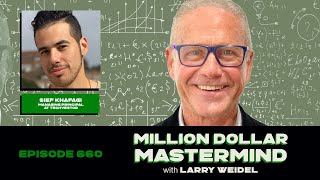
This is Episode #660 of the Million Dollar Mastermind podcast (published June 29, 2023) — an interview between host Larry Weidel and guest Sief Khafagi (Co‑Founder & CEO of Techvestor). The conversation covers Techvestor’s early fundraising and a costly $150k learning experience, founding team size and current headcount, their data-driven approach to short-term rental investing (tracking 250+ markets, operating in ~12 markets), capital raised (~$25M), the firm’s preference for owning properties for cash flow rather than flipping, and investor structure (LLC ownership with quarterly cash distributions). The episode emphasizes lessons on risk-taking, persistence after failure, building proprietary data and operational infrastructure, and positioning short-term rentals as an emerging asset class.
Questions this video answers
About a quarter million dollars.
$150,000.
Four.
A little over 30.
They track 250+ markets and are actively operating in about 12 markets.
Chapters
Welcome to this edition of the Million Dollar Mastermind podcast. This is where we pick the brains of high achievers from all walks of life and get their hard earned real world insights on ready. I'm your host, Larry Wydell.
What did you do when you did not have the resource, did not have the funds? You're at the guerrilla marketing stage. And we dug in. We really got after it. What does that mean?
You know, we started the company with about a quarter million dollars, which, again, being in a privileged position to be there, and we've always been safe with the way we approach business. Until we weren't, right. We took a gamble and we said, hey, let's go ask for help. We hired a firm that really helped us understand the world of capital markets in a lot more of a streamlined way. And I think a lot of people would be surprised that we spent 150 grand on something that actually didn't end up working. But it was an education. It was a crash course in how this world of investing works. And we learned so much with a.
Quarter of a million, quarter of a million, these experts involved, and they took.
150 right off the bat, you know, and we hoped it would work. Yeah. And it didn't work. But what we did is we learned a lot in that experience about what not to do and what to do.
How many is we here? You keep saying we. How many is we?
Our founding team is four people, and today we're a little over 30.
Okay, so you had four people jumped in there together and so you could share the blame. When you blew through 150 times, we got close.
Rope. We got close many times.
If you lived through that and didn't, you still had your friendships intact. You're doing well. But what were the main thing you learned from that?
I think at the time it was like, holy shit, we lost 150 grand. You know? So, like, I think, I think the way you view your lessons are so different depending on when you're asking the question. At the time, it was like, holy shit, are we gonna die? Like, is this, is this the end of the journey that we all wanted to go down on? You know, how do we navigate? I think in retrospect, it was the cheapest lesson we ever had. Right. So it's just about time. But it's sometimes also being optimistic enough to give yourself enough time to succeed. I think sometimes people quit so soon after failure where we could have easily closed up shop and been like, let's figure something else out. But we were like, okay, well, what did we learn from that? How can we apply it? And do we have enough conviction in our business to continue to build? And if all of those things are yes, yes, yes, then let's go keep building. You know, 150 loss today is, you know, again, you got to believe it. And this is where the optimism comes in, right? The rallying of the troops, as you mentioned earlier, is easy to get in. It's a lot harder to continue.
And so, you know, because the way I looked at it was, you know, you lose a million. And I got a $20 million lesson that if I keep going, I'm going to turn that into $20 million. And so let's keep going. The other thing people will say is, thank goodness in the early days you kept on going. You didn't give up. And I said, well, part of that was I didn't have General motors calling with $100,000 a year jobs, job offers bail me out at the time either. I wasn't like necessarily a hot commodity that I could run out there and find something exciting to replace it. So I needed to keep on going. And a lot of times the visual you have in visuals keep you going. But when you had, you knew this was a big market, you were going after controlling the whole short term rental space and you had to know that's going to be a big deal. And so that was worth hanging in there for and getting those lessons. And one good thing I can tell you, chief, always remember this is whenever you get burned like that anybody is going to come behind because we all have competition every day, right? It's like anybody who's going to come behind you, they've got to travel all of those steps. They've got to go, oh, yeah, that's.
A ring joke we have inside the company.
Every time you get one of those, you say, well, that one's behind me and the guys who want to come get me. Okay, well, hope you don't fall in the hole and stay there because we made it through. And so when you, I'm curious about, let's just say you get 50. How do you value, like you said, 25 million after the first 50 million the second year, what's the capacity of taking in new money? I guess it's fluid all the time. New money comes in, then you can go buy new properties and things like that. So there's really no limit. You know, like one thing that happens like in these ETFs that are, you know, the electronic fund transfer things that are new the new mutual fund type thing, you know. And Cathie woods was, she was a top performer and everything. And now she's, you know, all of her portfolio is dog food now because of the innovative tech. And so the thing is that what killed her, I think what really killed her was everybody wanted to jump on the bandwagon about two years ago and she was, they were accumulating like tens of billions of dollars in a couple month period of time. And the thing in that world, you have to spend it, you know, you have to go buy some, something and she had to buy stuff that she wouldn't have bought at that price and everything, you know. And so a lot of it's self inflicted. But in your world, how tight are the controls? Can you sit on it and be a little bit more selective about waiting for the good properties to come?
Yeah. The good news for us is first of all our industry is so nascent that we don't really have a lot of competition, at least at our scale. Secondly, the advantages that we have are around acquisition and discovery and solving for scale. Right. So coming from tech, we didn't want to just be able to buy one or two and let the market control us. We wanted to generally be able to scale as needed in real time. So we built for that and we tracked 250 plus markets using software. We got $25 million.
Talk about that, talk about that. That's a, that's a huge thing that you're able to do now if somebody wants to get in the short term rental thing for passive income, you know, to be able to, you know, have the whole battlefield covered. Talk about the 250 locations.
Yeah, so we're not in 250, we're in about 12. But we're tracking and market mapping, you know, all these other locations of interest because of either quantity, quantitative data that we've been able to identify, or qualitative discovery or something that we've been able to identify as why we can map it. And we'll map all this data so we can have a better understanding. If we got $25 million tomorrow for an example is can we go buy 1, 2 or 200 in this market? Does that real estate supply exist? Is the, is the short term rental demand there? Who's going there? The avatar? So that'll tell us how we need to design it and amenitize it. Is it for families? Is it bachelorette groups? Is it some other type of Persona? What's the seasonality look like? How has supply increased in the last 90 days. What are homes selling for in the last three months? And tons and tons of other data points. Right? So that's one thing, but also we become proprietary providers of data ourselves the more and more we buy. So we had this incredible flywheel, right? We gather all this data, we make decisions based on that data. Now we contribute back to this infrastructure of data with firsthand data that we can have that's verifiable and, and now we can see what's working and what's not and therefore make changes and therefore it'll influence the next cycle of data and data. And all of these things are happening in real time, which allows us to buy the best possible product, design the best possible product and drive the most profitable type product. And it's because we own the entire experience through and through.
Yeah. And the opportunity in short term rentals not to do your job for you in terms of selling it. Every place in the country where there's a college, every resort area, every town, you know, where you have business hubs where people are coming and going. The world is not going to get more, more stable in terms of people going, not traveling, staying at home all the time. It's going to be more moving around and that's going to require short term rentals. And so, and it's, that's the way it's always been. But to be able to capture that seems to be a really smart choice as a business opportunity. I think you, you threw the dart and hit the bullseye there.
We have a great team behind us and a lot of, a lot of people who believe in what we do. That's special sauce.
Still, still work and everything. But it's, it's nice to be working where you have that kind of potential and you have those kind of market imperatives that are not going to be going away, you know, so, and you're building up your experience and your knowledge and your, your, your personnel that's familiar with all. So congratulations. Tell me where is, is there a bigger opportunity or were you just doing it to find out for yourself where you, you, you know, you, you bought, you, you've cleaned them up and I guess you flipped more than 120 properties or you, you bought Il rent them out. Is that a bigger, bigger opportunity?
We, we are not in the business of flipping, so we are in the business of owning and we own for cash flow. Investors invest with us for, is for income and growth and the ability to not deal with toilets or guests. We deal with that on their behalf and we believe in owning. Right. We believe that owning the equity, owning the land where the house sits on, owning the infrastructure that we operate. And while that might mean we'll grow a little bit slower than renting infrastructure things, it gives us full control of the outcome over time. And that ultimately leads to better outsized returns and as you mentioned earlier, a more competitive moat to whoever comes next. Because we do believe that over time there will be more competitors, naturally, in any industry. And they're going to have to learn a lot of the lessons that we learned, but they're also going to have to build the infrastructure that we've built. And each day we get stronger and stronger and that continues to be a competitive advantage for us and our investors.
Yeah, they might pick off some of your properties, but they're not going to pick off the ones you own.
They can't.
Yeah. And the thing is, that's much like the model of like if you're Coca Cola, you know, where you have locally owned distributors and manufacturers and then you have the company owned. And so you've got your company owned element coming along and that's got to add to your stability. And so what, what do you, what are you excited about right now? The most you're excited about? How many years have you been doing this with your tech investor?
We're coming up on. It'll be two years later this year.
Yeah, well, you got three years before your restless spirit kicks in.
You know, I got enough time. You got enough time.
You've got time to do things before your next thing comes along. So what's on the horizon that you're most excited about right now?
I think we're just most excited about proving that this is the next emerging asset class. Right. I think we've been incredibly quiet with what we do, actually doing deals and putting out numbers and generating revenue and sending out distributions to investors. And I think a lot of people are super loud in the space with, you know, hey, we've done this really pretty shiny thing, but they haven't built anything of value yet. And I think we've spent the last two years doing so. And I think we're starting to see institutions and serious retail capital really look at us and be like, wow, okay. You know, it's hard to ignore that this is going to be an asset class of the future. I think we're going to see the way that people are shifting in mobility and travel. I think we're going to be at an opportunity to maximize on that. And the belief in the asset class I think is going to be the thing that we're most excited about. Because what we do is really, really hard. But it's really, really easy to understand, right? It's really hard to do, but it's really easy to understand.
It's easy to understand. But how does the payoff work for people? They put their money in. Do they get dividends? Do they get shares? Do they get. What do they get exactly?
So they get shares of an LLC and they're owners, direct owners, just like if they owned it themselves, but instead of being an owner in one property, if they were to do it themselves, they're an owner or a part owner. And 150 of them, we own and operate, do everything as the collective, and then we send them cash to their bank account every quarter based on how things go. And, you know, there's an underwriting and a projected hold and all those types of things, and tax benefits. Just like you owned it yourself, Right?
Fantastic. Well, it is a complicated world, but it is a huge opportunity. And to be able to take that complication out for people, you are lowering the barrier for entry into, you know, for millions of other people to be able to participate in this kind of growth. And it's an exciting idea. So well done and wish you the best.
Thank you so much, Larry. Yeah, appreciate it. Appreciate it.
Wish you the best. And let's stay in touch and.
I.
Can find out what your next phase is, how you've done your next phase is, and any last, final word you'd like to leave our audience with.
You know, I think what I think a big part of this conversation we talked about was a lot about taking risks at the right time and just understanding people. And to anyone listening, I think if you're applying this to your career, to an entrepreneurial journey, to an investment, I encourage you guys to take the risk and jump where you feel comfortable. And more importantly, just if you feel like you're doing business with a good person, oftentimes that's half the battle. Or if you're following a leader that's a good person, have to battle, find people that'll fight for you, whether it's in the investing world, in your career, in your family. Those are all things that are really important.
Absolutely. Well said. And a point that cannot be overemphasized. That was. I'm glad you brought that up. Thanks so much, Steve. This has been a lot of fun and look forward to checking in down the road, of course.
Thanks so much, Larry.
Take care.
Thanks for listening to the Million Dollar Mastermind. If you felt there were any valuable takeaways from this episode, please take a minute. Leave us a five star review. Your feedback is important and really helps us get the word out to a wider audience. Remember, we have a valuable webinar that is absolutely free. Register for it right now@whiteallnwinning.com thanks for listening.
More from Larry









Rick Jordan on Self-Engineered Proximity, Cyber Security Moats, and Truth-Based Leadership

Fire Fast or Fail Slow: Kevin Brittingham Reveals the One Rule That Built a $100M Empire
