Episode #701 - #704 Highlights: Investing in Private Markets: Insights from Ron Diamond of Diamon...
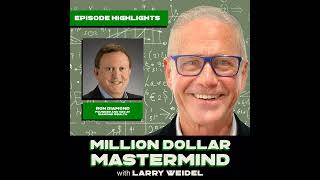
Ron Diamond discusses how family offices deploy patient capital differently than private equity firms, and why trust and relationships matter more than deal mechanics. He shares stories from Drexel and starting his hedge fund to explain his approach to leadership and delegation.
Welcome to this edition of the Million Dollar Mastermind podcast. This is where we pick the brains of high achievers from all walks of life and get their hard earned real world insights on winning. I'm your host, Larry Wydell.
So the amount of wealth since the Internet, the amount of wealth that's been created, so it's not generational, you can create an app and all of a sudden become a billionaire. So I think the speed at which wealth is created has changed a lot with the trajectory with technology. I chaired the Disruptive Technology center at Stanford University and I'd see companies that just, it was just a brilliant 25 year old kid had a great idea and he gets backed by Sequoia and five years later he sells his company for half a billion dollars. So it happens much quicker. I think we're only in the third inning in the evolution of family offices. I think today family offices are very inefficient, very fragmented and also very siloed. And I think that's about to change. But the reason I think that family offices are important is twofold. First, the less important from an economic standpoint is I think that as private equity and venture capital disrupted the public markets in the mid-80s because it was a better model. So let's say you have a company and you've got to report to a guy like me every 90 days. It's hard to run a company efficiently, very challenging. So private equity venture capital came in. It's like 2% covers the overhead, 20% I make money if you make money. It was a better model. You don't have to report every 90 days. The industries took off, they exploded. What's happened though in many instances is that many of these firms have become too big and a lot of the private equity firms have bastardized the business and it's become an AUM assets under management game. So I think what's happened is family offices now, as private equity and venture capital disrupted the public markets in the mid-80s, family offices are starting to disrupt private equity and venture capital. And the main reason is they've got patient capital and all goes back to alignment of interest because let's look at how everybody's compensated. So if you're a partner at a private equity firm, you know you're compensated to flip companies every three to five years. Just it's not good or bad, just the way it is. And so if you look at the typical model of these companies, private equity firm A buys a company, sells it to private equity from B, four years later they Try to make money on it and sell it to private equity so it could be sold three to four times in a 20 year period. If you look at all the taxes and all the transaction costs during the 20 years versus a family office who has something called patient capital and they just buy the company, hold it for 20 years, they don't have the transaction costs, they don't have the friction of the taxes. It's just compounding. It's an exponentially better model. The problem is that right now family offices are not as efficient as they need to be. That's starting to change. And you've seen some. I've did it. I've done a podcast with Tony Pritzker and Paul Carbone, who's a good friend. They've institutionalized this. So not only can they compete with Carlyle and Blackstone, they actually have a competitive advantage because they don't have to flip companies every three to five years. So that's the main reason advantage for family offices for from a economic standpoint, I'll also go from a, from a philanthropic standpoint. Family offices are not a panacea to solve all the world's problems. But I think family offices can solve many of the problems. And I'll give you just a couple examples. My first boss was Michael Milken from Drexel Burnham. Really Michael, brilliant guy, developed prostate cancer. And when he develop prostate cancer, rather than throwing $100 million to the American Cancer Society, he built like a VC fund. He put 2 million here, 3 million here, 500,000 here. And because of him, you and I and all the male listeners will die with but not of prostate cancer if we live long enough. And then one other example is Bill Gates. I would argue he did his family office did more for the vaccines and Covid than the U.S. government. So I, I don't think you could run a philanthropy exactly like a business, but I do think you can run it more business like. And I think that a lot of these family offices are very philanthropically motivated. And whatever the cause is, I think they're going to solve many of these big issues that are not going to come from the government and it's not going to come from the corporate sector.
Well, let's just say it's not Bill Gates. Let's say it's Bob Jones and he's got a couple of billion dollars. And what is the trend his, you know and the reason why it's fun to talk about this is because we have a lot of up and coming or current entrepreneurs super successful, wanting to get better and with the end in mind of, you know, well run businesses grow and you know, you want to be in this situation down the road and, and it's just nice to have, you're probably not going to understand the whole thing the first time it's put in front of you, but it's good to get the framework in your mind and get some of these words and thinking. And also it's nice to have an end goal that I want to end up in a family office. And so the relationship in there, let's just say with Bob Jones, how he goes to a family, he's got the money, now he goes to the family office. What does the family office do for him? Is the family office a person, a team of people? When you say you have 100 family offices under your umbrella at diamond wealth, how does that work with those individual family off, you know, family offices?
No, it's a good, it's a very good question. Family office is just an entity, right? So family office, it could be one or two people. Some, some family offices have 50 to 60 people. It's all over the range and it's basically they represent the interests of the family. And sometimes it's first generation, sometimes it's second, sometimes it's third, sometimes it's later. We deal mostly with the entrepreneurs who created the wealth, mostly first generation. So, you know, it's the family offices, they decide really on what they want to do and how they want to grow their assets. Some family offices are just looking to preserve wealth and that's fine. And some family offices are very aggressive and want to double and triple their net worth and that's fine too. It just depends on what your goals and objectives are.
So the Bob Jones in this situation, he would set the tone. I want to conserve or I'd like to grow or I'd like to be in, you know, I have some causes I want to be able to impact and then not knowing how to do that, he would go to you or your company and say, how can you help me expedite this? Would that be part of the purpose?
Well, I mean what we do, not entirely. So what we do, I invest in all the deals myself. So basically what we'll do is we invest just in private markets. That's private equity, venture capital, credit, real estate, things like that. I, even though I made money in the public markets, I think it's very difficult today to create alpha in the public markets. I just have money in the index funds, but you can do it in the private Market. So we'll put some money in. I'll syndicate a group 50, $100 million, whatever it is, I kind of know who likes what. And then we'll put together an SPV special per special purpose vehicle. And because of that, we get really incredible deal flow and good execution. And typically we were able to get better economics because we could put in so much money so quickly. I speak a lot throughout the world about family offices. And the best compliment I got didn't even seem like a compliment at the time. Somebody just came up to me and said that was really authentic. And that was what he said. And I thought about it for a while. I didn't even take it as a compliment. But then I really thought about it for a while and it really was. Because when I spoke, I. I'm not, I'm not the smartest guy in the room. I, I'm not the richest guy in the room. I'm not. I. I try to surround myself with people that are smarter than me. I try to surround myself with people and learn from them. So I think that for me, the, you know, the most important part of life is not just business. It's relationships. It's your relationship with your family, which is, I think, the most important relationship with your friends, relationship with your community relations, relationship with your business. So for me, the relationships that I have nurtured over the 30 years of my career, they are truly authentic. And I don't make money in everything I do, but the alignment of interest is there. So I think there's a level of trust that we have that the family office have with me. And again, part of the reason family office were created, it's not that all of a sudden these people who sold Beanie Babies wanted to manage money because that's not really what they wanted to do. They just stopped. They stopped trusting Wall Street. So if you think about it, 68% of the family offices started since 2000 and half started since the crash. And what happened during the crash? You know, I used to run a hedge fund so I could put up gates. Gates are based, you know, I can. You can't sell. Well, if you're widget manufacturer in Wichita, you don't know what gates are. And I think a lot of people felt taken advantage of. And I do agree that in many instances there is an inherent conflict of interest on Wall Street. I mean, I remember when I first started at Drexel, I graduated from Northwestern and I called my dad one time and to ask him a question, you could either have a Buy, hold or sell for a company. That's how the investment bankers would rate them. And I said to my dad, I said, you know, it's interesting because they've got a lot of buys and some holds, but they don't have any cells like that. I, I don't get it. And he kind of smirked. He said, call me when you figure it out. And about six months later, I figured it out. And what it was is these are investment banking clients, so they're not going to put a sell on an investment banking client where they make their money. So that to me is an inherent conflict of interest. Another conflict of interest is mo. A lot of these firms, a lot of the wirehouses, they're not even fiduciaries. I mean, they're not, which is really head scratching. And that's why RIAs were created, because they are fiduciary. So I think a lot of this with family offices, the growth in family offices, a lot of it really comes back to the lowest common denominator is trust.
And so you go out, you, you graduate from college, you get your graduate degree. What's your entry into this world? Do you have a, do you, were you just looking for a job or did you have a hard target in mind that you wanted, where you wanted to go?
Well, look, I think a lot of success is surrounding yourself with the right people, right? So Northwestern was a very good school and we had very good companies who came to interview at the school. At the time, Drexleburnum was like Goldman Sachs on steroids. I mean, it was the most profitable firm on Wall street by far. This is where Milken created junk bonds. And it was just, it was machine. But I came in, I got the. So I got a job at Drexel, which was fantastic. But I'm there two years later when Fred Joseph, this, I'm 24, I think at the time, and Fred Joseph, the CEO, says, we're going bankrupt. And I'm watching all these men in their 60s and 70s and 80s openly cry. And that didn't happen in the 80s. Many of them lost all of their money. So for me, the takeaway for me, and I don't consider myself an entrepreneur, even though I did start my own company. The takeaway for me was that I would never be loyal to a company ever, but I would always be loyal to people. And I learned that lesson from Drexel says, if this could happen to Drexel, this can happen to Goldman, this can happen to any firm. But I would always be loyal to People. And that's sort of an adage that I've had as I've grown my business, that I am very loyal and trusting of people, but not of a company. A company is just a bunch of shareholders or xyz. It means nothing to me.
Now. When your first two years there, before the bust, did you. Thinking back, were there signs or what was it like in that? I mean, was there an arrogance? What was it like?
Arrogance is an underst. Well, look, it was arrogance, but it was also. It was arrogance, but it was like these would. These literally were. Many of these people were the smartest guys in the room. I mean, the talent level at Drexel was just phenomenal. So I was on adrenaline just because I'm working. I love working around really, really smart people and being challenged. These were brilliant people. And if you look at what came out of Drexel, Blackstone, and you know, all these firms that came out that are a result of Drexel, it's still a tight community. So it was really an anomaly. I was just happened to be there. You know, I. My goal was to be there for hopefully 50 years and hopefully run one of the divisions one day. But two years later the company imploded. So I. I just think that there was some sort of. It's like, I'm a big basketball fan. When Jordan played and, you know, they had the championship seasons, there was just an aura about them, about the Bulls. And I think there was that feeling at Drexel, which was really neat to be a part of. I certainly didn't. Didn't earn it, but I was part of it only because I worked there and I could see it. I could sense it.
When you went out and started your hedge fund, you had by necessity having to be rubbing shoulders with smart, successful individuals. How did that impact? I. I have to think, Ron, you were in an enviable position to have some of that. Like if a bee goes out and gets pollen from the flowers, I guess that you had a chance to pick up some. Some good things. Good insights, good instincts, good information, good contacts. From the circle of people that you were working with, what do you think?
100%. I think that what I try to do is. My dad was a banker and he used to always tell me, he said when he'd have a meeting, he could always tell who the lawyer was, because the lawyer in the meeting was always the one who was trying to show that he was the smartest person in the room. The entrepreneur would come in. Sometimes he's loud and sometimes he doesn't talk. And his job there was not to be, but to find the smartest guy in the room. And that's really what I look at for myself. I don't want to be the smartest guy. I want to be the dumbest guy in the room. I want to be the poorest guy in the room. I want to be. So I want to surround myself with people that are better than me. And as a result, that's how you learn. So that's kind of how I look at the world.
Yeah. And so what was your. As pinnacle progressed, you know, growth forces you to, you know, you swell up and you've got to come up with new solutions. And things that worked in the, you know, things that worked at a certain level don't work anymore in terms of personnel, delegation, tracking. And how did you evolve as the leader of the team, keeping up with all the moving parts? How did you develop?
Well, the hardest part for me, and probably for most entrepreneurs, is delegating because, you know, you know, you just think, I want to. I can do everything better than other people. And you trust yourself. But to delegate, in order to grow, you have. By definition, you have to delegate. So what I did is I just found people in areas that were smarter than me, in different areas that I trusted implicitly, and then learned to delegate. But that didn't come naturally. It came after trial and error, and it came from the fact that if I wanted to stay here, I could do everything myself. But if I wanted to grow and to get up in here, I'm going to have to do that. So that's what caused me to do it.
And at some point, I think we realize one reason we're so much better at other people that doing things is we've done it more than they have. And you got to. You reach the point where you find people you're willing to trust, and even if they stumble out of the gate, stumble and fumble, you know, that next week they won't, you know, and you've got to give them a chance to drive the car, even if they get a bent fender.
You know, I used to, when. When I was younger, I used to own. Only want to be around the smartest people in the world. But. And that's important. But trust transcends that, right? So you want to be around people because no matter what business you're in, you're going to have setbacks, sometimes major, sometimes have nothing to do with you. It could be from a macroeconomic event. And as long as you're with good people who you could trust, things will take care of themselves. I truly believe that.
And so what was the toughest for you in your evolution to somebody who can keep up with many more spinning plates and keep things, keep them spinning?
The toughest part for me was, well, delegating certainly was the toughest part for, for me. And then to, to stay focused and to really, you know, ultimately, you know, you see a lot of people who are like, look at themselves and, you know, pat themselves in the back and how terrific they are or whatever. I think to realize that a lot of whatever success I. I may have had, a lot of that came from luck. A lot of that came from the fact that I was born into a family that valued education. A lot of that came from the fact that I was born in the United States. I mean, you could go back all these different things. So, um, which comes back to gratitude. So, you know, I, I just feel that, you know, it. It's such an important part of life, and most of us don't, where we get so stressed out on all these different things and worries about things. But there's so much to be grateful for. And that's what I really try to focus on. It's not always easy, but I try to.
But when you get up to this level of success, which people want, you know, a reason I wanted to talk about it, you've lived it, and you've lived it for a lifetime. People want to have the amazing, you know, staggering year after year success and, you know, where you walk in the room and you're everybody's hero and people are patting you on the back and you're taking, you know, you can buy anything you want, go anywhere you want, meet anything you want. You know, you're. You're living this life on another level. How do you keep that from going to your head? Because, you know, how would you address the issue of. And you had to face it pretty early on, success being harder, harder to handle than failure.
Great question. Dick Fuld has become a friend. Dick Fuld was the former CEO of Lehman Brothers. And when Lehman Brothers went bust, prior to them going bust in the financial crisis, he was probably the most powerful guy on Wall Street. He was a brilliant guy. He was very smart. And he looked at the world through the lens of, I am more powerful, I am more successful, et cetera, et cetera. And then when Lehman Brothers came down, he got humbled. And I think he's changed, and he's grown a tremendous amount as a human being. And he's actually a wonderful, wonderful person, which people don't necessarily see that. I think that I gave a talk to Northwest, to my alma mater, and they said, what are the. You know, what are. What's important to you now? It'll come back to a story that my. My daughter was 8 years old at the time, asked me. We have a thing in our house where if the phone rings three times, it's an emergency. I was in a meeting with a very large family office, and the phone rang three times, and I had never done that before. So I excuse myself and I take a deep breath, and it was Bella, my baby. And I'm like, bella, what's wrong? I'm thinking, she's in the hospital. So she's like, daddy, what are the five most important things in life? What's wrong? She's like, no, I need to do this. So I explained to her, that's not an emergency, and we'll talk about it when we get home. So I took a deep breath and, like, I sighed and I'm like, okay. She's okay. I come home, fast forward six hours, and she's like, that's the project she's working on. So she's like, I worked on it with her. She was like, she wanted to be popular, she wanted to be a good listener. She wanted to be a good sister, she wanted to be a good friend, she wanted to be a good daughter. Those are her five. And then there's only a child can do. They. They turn it on me and they're like, what are yours? Like that, I'll get back to you. But I did. I did think about it. And then I thought about it for a while and over the next couple months, and then she kept asking me, what are your five? And then I did. I did think about it. I wrote it down. And in what I. For me, they were in order of importance, love, gratitude, attitude, balance, and laughter. These are the five things for me, other people, it's something totally different, but these are what's most important to me. And if there was a direct correlation between wealth and happiness, I would just tell everyone to be. Try to get as rich as you can. There's not. It's not an inverse correlation, but there. It's not a direct correlation. So I think that the people that I surround myself with, um, what's the point of being successful if you're miserable? What's the point of being successful if you're already. If you're stressed out all the time or you don't like what you do or you're not part of, you're not close with your family, I mean all of these things. So I think that the, that keeping these things in the back of my mind and I've got it on my wall. So love, attitude, love, gratitude, attitude, balance and laughter. These are my five things. And I think that's something that I constantly remind myself of. And you know, you know, life goes by like that. I mean we're, we're 10, we're 20, we're 30, we're it, it just goes by so quickly. You just have to be grateful for what you got and just enjoy it, enjoy it and, and think things through. And I think that's really important. When I first board meeting, you're with all these advisors and you have, everyone's got an agenda like, but my agenda was just to hopefully I could add some value. I mean there's a lot of stuff I couldn't help at all. But there's certain, there's a few verticals that I can add value and I would just try to do it. And if I just come in with through the lens of look, I know what I know, I know what I don't know, I don't know more than I do know and what I do know, I'm going to add value to that. And that's kind of how I looked at it. And some of the people on the board, on any board, you know, they want to be the smartest guy in the room. That's not me. I don't want to be. I just want to figure out you.
Find that one upsmanship going on, that testosterone is at play. Even in the boardrooms, they want to show off ego.
I have thought of writing a book about it. I mean ego is a double edged sword. On the one hand, you need a certain amount of ego to, to do well and succeed in life. On the other hand, it's also our Achilles heel. Right. Because it's destroyed many people too. Here you go. And it's not confidence, it's actually insecurity. And I didn't fully understand that when I was younger. So I looked at it through the lens of I used to look at vulnerability. So I watched a lot of TED talks. Brene Brown I there did a TED talk on vulnerability. If you would have done a podcast with me when I'm 25 and I would have brought up vulnerability, there would have been a zero percent chance that that would have been a topic. But I think the fact that we are vulnerable, so I, I share a couple in tiger 21 basically, it's a group of people that have had success and we talk about different issues, but when people are authentic and honest and vulnerable, people open up. I, I was, I was at the dog park the other day with a guy that I knew a little bit. You know, our dogs hung out a lot and we, we knew each other for like a year and a half, but, you know, not that well. And then we were talking and I was just, he's. I was on the phone and I was telling him what was happening. There was some issues that I was having with, with a kid and I was just honest. Like, it, it, you know, here's what it is. And then he opened up to me, he's like, yeah, I've got this. And so I just think that we're. If you look at it, it's philosophical, but like, we're all in it together. I mean, if you look at it like it's me against the world and I, your life's going to suck. But if you look at it, how big is it? You know, how big is the whole? I think you could live a much more content, happy, satisfied life. So I, the metrics that I use are probably the metrics that a lot of the Your listeners were 25 used use currently. And you know, what they want to do, how they want to accomplishment, how much money they want to make, where they want to live, how they want to live and all that. And I'm not minimizing that, but I'm saying you get to a point in life when enough's enough and you just have to enjoy what you're doing and, and you have to be real and you have to be authentic. And you know Shakespeare's quote, you know, be true to thine self. I think that's probably one of the most prophetic things anybody's ever said. I think it's really true.
And so 12 you're, you sit on the advisory board of 12 privately held companies and you act as chairman for four of them. Isn't that, know, being chairman of a board, isn't that a time consuming thing?
It does consume time. But I will only do it if I know the people. If I really like the people, I really believe in the company. So if I get to hang out with a friend, you know, for four hours every, you know, month or so, that I really like and respect and I like what he's doing, it's again, it's not work. Yeah, I don't look at it as work.
Well, let's Talk about the not work side. One of the great things about being in business for yourself, having your own company, is you can take the time, you know, you get the money, but, you know, making money. I've always felt sorry for guys that own, you know, they own and manage the restaurant because they're working, they're making a lot of money, but working 100 hours a week. And they never, never get away from it because, you know, you have the people problem and the server didn't show up and the managers. Yeah, the manager stealing money, you know, around the corner and, you know, it's just a rat race. And so many jobs you get out there where you have all the money, but you don't have any discretionary time. And then some place, you, they, they have plenty of discretionary time, they just don't make any money. And so how have you balanced that out with your life to where you do have the enjoyments, the recreation, you know, the things that you want to do that are fun for you and your family to do? And what are some of those kind of things you've been able to do that maybe you wouldn't have been able to do working inside, you know, a big, you know, like Goldman Sachs or something like that?
I think part of it, you know, my dad passed at 57, and I think that had a big impact on my life. And I realized, you know, life is very short. And I, you know, when I'm 100 years old, hopefully I don't want to lie, sit back and say, I wish I worked more. I don't think that's going to happen. So it's really the relationships that you make that's the key. I love to travel. So we get, fortunately, we travel a lot as a family. I love to ski. You know, we do that. So to me, I just think figuring out what's important to you, you know, I read, I don't read as much as I'd like to, but figuring out what it, what's important to you. I've got friends who love being in Colorado and just love climbing. You know, just climb, hiking every day, right? And that's fantastic for them. I like, I like it. I don't love it, but I like it. I like other things, but I just think that you have to find time for things you like or what's the point? Our time is our most important thing, right? It's the most precious commodity we have. And what did I want to do with that hour? More than anything, I just wanted to watch her play yeah, and she got upset with me and she argued with me and I ended up not going and whatever. But then the next time I did go and I explained to her, I just like, it just, it doesn't make, it might not make sense to you, like why, what possible fun could it be to watch somebody else hit tennis balls with a pro? It makes me happy. I really love doing it. So I think watching my children grow and develop family, friends, developing good, you know, relationships. There was a ted. I watch a lot of TED talks. There's a TED Talk on. I'm doing a TED Talk in about a month. In the last. Yeah, and the last. My favorite TED talk was a guy who did a longitudinal study on relationships. And basically he studied. I forgot his name, but he studied kids. 250 kids from Harvard starting in 1936, and 250 of the poorest kids in Boston. And he studied their lives. And it's. The study's actually still going on right now. People are in their 90s right now. And he saw some people go from, you know, down here to up here, and some people go from up here to down here. And what he found was the common denominator to live a meaningful life is having quality relationships. And, and you don't have to have 50 best friends. You could have two, you could have one. But having, having the close relationships with people, that is what matters. And that really resonates with me. So that to me, developing relationships with people of all ages, of from all, all, all over the world, it just, it's something that's very important to me.
Thanks for listening to the Million Dollar Mastermind. If you felt there were any valuable takeaways from this episode, please take a minute and leave us a five star review. Your feedback is important and really helps us get the word out to a wider audience. Remember, we have a valuable webinar that is absolutely free. Register for it right right now at whiteallonwinning. Com. Thanks for listening.
More from Larry









Rick Jordan on Self-Engineered Proximity, Cyber Security Moats, and Truth-Based Leadership

Fire Fast or Fail Slow: Kevin Brittingham Reveals the One Rule That Built a $100M Empire
