Episode #701 - The Driving Forces of Entrepreneurship with Ron Diamond, Founder of Diamond Wealth
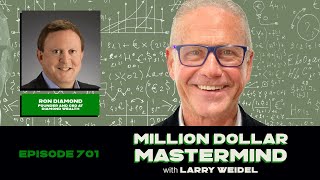
This is a podcast interview (Million Dollar Mastermind) where host Larry Weidel speaks with Ron Diamond (founder of Diamond Wealth) about his background and the family office world. Diamond explains what family offices are, typical size thresholds (roughly $250M+ for single-family offices), their rise since 2000/2008, advantages over private equity (patient capital), common challenges (low generational survivorship rates), and the psychological/interpersonal issues of wealth (entitlement vs. gratitude).
Welcome to this edition of the Million Dollar Mastermind podcast. This is where we pick the brains of high achievers from all walks of life and get their hard earned real world insights on ready. I'm your host, Larry Wydell.
I'm talking with Ron Diamond. Hello, Ron.
Good evening.
And where are you today, Ron?
I am based in Chicago, Illinois.
And Ron, I gotta tell you, between me and you, your track record and your accomplishment is the most amazing stack of achievements. I kind of stand in awe of someone who's been able to be this busy in accomplishing things in his life. And congratulations on the Diamond Wealth Group and representing over 100 family offices ranging in size from 250 million to 30 billion, and longtime investor and entrepreneur and incredibly successful. And when you, your successful opportunities open and Ron, you have taken advantage of them and served in so many capacities and made an impact everywhere you've gone. How did you get, when, when early in your life did you decide get the feeling you're going to be involved in the finance world?
Well, first, thank you for having me. It's great to be here. I've always enjoyed your podcast. I don't know, I, I think when I was a kid, I, I, my father was a banker, my grandfather was a banker. I just remember sitting around the dining room table, not understanding a word they said, but loving the conversation. And so I was always intrigued by business probably since I was very, very young. And then I, in college I went to Northwestern, I studied economics and then I went on to Drexel Burnham. But I, I think it was at a very young age that I became interested.
What do you think was fascinating about it? You know, you're a young kid, you don't understand, you don't understand the conversations. The adults are, are having these animated conversations, I imagine. What would you find fascinating about it or what pulled you in, would you say?
I just did a podcast with, with Mark Lipschultz, the founder, co founder, Blue Owl. And he, we're about the same age and he said, you know, one of his role models as a kid was Alex P. Keaton from, from, from the TV show Michael J. You know Michael J.
Fox, right?
I also used to like to watch that show and again, I can't tell you why I liked it, but I just did, I like watching it. I, I can't give you a definitive answer. I, and what drove me or how I got interested in it. It's just that I was always interested in it. My dad was a absolutely brilliant, brilliant man. He unfortunately passed at a Very young age. But, you know, he was my role model and I would just listen to him in awe. Even though when I was younger I didn't understand what he was talking about. Now I kind of understand what he's talking about.
What do you think you picked up to help form your attitude and approach.
And.
Drive growing up in that environment or, you know, school or other activities that help trigger you being able to move up through the ladder in later years? What do you think was a driving, you know, kind of activated those driving forces?
Well, we came from a very close family and education was always stressed as very, very important. It was a given I would go to college. It was a given that I would, you know, go to the best school that I could get into. It was instilled in me, you know, the work ethic. My dad was worked tremendous amount of time, very long hours. But he also, he, he loved what he did. And to me, if you can marry the two, if I don't mind, I do mind working hard if I don't like what I'm doing. But if I like or love, which I currently do, what I'm doing, I don't even consider a work.
Yeah. And how would you describe to outsiders the world that you're in and what you do and why you love? Seems like a foreign world. I mean, it seems like another universe, you know.
It does and it is. So I'm in the family office world. And after I graduated Northwestern, I went to Drexel Burnham and Drexel imploded. And then I started a hedge fund. And how I got into the family office world was in the 90s. My clients, they didn't used to call them family offices, they used to call them rich people. So I had a bunch of rich people who are now called family offices. So that's kind of how I got into the family office space. But family offices, typically you need a minimum of about $250 million for it to make economic sense to have a single family office. We work with about 100 of these families anywhere between 250 million to 30 billion, and anything less than that between 5 million to 200 million, typically goes under a multi family office. So my world, I'm dealing with the wealthiest, most successful people, predominantly in the US but throughout the world. And these are entrepreneurs, These are people. Most of the people that I deal with are first gen. So it's not that they inherited a lot of money. They created it, they created wealth.
Yeah, first generation. For people who don't know what a family office Is what would be the basic explanation?
Okay, so I gave a keynote at Stanford five years ago, and I had $5 billion family offices. And I said to them, what's the family office to explain it and why did you create it? And I had five completely different answers. I think the easiest way to understand it is you have a widget company and your job is to manage widgets and grow and sales and things like that. Here, basically, people have had a liquidity event, they've sold their company. So now the business is just the money. So let's just use $500 million. The goal of a family office is several fold. One, obviously, it's to create alpha and to grow the assets. But it's a lot more complicated than that because you're dealing with generational wealth. So you're dealing with things like next gen. How do you raise kids with gratitude who are not entitled, very difficult to do next gen succession, governance, all of these soft skills that are really, really important. The ironic thing is that the model today, we're still in its infancy. Even though the term family office gets bantered around all of the time. It's fascinating because the model itself doesn't work. Only 25% of family offices actually make it to the second generation, and 10 make it to the third, and 5 make it to the fourth. So this whole model doesn't work. And part of the reason is it's actually a relatively new phenomenon. I mean, you can go back to Akbar the Great when it first started, and you can go to. In the, in Europe. You can go hundreds and hundreds of years in the US probably with Rockefeller and Vanderbilts when it started. But really, the family offices that I'm dealing with, 68% of family offices today started in 2000, and half of those started since the crash of 2008. So this is a very, very new industry. Wow.
And you're dealing with. Because the idea, you know, the ultimate, your hope when you start a business that it's successful, that it grows, and that you hope it could turn into a generational business or create generational wealth. And so why does this model, this model, why was it created and how is it supposed to work? You said it doesn't work all the, you know, know all the time. How is it supposed to work?
Well, again, it's new, right? So the amount of wealth that's since the Internet, the amount of wealth that's been created, it's not generational. You can create an app and all of a sudden become a billionaire. So I think the speed at which wealth is created has changed a lot with the trajectory with technology. I chaired the Disruptive Technology center at Stanford University and I'd see companies that just. It was just a brilliant 25 year old kid had a great idea and he gets backed by Sequoia and five years later he sells his company for half a billion dollars. So it happens much quicker. I think we're only in the third inning in the evolution of family offices. I think today family offices are very inefficient, very fragmented and also very siloed. And I think that's about to change. But the reason I think that family offices are important is twofold. First, the less important from an economic standp is I think that as private equity and venture capital disrupted the public markets in the mid-80s because it was a better model. So let's say you have a company and you've got to report to a guy like me every 90 days. It's hard to run a company efficiently, very challenging. So private equity and venture capital came in. It's like 2% covers the overhead, 20% I make money if you make money. It was a better model. You didn't have to report every 90 days. The industries took off, they exploded. What's happened though in many instances is that many of these firms have become too big and a lot of the private equity firms have bastardized business and it's become an AUM Assets under management game. So I think what's happened is family offices now as private equity and venture capital disrupted the public markets in the mid-80s, family offices are starting to disrupt private equity and venture capital. And the main reason is they've got patient capital and all goes back to alignment of interest because let's look at how everybody's compensated. So if you're a partner at a private equity firm, you know you're compensated to flip companies every three to five years. Just it's not good or bad just the way it is. And so if you look at the typical model of, of these companies found private equity firm A buys a company, sells it to private equity from B, four years later they try to make money on it and sell it to private equity. So it could be sold three to four times in a 20 year period. If you look at all the taxes and all the transaction costs during those 20 years versus a family office who has something called patient capital and they just buy the company, hold it for 20 years, they don't have the transaction costs, they don't have the friction of the taxes, it's just compounding it's an exponentially better model. The problem is that right now family offices are not as efficient as they need to be. That's starting to change. And you've seen some. I've done a podcast with Tony Pritzker and Paul Carbone, who's a good friend. I mean, they've institutionalized this. So not only can they compete with Carlyle and Blackstone, they actually have a competitive advantage because they don't have to flip companies every three to five years. So that's the main reason advantage for family offices. From an economic standpoint. I'll also go from a, from a philanthropic standpoint. Family offices are not a panacea to solve all of the world's problems. But I think family offices can solve many of the problems. And I'll give you just a couple examples. My first boss was Michael Milken from Drexel Burnham. Really Michael, brilliant guy, developed prostate cancer. And when he developed prostate cancer, rather than throwing $100 million to the American Cancer Society, he built like a VC fund. He put 2 million here, 3 million here, 500,000 here. And because of him, you and I and all the male listeners will die with, but not of prostate cancer if we live long enough. And then one other example is Bill Gates. I would argue his family office did more for the vaccine and Covid than the US government. So I don't think you can run a philanthropy exactly like a business, but I do think you can run it more business like. And I think that a lot of these family offices are very philanthropically motivated and whatever the cause is, I think they're going to solve many of these big issues that are not going to come from the government and it's not going to come from the corporate sector.
Well, let's just say it's not Bill Gates, let's say it's Bob Jones and he's got a couple of billion dollars. And what is the trend and the reason why it's fun to talk about this is because we have a lot of up and coming or current entrepreneurs, super successful, wanting to get better and with the end in mind of at, you know, well run businesses grow and you know, you want to be in this situation down the road and it's, it's just nice to have. You're probably not going to understand the whole thing the first time it's, it's put in front of you, but it's good to get the framework in your mind and get some of these words and thinking and also it's, it's, it's nice to have an end goal, you know, that I, I want to end up in a family office. And so the relationship in there, let's just say with Bob Jones, how he goes to a family, he's got the money, now he goes to the family office. What does the family office do for him? Is the family office a person, a team of people? When you say you have a hundred family offices under your umbrella at diamond wealth, what. How does that work with those individual, you know, family offices?
No, it's a good, it's a very good question. Family office is just an entity, right? So family office, it could be one or two people. Some, some family offices have 50 to 60 people. It's all over the range. And it's basically they represent the interests of the family. And sometimes it's first generation, sometimes it's second, sometimes it's third, sometimes it's later. We deal mostly with the entrepreneurs who created the wealth, most first generation. So, you know, it's the family offices, they decide really on what they want to do and how they want to grow their assets. Some family offices are just looking to preserve wealth and that's fine. And some family offices are very aggressive and want to double and triple their net worth, and that's fine too. It just depends on what your goals and objectives are.
So the Bob Jones in this situation, he would set the tone. I want to conserve or I'd like to grow, or I'd like to be in the. You know, I have some causes I want to be able to impact. And then not knowing how to do that, he would go to you or your company and say, how can you help me expedite this? Would that be part of the purpose?
Well, I mean, what we do not entirely say. So what we do, I invest in all the deals myself. So basically what we'll do is we invest just in private markets. That's private equity, venture capital, credit, real estate, things like that. I, even though I made money in the public markets, I think it's very difficult today to create alpha in the public markets. I just have money in the index funds, but you can do it in the private market. So we'll put some money in, I'll syndicate a group 50, $100 million, whatever it is, I kind of know who likes what. And then we'll put together an SPV special special purpose vehicle. And because of that, we get really incredible deal flow and good execution. And typically we were able to get better economics because we could put in so much money so quickly.
And so how Much hand holding and how much do you get involved in the personal life? Because, you know, I also live in Palm beach half of the year and there's with, with the wealthy families, there's a lot of drama.
That's an understatement.
There is, yeah, there's a.
Look, a lot of it is psychological. I try to, when I, when I'm talking to people, I try to. I mean, for me, one of the pillars of at least how I try to live my life is with gratitude. And I mean, yeah, you have an investment, it goes down, you have an early stage venture deal and it went to zero, it's going to happen. Right. And interest rates all of a sudden spike up and a lot of your real estate deals aren't working. That's not fun. But it's, it's, it doesn't really, at the end of the day, it's not really what's most important. The important things are your, are your health, your family and things like that. So I just think a lot of it is. Even though people sometimes get really upset and really emotional when they invest and they lose money, at the end of the day, it's a, it's a means to an end.
Yeah, but how about interpersonal, you know, sibling rivalries? And this one's taking, you know, wanting, you know, more money here and you know, they're, they're arguing and, and I, I, is, is the, do you get into mediation?
I don't, I don't personally know, but I mean, I see it a lot and I see, I mean, the worst thing, the opposite of gratitude is entitlement.
Right.
I, when I, when I meet or see people who are entitled, I mean, I, they're just not in my world. I, I have nothing against them, but I just have nothing with them. So if somebody's entitled, if because their grandfather did something or their father did something, right. They're entitled to do X. I have no interest in, in dealing with these people. So I think a lot of it's incoming upon parenting and parenting and showing people that yes, you're fortunate, but you've got to have a lot of gratitude for what you've got.
Thanks for listening to the Million Dollar Mastermind. If you felt there were any valuable takeaways from this episode, please take a minute. Leave us a five star review. Your feedback is important and really helps us get the word out to a wider audience. Remember, we, we have a valuable webinar that is absolutely free. Register for it right now@whiteallonwinning.com thanks for listening.
More from Larry









Rick Jordan on Self-Engineered Proximity, Cyber Security Moats, and Truth-Based Leadership

Fire Fast or Fail Slow: Kevin Brittingham Reveals the One Rule That Built a $100M Empire
