Episode #703 - Delegation: The Key To Growth with Ron Diamond, Founder of Diamond Wealth
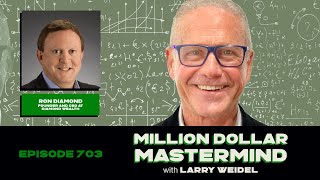
Ron Diamond, founder of Diamond Wealth, talks with Larry Weidel about scaling a business by delegating to people smarter than you. Diamond's five priorities are love, gratitude, attitude, balance, and laughter. He also discusses public speaking and giving back.
Questions this video answers
Episode #703
September 27, 2023
Larry Weidel
Ron Diamond
Welcome to this edition of the Million Dollar Mastermind podcast. This is where we pick the brains of high achievers from all walks of life and get their hard earned real world insights on ready. I'm your host, Larry Wydell. Looking back, one thing you went to Drexel and were around smart, successful, high achieving individuals. The other thing is when you went out and started your hedge fund, you had by necessity having to be rubbing shoulders with smart, highly successful individuals. How did that impact, I have to think, Ron, you were in an enviable position to have some of that, like if a bee goes out and gets pollen from the flowers that you had a chance to pick up some, some good things, good insights, good instincts, good information, good contacts from the circle of people that you were working with. What do you think?
100%. I think that what I try to do is my dad was a banker and he used to always tell me, he said when he'd have a meeting he could always tell who the lawyer was because the lawyer in the meeting was always the one who was trying to show that he was the smartest person in the room. And the entrepreneur would come in, sometimes he's loud and sometimes he doesn't talk. And his job there was not to be, but to find the smartest guy in the room. And that's really what I look at for myself. I don't want to be the smartest guy. I want to be the dumbest guy in the room. I want to be the poorest guy in the room. I want to be. So I want to surround myself with people that are better than me. And as a result, that's how you learn. So that's kind of how I look at the world.
Yeah. And so what was your, as Pinnacle progressed, you know, growth forces you to, you know, you swell up and you've got to come up with new solutions and things that worked in the, you know, things that worked at a certain level don't work anymore in terms of personnel, delegation, tracking. And how did you evolve as the leader of the team, keeping up with all the moving parts? How'd you develop?
Well, the hardest part for me and probably for most entrepreneurs is delegating because, you know, you know, you just think, I want to, I can do everything better than other people. And you trust yourself. But to delegate, in order to grow, you have, by definition you have to delegate. So what I did is I just found people in areas that were smarter than me in different areas that I trusted implicitly and then learned to delegate. But that didn't come naturally. It came after trial and error, and it came from the fact that if I wanted to stay here, I could do everything myself. But if I wanted to grow and to get up in here, I'm going to have to do that. So that's what caused me to do it.
And at some point, I think we realize one reason we're so much better at other people than doing things is we've done it more than they have. And, and you gotta. You reach the point where you find people you're willing to trust, and even if they stumble out of the gate, stumble and fumble, you know, that next week they won't, you know, and you've got to give them a chance to drive the car, even if they get a bent fender.
You know, I used to, when. When I was younger, I used to own. Only want to be around the smartest people in the world. But. And that's important. But trust transcends that, right? So you want to be around people because no matter what business you're in, you're going to have setbacks sometimes, major, sometimes have nothing to do with you. It could be from a macroeconomic event. And as long as you're with good people who you could trust, things will take care of themselves. I truly believe that.
And so what was the toughest for you in your evolution to somebody who can keep up with many more spinning plates and keep things. Keep them spinning?
The toughest part for me was, well, delegating certainly was the toughest part for. For me. And then to. To stay focused and to really, you know, ultimately, you know, you see a lot of people who are like, look at themselves and, you know, pat themselves in the back and how terrific they are or whatever, I think to realize that a lot of whatever success I may have had, a lot of that came from luck. A lot of that came from the fact that I was born into a family that valued education. A lot of that came from the fact that I was born in the United States. I mean, you could go back all these different things, so. Which comes back to gratitude. So, you know, I just feel that, you know, it. It's such an important part of life, and most of us don't, where we get so stressed out on all these different things and worries about things, but there's so much to be grateful for. And that's what I really try to focus on. It's not always easy, but I try to.
But when you get up to this level of success, which people want, you know, a reason I wanted to talk about it. You've lived it, and you've lived it for a lifetime. People want to have the amazing, you know, staggering year after year success. And, you know, where you walk in the room and you're everybody's hero, and people are patting you on the back and you're taking. You know, you can buy anything you want, go anywhere you want, meet anything you want. You know, you're. You're living this life on another level. How do you keep that from going to your head? Because, you know, how would you address the issue of. And you had to face it pretty early on, success being harder, harder to handle than failure.
Great question. Dick Fuld has become a friend. Dick Fold was the former CEO of Lehman Brothers. And when Lehman Brothers went bust, prior to them going bust in the financial crisis, he was probably the most powerful guy on Wall Street. He was a brilliant guy. He was very smart. And he looked at the world through the lens of, I am more powerful, I am more successful, et cetera, et cetera. And then when Lehman Brothers came down, he got humbled. And I think he's changed, and he's grown a tremendous amount as a human being. He's actually a wonderful, wonderful person, which people don't necessarily see that. I think that I gave a talk to Northwest, to my alma mater, and they said, what are the. You know, what are. What's important to you? Now? It'll come back to a story that my. My daughter was 8 years old at the time, asked me. We have a thing at our house where if the phone rings three times, it's an emergency. I was in a meeting with a very large family office, and the phone rang three times, and I had never done that before. So I excuse myself and I take a deep breath, and it was Bella, my baby. And I'm like, bella, what's wrong? I'm thinking she's in the hospital some. She's like, daddy, what are the five most important things in life? What's wrong? She's like, no, I need to do this. So I explained to her, that's not an emergency, and we'll talk about it when we get home. So I took a deep breath and, like, I sighed, and I'm like, okay. She's okay. I come home, fast forward six hours, and he's like, that's the project she's working on. So she's like, I worked on it with her. She was like, she wanted to be popular. She wanted to be a good listener. She wanted to be a good sister. She wanted to be a good Friend, she wanted to be a good daughter. Those were her five. And then there's only a child can do. They, they turn it on me and they're like, what are yours? Like that, I'll get back to you. And I did, I did think about it, and then I thought about it for a while and over the next couple months and then she kept asking me, what are your five? And then I did, I did think about it. I wrote it down. And in what I. For me, they were in order of importance. Love, gratitude, attitude, balance and laughter. These are the five things for me, other people, it's something totally different, but these are what's most important to me. And if there was a direct correlation between wealth and happiness, I would just tell everyone to be, try to get as rich as you can. There's not, it's not an inverse correlation, but there, it's not a direct correlation. So I think that the people that I surround myself with. What's the point of being successful if you're miserable? What's the point of being successful if you're already, if you're stressed out all the time or you don't like what you do or you're not part of, you're not close with your family? I mean, all of these things. So I think that keeping these things in the back of my mind and I've got it on my wall, so love, attitude, love, gratitude, attitude, balance and laughter. These are my five things. And I think that's something that I constantly remind myself of. And, you know, you know, life goes by like that. I mean, we're, we're 10, we're 20, we're 30, we're. It, it just goes by so quickly. You just have to be grateful for what you got and just enjoy it, enjoy it and, and think things through. And I think that's really important.
Well, let's, did you. The last one's. LAUGHTER Right, Yeah, let's talk about that.
It's a very important part of my life. I, sometimes I'm that guy.
You ran past it both two times and just kind of threw it away, but I, I caught it. So.
No, I, look, I think it, there's a lot of things that are just. I love Monty Python. I mean, I love, I, I, I, I just. You have to look at life. I mean, it's hard and is difficult and it's challenging and all with other problems that we have and we've got massive problems. You also have to have a sense of humor, I think, in the, in the world and, and I think it's really important. And I always. I always did, and it was really important to me. I just love to laugh. The Monty Pythons, like, you know, they have this skit where like, well, who made you king? And, you know, like, that's not fair. It's like, that's fine. It's true. So, you know, life isn't fair. And I just think that laughter is. To me, it's. It's the fifth most important thing. And I think that if I could ever make somebody laugh, like where it's a belly laugh and they just fall on the floor.
Yeah.
I feel so, so good. And I. I just like being around people who are happy and laughing.
I'm. I'm going to have to send you this. That. My dermatologist. I started off the day of the dermatologist.
Lovely.
And he came. He had some procedures, too, but he had a minor. But we started talking. For some reason, this came up and he want. He Had I ever heard the David Spade rip on Aspen and how expensive everything is and everything. And I said, no. He said, you got to get it. So he runs out of the room and he gets it. And he played it the whole time while he was working on me. Then he sent it to me at the end. It's just hysterical, you know, but, you know, just looking. And when it was over, he said, that didn't take any time. And so it. It does smooth things. But have you noticed. I've noticed that sometimes you get people around you, you wind up working with them and this and the other, or they even get into your inner circle where you, you know, kind of a friend, friend. But I've noticed people that can't make fun of themselves never laugh at themselves. They're almost. It's almost a burden to be around them. You know what I'm saying, isn't it?
That's one of the things I do thrive on. I'm very good at laughing at myself. And, you know, I take what I do very seriously, but I don't take myself very seriously. And I think there's. It's nuanced, but, yeah, you have to be able to laugh at yourself. I mean, that's the way life has to be.
Yeah. Like in the New Testaments, I think the apostle Paul says, if I. I boast of anything, I'm just bragging about my weaknesses, you know? And, you know, the people can tolerate that. People can enjoy that because they. They all. They all see your weaknesses, you know? And so the thing in life, when you get when you're successful, another thing that happens, part of the, the, the hero culture is people want you to. Not everybody's figured out what you figured out and they want you to come speak. And so how early on did you get on the speaking circuit and you know that get involved in that kind of thing?
Very early, but it was serendipitous. It wasn't like a grand plan that I wanted to be a speaker. I just. Right. Just asked to speak at a couple events and then I was asked to speak at more and more. And I do enjoy it. I do enjoy interacting with, with people. I think that, you know, it's important. Anybody who's had any amount of success, I think it's very important to, to give back in any way they can. And I certainly had a lot of people when I was starting out who helped me out. And I think it's very, very important that I remember very vividly when I was in college, I was a sophomore in Northwestern and I called one of my dad's friends because I was looking for an internship and I called him and he made me feel like this big. He's like, do you have any idea how big our company is? And just. I can't, I can still. I cringe at how. And all I wanted, I wasn't even asking for money. I just wanted to do work for him for free and hopefully I might be able to add value. And I just said I would never ever make people feel that way. And, and I can still feel that feeling right now, viscerally. Yeah. So I just think it's really important that, that wherever you are, you have to give back. You have to. You know, you did not start here. You started. Everyone started at the same place. Maybe some people had advantage, but we all start somewhere and we all need mentors. And you just. I think it's important. It's not that it's an obligation. I just, I, I feel fortunate that I get to give back. Not that I have to give back.
And would you say that. Is there any truth to the thing that most people think about speaking? You know, they want to make money, you know, you know, get a speaking tour, this, that and the other. But even when you're not making money, even when you go out and you speak, because it's annoying to have to travel and prepare notes and it takes time away from other stuff. So, I mean, there is a price to be paid there. But have you found that the benefits of the people you meet, the things you realize, the ideas that come up the interaction. Somehow there's a extra magic comes into your life when you're. When you open yourself up to speaking and getting in those other kind of environments.
Yes. I looked at things through a different lens when I'm younger, when I was younger, and I think most of us do, When I ran my hedge fund, when I first started, let's say, I came to you as a potential investor and I thought you typically invested a half a million dollars into your investment vehicles. I would have lunch with you, and my goal of lunch would be to have you invest with me. So it wasn't a bad thing. It was just sort of like that was my mo. As I got older, I started realizing that I wasn't really enjoying the lunch because I wanted to. If it was. If you said yes, then it was a successful lunch, and if you said no, it wasn't a successful lunch. So I just, you know, I don't think it was one thing that happened, but I just started giving. And when, the more you give, the more you get. And it sounds, you know, trite, but it's really true. And so when I speak, I don't have an agenda. I don't, I'm not trying to sell anything. I don't have a product to sell. But usually good things happen when you, when you do, when you educate, it might be somebody asks you, hey, you want to be on the board of this company? You want to, want to be. You want to teach school? You know, I taught some classes at Stanford, so you want to do this. So I think good things happen. And I just, I'm a firm believer now, much more so than when I was, you know, 25, that, that if you go in with a giving attitude, it pays off in spades. And I know that for certainty.
Thanks for listening to the Million Dollar Mastermind. If you felt there were any valuable takeaways from this episode, please take a minute. Leave us a five star review. Your feedback is important and really helps us get the word out to a wider audience. Remember, we have a valuable webinar that is absolutely free. Register for it right now@whiteallonwinning.com thanks for listening.
More from Larry









Rick Jordan on Self-Engineered Proximity, Cyber Security Moats, and Truth-Based Leadership

Fire Fast or Fail Slow: Kevin Brittingham Reveals the One Rule That Built a $100M Empire
