Episode #714 - Do Businesses Make Patients Worse? With Dr. Harry Leider, CEO of Organicell
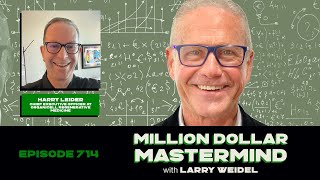
Dr. Harry Leider, CEO of Organicell, discusses his path from Penn medical school through population health and six years combating the opioid epidemic, when prescription overdose deaths climbed from 50,000 to 100,000 annually. At Walgreens as Chief Medical Officer, he launched telemedicine and uncovered the Theranos fraud.
Questions this video answers
October 31, 2023.
About six years.
About 50,000 per year earlier; he says the problem later grew to about 100,000 per year.
Five years.
Approximately $150 million.
Welcome to this edition of the Million Dollar Mastermind podcast. This is where we pick the brains of high achievers from all walks of life and get their hard earned real world insights on winning. I'm your host, Larry Wydell.
If we're looking back and we're saying Harry's going to write his own, a.
Book.
About his life and lessons he's learned. And the first part of that, what are things you really did right and maybe came because you just, your instincts were that way, your upbringing was that way, or things you were told, you know.
Well, I guess we'd start with one thing. I worked really hard. So even though I had a lot of fun at Penn State, it was a big state school and I was in a fraternity and I did all that leadership stuff. I was, you know, I worked incredibly hard that. And did it, did, you know, graduate very, very high in my class. And that enabled me to get to Penn, which, you know, many people could argue is the best or one of the top three med schools in the country. It's the first, which is really interesting. It's the very first med school in the country, Pennsylvania. So I think hard work is hard to, hard to get around not doing hard work. You know, you see these TV series when people just, you know, young people just become successful because they're in the right place at the right time. Yeah, I, I think most careers require hard work. You know, Malcolm Gladwell, who we all know very well, the former Wall Street Journal journalist who has written a number of books in his famous book called Outliers, talking about people that are extraordinary at something, it's music or leadership or whatever it is. He has this rule that you got to put 10,000 hours in.
Right.
To truly become excellent at something.
Yeah.
And I, I believe that. I don't think there's any substitute for the hard work early on and then experience now.
And so that would be number one. How did you come by that?
Was that.
Did you hit the ground running like that, or was sometimes you get a challenge from your parents or from other people around what caused that?
Well, that's a deeply personal story. Without getting into too much detail. I had a little bit of a tough upbringing, a little bit of challenges in my family with relationships with one of my parents. And some people might turn that into a negative thing. You know, maybe alcohol or drugs or partying too much or whatever. I actually felt better by achieving. So I channeled a lot of that sort of frustration into I'm going to do better, I'm going to make myself better, I'm going to work harder. And it made me feel better to do that. So out of that kind of negative family situation came a tremendous drive to succeed and be the top.
Yeah. And that became part of your identity. It seems like you you made a decision to adopt that as part of your approach to life early on, based off seeing other examples.
Yeah, yeah. And in fact, it's only now that I've or recent years that I've been able to take my foot off the accelerator just a little. Larry.
Yeah.
You know, because, you know, working hard and being focused can be a wonderful thing for your career, but you can have some collateral damage to family and friends.
Right.
How to take your foot off the gas every once in a.
Right. And so as you have moved, you move forward now, what was the next big we might go back to the the Harry Leiter book on on winning and get in some of the other chapters after hard work. But now let's I'm interested in how you got into your next stages.
Yeah, I did a couple companies in this area of disease management called population health, and one was in diabetes after the heart fail. And then I worked for a specialty lab that was in a very interesting space and I got thrust into a very big public health issue, and that was the opioid epidemic.
LARRY Right.
You probably know there's been a number of public TV shows about the opioid epidemic. Sackler family There was one recently on TV called Painkiller. There's a famous there's a best selling nonfiction book called Empire of Pain, all about the opioid epidemic. But anyway, I worked for a specialty lab and our customers were doctors who were pain doctors who asked the patients to submit urine drug samples to our lab to prove that they were actually taking their meds correctly and not selling them or mixing them or all that. But I did a lot of speaking, Larry, all around the country about the opioid epidemic, because what I learned was at that time, 50,000 people were dying a year from prescription drug overdoses. More than car accidents, more than heroin and cocaine involved. Big public health problem today, it's 100,000, by the way. So the problem got even worse. So for six years I was involved with the opioid epidemic and trying to help doctors manage their patients safely. And then one day I got a call from a recruiter and she said to me, and I got them periodically, but this was particularly interesting. She said, I got this really interesting job. This small company called Walgreens is looking for a chief Medical officer, a small company because I always work for smaller or medium things. And they think you might be a good candidate or we think you might be a good candidate, you're interested. So lo and behold, after interviews and the whole process, I moved from Baltimore to Chicago, where the headquarters of Walgreens is, because the very first Walgreens in 1901 was in Chicago. And I became the chief medical officer for five years at a Fortune 50 company, one of the biggest companies in the country. So that was when you.
When you went to these various companies.
Yeah.
Now was in Walgreens, you were starting something. Were you starting something new or was something already exist?
Well, it was a well established organization, but I was starting new programs, Larry.
Right.
Well, I helped them start a tele before telemedicine was even a big thing. I helped launch a telemedicine program at Walgreens. Yeah, A lot of digital tools that our customers could use on their phone to keep track of their kids or their health. But you know, the basic pharmacies were certainly there.
But now you've had a track record of being the CEO at moving into a new company. And usually when that happens, it's because things are not necessarily going as well as people think they should be. And you know, one of the solutions, easiest thing to do is get a new CEO. And so what was your. How did. Did you develop a method for succeeding as the new CEO?
Well, in these cases, just to be clear, I wasn't the CEO. CEO of a company. I was the chief medical officer. So I was one I reported to. Right, right. But you know, the most important thing for it, you still had, but you.
Still had departments that you were running. Yeah. People, personnel budgets, this the other worse to turn around and things like that, targets to meet.
Of course.
Yeah.
The number one thing though, for the head doctor, the chief medical officer in a healthcare organization is to make sure the quality of the, of the service or the care is top notch and nobody gets hurt. And you're, you know, business can. There are business needs and business drivers that can sometimes push companies to do things that might be risky for patients.
Yeah.
And job of the chief medical officer to be the one who says, no, we're not going to do that. So the great example of Walgreens, I have to be a little careful what I say because it's a. I do have a disclosure agreement with them, but while I was at Walgreens, I inherited. I don't know if we talked about it when I met you, Larry, but I inherited the A little bit of the debacle of the Theranos relationship. The Elizabeth the driver, I don't think.
I don't think we got into that.
But that would.
So Walgreens, I think I would remember.
That was a partner with their nose and invested $150 million. And as you know, she, Elizabeth is now in jail, as is her. So I was in the middle of all that, trying to clean that up while I was. Yeah. Wow. Challenging.
And so how do you go about that when, you know, to turn things around? How do you go about that?
That was probably the most challenging thing in my career because 1. I don't know how many listeners know the Theranos story. There's been multiple TV shows and books written. The Hulu series, the Dropout, is the latest one. But Theranos, which said they could do 200 lab tests with one drop of blood, had on their board people like George Shultz, the former Secretary of State, Henry Kissinger, James Mattis, the general. So people could not believe that there was any potential for them to be fraudulent. So it was very, very challenging to convince people that there could be a problem there.
And so when you get in that situation, what's your latitude? What can you do? What can you not do?
Well, I put together a small team to investigate the situation. It was engendered by me getting into my quality department. Larry. Complaints from our customers saying, I did a lab test at Walgreens. I supposedly was using the Theranos technology, and it said that I had a high prostate level, antigen level, which is a screening for cancer. I was worried I had cancer. I went to my doctor, they repeated it and it was normal. And I got a bunch of those kind of complaints. And that's what started worrying me. And then I ended up calling up Theranos. Never forgot to this day. And I said, I want to speak to your lab director. And they sent me to somebody in New York and I asked him what his background was, and he said he's a dermatologist. Can you imagine?
So you have a dermatologist?
Yeah. Most controversial lab in the world. And their lab director. And it turned out was because the real lab director quit the week before. So they needed somebody quickly just to be on the masthead. So that tipped me off and started a year long investigation. Their attorney, this is well known, it's all publicly known, was David Boyce, who's one of the most famous world. He, you know, he, he defended O.J. among other people. Right. So at the end of the day, without Getting into all the details, we started a year investigation and got data and eventually determined that they were fraudulent and pulled the plug right before Medicare shut them down.
And so dealing with that, that, that's.
An unusual, it's a very, very unusual.
Situation that's basically out of control fire. You're just trying to put it out any way you can.
Right, right. Most people will never have a situation like that in their career but minimize.
The losses, things like that. And well, what would you say? I mean let's just, let's take advantage of your experience in that situation and look back through the filter of time and say what would you give yourself high marks for doing that other people could learn from in that kind of situation? Because unfortunately Harry, that's not the only time that things like that's going to happen.
Everybody faces moral dilemmas where maybe the opportunity for an organization to make money, a company to make money, maybe at odds for what's good for somebody or other people. Right, right. Especially when things are, you know, for profit and publicly held. I think the thing that I did right was I was committed to finding the right answer. And even remember to this day I had to have a discussion with my wife and I said, you know, this could really go wrong. And I said I could get fired, you know, if it turns out I don't come up with evidence or we don't find anything. And it looks like I'm creating waves unnecessarily, you know, I could lose my job. And she very, very supportive and said, look, you got to do the right thing. These are people's lives at stake. And so being tenacious and focusing on the right thing and being willing to take risks when it comes to people's health and welfare was my North Star. It's always this.
Yeah. And that caused you to do what? I mean, how did that play out in the real world?
Well, in this particular case there were because the company fraudulent, this Theranos company, it was hard for some of my peers to believe there was a problem. And let's talk about that for a minute.
I was going to write one of my 50 books that I was going to write and never will was going to be to have a heads up book for naive young college graduates coming out into the real world. And it's going to be like 25 monsters you will meet in the business world. And it was going to be lead off off with narcissist, you know, and because they're very convincing, they're very lovable and they're going to agree with everything you say, you know, you know, they're everything that you know. Oh, we want to be honest. We want to give the, this best value and we would never, you know, and everything that they're doing wrong, they're going to lie about. You know, every word out of their mouth is lying. It's hard to believe, you know, nice guys like you and me who grow up from families where you don't have people like that, you know, you have. You don't know that there's narcissists. You don't know that there is congenital liars. You don't know that they're con men out there and they're very convincing.
You can't.
Yeah.
And Eliza, I mean Elizabeth, many people ask me because I met her several times, you know, do you think she was just faking until she made it like the whole Silicon Valley thing of you try things till they work right, or was she a sociopath?
Yeah.
And I don't know for sure, but when patients lives are at stake, people's lives are at stake with their lab test. You don't fake it till you make it. You don't just throw spaghetti against the wall. It has to work. I think for any leader. We're using a healthcare example to have a core set of values that are really your cornerstone, that you believe in high quality work, teamwork, transparency, you know, whatever it is to have things that you really believe, that even when there's pressure, that you can go back to time and time again as the way you function in the world is valuable. And you will lose some things. I mean, sometimes you will lose a job. I have been fired in my career.
Yeah. And if you're fired for the right reasons, you walk away. You can leave with your head held.
Right? Right.
Thanks for listening to the Million Dollar Mastermind. If you felt there were any valuable takeaways from this episode, please take a minute and leave us a five star review. Your feedback is important and really helps us get the word out to a wider audience. Remember, we have a valuable webinar that is absolutely free. Register for it right now@whiteallonwinning.com thanks for listening.
More from Larry









Rick Jordan on Self-Engineered Proximity, Cyber Security Moats, and Truth-Based Leadership

Fire Fast or Fail Slow: Kevin Brittingham Reveals the One Rule That Built a $100M Empire
