Episode #729 - Why You Should Write A Business Book with Anna David of Legacy Launch Pad Publishing
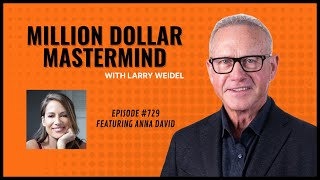
Anna David, a writer-turned-publisher, explains why entrepreneurs should write business books. She's published over 50 books through Legacy Launch Pad Publishing and says a book is one of the fastest ways to build authority, land speaking gigs, and attract better clients.
Questions this video answers
2016
Over 50 books (as of the interview)
Welcome to this edition of the million Dollar Mastermind podcast. This is where we pick the brains of high achievers from all walks of life and get their hard earned real world insights on winning. I'm your host, Larry Wydell. Let's talk to Anna B. David. Hello, Anna.
Well, hello. Thanks for having me.
Yes. And congratulations on your new baby.
Thank you.
Baby boy or girl?
Baby boy. He's, he's really good. I know every parent thinks they've got the perfect kid, but so far, three and a half months in, he's pretty perfect.
Wonderful. Well, they can be pretty non perfect at three and a half months and so never sleeping and things like that. So that's good if he's perfect.
Yeah. I'm still hearing from my parents about how imperfect I was at that age and then continue to be imperfect. But he's a good one.
Wonderful. And so let's talk about winning. You're a writer and now publisher and you're going to open our eyes to what it's like to live in that world. And you know, the thing about it, Anna, which you should get some unique insights is that it is such an ambiguous world for trying to support yourself, you know, where it's like an actor, where's the next job coming from? Unless you get on a series or, you know, you hit, hit the jackpot or something. But where you've got to continually make choices about what to do, what put your energy in because you're out there by yourself, you know, sure, you're, you're bush it, whacking your way through the jungle and trying to survive. And so I'm sure you have accumulated a lot of fun lessons. Let's talk about. You started. Did you always want to write?
I always wanted to write. I majored in creative writing. I was submitting articles to Highlights magazine when I was 12 years old, so there was nothing else I wanted to do much to my parents. Horror, horror, it was not what they wanted for me. And you don't really get as a kid, like they didn't communicate, oh, we're just scared you're gonna not be able to make a living. It was just like go to law school, go to business school and I didn't.
Yeah. And so why.
You know, honestly, there.
Was, explain yourself, young lady.
There was nothing else. I was good at nothing. Truly the things I'm good at, I'm really good at and there are very few of them. And you know, it was all, I see in retrospect that it was extremely therapeutic for me to Be able to sort of make sense of my life and feel seen. I felt very unseen and unheard. And I believe that is the why behind what I do because I was able to feel seen and heard from doing books. And now I help other people. You'll see.
You've got, so people know where we're going with this. You've got a real unique idea. You, you eventually started publishing and you're starting, you're publish publishing books for.
Entrepreneurs.
Yeah. High earning entrepreneurs who have become experts in their field. They, they got a lot of expertise, they've got a tremendous track record of success and you help them turn that into a book. And there's a lot of people listening to this who are in that successful entrepreneur category. And like all successful entrepreneurs, they want to keep on going because they know if you're not growing, you're dying. But sometimes you don't notice how far you've come. And sometimes getting that down and putting that can increase your credibility. I'm giving your sales pitch for you.
Right. Thank you.
Give your, you know, increase your credibility gives you a calling card, you know, helps crystallize who you are. And so now, now you, you take over your story. Why should people, why should an entrepreneur want to do that? And how did you get that idea going from, you know, creative writing and you know, all these no telling what kind of novels and making stuff up.
Yeah.
And you're good at it. But then you go into where now you're working with entrepreneurs.
Yeah.
And so, so let's, let's talk about that.
So. Okay, so the reason they should do it is there's, there's so many reasons, you know, there is no more efficient way to get instant authority. You know, I think in, you know, nobody cares where or that I went to college. Everybody cares that I have a book. And you immediately, as you know, you, you differentiate yourself from your competitors because you are the authority and in your field. So it is also a way to crystallize exactly what you do both for yourself and for your prospective clients. I think we're all exhausted by having to explain what we do and why. It's benefic and all, how it works. But it gets you on. When I say it gets you on stages. If it becomes down to you and somebody else, they will always, any event organizer will always pick the person with the book. But, but I mean most, perhaps practically it gets you better, more higher quality clients. So that's why you should do it. I think the only reason I see people not do it is that. That they don't feel worthy. They sort of have imposter syndrome. They sort of think, oh, it's up to. I'm not that kind of person that should be in the spotlight or whatever it is. And I just think that's sort of, you know, head trash and. And get out of it. If you have achieved success, there's absolutely no reason you shouldn't do a book. And the time. The best time to do it was 10 years ago. The five years ago. The second best time is right now.
So, and so how did you. How did you get the idea of starting a publishing company and then narrowing in on this particular niche, let's say?
Well, I really had to be hit over the head to understand this. I was trying. I was listening to all the marketers before we were recording. We were talking about how I was broke up until, you know, really four or five years ago. And broke is all relative. I was able to pay my rent and now. But it was a struggle. Now I'm able to very comfortably pay my mortgage. So things changed a lot when I became what transitioned from being a writer to an entrepreneur. I listened to all those marketing gurus, and they all said, oh, create a funnel. Do a course. And I spent so many hours and so much money doing that. I have. I've really sold. I've created, I don't know, 15 to 20 courses. I've maybe sold like three to 10. You know, it was just a disaster. And I kept trying and trying and trying. Meanwhile, because I wrote a New York Times bestselling book for an actor, people were always coming to me and asking me to write their books, and I had no. I had no interest, and I continue to have no interest in doing that. So I would just say no. And one person, his name's Darren Prince, he's a sports agent, was very insistent, so insistent that I just. To get him off my back, I said, well, I know this writer who needs work. She's always telling me she needs work. I could hire her and then I could edit it for you. And he said, as long as you're involved, that's great. And then he said he needed it published. And so I figured out how to do that. And then I watched him take that book, get speaking engagements, get spokesperson jobs, get more clients, set up nonprofits. And he's the one who taught me what a book could do. And from there, that was 2016, and we've published over 50 books since then. And honestly, it's just been one person after another. We've never done advertising, we've never done promotion. We're pretty much referral only and it's never stopped.
And so how did you figure out how to publish? You know, what was that going down? Someone show you the ropes or.
No. And I will tell you, they always say start a business based on what you wish existed. Again, I'm a very slow learner. About 10 to 12 years ago I explored self publishing. I was a real snob. I was like, you are traditionally published, you know, a big five publisher acquires you or it doesn't count. But then I wanted to figure it out and I kept looking for someone. I didn't want to learn the back end of Amazon and keywords and categories and all of that stuff. I couldn't find anyone who would do it because my back was up against the wall and this guy wanted to pay me good money to do it. I figured it out and I will say, I will be honest. Every single book we figure out more and more now I have a team so I don't actually have to do that work, but we refine the process on every single book. And now we know how to do things that traditional publishers have no idea how to do and we know how to just secret back end Amazon things and Barnes and noble things and, and I'm learning all the time. I learn on every book.
Yeah. And so the thing is with 50 books you now you're as a writer, going from a writer and you're, you know, your friends, I'm making this up. But your friends down at Starbucks in, you know, during the day, sitting at the table next to you, J.K. rowley writing her book or whatever and going from that random circle of friends or whatever to where now you're dealing with entrepreneurs, Entrepreneurs. That's had to have an impact on you.
It absolutely has. Really? Like, like Darren, my first client. My clients teach me things because they're the people that, that I have aspired to be and I have sort of become. They're the authorities in their space. What I learned the first couple of years, we did not have a sort of refined avatar. We really worked with anybody who reached out to us. And I found that the non entrepreneurs, the people who negotiated to pay the least, were the most demanding, the most difficult. And I found that the entrepreneurs, the very successful entrepreneurs were the people I liked working with because they understood what it was like to run a business and not to concern themselves with every little detail and not to, and to be a good client. I mean obviously there are exceptions, but so, and we really, like I said, we're referral only or we really try. We return down more people than we accept in terms of clients.
Well, you are a snob.
I am, yeah. I mean, I'm from Marin County. I was raised by total snobs. So it's continued.
That hasn't gotten away. Isn't your really.
Not really. Really. Alas.
Now, talk about, like, for example, you know, we're talking about, like, three titles that I've got here that have been written for your. On, you know, for your publishing company. Like how to be a Badass Female CEO. Tell me about that one and how that came about and what you learned about from the process for being exposed to a badass female CEO, which hope hopefully, like you say, that's what you're trying to think.
Yes, yes, I. That one was interesting because I. I was able to get on Good Morning America for my book called make youe Mess yous Memoir. And side note, you know, everybody, make your mess your memoir. That was.
That was my make your mess your memoir.
Yeah.
On Good Morning America.
For that I did. Good for you. And I used to do a lot of TV back in my old life, and I didn't appreciate it at all, but I also didn't know how to use it correctly. I would go on the Today show and then I would look and see that I only sold 10 books from that appearance. And I'm like, this isn't fair. This isn't right. You don't go for that reason. When I was on Good Morning America, I probably sold six books, but it brought in hundreds of thousands of dollars in new clients who saw talking about this. So it was actually a guy I went to college with. His wife saw, I posted the Good Morning America segment on LinkedIn and she reached out and she was probably our 10th book. And, you know, so it was relatively early on in the process, but she was somebody, you know, What I learned from her is she had a podcast that was already going and she wanted a book that would help her get clients and, you know, sort of be adjunct to the podcast. So that was a fun book. I, like I said, I don't write any of them and I don't edit any of them. That is my team. They're the ones that are in the weeds. I'm just sort of getting the clients overseeing the process and my hands are kind of all over them. But it's really more conceptually and how to launch successfully.
Thanks for listening to the Million Dollar Master Buy. If you felt there were any valuable takeaways from this episode. Please take a minute and leave us a five star review. Your feedback is important and really helps us get the word out to a wider audience. Remember, we have a valuable webinar that is absolutely free. Register for it right now@whitealawnwinning.com thanks for listening.
More from Larry









Rick Jordan on Self-Engineered Proximity, Cyber Security Moats, and Truth-Based Leadership

Fire Fast or Fail Slow: Kevin Brittingham Reveals the One Rule That Built a $100M Empire
