Episode #739 - Successfully Scaling Art Businesses with Mark Weiss, Owner of The Weiss Gallery
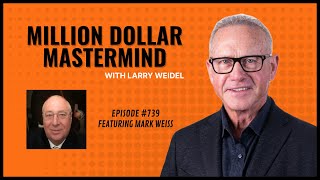
Transcript of a podcast interview (Million Dollar Mastermind) between host Larry Weidel and Mark Weiss, owner of The Weiss Gallery. The conversation covers the challenges of running and scaling an art gallery in London: fundraising and investor relations, cashflow pressures and feast-or-famine sales cycles, the importance of location and shop windows for walk-in customers, international expansion after moving to London, notable early sales (e.g., Tate), staffing and family involvement, and personal work–life balance.
Welcome to this edition of the Million Dollar Mastermind podcast. This is where we pick the brains of high achievers from all walks of life and get their hard earned real world insights on winning. I'm your host, Larry Wydell.
What was the first real shock that you got about the streets are not paved with, with gold. And when you got into London it.
Was difficult to sell pictures. It wasn't that easy.
You open your, your store now, I wanted to add this.
Not a store, a gallery.
Gallery. Excuse me. As you open the, the gallery and you're, you're leading up to that with all this travel and fairs and everything, you're earning the right to follow your own instincts. You know, say you said, I didn't know why I was interested in that, that style of that whatever, but when you put that much energy into it, you pretty much earn the right, you know, to follow your own instincts and pursue the things that you're most interested in. Would you agree with that?
Would you have to just hold that thought for a minute? Because I think the other thing I need to make sort of understand, I'm now running not a family business, I'm running a public company. I think it was over a hundred shareholders. I think the number was something like £800,000, which, you know, talking, you know, 30, how many years, I've lost count of how many years ago it is.
Now that, that was a lot of. That was a lot of money for you.
Yeah. Our window is somewhere between 500 and a million. And we raised 800,000, 300,000 on that, went on all the setup expenses and the lawyers, by the time they dug their fist into it, everybody, we were left with around £500,000 capital to spend. And that quickly dissipated because I was under an impetus to spend the money because the lawyers and everything. There were certain strictures for these, the new schemes. You couldn't just sit on the money. For example, you had to actively show that you were trading. So I was told to, you know, you must go out and buy stock. Buy stock, Buy stock. So I probably ended up buying things that I shouldn't do just because they wanted me to spend the money. And of course soon you spent the money. It's, we need to be selling now because we're going to run out of money. Yeah, it was actually quite tricky and you know, and, and I'd kind of bluffed and blustered my way, you know, in order to raise this money, I had promote myself as something that at that point I wasn't actually that person. You know, I hadn't got the experience that I claimed to have got. You know, it was, it was, you know, it was a bit of a puff job. So I had to then demonstrate that or try to operate in the manner that. And to have the success rather that I intimated to everybody would happen. And there were one or two, you know, we had some very fortunate early successes, but then, you know, we went through, you know, the business is very much like this all the time still to today. So you never know.
Feast or famine.
It's always it's feast or famine. It's a feast or famine. Obviously, the big difference is, you know, with all the experience I've gained now, now 50 years in the art market, you just make sure you've still got a store cupboard to live on.
It's kind of like the jewelry business in the sense that you, you see people sitting in there, nobody coming in, and you're just looking at the walls. And a lot of this is. You'll see that even at art fairs, nobody even comes. Go to an art fair. You go to all the effort that you talked about that you were there, and then you're sitting there for hours and nobody comes by to even look at your stuff. But when you have a brick and mortar operation and you have bills, the electricity, all of that, and day after day nobody's coming in. But then, you know, it could be one big say you're good for the year, the pressure's off. It's a lot like commercial. They used to say commercial real estate would be, you know, it's not like selling houses, you know, which is more steady. But even now the houses are, you know, $20 million and Aspen and Palm Beach. But the, you know, usually the house business is more smaller and steady, and then the big hits come in on the commercial sales, you know, so if you've got the stomach for it, you go into the commercial side of things. But that it's a lot like the jewelry business. It's a lot like the art galleries. But you knew that, didn't you, when you, you came in?
Yes, I should just go back to the property market. Dear, dear, dear, now deceased close friend of mine who's a real character, and he has had this joke, say, well, I used to be in real estate, now I'm just in a real estate.
When you open your. How did you get sales early on? How did you find your clients? I mean, you know, I'm sure you did announcements coming to town, you know, big opening. And I remember when we had a Grand opening for one of our galleries at the first one and of course no sales the first night. And I said why didn't somebody tell me? There's no. What one of them said was that been to many of these. They said I've never seen anyone sell anything on the, you know, the grand opening night. And I said why, why didn't anybody tell me this? I probably wouldn't have even gone why.
Aren'T we, you know, focused on that particular location? The unit is still there today. It was became a jewelers and I'm not quite sure but I think it's about change hands again. Albert street is a great cross street from Piccadilly. Saint James's is, was. You're going to get people dry. It had a fabulous shop window which again I have today. So you're always fishing for somebody who's never been in the gallery before, who maybe never looked at these pictures before, who may walk by, drive by, see something in the window or inside the gallery and go oh my gosh, that looks interesting. And then subsequently comes in the gallery. And then once they're in the gallery you do your best to promote whatever it is that they've come in to see and you know, and you just try to therefore, and then to establish some sort of relationship with them and, and potentially they might, might buy a picture. And indeed, only a year ago, almost exactly a couple had been for dinner at Wilton's, which is just two doors down, three doors down from us, been out for dinner, walked by the wind, the gallery at night, seen a picture in the window, the wife had liked it, they came in the following day and they bought that and another painting for half a million pounds.
You find out a lot of your sales are walk in.
No, I wouldn't say a lot of sales are, but we do it is important. The shop window, the location. I mean that's. It is a sad fact that many of my colleagues agree when I say this to them that my gallery now is one of the very last grand old style gallery spaces with a shop front on the main street, dealing in old masters left not only in London but arguably in the world. I mean you've seen what happened in New York. I mean right, Retail, ground floor retail has virtually disappeared.
How long did it take you to go international or when you opened your, your, your gallery, what was the first big sale you made?
Well, the first big sale that we made or invoice number one was actually in truth was made just prior to the opening of the gallery. It was actually to The Tate Gallery in London. One of our first veritable international clients was a man named Bruce Toll who he and his wife happened to be drove by the gallery in their chauffeur driven limo and saw this very beautiful portrait in the window. And actually I remember he, when he came in the gallery to, to, to actually purchase the painting or agree a deal on the painting, he said to me, well obviously Mark, you know, I don't know you, but the word on the street is you're a good guy to do business with.
And so you have to wonder who he was talking to so you could reciprocate. How, how long did it take you to get, how long was it before Margaret Thatcher started buying portraiture from you? Just, I'm just kidding.
You say that actually we did sell a few years ago a port a very early portrait of Henry VIII where he came, the icon today in the Holbein portraits, which was bought for 10 Downing street and actually got a picture hanging over here which was also hanging. It was the property of Horace Walpole who was the then prime minister in the 18th century and the painting hung in his, in his wife's drawing room or dressing room in Thames. Downing street.
Your first location in London was not German street. Right.
It was 1B Albemarle street which is, was the first unit retail unit, still is as you, as you turn into Alba street on the right hand side. And at that point in those days, in the mid-80s, there were many more galleries in London than there are today.
Yeah.
So there were two galleries directly opposite me and there was probably four galleries further up the street, all of which I think virtually disappeared. Sadly today we were getting into how.
You got into the international market when you moved to London. Was that in the back of your mind of wanting to get into.
Yeah, absolutely. Now the whole point of moving to London because when we were in Essex, right, we were provincial dealers and you know, our clientele really, we didn't really sell pictures to anybody live more than 100 miles away. Yeah. Now I'm selling pictures to people who live 10, 15, 20,000 miles away.
Is that from the London location or.
Well, I think it's, it's obviously a combination of, of absolutely being in London, but obviously by now it's, it's a result of the reputation of the gallery and the quality of the portraiture and the importance of the portraiture that we now sell.
Have you been able to elevate the quality of the portraiture that you're selling as you've gone along and in fact.
I was saying this just to my team, literally just a couple of days ago I said that 15, 20 years ago we moved into the current location about 20 years ago. If we had one or two really great pictures in the gallery, I'd say that was something. And the rest of the other pictures, though obviously I consider them to be certain stock were not at that level. In the gallery today we have probably at least a dozen paintings of international importance.
And you're on Jermyn Street.
Fabulous street.
Yes. Which end of Jermyn Street? Towards Piccadilly and. Or the ribbon.
We're the St. James's End. Oh, St. James's so we're opposite Turnbull and Assa. The famous.
Okay, I was gonna ask you about them.
Yeah. And then you've got. Is it Davidos Corner? And by the way, Schwarzenegger. Yeah. He was buying cigars just across the road the other day.
Just so people, y' all will know listening. We were, Mark and I were talking before we started and I was nailing down his location on German Street. And I used to live at Economist Plaza, right near Stone's Throw. It's a noisy place at night, Mark. That's why I had to get out of there.
It was, you know, I mentioned Sir John Harvey Jones, who would have been my father in law had I not pulled out of a wedding, our wedding, four days beforehand to his daughter Gabby. Not a great thing to have done. He actually was the chairman of the Economist company.
Really?
Yeah.
And you pulled out on his daughter. How did you expect to ever keep your doors open after that?
Yeah, he did speak to me for a year.
What, what kind of thing do you go through? What's the roller coaster like? Like you say, what have you. You said, if my father only knew what I'd had to go through to keep this gallery going and everything. What is the struggle? Because, you know, one way you can look at it, Mark, is here I have paid such a price of traveling and, you know, 14 years or something doing these shows, doing the, you know, being on the road with the, the wagon and you know, beating the bushes and not being at home living out of suitcases, basically. And so for years, you know, over a decade. And so I paid my dues. And so then I work my way in, I get a storefront. It's like, when is this ever going to end? But the truth of it, it never ends if you want to play in the big leagues. So you're in London, you've got a gallery, you had some big sales. The Tate has bought right off the bat. You know what, what could be better as far as a kickoff? But still, you've got to keep your. Your pedal to the metal. Get up early, work hard, stay late. That type thing. You never reach a point where you can coast.
I am somebody who works to live rather than lives to work. It's very important for my own psyche to actually be able to switch off and relax and to do the other things in my life that I enjoy. One of the ways that I've been also able to do that, obviously one has to bear in mind you have got to keep a business going and is one of my. And I would say it's a skill set which has enabled me to get through some of the traumas that I've had to deal with in. In my working life. I compartmentalize things so that when I go home in the evening, by and large, I'm able to switch off, watch television, listen to music. My great passion at the moment is cooking. So I love to cook. Even if I've had a hard day in the gallery. I go home and from a standing start, I'll cook dinner. Now, my wife is trying to change that, and that's her heart, and allow. Give her a bit more autonomy in the kitchen. So, in fact, she cooked me dinner last night, which was delicious. You know, part of this is also, I think, an element of my success. You know, I am admittedly a control freak. I'm very anal about detail and, you know, I like things to be correct and right. Even the sort of smallest things will upset me if it's not quite right. So now you can take that to. To an extreme where, you know, you only end up, you know, with even more stress than you need. You've got. You've got to learn to sort of balance that to some extent. And one of the things that I've been very fortunate over the last few years is the team that I have now working in the gallery. My wife worked with me. We got married late in life. In fact, we'd only married just over 20 years, which more or less coincided with our occupation of this premises at German Street. So until a couple of years ago, my wife was our gallery manager. There aren't many people who would ever want to or ever successfully work with their wives so closely in such a narrow space, but we did establish a very good working relationship. And I freely admit that I wouldn't be, or have had the success that we've had be where I am today if it wasn't for my wife who has been an absolute rock that I've been able to be the creative element that then gone out and does done all the magic. You know I think any any successful entrepreneur often needs that rock in which enable so he doesn't have to worry about the small things.
Right.
And I have through most of my working life worried also had to worry about the little things.
Yeah.
As you know we talked about earlier. You know even when I moved to London there would be moments where I nearly went bankrupt in the early 90s and I had to I only had one member of staff had let them go. I had to sell my car was literally a paper's width away from being closed in app.
Thanks for listening to the Million Dollar Mastermind. If you felt there were any valuable takeaways from this episode, please take a minute and leave us a five star review. Your feedback is important and really helps us get the word out to a wider audience. Remember, we have a valuable webinar that is absolutely free. Register for it right now@whiteallonwinning.com thanks for listening.
More from Larry









Rick Jordan on Self-Engineered Proximity, Cyber Security Moats, and Truth-Based Leadership

Fire Fast or Fail Slow: Kevin Brittingham Reveals the One Rule That Built a $100M Empire
