Episode #745 - From One Box To A Global Empire: The Grit And Hustle with Kelley Thornton
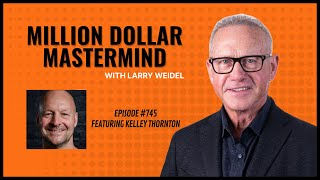
Kelly Fordin started with a high school painting company, spent 18 years in CPG sales, then founded Tiege Hanley. His first version failed, but he rebuilt it and expanded into 110+ countries by staying close to customer feedback and learning business fundamentals the hard way.
Welcome to this edition of the million Dollar Mastermind podcast. This is where we pick the brains of high achievers from all walks of life and get their hard earned real world insights on winning. I'm your host, Larry Wydell.
Hello, Kelly Fordin.
Hello, Larry. Good to see you today.
Yes. And what an exciting season it is for all of us. Lots of going and coming in business and family and friends and all. It's a great time to celebrate, you know, this podcast about winning and accomplishing the things you want to in life. It's hard to get through the year without looking back on the year and saying, you know, am I on track? Am I delivering where I wanted to deliver? So what a perfect time for us to talk because you got a lot of winning going on in your life and it's. Winning is never, you know, just accidental. It's a result of decisions and effort and adjustments. And so congratulations on all your accomplishments. So one thing, you know, you got bullet points to, you know, for pages of bullet points of achievements, but one thing is to have started a company that now has, has expanded into 110 countries or more. You know, it's probably expanding day by day, but that's a tremendous achievement. Congratulations. We'll get into all of that stuff. But, you know, I'm proud to, I'm, you know, I'm very grateful to have a venue to where I can spotlight people like yourself, Kelly, in the world that are ignored by the media so much and in terms of publicizing all the negative garbage out there and you know, people can, can lose sight or they're never really told. There are people like you out there, you know, doing things and to give them hope. You know, the thing is they know that story gives them hope and encouragement. You know, like this still happens in the world and not just kind of overcome and have a happy afternoon or something, but have a, you know, a powerful, impactful life.
Yes.
And so, you know, when you started, you know, in your beginnings, how humble was your start when you started?
Extremely humble. Extremely humble. I had had an advisor say to me, just sell one box of skincare. We're in the skincare business, Larry. We're helping guys think about how to take care of their skin. I had advisors say to me, just sell one box and get back to me. And I thought it was a joke, you know, and he said to someone you don't know, like, right, just to somebody you don't know. And it was brutally hard. Brutally.
How long did that take?
It took a long time as A matter of fact, that is still the business that I have right now. Tiege Hanley. But it was version one of it, and in version one was a complete failure. We couldn't sell. We couldn't sell one to anybody. It was like, you know, I was trying to stop somebody on the street to see if they would go to my URL and buy it.
Now, the thing is, though, you know, and the story, the lesson about that is that you were not a rookie. I mean, you were not a rank amateur. I mean, you were an educated pro with success and this, that and the other. You launched that. And still, you know, it's not unusual that you, you, you know, person in that situation can go out and put something together, believe in it, and, you know, just be totally convinced this is going to skyrocket and then to fall flat in your face. And so you should get disturbed. People listening that don't get discouraged if you go through that phase. And Kelly's going to tell you why. But, Kelly, how early in your life did you start thinking about things that you can remember? Thoughts came in your mind, you noticed things about other people you had things you wanted to do that eventually sent you down this road. What were you interested in growing up?
You know, the early thoughts were in high school. I was always driven by the concept of, you know, of success. We were talking before the show about what success is. But I was very interested in financial success early on, and I was a very, very, very motivated youngster. I was interested in doing anything I can and very interested in work, believe it or not, was very motivated by work and the output of work and the output and the outcome of work, which was financial. So it was very, very early on, like, you know, high school. I had my first business, which was a painting company in high school. And. And I was very, very, very fortunate. The benefit of that now, and the thing is, you.
How did that get in your mind that business could be. It was, I guess, the income attached to it. You know, I grew up. I grew up disadvantaged in the sense that I had the. I grew up playing sports. You know, fun is sports to me. And so, you know, you went from one sport to another around for the year. And the idea of business just, you know, I equated business. If it was a warsatch test, it would be business equal, boring. And so I could not imagine, you know, any. Any, you know, thinking about my future was just like, oh, no. And then thankfully, somewhere along the way when I got out, it was like, no, business is sports business. Is competition. And now it took on a whole new meaning for me, you know?
Yeah, I mean, that is what it is.
Positive attitude towards business right from the beginning. That's a tremendous advantage.
That is what it is, Larry. I mean, everybody, all of us entrepreneurs have read Roosevelt's a man in the arena. Paragraph or saying. Or, you know, that's what it is. It is a competition. Every single day is a competition. Every single day. I come into work every single day ready to compete every day. I'm always thinking about that.
Yeah. And so how did you start the painting company and how big did that get? Because that's how you kind of made yourself independent, put yourself through school. Is that right?
That is right. Yeah. It's amazing. You know, I moved to Connecticut from Maryland in my. Between my sophomore year and junior year in high school. And I right away, in the fall, I was washing dishes and busing tables like a lot of young people, men and women do. And I was right away I started painting New England. I live in Chicago right now. I've been here 30 years. But new England, as most of us know, is these old clapboard houses, right? 200 year old houses. And there's a lot of maintenance. So there's a big opportunity to be cleaning and painting houses, cleaning exterior and painting houses. So it was an endless supply of work. And, you know, I added one of my high school friends and then two of my high school friends and then three of my college friends and then five of my college friends. And it was 10 of my college friends before we finished. And you know, and we. During spring break, I was painting houses. During Christmas, I was painting inside of homes. And it was just a constant flow of business. It allowed me to graduate debt free. As a matter of fact, my wife is from Connecticut. It allowed the two of us to start and she had a little bit of debt to clear out that debt. And it really allowed us to buy a house early on in Chicago, very early on in our career. So there was a huge financial advantage to getting started early, graduating college debt free, and then getting right into kind of a house early on. Massive advantage. It all came from entrepreneurial, you know, kind of process.
Well, right from the beginning, you had kind of an accelerated learning experience because you were going to college, getting that education, right. And learning how to solve problems, get things done, study for tests, all of that, the interpersonal things. But also exact same thing. You're learning business skills, but dealing with customers, you got. Then you add on employees, you've got bills to pay, you got Taxes, you got supplies. And it gets complicated. It had to get complicated there.
Yeah, right away. I mean, you know, getting credit with the paint store and, you know, having a truck and a van that was constantly breaking down and trying to do your best to be compliant with, you know, employment laws when you're in high school. I mean, it's cutting too many corners. Try not to cut too many corners. But it was a great experience. It was awesome. And along the way we built some strong friendships and have a lot of fun stories to tell in terms of.
Business fundamentals and personal discipline and lessons that you got established, ingrained in your system. What do you think were some of the most important things that you came away from that experience built into you and information and skill sets that started there?
Yeah, I mean, we hear it all the time when we talked with other business people and entrepreneurs. But just that absolute grit, I mean, it just is hard. You spoke about it earlier. It's really hard. So you learn that early on and it gives you this level of resilience that is just required to get up and put your feet on the ground every day. After that experience, I was in sales for 18 years. So I was, you know, I was a very active sales guy. And back in my time and probably yours too. I mean, it was, you know, pick up the phone and making calls. That's how you did it. Yeah. So it taught me that resilience and grit very early on, which took me into my next career and really, really catapulted me into that career.
So you leave school and you graduate, you move on, and what was on your radar is the most attractive next step for you. What were you looking for?
Sales. I wanted a sales job immediately. All I cared about was a great sales job where I could maximize my income based on my performance. That's all I wanted to do was get a sales job.
And where did that take you?
You know, it's interesting. I. I went to the University of Connecticut and I happened to meet my wife there and I interviewed for, you know, at IBM and NCR and all these. This was 1990, 89. And I ended up accepting a job with National Cash Registers would actually became, I think, part of IBM. And they were going to pay me 17 or $18,000, which was an okay salary. And I would get a little bit of commission and I maybe make $20,000. And this is my first year out of college. And I ended up. My father worked for a company, a French owned company in Newark, New Jersey. I don't know if anybody's been to Newark lately. But in 1990, it wasn't one of the finer cities in, in the Northeast. And I ended up working there selling packaging, corrugated packaging displays, printed packaging and cartons in a sales job where I could make $30,000 my first year. And I was, you know, six months training and then straight commission and I, I went for it. And it was a great, it was, it was, it was. Everything that I learned in college went out the window when I started working for a French firm in Newark, New Jersey. It was just a dog eat dog world.
Talk about that.
Horrible. It's absolutely horrible.
Your first, when did you get first hit? Smacked in the face. And this is, this, this is different.
All that other stuff, forget it was. I'm like, I don't even know why I went to college. This place is just insane. I mean, they were, the people they would hire, you know, the quality of the people they would hire, what people were doing. They would, they would, they would, you know, give. Two sales guys would be going after the same piece of business, which anybody in sales know that's, you know, that's taboo, right? You divide up accounts and you know, and blah, blah, blah. They'd have two sales guys going after the same piece of business, giving them different pricing to see who could actually land that. They didn't care about the sales people. All they cared about was like, who do we think is going to close this deal? Like, we're going to give them the best prices. They would give, you know, brokers, people that didn't work at the company that were like, you know, arbitraging, you know, our packaging that was being made. They would give them lower prices than salespeople. It was just, it was a total free for all. It was an absolute free for all. And people in the customer service department were getting, you know, widely known we're getting kickbacks from the carriers. They would write, you know, the freight carriers, they were like, you must use. I'm not even going to name it, you must use XYZ carrier. You know, there was a criminal that was, that was, that was put in jail by the owners after they bought, bought the company. And then they brought him back in to run the company years later, you know, he was firing everybody. It was just, it was complete insanity. Complete, utter chaos.
Well, this is where the Sopranos are and it shouldn't, it shouldn't be a surprise. And so your dad is the one who got you this great job. Thanks, dad. Yeah.
For those of you who are sick and tired of fooling around and are dead serious about wanting to move up fast. I've got something especially for you. I've combined the best insights from over 40 years in business and making $70 million in income and compress them into a free webinar. That's right. It's a free resource. If you want to find out exactly what the concepts are that I use in coaching million dollar earners, Register now@widelowinning.com youm'll discover the five part framework used by so many to reach their financial, personal and professional goals. You can find that link in this episode's show.
Notes.
I got fired from that job. They brought six of us in and, and two of us, two got two left within like, you know, six or so months. They were like, they couldn't take it, you know. And then they brought us all in. I had the most sales. I had second, like second most sales. Almost a million dollar sale in my first, like first. Yeah, year and a half in. And the guy came in and he was the convict. He came in and he wore these bolo ties and a cowboy hat in Newark, New Jersey, and cowboy boots. It just made no sense at all. And he was smoking a cigarette. He was holding his ashtray and he was. He had Parkinson's disease. So his ashtray was shaking as he was smoking. And he says, business is bad. You're all effing fired. Get your ass and get out of here. And I was like, I have no idea what that just was, but I think I just got fired. I think we all just got fired. He fired all fours, brought us into a little room. There was the French guy, had a little posse of women that worked in marketing out front of his office. And it was just complete chaos. I was so happy to be out of there.
Yeah. And so after that, you obviously did not major in college in finding the best possible job for yourself, but you got an education and how things should not be. But you didn't sour on sales.
No, I love sales. And I interviewed for a bunch of companies right away. I got a job right away, but I picked the most. The company that I thought was best for me, I was in Newark, New Jersey, actually. I lived in East Rutherford, which is right where the Meadowlands, where the Giants play.
Right.
And Newark's 20 miles south. I picked a company. I had an opportunity to go with a company right there in. In where the Meadowlands is, or go to a company. It was an hour and 45 minutes south of me in, outside of Philadelphia. And I picked that company Because I thought that company was really innovative and they had like unbelievable equipment and capabilities. And I felt like I could really do a good job of selling the products that they made. So I accepted the job. And I commuted an hour and 45 minutes, four days a week while each way down to that, down to that office and was, you know, very, very successful there. A family, the Edelman family, owned that and a few other similar plants. And it was, it was just a great experience. I really enjoyed it. And they took me to Chicago. They brought me to Chicago. They, they told me to come to Chicago.
Now what did you learn there that prepped, you know, because sooner down the road there, you're, you're starting your own business. And what did you learn there that you've carried with you there?
I learned a high degree of professionalism and actually I learned a lot from my customers. So the work that I did was. Worked with a lot of large global CPG customers. Had it not been for that experience, I wouldn't be where I'm at today. They taught me things like process.
CPG means so consumer product goods.
So we're talking about anything from Pepsi to Frito Lay to Craft to Pfizer, you know, that makes bare aspirin to, you know, Unilever, that makes shampoo, to Mars, that makes candy bars and Hershey. These type of companies that are selling consumer, consumer product companies around, you know, all around the world. Right. So how does. And the business I got into was. And my second business that I, that I started was an in store design and strategy, a shopper marketing company. So those big consumer product good companies were taking me around the world to help me understand how consumers were shopping, you know, for products. But what I learned, to answer your question, they taught, they taught a lot of very good holistic business practices. Making products, selling products, designing products, shipping products, distribution, getting products, you know, into store marketing was a ton of marketing. How do you sell a product, how do you develop a brand, you know, all of these things. What's sustainability really like? We, we were doing things in sustainability back in early 2000s when, you know, no one, no one was even, wasn't even on anybody's radar. So I was really a master of learning from my customers and, and of course how to conduct business. Right. You know, purchase orders and payments and reconciliation, all this stuff.
Now you were selling, you were learn from your customer. But what were you selling to them?
I was selling for 18 years. I was selling them in store displays and merchandising. So anything to help sell A re. Sell a product at retail. So the consumer product. Good companies would do things at the shelf and the end, caps and signage and, and, and. And we would. We would provide them with the design and the production of those components.
And how did you get. How did you know how to value this experience? When did it dawn on you this could lead to different things? For me, because, you know, there's this certain thing that winners do. They're always looking down the road.
Right.
And it's not. Not what I'm going through today. It's what can I get from this in terms of a contact experience, skill, develop a skill set, or learn where to get answers, you know, down the road. That's what Mark Cuban says. Whatever job you're in, you know, pick it clean for all the information you can get and. Cause you probably won't be there forever, but you can take that information with you, use it to your advantage down the road. So when did it dawn on you? I'm picking up some really valuable insights. And what is this about? They took you around the world.
Yeah. So, you know, it was really interesting. My. So I had already, as we've established, I had already had this crazy entrepreneur bug. I'm 18 years in, right. I've been working for this company. I started in Newark and then I went to Philadelphia. They moved me to Chicago. Same company, first year and a half was with a different company, but 18 years with the company out of Philly, and, and, and we were. We went through a series of. Of. Of M&As, accurate mergers and with other companies. And we were. We were part of. At this point, we were part of International Paper. So we were part of a 27. I worked for a $27 billion company, and I was going through RFPs with my customers. So our request for proposals and to go into contract with a lot of my customers. And so I had a really good understanding of the P and L for the company that I worked for in New Jersey. I was in Chicago. But I had a really good understanding of P and L. And I understood how much revenue I was bringing in as a salesperson to the company and what the company was making and where all the expense below the line expenses were for my business. And when I saw that, and I saw how much money I was bringing in and how much money they were paying me and how much money that the company was making, I thought to myself, man, if I could do this, if I could bring in this much revenue to this company, and they could be, you know, and they personally, they weren't making anything off of it. I said I could just, if I just sold, you know, a million dollars for myself, I, I could make XYZ amount of money. So I really got challenged, challenged myself to go out on my own and to replicate what I was doing and say even if I could just do a fraction of what I'm doing, I could, I don't have to report to anybody and I can be my own boss and have the same level of income. That's what motivated me.
Thanks for listening to the Million Dollar Mastermind. If you felt there were any valuable takeaways from this episode, please take a minute. Leave us a five star review. Your feedback is important and really helps us get the word out to a wider audience. Remember, we have a valuable webinar that is absolutely free. Register for it right now@whiteallonwinning.com thanks for listening.
More from Larry









Rick Jordan on Self-Engineered Proximity, Cyber Security Moats, and Truth-Based Leadership

Fire Fast or Fail Slow: Kevin Brittingham Reveals the One Rule That Built a $100M Empire
