Episode #749 - The Importance Of Credit Sharing And Team Building with Adam Davidson
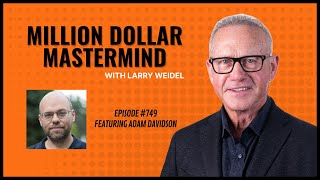
This is a podcast interview (Million Dollar Mastermind, Episode #749) in which Larry Weidel interviews Adam Davidson. Davidson describes moving to Charlotte, Vermont, and reviews career milestones: creating the Planet Money podcast in 2008 (launched the week of the 2008 financial crisis), building and leading the Planet Money team at NPR, winning awards (including a Peabody), and lessons about hiring the right people, sharing credit, and navigating institutional politics at NPR. He also recounts earlier work as a foreign correspondent and his path through public radio.
Welcome to this edition of the Million Dollar Mastermind podcast. This is where we pick the brains of high achievers from all walks of life and get their hard earned real world insights on winning. I'm your host, Larry Wydell.
Hello, Adam Davidson.
Hey, Larry, how are you?
I'm doing well. And where are you joining us from today?
I'm in Charlotte, Vermont. So a little bit south of Burlington in northern Vermont.
A little bit different pronunciation than the North Carolina Charlotte.
Yeah, I'm not, I think they're named after the Same King George 3rd's wife, Queen Charlotte or Charlotte, but for some reason we maintain the German pronunciation.
And so Adam, appreciate you joining us. And you know, in our podcast we talk about winning and real life experiences along the road, the highway of life. And we like to get people that have had success because that means they've made more right decisions than wrong, at least at certain times of their life. And from that you, you know, you kind of set patterns and that allows you to kind of compound your success down the road. But what's going to, what works for some, some people doesn't necessarily work for everybody. So we like to get as many viewpoints as possible so we can pick and choose and, you know, stay fresh basically and offer kind of some inspiration and hope to people are on the way up, a way of giving back. So I appreciate you taking your time and so talk to us about why in the world are you in Charlotte, Vermont?
Yeah, we moved here. I mean, in a way, it's a now familiar story. We came here early in Covid. We had been sort of quarantining with our son who was 8 at the time. And it was really rough for him, like it was for a lot of kids. And we had some friends who lived here who had been quarantining. So we thought it would be safe to pot up, as they said at the time. And we thought we were coming for a few weeks and then we thought, well, why don't we stay the school year? Because Vermont was doing. It seemed like a better place for an 8 year old to go to school than Brooklyn. And then by the end of that year, you couldn't drag us away. We just, I mean, I've only lived in big city, I've only grew up in New York, in Manhattan, lived in Chicago, Louisiana, lived in Baghdad for a while. So this is my first time out in the country, first time in a freestanding house, first time owning property because, you know, city people often don't. But I love it. I'm really I mean we're, we're out there, we're 30 acres of, you know, cow pasture and the nearest neighbors a 10 minute walk away. But it's, I love it. I'm surprised how much I love it.
Yeah, fantastic. Well, congratulations on that. And let's talk about, you know, what my job is on here is to put you in the, let people appreciate you in the most positive, powerful light so they can understand who they're listening to and kind of helps form a perspective with you. Look on your life. What would you, how in, in your opinion, what are the biggest achievements that you could point to that were maybe life changing Career, you know, breakthrough. There's always a thing. You know, we start, we always wonder if we're good enough and we have things we want to do and we fumble and stumble and then those of us who are able to work hard enough, get fortunate enough to get in the right circumstances to have some things compound, are able to have some achievements and along the way we learn things and a lot of those are powerful lessons that can be passed on. And so if you look at your life, what would you say coming up, up, you know what, what would you. Well, you can do it in whatever order, but what do you look at your life and you say, this is where I'm the most proud of this. This gave me the feedback I needed to know that I was on the right track and I could, I could make my mark in the world.
I mean there's a bunch of things come to mind. I mean probably the, the biggest thing would be creating the Planet Money podcast in 2008, which I left in 2013. And it's going very strong, more than a billion downloads at this point and one of the more successful podcasts of all time. And also kind of was a proof of concept of something I had believed was going to work, but than to actually make it work was pretty exciting. So that the, the whole idea was a pretty simple one, which is that most business reporting is pretty boring and alienating to people who aren't already engaged in, in the business that's being written about. You know, I grew up, my parents were artists and the New York Times business section was the, we grew up in New York City and the New York Times business section, you just kind of ripped it out of the paper and threw it away, you know, and ever looked at it twice and, and I remember as a young adult trying to read the business pages, read the Wall Street Journal and if you didn't already know what the Fed was or why the stock market mattered, or it. What GDP was and why it mattered. You know, it just. There weren't a lot of entry places. And I felt. As I became a business reporter, I became one just because I was broke and I needed a job. But then I fell in love with the topic, and I was really frustrated that my bosses, my editors, were making me be as boring as all the stuff I hated. And I just kept saying, I think we can make this stuff. It's like we gave up already. We just decided culture reporting can be fun and business reporting has to be boring and serious. And so I kept complaining and complaining, and I finally did something about it and created this Planet Money team. And probably the single smartest thing I did was not come up with the idea, but come up with the right group of people to build the team. And took me a long time to learn the lesson of hire the right people and get out of their way. I thought I had to boss them around all the time at first, which turned out to not be the right idea. So I'm very proud of that. And it, by coincidence, it wasn't our plan. It just happened to launch literally the week that the financial crisis launch happened in September 2008. So you're. Maybe some listeners aren't old enough, but I have a sneaking suspicion you might be to remember that week. It was crazy. We were like. It seemed like the entire world was about to end because of these weird financial instruments. And even the financial pros didn't understand them. So it. We happened to launch exactly, I think, when the world needed us. And I'm very proud of what we accomplished there. And it sort of led to every single thing I've done since then.
Well, you've hit the. You basically found a need. And I can remember, I won't say decades, but a long time. It took me before I could even understand the cartoons in the Wall Street Journal. And I made that my first goal. You know, where I could understand at least some of the cartoons a little bit?
And.
The problem with making financial news interesting has been a long one. I've got a friend who, Forston Overguard, who goes around the world doing Leica workshops now. But he started like you were, but he started over in Denmark, and they had him working for the paper doing profiles of all the executives, and nobody wanted to read anything. So he started taking his camera along and taking pictures everywhere. He could put a picture in there. And from that, people said, how do you take your pictures? How do you make your camera work? And so that gave him another career, you know.
But that's great.
Yeah, but the thing is, he ran into the same problem you did. And so at least you were thinking and you were noticing the issue. Now, how much problem was it to pull that off, you know, to make that happen inside, you know, where, what, what institution did you, was that inside the paper or the magazine or.
That was inside of npr, National Public Radio. And it was, I'm still shocked we pulled it off. I mean, you know, NPR is a wonderful place in many ways, but it's also, you know, it's a nonprofit. It's very bureaucratic. And so they don't like change, they don't like new initiatives and, and, and even more so NPR is the national entity, but, you know, each, the content, the, the radio shows go out over member stations, over 800 or something stations around the country and even some around the world. And so the member stations were extremely powerful and they were not interested in supporting. We were a digital first team. So we were the very first real podcast that NPR did. So there was deep political and not, not like Democrat, Republican political, but office political antagonism to US Turf. There was turf battles and then there was also just kind of the inertia of any large institution. Like I wanted to do things in a different way and people didn't want me to do things in a different way. And I probably, I go back and forth on this. To be honest with you. I could be a real jerk. I mean, I was a real like bull in the China shop. I was on a mission and I, you know, I had arguments with people, I had fights with people. I really, it was public radio, so everyone was more or less nice. It wasn't like yelling and stuff, but it was, it. I lost. I bet you there's a whole bunch of people who hate my guts from that period. And some sometimes I do have real regrets about that. I would love to have found a way to do it. Being a jerk. At the same time, I'm not, I'm genuinely not sure it could have been done. Being polite, like, it, it just. So I don't really know where to land on that one. I don't want to be that guy again. It was hard on me, hard on my wife, hard on the people I worked with, because I was really on a mission. I was not messing around.
So how long did it take from the conception of the idea where you started, you verbalizing it and then you actually had your first on air podcast.
So it was about probably eight months of like Building a constituency around it. And I was lucky to have a great boss, Ellen Weiss, who was then later fired because the system didn't like such people. Not fired because of me, but, you know, who really backed me up. So I did have that. I had her, like, giving me kind of political cover and support. And. But she. In the beginning, she's like, I can't just let you do this. I'm gonna give you three weeks away from your day job to come up with a more comprehensive plan. So I had three weeks to really flesh out. Here's how I'm gonna do it. And then she liked that plan enough to say, okay, you've got a month to start putting a team together and try and execute it. And then I did well enough on that that she said, okay, you can add a couple people to your team. But it was like that. It was week by week, or certainly month by month for, like, the first year. I mean, we were winning. We won a Peabody Award. We won a Columbia DuPont Award, a polka award. We were like, what's the big deal.
About a Peabody Award?
I. I think it's the most prestigious award. I mean, it's like, so unlike an Emmy or a Pulitzer. It goes to entertainment and journalistic media. It's all broadcast media, so audio or video. And so it's. I don't actually know. Just when I say I go on a Peabody, people are super impressed. So I say it a lot, but I don't. It's. It's University of Georgia.
You talk to people inside the industry, but outside the industry, if you're not. You know, it's kind of like in sports, there used to be. The guy that trained me in financial services won the Hickok belt in 1958. Bullet Bob Turley won three out of four games in the World Series. You know, one is a reliever, two as a starter.
Yeah.
And so that made him the winner of Professional Athlete of the Year of all sports. You know, and it sounds like, you know, it wasn't just like, a Cy Young or, you know, what, you know, NBA MVP or something. It was like, for all sports. And it sounds like the Peabody might be a similar type award.
For those of you who are sick and tired of fooling around and are dead serious about wanting to move up fast, I've got something especially for you. I've combined the best insights from over 40 years in business and making $70 million in income and compressed them into a free webinar. That's right. It's a free resource. If you want to find out exactly what the concepts are that I use in coaching machine million dollar earners. Register now at widel on winning.com you'll discover the five part framework used by so many to reach their financial, personal and professional goals. You can find that link in this episode's show.
Notes.
I think it's a similar type of word like, like, you know, like. And it's also not, I mean it will be for a specific set of shows, but there's a bit of like lifetime achievement aspect to it as well. So it's, you know, the Emmy award for entertainment TV is, you know, that is, you know, I mean, it's great to win an Emmy. I'm sure I'd love to win an Emmy, but it, and I'm not. That might be more prestigious than a Peabody, I don't know, but. Or the Pulitzer Prize for journalism, which now does honor audio. It didn't at the time is pretty cool, but this is like Stephen Colbert and the Saturday Night Live and people I wouldn't normally be competing for an award against are up for it. And the best journalists are also up for it. So, yeah, it was cool. It was really exciting.
Now how far into the podcast did that come?
Come? That came pretty early. Like a year. A year?
Yeah. Pretty significant.
Yeah, very significant, yeah.
Now what did that do for you and for the show?
So.
The.
I, I think that, I mean, the show continues. So I left in 2013 and the show basically continues much like when I left it. I mean, it's the same size, same number of people, same number of shows. And that's kind of a bummer to me, to be honest with you. I felt like we had cracked something that could have allowed for, you know, podcasting coming into broadcast radio. You know, it's like, you know, the Internet, coming to newspapers or streaming, coming to TV or whatever. It's one of these like massive disruptions. And I felt like we had developed a whole way of thinking about how to produce digital first shows, a whole way of thinking about how to cover complex topics and that it should, you know, I always thought it should be the beginning of a whole, like a production studio, a whole approach. But again, I mean, to this day, NPR is kind of stuck in this world where the member stations rule the ruse. So I, I always joke that it's like if the New York Times was run by the newspaper delivery truck drivers, they probably wouldn't have a website. And, and it's a bit like that. So I'm very proud that it continues. I Find it a little confusing that NPR has one of the most successful podcasts ever and doesn't do more with it. Doesn't see it as. They don't kill it, they don't grow it, they just leave it be.
I'll tell you why. Okay. Nobody there has ownership of it.
Nobody has ownership. I think that's true.
And so that's why, you know, one of them had a great idea about how we could, you know, use it or something. Then, you know, take. Have a reason to take ownership of it. Things. Things might start to spiral. Maybe. Maybe you should start feeding some ideas to some of those people.
Right, right, right, exactly.
Like, here's what you can do with it, you know. You know, here's how you could get some real cred, you know, here's how you could get more Peabody, you know. Right. There's more Peabody sitting.
I think that's exactly right. Yeah. And in fact, one of the big lessons learned, and it took me a while because I was, as you remember from two minutes ago, I was kind of a jerk. And I realized I need to let more people, like, I had kind of set things up where my success was someone else's failure. And.
How was that? How did you do, you know, when you look back at that, what does that mean? How did you do that structurally?
By. I would, you know, I would. I would make it, you know, I'd say we need, you know, we need more staff or we need more money or we should do. And anyone who objected to it, I would really hammer home their. Just, they don't understand the future. They're not understanding this and that. We were in a weird place where, because we're a digital product and this gets. I mean, this is the weird idiosyncrasies of npr, but I think this is true of any large organization. Budgets were either radio budgets or digital budgets. And we were like, kind of both and kind of neither. And as a result, our successes didn't really accrue to anybody higher up in the organization. It was so associated with me. I had so thoroughly made clear, this is my baby, this is my thing. It's not your thing. That if I succeeded, I got all the credit. And if there was some kind of. There wasn't any failure, but anything, any issues, that was sort of on the bosses. And so later in my leadership there, I did clue in, like, I got to give other people some wins here, or else I'm not going to have any allies. Everyone's gonna hate my guts. And so I did try I did make a concentrated effort of making it really clear it was a team effort, making sure, you know, in front of vice presidents, telling the CEO how helpful that vice president, you know, oh, it couldn't have happened without that person, that kind of thing. And that did help me quite a bit. And then eventually I realized I needed to follow. So we eventually just fell under digital because I realized on the one hand I liked being this kind of orphan because it meant I didn't really have a boss. On the other hand, it meant nobody won if I won. So I wanted to share the winning more.
Now, how long had you been with NPR when this happened?
I'd been there about five years. I'd been in public radio at that point for 15 years and, you know, member stations in Chicago and then other shows, but, but at NPR proper. So in Washington, D.C. for about five years.
Was it a big coup to get picked up by npr?
Oh, yeah. No, I, that was, that was the dream for a young. So I, I had been, you know, and this, the world has changed quite a bit since the 90s. But when I was starting out, you know, if you were in radio, you started a local station or tv, and then you hope to get to the national. Same with newspapers. You know, you start at the, you know, small local paper, then you get to a regional like the Atlanta Journal Constitution or something. Then you get hope to get to the New York Times or the Wall Street Journal. And so it's a similar thing where I really from basically graduating college. And now the one thing that was weird about my career, because I think this is more common now, but in the 90s, it was not common to be both print and radio. So I kind of flipped back and forth over my career between radio and print, which was unusual. But, yeah, that was my dream. I went to the Middle east, so Plant money launched in 2008. So going back to 2002, I got this job at Marketplace, which was a public radio show but not an NPR show, and I became Middle east correspondent. And in journalism, being a foreign correspondent can be a wonderful way to kind of jump up a few notches because, you know, foreign car spot, you're sort of, you're, I mean, you're given some support, not a lot. You're given some training, not a lot. And then you have to, you know, go to some country, figure things out, make it happen for yourself. I mean, it depends, you know, if it's the New York Times or something where they have a big bureau. You're, you've got a whole infrastructure, but I didn't have anything. I was just figuring it out. Actually, when I got to the Middle.
East, you were over there.
Sorry, go ahead with.
Who were you over there?
Marketplace Radio. Richard Engel from NBC was my backup. He was my support. Now he's a much.
So you land in Bangkok and you're supposed to send in articles on business news or something.
Yeah, Baghdad. Baghdad. Yeah. I started in Jordan because we were waiting on the war. So I was waiting for the war. I got there around Thanksgiving 2002 and, you know, and I would do some stories like it was wonderful. I got to go to Lebanon, Syria. I traveled around Israel, Palestine.
Thanks for listening to the Million Dollar Mastermind. If you felt there were any valuable takeaways from this episode, please take a minute and leave us a five star review. Your feedback is important and really helps us get the word out to a wider audience. Remember, we have a valuable webinar that is absolutely free. Register for it right now@whiteallonwinning.com thanks for listening.
More from Larry









Rick Jordan on Self-Engineered Proximity, Cyber Security Moats, and Truth-Based Leadership

Fire Fast or Fail Slow: Kevin Brittingham Reveals the One Rule That Built a $100M Empire
