Episode #750 - Balancing Vision And Adaptability with Adam Davidson, CEO of Masterful Storytelling
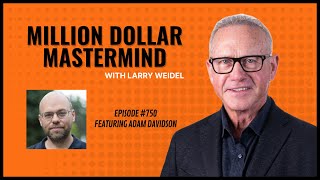
Adam Davidson talks about his path from Chicago local news to The New Yorker, including his work reporting in Iraq with local fixers and covering currency traders. He emphasizes writing constantly and accepting the insecurity of early career stages as essential to getting better.
Foreign.
Welcome to this edition of the Million Dollar Mastermind podcast. This is where we pick the brains of high achievers from all walks of life and get their hard earned real world insights on winning. I'm your host, Larry Wydell. Talk to people and you would, you would hear things happening and then you would follow up or how, how did that go? How does, how, how does someone on the ground be successful in that, you know, you're thrown out of a plane into a foreign country, different language, different, everything's different. And then, yeah, it's, you have to make sense to send back to the people back home something valid. So how do you do that?
So one person a journalist relies on a lot is what we call a fixer, which is like in a foreign country, we'll hire a local who can be our translator, often our driver, but also knows people there are different fixers. So some fixers are kind of the full package. Some are really plugged into, say the political leaders or the intelligence officials or the military leaders. Some fixers are just terrible at their jobs, but they usually don't last very long. So when a journalist goes abroad, one of the very first things they'll do is they'll call people who've been to that country and say, do you have any good fixers? And a good fixer is a precious, precious commodity. So that helps a lot. It's almost like cheating because depending on the fixer. But then, although I didn't have a fixer when I got there at first, and so, and it depends on the publication, you know, how marketplace was more interested in what we would call features than hard news. So they weren't expecting me to be the first person to report that Jordan has signed a memorandum of understanding with the US military to allow troops stationed there or something like that. That would be something like a New York Times person, like the Washington Post person and the New York Times person are competing for these big scoops. At that time, I was not really competing for scoops. It was more what are some articles that can bring to life? So I did a story I remember on. I found this fascinating. A bunch of there were currency traders who were waiting for the war to start and there was this kind of complicated currency trade where there was the Iraqi dinar under Saddam, but then the Kurds in the north used an older Iraqi dinar because they were sort of autonomous, so they had a different currency. And then there was the US dollar and there was sort of this active trade. It doesn't matter what the details are. Doesn't matter. It just the way you traded indicated who you thought was going to win the war. So if you thought Saddam was going to win the war, then the Saddam dinar would be more valuable. If you thought the US was going to win a war, the Kurdish and dollar would be more valuable. And I was interviewing these traders who were telling me, oh, Saddam's going to kill the American. They were real like Islamist supporters, you know, America's going to be destroyed. This is going to, Saddam's going to win. And then I was like, but look at how you're trading. You're trading based on America's going to win. And this guy got very mad and said, that's business I'm talking about. And I was like, you know, it was kind of a funny story. I did another story later when I was in Iraq about how they had revalued the Iraqi dinar. So it had not under Saddam there had been so much inflation and they just had these small bills. So to go to the supermarket, you'd need like a giant bag full of dinars to, you know, It'd be like 20 bucks or something. And so then the Americans reprinted the dollar, the dinar with, with higher value currency and suddenly Iraqis are buying wallets. Nobody had had a wallet in, you know, 20 years or 15 years because.
There was no need replace the paper bags, huh?
Yeah, exactly. And so I did a story about that. So they were like fun stories, but the idea was to get at deeper issues. And I did break some stories. I did do some.
Here's something I'm curious about. Coming out of school, I get the idea you always knew you were going to be a writer or wanted to be a writer, Is that correct?
Yeah, as long as I can remember. Yeah.
So now you get out. And when did you start noticing what successful writers, the pattern to people who were successful in this field versus people who weren't, you know, things they did to be more focused, to be more efficient, to, to get more interesting articles, to be able to, you know, how much schmoozing with the, the bosses and how much, you know, what, what was involved in that. Did you get some. Were there role models out there that you gravitated to or that you learned from and picked up some trends, or do you just dive in?
Yeah, I think of a bunch of people. I mean, I think, I mean, one thing that comes to mind right away is. So I started in the local station in Chicago and I produced live talk shows. So, you know, like a host interviews guests and I'd find the guests and put. And I enjoyed that a lot. But that it's. You know, it wasn't what I wanted to do forever. I wanted to be a writer. And my best friend at the time was actually a playwright. And he. I would call him and complain about how I wanted to be a writer. I wanted to be a writer. And one day he just snapped at me, and he said, everyone we know wants to be a writer. Everyone wants to be a writer. Do you know what writers do? They write. And you talk about writing, but you don't write. You gotta write. And it sort of, like, kicked me in the butt. I actually quit my job with no plans, really, other than I'm gonna write. And I was, I think, 26, 27, something like that. And I. It probably wasn't the wisest thing. Like, my son's only 12, but if. If he does something like this, I'll be scared for him. I won't be happy about it. But I suddenly needed to write to pay my rent. I didn't have. And I wrote everything. I wrote for the Chicago Tribune. I wrote for a bunch of magazines. I wrote for Rolling Stone, But I wrote a manual for a paper shredder. I found a job doing that. I wrote a course for an insurance company on how to be an insurance adjuster. I had this one project that was sort of funny that the Air Force was building some new command kind of center, and they needed. It was going to have, like, an encyclopedia embedded in it about the world. So if you're. I mean, I didn't know what they were doing because I didn't have security clearance. But you're deciding where missiles should go or something, and you're suddenly like, what's the capital of Syria? Or something. But the actual encyclopedia was classified, and they didn't want to put it in it. So I had to write essentially a fake encyclopedia just for the demonstration of this, which was actually kind of fun. It was before Wikipedia. I would just kind of. I mean, I think it had to be factually accurate, but they didn't really care what I wrote. That was actually a fun project, but I just wrote like crazy. And that same friend of mine, he would teach writing, and he just said, when you're young, just write. And I tell young people this all the time, if you want to be a writer, write. Write badly. Write a lot. Don't sit around thinking, what's my voice? What do I have to say? Just type, type, type, type. So that was a major lesson, I think I was probably overly insecure for a good period of time, I was probably overly cautious. Maybe that's a little bit why I became overly arrogant when I did start finding my voice.
Watch out for, by the way, is where, you know, we go through here. People, you know, they listen. I like to point out things that. That's kind of a pattern, actually, Adam, that, you know, you. You get in a feel where you, you feel like a fish out of water. You don't know who, what, or where. Then you learn who, what or where. Then you bore everybody to death telling them who, what and where because you're so proud that you've learned it.
Yeah.
And then you, then you have your first success, and now you think you're an expert because you think you're always going to have successes and your education doesn't really begin until you have your first belly flop.
Yeah. And I've had a few of those. We can get into that, too. Yeah, Exactly. I'm now 53, and I'm in a phase of life where I. I'm very aware of what I'm not aware of, I think. Yeah. My wife, when we were in Iraq, I fell in love with my wife there. She's an American journalist, too. And we, we were there for a year, which very few were in that early stage. So we were some of the longest tenured journalists in that first year. And she said you could always tell how long a journalist has been in Iraq because when they get off the plane and they arrive, they know everything. You can't tell them a thing. And then after a week or two, they're like, huh? It's a little more complicated. And after a month or two, they're like, I have no idea what's going on. This is so confusing. And I thought, that's a good life lesson.
That's. That's a good life lesson right there. Very, very astute on your wife's part now.
Yeah.
Would you say, coming up, the, you know, you're writing and what would you remember as the first big writing success that followed from that? You know, like this put you in a position to have your first big significant writing success? What would you say that was?
I mean, it's funny. Cause when you're starting out, I mean.
Just.
The first thing I got published in the Chicago Tribune, so the first thing I'd publish in a real proper newspaper where like, the printing press printed it, was kind of a nothing. It was a little book review in the book review session. But I remember there's a bar, the Billy Goat Tavern, that was the big journalist bar in Chicago. And I remember. I mean, I don't know if I've ever been prouder of anything in my life. Like that first, you know, that first moment. And there was an older guy who really mentored me a lot in those years who, I mean, just really celebrated with me, even though he had. I mean, this would have been nothing like, you know, he was wildly more successful. But that was. I'm not sure anything's quite matched that for like, holy crap. I went from someone who's wanted to be published in a newspaper to someone who's been published in a newspaper. That was really exciting.
Well, I guess it's like a musician that first time they hear their song on the radio or something similar.
Yeah, yeah, exactly. Yeah. Every musician can just have that experience.
Remembers the comedian the first time they were on TV with Johnny Carson or somebody, you know, Jimmy Fallon.
Yeah, yeah.
So now.
Exactly.
So you were gonna say after that.
And then after that there's a series of steps. So then that was a small thing in the arts and culture section, but I wanted to be a magazine journalist. So I went on to the Chicago Tribune and I got to magazine, and that felt like a big step up. And I had. My first feature article was about accident reconstructionists. So there's like a big car accident and there's a big lawsuit and they hire these traffic engineers to. Oh, wait, that wasn't my first one. My first one was about the Encyclopedia Britannica, I'm now remembering, that had just gone digital, actually. And so that. Then I went from writing a 600 word book review to a several thousand word feature. And that felt like, holy crap. And then your first national magazine article, which for me was an architecture magazine called Metropolis. Then your first sort of top level magazine article. So I had something in Harper's Magazine, which at the time, it's kind of diminished, but at the time was pretty special stuff.
Yeah, very big.
And. Yeah, and then the first New York Times magazine article. So each of those. And then I had similar successes with radio, where I had my first this American Life, which is a big radio show.
Well, you know, one thing I'm hearing that I'm going to insert here, that strikes me as interesting, even as something as far away from writing as golf. There's a parallel, and that is if you play golf, what you hear all the time is, you know, what's your handicap? Well, I'm a 20. And then I'm trying to get it down to a 15. And then I get it down to a 20. And it's like, when's enough? You know, why do you keep, you know, you know, you could beat all your friends. You're great at your club. You, you, you won the last member member tournament. You know, what's enough for you with the golf? And it's like you're always, you know, you, you know, the fun of life is continuing to climb the ladder. You put a kid at the bottom of some stairs and they want to keep going up. And it's interesting, this parallel to you. You get out there and you prove yourself in the writing world. Well, I prove this. What's the next step? The next step. It's a progression, right?
Exactly, exactly. And, and I would say, I mean, part of it is just practical. There's just more money at each step. But part of it is, I'd say more than that. It's, yeah, it's, it's a personal, like, I want, Can I do it? Can I play with those people? Can I play with those people? And, and, and that, you know, continued until I got to the New Yorker, which, you know, in, in magazine journalism is sort of the top of the heap in the United States. And, and then, I mean, actually I, I dreamed of being at the New Yorker. It was all like. And I got there in my mid-40s, so this is much later in the story.
Yeah.
And I had a great run there, but I eventually quit and it no longer was exciting to me. And then I really had to. I mean, this happened since I've been in Vermont, so it's just the last three years, I had to really rethink my life because I, that was the hill I was climbing, was from where I was to the New Yorker. And then I climbed that hill all the way to the top. And so I'm looking around for the next hill.
Thanks for listening to the Million Dollar Mastermind. If you felt there were any valuable takeaways from this episode, please take a minute and leave us a five star review. Your feedback is important and really helps us get the word out to a wider audience. Remember, we have a valuable webinar that is absolutely free. Register for it right now@whitealawnwinning.com thanks for listening.
More from Larry









Rick Jordan on Self-Engineered Proximity, Cyber Security Moats, and Truth-Based Leadership

Fire Fast or Fail Slow: Kevin Brittingham Reveals the One Rule That Built a $100M Empire
