Episode #751 - Vision And Leadership In Business Success with Adam Davidson
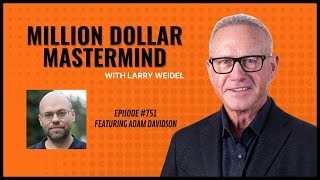
This is a transcript of Episode #751 of the Million Dollar Mastermind podcast (January 2024) in which host Larry Weidel interviews Adam Davidson. Davidson reflects on leadership failures and lessons: interpersonal arrogance early in his career, losing a podcast company (with Sony investment) that went bankrupt and cost $9 million (2019–2021), strategic mistakes (over-investing in highly produced shows at ~$46,000 per episode), insufficient KPI/OKR monitoring, and letting his team drift from his vision. He also recounts helping on the film The Big Short (advising on financial jargon and working with actors like Brad Pitt) and mentions his book The Passion Economy. The tone is candid, self-critical, and reflective.
Questions this video answers
$9 million
2019–2021
$46,000 per episode
About 500,000 listeners
The Passion Economy
Foreign.
Welcome to this edition of the million Dollar Mastermind podcast. This is where we pick the brains of high achievers from all walks of life and get their hard earned real world insights on winning. I'm your host, Larry Wydell.
Now, when. Where along the way did you get your first significant belly flop?
You know, it's funny, Plant money is both my greatest success, but in some ways I do look back at it as some, as a bit of a personal. As bits of it. I don't want to overstate it because I'm very proud of myself and it. But I really don't like who I became for part of that so that, you know, I had external success.
When did you realize that? When did you realize that? At what point? And was there an incident or something where, you know, you hear about the guy that, you know, he drinks a lot and then he drinks more and then all of a sudden he has a. Comes home from a party and runs into a tree and he said, okay, that does it. I got.
That's rock bottom.
Yeah, I've struck bottom. So what, was there any incident or something like that or just over a feeling came to you over time?
Yeah, I think a few things come to mind. And I do want to be clear. I was not like, right. Like, you know, you hear about these horrible stories, like, I don't think I did anything fireable.
Or you weren't throwing, you weren't throwing bowls of cereal up against the wall when the secretary brought it in and it was cold milk rather than warm milk like we've had. Right, right, right. Like we, we had a CEO did that once.
But yes, no, I was not throwing anything. I was not, I was definitely not being inappropriate in any way. It was just, I had a boss who said to me, adam, I keep hearing that people think you're arrogant. And I said, oh, I know why that is. It's because I think I'm better than them and I make sure they know it. And I think I kind of liked that for a while. I liked feeling cock of the walk the big shot, like, I'm the best guy around here. You know, there's. But there are a couple incidents. So one incident was just, we had a meeting with the whole team and it was to promote a new idea. We wanted them to do something different. And I had this thing about people being late to meetings. I just found it disrespectful and infuriating. And so the meeting was supposed to start at whatever it was, 2:00 clock, and people kind of rolled in around 2:05. It wasn't like they were 40 minutes late. They were like five, you know, just. And I just started yelling, like, do you know how hard I've worked for this meeting? Do you know how. And you don't even have the decency. And I don't even remember what the initiative was, but it just ruined the day for everybody. It just meant. And I think, and I hate to admit this, but it was a realization that I'm not gonna get what I want that way. Like there. Yeah. Then I had a smaller moment where one of my reporters, who's really brilliant, was. I was telling her how to do a story. Like, I was like, you should do it this way and this way and this way. And she just finally said, your idea is probably better than my idea, but I can only do my idea. I don't. I can't do your idea.
She was pretty smart.
She was pretty smart. And then, then I realized I was really intimidated by her, that she was better than me and I couldn't. I had to learn to be okay. Now later I learned, like, it's great when you. Your team is better than you. Like, that's the best possible situation. But that I remember, like, really just being jealous and threatened and upset that I, like, almost like she was being better than me at me. Like, she was attacking me with her goodness. And I'm just. And I had to learn to not only accept that she was better than me at a lot, but that. That's great. So that, that was a big. But my biggest belly flop was I started a podcast company, Sony Music invested in it, and I lost $9 million of their money and the company went bankrupt. And it was all my fault, 100%. So that. That, that happened not that long ago. That. That was like 2019 to 2021.
And how did. Looking back on that, where would you say was the fork in the road that you took or that got you off track that set the pattern going in the wrong way? Was it right from the beginning or halfway through it?
Yeah, I remember right in the beginning, a friend being like, you've already. He was kind of being a smart ass, but he was like, you've already ruined this company and you don't know how. And he was right, actually. And. And it was a combination of things. I mean, we. The whole podcast industry, as you probably know, has changed a lot in the last few years. And, and, and so, I mean, along with Sony, I had developed a theory of the case, like how we're going to succeed. And it was really all about really expensive, highly produced podcasts. And our theory was that there's going to be so many new podcasts that only the really highly produced ones are going to succeed. And that had been true that, that highly produced, I mean, like where you, you know, you're editing them for months sometimes. I mean, they're really like more documentary than podcast. And that had worked. That. That was Planet Money. That was this American Life. That was cereal. That was. And I think what we hadn't understood, I think we fundamentally misunderstood the medium probably in a way that you do understand it, that people like an immediacy in podcasts. They don't. It's not, you know, people don't seem as drawn to those kind of carefully produced shows, but also they're just crazy expensive. I mean, our average price per episode was 46,000 DOL. Wow. I'm guessing you don't spend $46,000 on each episode. You certainly haven't offered me 46,000. Yeah, and that just puts a pressure on because we were still just ad supported. Like, if you're less than 500,000 listeners, you're not breaking even.
Right.
And we weren't getting anywhere near 500,000 listeners.
It's hard to get off. It's hard to get on the on ramp onto the Interstate and have 500 listeners.
Yeah, exactly, exactly.
You have to build to that. Is that right?
You have to build to that. And so. So there was a fundamental bad strategy, but that's survivable if you've built an organization that can adjust strategy. And I hadn't done that. I had really built a team that really could just do this one thing and could not do another. And then I hadn't really built. I was so obsessed with not being a jerk. I was just obsessed with it. I went to anger management training. Like, I really wanted to be a good guy, which is not a bad thing. I'm not against being a good guy, but I had a content vision which was basically like, let's do business shows that are more accessible but more, I mean, kind of like what you do more. Like, Planet Money is a news, a business news show. I wanted to do, you know, more news. You could use, like, shows that would be useful to business people. But I hired a bunch of young people who didn't want to do that. They wanted to do other things. So I let them do what they wanted to do.
Oh, no. Oh, no. Yeah, the pendulum swung the other way.
Yeah, it ran completely the other way. And I Just, and I just allowed. So I had the wrong strategy, but I also had the wrong tactics, you know, and, and I had the wrong leadership model. And, and it's not, oh, I should have been a jerk. That's not the answer. But the answer is I should lead. A leader should lead and shouldn't. Like, probably the team wanted leadership. They don't, you know.
Yeah. And the leadership thing is you got to get results, you know, and even if you go, you know, the thing is if you go overboard and you're a jackass, at least you can apologize. But if you get, if you get the results, you still live to fight another day. But, you know, what I'm saying is I used to say I'm happy to do a lot of apologizing, but the one thing I'm not happy about is failing.
Yes. Yeah. And then the last thing is we just weren't monitoring KPIs OKRs. We just weren't. We knew the numbers. So we would look at our audience numbers, we'd look at our revenue numbers, but we weren't scheduling in, like real bottom up review. We sort of were on autopilot.
Okay.
With this strategy. And I was kind of waiting for someone else to do it. I was sort of. And so by the time we really sat down and looked at the numbers like it was, it was pretty much game over already. Like, and we could. Now part of that is that it was Covid. Like we were, you know, we were 2020 was really challenging because we had built a whole portfolio of shows, all of which were undoable in Covid because they were all basically flying people around to go interview people. Yeah. And so we had spent, you know, the last. We'd spent six months in 2019, early 2020, building a whole portfolio of shows. Then we had to spend just as much time undoing a bunch of shows because there were all sorts of contracts and legal issues. And then we had to build some Covid friendly shows. So it's not, it's understandable, I think, that I lost that I didn't. I'm not trying to give excuses. Like, I, you know, I think a good leader could have walked and chewed gum at the same time. But sometimes when I tell the story, I almost feel like, is it even believable that someone would be this bad a CEO? But.
Oh, yeah. Oh, yeah, yeah, yeah. Oh, yeah.
But it was, it was end of December when, like, I called for, like a thorough review of all our base assumptions.
What do you think your friend saw that early in the game that was a red flag to him. You thought about that?
Yeah, actually, I never have. That's a really good question. If I had to guess, it would be that I was too quick to give up my vision, that I. That I was. I mean.
Yeah, that would resonate with an outsider, you know?
Yeah.
He knows you. You probably told him other vision, this and the other. He sees you're off track. Like, that would resonate, I think. Yeah.
Because when he would ask me, like, what I was up to, you know, I'd say, well, this person wants this and this person wants that, and Sony wants this, and. And in a way, like, who cares, right? Like, if. Or like, that's information, but that's not.
Yeah. What everybody wants is at bottom line is a win, and you're really the only one who can make that happen. Yeah.
And it also, like, it's self defense, you know, it's like dating someone and just whatever they. Oh, I like classical music, too. Oh, you like jazz? I prefer jazz, yeah. Oh, you're a vegetarian? I'm a vegetarian. Oh, you want steak? I'll eat steak. You know, it's just not an appealing person, you know, and then you break it back.
It becomes obvious. It's a nose in your face. Like, trying to please all the people all the time, you know, becomes like, oh, that's what I was doing. You know, that's.
Yeah.
And. And, Adam, that's one of the benefits of what comes from having these shows where you're talking about winning is a lot of the times the lessons are right in front of you and you just don't see them. You know what I'm saying? In fact.
Exactly.
They're probably lessons that you wrote a frigging book on.
Yeah, exactly. Actually, literally, by the way, literally, I wrote the book the Passion Economy, which is about how to succeed in business. You need to have a distinct, unique vision, and you need to pursue that vision. And that at the core of any business is how do you uniquely add value to your customers? So, yes, I literally. I had never thought of that until this moment, but I literally wrote the book on it, and I couldn't. I mean, if you read the Passion Economy, it's like, how not to do what Adam did. You know, that is exactly. I had never thought of that. That's funny. And now I talk because I have some time. Like, I'm able to talk about all this. I'm able to laugh about it. I'm able to see it with a kind of clarity. It's not even a mystery. But obviously, I mean, I went through incredible embarrassment, shame, despair, anger. One really tough thing about being a CEO is there's just nowhere to hide. Like, I wanna blame others. I wanna blame this one and that one. And it's not that no one did anything wrong. It's that I built that team. I structured how that team was gonna work together. I made all the key decisions and I need to own that. That is my. Like, I can't move. You know, my son's 12. I'm constantly talking about that with him is because, you know, like a lot of kids, oh, it's not my fault that broke. And it's like, you don't have to, like, flagellate yourself. You don't have to be miserable. You're not going to prison, but you gotta own it. You gotta own your mistake.
It seems like in the career you've chosen, you get involved in a whole lot of things, you know, for, you know, here we took podcast, book, working around the world, magazines, you know, different, moving up the ladder and. But I see on here your one thing is you worked on the, the movie, the Big Short.
Yeah. Yeah. That was amazing.
What was that experience like? And what did you, what did you learn from that? Why did they have you involved in that anyway? Because you were a financial guy.
Yeah, my brother Eben is a Hollywood guy. He works in Hollywood and he was at Paramount Pictures at the time, which produced the. Put out the Big Short. And he had a meeting with Adam McKay, who was in the early stages of writing and directing the Big short. And Adam McKay was talking about, you know, he's. He's doing this movie, he doesn't fully understand all the finance stuff. And, you know, at the time, Adam McKay had, you know, he was famous for. He was Will Ferrell's creative partner. So he'd done Anchorman and Talladega and the other guys. And, and, and so my brother was like, oh, you should talk to my brother Adam. He knows that finance stuff. And Adam and I, like, we arranged a phone call and Adam McKay and I, and it was the kind of thing, I think he thought I was going to be some boring Wall street guy. And he was just going to ask a few questions. I thought he was going to be a dumb Hollywood guy who was going to. I'd had other calls with Hollywood people who didn't really actually care that much about, but we hit it off big time and we're actually still very close friends and have worked on other things together. But as he was writing the movie, I was Sort of his ongoing resource on what's happening. If you remember, in the movie, there's all these different teams of people who are basically taking all these views on these very complex financial instruments. So I would basically just. McKay's super smart, but he just wasn't deeply. He didn't know that material well. And I knew it very well from my time covering the financial crisis. So I would just walk him through all that. Yeah, and the jargon. I mean, I feel like a lot of it was translation. It was like. Yeah, and I actually did that on set too, because the actors, you know, it's like acting in a play in Turkish when you don't know a word of Turkish. Like, they, you know, if you're suddenly saying, you know, well, I'm worried about the, you know, the mezzanine tranche of these collateralized debt obligations. If you don't know what any of that is, like, where do you put the emphasis?
Exactly?
How do you feel about this? You know, So I worked with the actors, like, translating it. Brad Pitt, who was awesome. Everybody, all the actors were so professional. So, like, generous and nice. I mean, it was amazing. It was really one of the great experiences of my life. And so Brad Pitt was sort of accidentally. We had given him some really long technical lines. And so we were sort of rewriting the lines on the fly, which was really. There's tape somewhere out there of Brad on set going, Davidson. So it was. Yeah, it was. It was a great, great experience. I loved it.
Thanks for listening to the Million Dollar Mastermind. If you felt there were any valuable takeaways from this episode, please take a minute. Leave us a five star review. Your feature feedback is important and really helps us get the word out to a wider audience. Remember, we have a valuable webinar that is absolutely free. Register for it right now@whiteallowinning.com. thanks for listening.
More from Larry









Rick Jordan on Self-Engineered Proximity, Cyber Security Moats, and Truth-Based Leadership

Fire Fast or Fail Slow: Kevin Brittingham Reveals the One Rule That Built a $100M Empire
