Episode #752 - Embracing Failure: Navigating Risk In Organizations with Adam Davidson
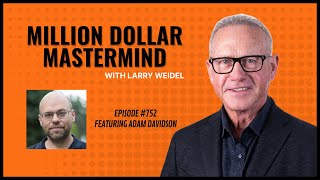
Adam Davidson built a company with Sony, watched it collapse, then became a consultant and CEO of Masterful Storytelling. He argues that CEOs are lonely, failure teaches you more than success, and leaders need regular reflection through journaling or coaching to stay effective.
Welcome to this edition of the million Dollar Mastermind podcast. This is where we pick the brains of high achievers from all walks of life and get their hard earned real world insights on winning. I'm your host, Larry Wydell.
Now, you've got a zillion followers on you're not Kardashian level, but you're highly followed on Twitter and LinkedIn. I didn't get a chance to go to Instagram or YouTube. We just looked at those two. But you got a lot of people follow you. Why in the world do they follow you? This is just accumulation of people who know you from all of these years. And why do you think that you're so popular in social media?
I think it's my looks, I'm assuming as a heavyset bald guy in his 50s. I mean, I think, you know, at different. It's actually a little, it's a little misleading in that the way I look at it is it's several different audiences because it's. Because I would see my posts, my follows go up. When I'm reporting on the financial crisis, reporting on inflation dynamics. For a while at the New Yorker, I was very much reporting on Trump's business and had a lot of, I broke some stories there that got a lot of attention and then. But I've noticed it like when my book came out, it was actually harder than I thought to use that audience because I don't know how many of them are, you know, I think it's overlapping or distinct audiences. In a lot of cases, I've sort of gotten off Twitter. I just find it, it's become quite toxic, I think. I mean, that's not an original thing to say, but I'm Fairly active on LinkedIn and where I'm more just, you know, and, and these days my, my life is. I, I made a decision. So when I moved to Vermont and then my company imploded. Actually, this might be interest. I mean, so when I was running the company with Sony, the idea, and it's a model they've done many times with others was I, Sony gives the money, I give the know how we build a company together and then in about five years Sony buys it from me. And we would do all these estimates and, and of how big the company would be and sort of the low end was I would get 10 million. The likely end was I would get 100 million. And it felt like a billion wasn't impossible. When we would do our numbers based on our theory of what was happening and the growth of the Podcast industry. And I sort of had in my head, this is another big mistake. Well, worst case scenario, if all I do is just follow the trend, I'm going to get rich. Like, if I don't even beat the trend, I can get rich. And so I sort of in my head was like a guy who's about to be super rich. And my wife was actually upset about it because she's like, every super rich kid I've ever met is a loser. And I don't want our son to be a loser. So she actually wasn't sure she wanted me to get super rich. And then when the company imploded and there was, I mean, I don't want to show off, but I think I made a dollar in the sale of the company back to Sony the and suddenly I'm in Vermont, I've lost this company. And I was like, oh, I'm not going to be rich. But I was like, well, what was I going to do if I was rich? And what I was going to do is there was some writing projects I wanted to do. There were some really specific things that I wanted to do with the financial freedom. And I was like, well, why don't I just do that? Why don't I just live as if I'm rich and figure out the money side? And so that's mostly worked. I mean, that's pretty much worked since I've been up here is I do, you know, some consulting and some coaching with business leaders and then I do, you know, a bunch of cool, fun writing projects. Worked on some movie projects. So that's sort of my new, my new way of living.
Is that where Masterful, you know, it says you're currently CEO of Masterful storytelling.
Yeah. So it, I mean basically I do two things I work with companies on. I mean it's frankly, I needed myself when I was running my company. I call it a strategic story. How does a company really nail who they are? What makes them distinct? Then who needs to know that they're distinct? And then how do we tell those people? So it's, it's. Which can get pretty deep, I find with companies. I mean I told one story of I didn't have, you know, my company didn't have a core story because I was going through some essentially a personal emotional which is not uncommon. I've met other CEOs. Sometimes you have a condition where there's a difference of opinion at the top leadership and they're not willing to sort it out. And so there's an incoherence of story. Sometimes they have a great story, they just aren't very good at telling it. So they.
Right.
It's very vague or it's very. So that work, I really enjoy that work and I think, you know, it's something I'm pretty good at. So I've done big projects with, like, I did something with Salesforce, something with LinkedIn, something with Apple. But mostly I work with, like, I don't know, 10 to $100 million a year companies, often private equity backed, where they're in some kind of transition, they were just bought by private equity, or they're looking for an exit, or there's a leadership change. And so I find that work really satisfying. And then I also do personal coaching with business leaders on their own. I mean, you'd be very good at that. Maybe you do that. I don't know. But. But it. I mean, it's not unlike this conversation. It's sort of getting them to share, to kind of figure out, who am I? What do I stand for? I do find a lot of. A lot of men, although women, too, especially late 40s, 50s into 60s. There's a real period of. I've been on this train and wait, what, What. What do I stand for? What do I believe in? You know, I've just been pursuing career success, so that's really fun. And then I have a bunch of creative projects that are great. I'm working on a book about ancient Mesopotamia, and it happens to be a fascination of mine, and I'm working with this friend of mine who teaches at Harvard and.
So you're going back. You're going back to your trip to Iraq?
To Iraq. Yeah, yeah, exactly. Yeah. I got to visit a bunch of sites in Iraq and I was like, this is cool. Like, this civilization began.
It's amazing how much civilization has been centered there.
It's really incredible. 30 degrees. Yeah, exactly.
And there's been no air conditioning.
Yeah.
Until maybe some. Some recently. It's just like, how did these people live? You know, it's just. Yeah, it's not just Las Vegas. It's hot. You know, it's. You got a dark.
And that actually. That actually is part of the theory of why civilization began there. Because they. They needed these massive irrigation programs. They needed to. And it's even worse than you described because it's hot. It's like, no one should live there. It's unbearable. But then. And it doesn't rain almost ever, but when it does rain, it suddenly floods and it destroys everything. So it was these really Complicated environmental conditions that forced a kind of partnership that eventually led to cities and states and empires and.
Well, I'll keep my eye out for that book because it does sound. Sounds like there's a lot of interesting subject matter there. As you look at companies and you have looked at companies for a long time, behind the companies are people.
Yeah.
And if they're mentally, you know, if they, you know, it depends on their experience level, depending on their mental health balance there, you know, it all comes back to the leader.
Doesn't all comes back to the leader. And it's. And, and the, and it is. So I don't mean, you know, people get annoyed when you talk about like, oh, the poor CEO. And I don't mean it that way, but I mean, can be so lonely because, you know, I watched it at my, like $5 million a year, 25 employee company. I can't imagine what it's like at a. And every interaction you have is, Is not a real interaction. You know, the, the right. You know what, whether it's your employees or your investors or your customers, people are shaping how they talk to you and you. And so, And I think. And you have to actively. Nobody's coming up to you and saying, hey, you're screwing up. This is bad. Like my friend even he kind of hinted at it, but he didn't come out and say it. And because they have some other agenda. And so you have to, like, you both have to be a great leader and you have to constantly monitor your leadership and monitor what am I doing wrong? How. How does. What am I missing? And then you have to be a model. You have to, like, you're kind of on stage, but then you also have to be true to yourself if you just fake it completely or just, you know, so I think it's a really. A great leader is sort of a miracle. I think, you know, there's things like vistage and ypo and EO and these groups that I think can be incredibly helpful where you can just meet with peers who don't. Aren't in your chain of command, but can just share their experiences. Your show seems like a really good example of being able to learn from other leaders. But yeah, I think, and I think in a lot of. I think there's probably, I think there's kind of a leadership crisis in corporate America in business right now, as well as politically.
I think you can actually extend that out. Just like in every area of life, there's a leadership crisis.
Yeah, exactly. Yeah. And it's tricky being a Leader. Because you might think, oh, I gotta be, I gotta tell everyone what to do. And it's, you know, that's not gonna work for 26 year olds. But what I did isn't gonna work either is I'll let them tell me what to do. It's how do I, how do I become better at persuading, how do I become better at guiding at exciting people about a vision and how do I become better at listening to them intelligently? So it's not. You get to do whatever you want, but here's our big goal, right? That can't change. But I'm going to really be open to my blind spots. I'm going to be open to fresh ideas, exciting ideas.
So it's, yeah, it's. A lot of it has to do with your. Well, part of it, let's just say when you've got new people and they're bright and this, that and the other, they're full of themselves. Is give them areas where they can, I used to say, get them in a position where they can find out how stupid they really are as fast as possible. Yeah. So when we have a meeting, they'll pay attention.
Yeah, that is a very good point. And also allowing for failure, like right on the list of problems at npr. It's the most risk averse culture I've ever been a part of and you know, they'd rather not try anything if it means they never have to fail. So you want good failure, you want learning failure, you want failure that's testing the envelope. But you don't want rampant failure, you don't want just people running around.
So yeah, it's, you gotta minimize the impact. It's kind of like you can't, you know, you want to give a two year old freedom to run around the yard, but you don't want to give him freedom to run around on the street. You know what I'm saying?
Right, right.
There has to be boundaries.
Right. He doesn't get the AK47 until he's four or five. Yeah.
Yeah. As my brother said as he shot my sister in the ear with his BB gun and we were driving down the road one day, he said, well, I was aiming at the bird. Wow.
Can she hear? Does that cost per minute?
Think we let him? I don't think we let the 6 year old have the BB gun in the back seat.
Wow.
Oh me. Well, I always like to give my. This has been a lot of fun, Adam. Thank you so much. Look forward to talking to you some more down the Road, see what kind of adventures you get yourself into.
And yeah, this was a blast.
And have some fun talking about that. But can you. I. I like to offer our guests a chance to have the final word. You know, you kind of wonder at the end of talking this much, is there anything left to say? But somehow people of accomplishment always have something on their mind that they feel like they can pass on and will be useful to people coming up and who want to do great things and are. Are willing to try. And so what would you say?
Well, I'll tell you what is on my mind these days. I have a buddy, Scott Stern, who teaches entrepreneurship at mit and he's a big data guy. And he said when people study what makes a business leader successful, the thing that comes up again and again, the most consistent is that they give time for reflection, time alone with themselves for reflection. And. And that is something I've become increasingly obsessed with in my life and with the life of my clients. When I look back at my life that you're always. You're always on some kind of race to something. I mean that. And I like that. I like being a races. I like having goals, but having some method, whether it's a coach or meditation or church or whatever it is, or a. A friend you can go for long walks on or go walk, going for walks alone. Having really honoring and taking that time. And I think an hour a week is probably a minimum of just what do I want? What is working? What is. I'm increasingly thinking that is a major, major requirement for both leadership, but also. And career success, but also just a happy life.
Well, you know, I don't know how you, you know, I don't know if you're. But most high achievers are. Have a tension deficit to some degree.
I do have adhd. Yeah.
And the thing is that for people like us, me, anyway, when you tell me just sit and meditate on a chair, it's like, you know, I'm gonna go crazy. But what. What saves the day for me is journaling. You know, if I've.
Yeah, journaling's a fabulous.
If I can write things down. And then if I have a schedule, you know, I break it down Monday through Sunday every day. I've got a whole list of things to kind of go through and keeps me on track. But otherwise I think I would just sitting and staring at the wall, you know, you need to do it. But the challenge for all of us is to take that insight that you gave and find a way that works for you. Where you can do it.
Yeah. And I'm not saying any particular. Like I. There are people who do it through, through prayer and religious. There's people just have a buddy they go biking with and they just.90% what they talk about is just nonsense. But it's just that, that honest moment. I will tell you, I have no gain in this. This isn't me selling something. But there is an app called Positive Intelligence that it's a little pricey, but it's this guy who at Stanford kind of took meditation and took it into like these two minute little chunks throughout your day that I found really helpful because. Yes. I mean, we could talk about that for days, but I was diagnosed with adhd pretty old because when I was a kid it wasn't really a thing. And so I do struggle with that. But these, you know, an hour a week could be eight or whatever it would be. I'm doing the math. It could be 32 minute sessions a week. It doesn't have to be sitting for an hour lighting incense and praying to the gods or something. It could be whatever works for you. Absolutely.
That's Positive Intelligence.
Yeah, Positive Intelligence. I think it's positiveintelligence.org, i found that.
Pretty easily on the app or dot com.com.
Yeah. Yeah.
So. Hey, Adam, thanks so much. This has been great and I look forward to talking to you down the road. Thanks for taking the time and a busy Christmas week.
Yeah, thank you. This has been an absolute joy. I really hope we talk again.
All right.
Thank you, Larry.
Thank you.
Thanks for listening to the Million Dollar Mastermind.
If you felt there were any valuable.
Takeaways from this episode, please take a minute and leave us a five star review. Your feedback is important and really helps us get the word out to a wider audience. Remember, we have a valuable webinar that is absolutely free. Register for it right now@whitealawnwinning.com thanks for listening.
More from Larry









Rick Jordan on Self-Engineered Proximity, Cyber Security Moats, and Truth-Based Leadership

Fire Fast or Fail Slow: Kevin Brittingham Reveals the One Rule That Built a $100M Empire
