Episode #754 - Lessons From A Dental Entrepreneur with Andrew Turchin
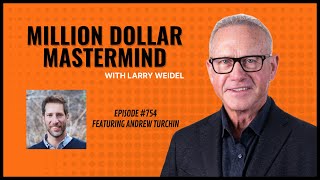
Andrew Turchin built a systematized dental practice and created a 4-day Cosmetic Confidence Coaching Program that teaches complex cosmetic dentistry in a fraction of the usual time and cost. He credits SOPs and checklists for predictability, and now trains other dentists to scale their patient impact.
Welcome to this edition of the million Dollar Mastermind podcast. This is where we pick the brains of high achievers from all walks of life and get their hard earned real world insights on winning. I'm your host, Larry Wydell. That's the other thing is once you.
Get things that work for you, you don't need to keep looking for more. You just need one go to thing in all these different situations in life, you know, you've got to, you know, because you're going to be facing these things over, you know, situations over and over again.
Yeah.
New projects, you know, starting from the idea, the conception to working out the details, get a plan, decide you want to launch and then get into the launch. When you went into that office, let me ask you this, it to hear to, you know, you, you give yourself not enough credit but, you know, you don't accomplish things without putting a lot of, you know, your shoulder into it. And when you went in and to the office, you're the new guy and you're showing up. How hard was it for you to establish yourself and was there some, some trials there for you? Where do you develop your toughness?
Yeah, well, the first of the two, let's just say real big guys I worked for was a tough guy. So that was, I think, great experience. He's tough on his team and had very high expectations and, and you know, to be honest, a really big ego. So it was interesting to learn to deal with those type of personalities. And in the end, the great thing is my goal was to work for myself. So it was really simple. I just, I just had to learn as much as I could, I had to impress them as much as I could. But in the end I was, you know, I was going to be there more than a couple of years, I think I was there two and a half years and that was plenty of time for me to start my own thing. And it's not that I knew everything yet, but I think I learned everything I could from that situation. And sometimes you have to just, you know, get in there and get your hands dirty as well, you know, on your own and just, you know, branch out and do your own thing. So, you know, in life we have different opportunities and I look at some of the opportunities I didn't take that some would argue I should have, that it could have put me at a further place than I am now. But interestingly enough, I once analyzed when I was looking at buying the largest cosmetic practice by many, many times, I, I, I did some math and estimated what I thought I, my potential was of how much I personally could produce. Now back then I didn't think about having many associates and, you know, these other methods, but here we were pretty much a single DOC practice that was producing five times what any other dentist in the country could produce. You know, any other dentist, not the average dentist, literally five times the next biggest producer. And, and I decided I couldn't do it and I didn't want to do it. And it was an interesting decision then and it's even more interesting to look back at it now in my old age. I just turned 50 and I, I, I think it's interesting and today to, to this day, the number I estimated then, besides accounting for inflation, was actually very accurate to what I thought I could produce in the style and quality that I wanted to produce it in. Yeah, so, so I decided to train other dentists to do what I do instead of just doing more dentistry. I want to help more people, right? Yeah, we grow in a lot of different ways and I want to help a lot of people. But I, if I help, If I train 20 dentists a year in detail to do exactly what I do, I'm helping thousands of patients each year around the country. That's how I decided to grow and spread what I do uniquely.
What did you learn about running? If the fellow that you went to work for out of Columbia was tough, he was probably tough on the essentials. The things that he had learned, you had to have the non negotiables. And what did you learn about running a business from him about things that had to happen, needed to happen for you to grow, basically?
Well, it's interesting because when I, when we were there, he was actually starting an expansion situation. A dso, one of the now dental service organizations are huge in private equities, buying up practices and creating these organizations called dental service organizations. And he, that's, this is really popular now, but 20 years ago he had a private equity group that he was, you know, working with to, to buy up practices and we had a centralized organization. So back then he was very into standard operating procedures that dental practices rarely had. You know, clinical protocols, things like that. And now it's ironic because I still have a connection to that office and I don't think they, you know, that person was in my office recently. Actually, he was just my office. He did my smile just Friday. He's brand new, my New Year's smile. I just had my own teeth done by my mentor.
Really?
Oh yeah. And, but to the point he said, you know, Andrew, you're, you're so much more systematized than they are now. Back in the day, that dentist was very into systematizing and standard operating procedures. And it's one of my office's core values. Five core values and is systemized. That's our practice. Very important. Because my theory in life, and I think most business people would agree that without systems, you're just making it up and you can't have. You can't get the best results without it. Doesn't mean we don't have room for some variability in there. But there's some core ideas and principles of how we do things in our practice that are not negotiable because it's how we get the best result for our patients.
Yeah.
I love predictability.
That's like the military, you know, sop, Standard operating procedure.
Yeah.
And, you know, people say with like planes, they just had a big thing in Japan accident where the aircraft.
Oh, I missed it.
Oh, yeah. But a collision on the Runway. But the thing was, the plane catches on fire. That has 389 passengers. I think a smaller plane hit it. All the ones that pretty much didn't make it on the small plane, but they offloaded all of the 389 with no injuries.
Wow.
While it was burning.
Protocol. They have. Right.
Sop.
Sop. I. Checklists.
Checklists. You know, the airlines. One thing you find if you ever want to go be a pilot, you know, is all of the incredible checklists. You're like, why do they have all these checklists? You know, you see actually a pilot in the cabin on a flight, commercial flight, they're going here, here, here. Now the checklist. Why do they use checklists? It's because they work.
Yeah, exactly. Exactly.
And when you do, you have it systematized. The airlines are an incredible example of how big you can get and how reliable you can be.
Absolutely.
You know, when 2001 hit, and I know that was big for you because you were in the city at that.
Time, I lost two of my dearest friends.
Did you? Did you? Yeah.
So I'm sorry about that. Sorry, don't want to get that.
But the thing is, like, it was amazing how many. When they dropped all that, they said, okay, all the planes have got to land. You know, we got to get all the planes out of the sky until we find out what's going on here. And like thousands of planes, you know, they showed the map of dots in the United States of how many planes were commercial flights were airborne at that time. Just mind Blowing.
Wow. And amazing.
That goes on and on and on all the time. And it almost. You almost never have a problem is a great testament to having systems. And so I guess when it makes. It's got to make it easy for you when you have broken your practice down, even the complicated steps, down to where there's a procedure where you can bring people in in a short period of time, teach them and send them out the door and know they reliably got a system they can duplicate when they get back home.
Absolutely. And I think I did it for myself first. I wanted to be the best I could be. And for me you have a system and only doing it that way over and over again can you know where to update things and change them. You do them differently every time. There's no way to measure what worked or didn't work because there's no track. You have to do it 10 times in a row one way before you go, oh, you know what? I could fine tune, I could fine tune this. And then we fine tuned our systems to the point where. Yes, I mean, I think I'll tell you, I'm very proud of this. The, you know, the continuums, the textbook that I talked about. If you go to their continuum of education, it will cost a dentist probably two years of their life, you know, going, let's say a few times a year down for four day courses and probably $125,000 of education costs besides the opportunity cost of leaving their practice and everything like that. I have simplified the most complex types of dentistry, everything in his textbook and more, into a mathematical formula that gives the dentist an answer of what they need to change to the teeth to make it work aesthetically, functionally and phonetically is how you speak. And so we managed to teach this in just two two day courses, like a four day course. And for $10,000, they save well over a hundred thousand dollars. But most importantly, they go out and get to help people right away. And our process is just so predictable and so precise that they don't need two years of pontificating to try to. What happens is most education systems think of college as the worst. They just give you ideas and ideas and ideas and ideas.
Right.
Nobody distills it down to what the heck to do.
Thank you. Right, thank you.
Yeah, and, and that's what my course does. And I'm very proud of it. It literally distills it to step by step, every single thing. And it takes into consideration all that knowledge base, that great knowledge base that I didn't Create at all. I created a few pieces of it, but what I did, I think. I. Not even think I know. I distilled it down to simplify it greater than anybody's ever done in the hundreds of years of dentistry. And. And this way, I get to teach it in just four days. And people come out of the gates running. A lot of our participants have spent all that money and time already, and they're just not doing it because they don't know what. What to start with and exactly what step is next and what's the. They don't have the confidence. So I actually call our course the Cosmetic Confidence Coaching Program.
Yeah.
Because it's, It's. It's intended to give you all the confidence you need, all the knowledge and confidence you need to move forward. I'm not talking. When I say confidence, I'm not talking about some type of false bravado. I'm talking about, you know, based on knowledge and having a process that you. You trust.
Well, you know, here we see a lot of the threads of some of the things we've talked about, like referring back to. Even when you said you got interested in dentistry as opposed to physiotherapy, the precision, you know, you liked precision.
That's what it came down to. Yeah.
You gotta be, you know, the more specific you are, the more dynamic you are. And I've heard a long time ago, and I guess it'd be. I guess this will be patting you on the back. But, you know, they say that the thing about the genius of if genius does anything, it takes an incredibly complex series of things and simplifies it down to a core to where you can turn it over and automate it, you know, yes. Assembly, light it, basically. You know, and. But somebody's got to do that. You know, the Henry Ford has got. Someone's got to be there. And I don't know the story of Henry Ford in that great detail, but I bet he knew how to build a car. Yeah.
Yeah.
You know, I bet he built a lot of cars himself before that assembly line got established. And the thing is, when we're entrepreneurs and we're getting started, a lot of times we begrudge the fact that we've got to be. You know, we're starting with ourselves, and we begrudge the fact that we've got to be doing everything and working hundreds of hours a week. We don't have the money to spend on this and that. But the fact of the matter is, the people who have the money usually blow it Spending on the wrong things. And when you're forced to do those early repetitions yourself, you kind of find out to yourself what works and what doesn't. And it's really and indispensable piece of the process of building something that can last and can expand, that you can turn over and teach to other people. Would you. Am I on the right track with that?
Absolutely. I mean, I feel so lucky because I want to say it's hard work, but I think sometimes when you're working in your zone of genius, things just happen very easily. And my. And I say zone of genius, unique ability, you know, all these different terms and, and simplifying just happens to be, you know, the way I communicate with patients. I've simplified. I try to teach Dennis that not to get too in the weeds with details as much as I'm a detail guy. How do you communicate simply? How do you communicate these ideas simply? And I think this mathematical formula I came up with, I don't want to call it luck, but I was in my zone. I actually wrote the formula in on a two hour flight. I do my best thinking on planes. I don't know if you're like that.
Yeah.
You know, I never get the Internet service. It's not that I'm too cheap to spend $8 or whatever it is. I want the time alone. And I am always reading and, or writing and usually both, because I'm usually reading and my brain gets stimulated. I start writing. But I pulled out my laptop and I created an Excel spreadsheet on this flight. And because I realized, oh my. I have this course, I'm doing my first course. How am I going to teach them all of this complexity and them actually get it and be able to use it?
Yeah.
I could spit out the information. But then how do they go? Okay, with. We're talking about like eight different variables really, of tooth position. How do I account for all of them in. In that person's face? And. And I wrote a formula that solved for all of them accurately. And I had to create my own measurements, by the way, measures that aren't in dentistry, like how close is, you know, what's the measure from the tooth to the lip. And that's something nobody in dentistry measures unless they come to my course. And all these different things. Right. I won't get into it. But I wrote the formula and it has never changed. It was. And I've used it thousands of times and proven its accuracy. But it was right the first time I wrote it on that plane.
Wow.
Amazing. You know, so I wish I could tell you it was like the Edison, you know, bulb that he worked in had thousands of iterations before it worked. It literally worked the first time. Of course, I had over almost two decades of knowledge at that point and experience, but the fact that I was able to create that was just, I. I don't know, one of the, you know, luckiest things in my life, I think.
Thanks for listening to the Million Dollar Mastermind. If you felt there were any valuable takeaways from this episode, please take a minute. Leave us a five star review. Your feedback is important and really helps us get the word out to a wider audience. Remember, we have a valuable webinar that is absolutely free.
Reg.
Register for it right now@whiteallumwinning.com thanks for listening.
More from Larry









Rick Jordan on Self-Engineered Proximity, Cyber Security Moats, and Truth-Based Leadership

Fire Fast or Fail Slow: Kevin Brittingham Reveals the One Rule That Built a $100M Empire
