Episode #762 - Consistency Over Quick Wins with Lisa Brooking
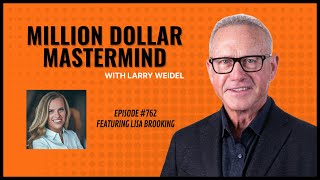
This is a transcript of Episode #762 of the Million Dollar Mastermind podcast (Feb 2024), a conversation between host Larry Weidel and guest Lisa Brooking. The episode emphasizes consistency over chasing quick wins in both athletics and business—keeping training fundamentals (base mileage, regular movement) and incremental habits rather than pivoting to every new fad. Brooking discusses practical approaches to maintaining fitness (movement counts, cross-training, mindset), the role of health coaching and precision screening, and recounts her nursing-to-leadership career—clinical bedside experience in cardiac care and neurotrauma ICU, advanced education, and later healthcare leadership. The episode also notes Brooking's recognition (Woman of the Year award which was renamed the Lisa Brooking Award) and closes with a listener CTA and webinar link.
Foreign.
Welcome to this edition of the Million Dollar Mastermind podcast. This is where we pick the brains of high achievers from all walks of life and get their hard earned real world insights on winning. I'm your host, Larry Wydell. That's very parallel into financial services business that I've been in most of my life. And that is that, you know, an average sale might, depending on what era was in, might be 500, 800, a thousand dollars, $1,500. But then you get certain people that get a chance to get the $5 million sale on so and so because their uncle has a company and they may get a chance to get it and they wind up derailing their whole business. They stop getting all the $800,000 sales, keep that steady stream going in, chasing the big fish, and then when the big fish doesn't come in, they really sabotage themselves, really. So you really have to keep your basics going. No matter what opportunities come along, you know, stay inside yourself. You agree with that. Like you said in the race, the race starts off and it's fast. It's like you say, well, that's not how I do it. You know, you can approach things from knowing your own strengths and everything and still get the job done, but you don't like throw everything you know about yourself and how to get the big performance out of yourself just because something big opportunity came along.
Exactly. So certainly in order to gain trust and with clients is you want to know that they can have faith in you. And so you're not just going to pivot with any new fad that comes out. Oh, we're doing this now. Oh, we believe in that. It's like, no, we have our core values, our core principles. And with that, we have this fantastic offering that we have a proven track record. We continue to bootstrap on new offerings and new testing as it comes out and we fine tune it. But at the same time, same as in finance, if you just keep pivoting with every fear that comes out into the market, I think you really open yourself up to a lot of vulnerability. And so for me, I have faith in the process with running. I know what baseline mileage I need to run. I know what I need to do to get into shape. Yes, there's new emerging technologies. A lot has advanced in sport over the last couple decades, but at the same time, I know those foundational pieces haven't changed. Same with in medicine. Food is medicine, movement is medicine. That's not going away.
Well, I'm going to ask you a Technical question. Then we'll get to business. But would you say, you know my buddy out in Atlanta, Aspen, who is a cycling coach and he's ski, you know, ski instructor and all that too, but he's always talking about fighting during the winter to get out on his bike any day that's possible to ride, because he said, I've got to keep my core, my base. He always calls it his base. And I've wondered about that. Is the base the VO2? You know your lung capacity because you can't like go in, work out hard for a week or two, and your VO2, you know, your lung capacity go up. But when someone talks about as an athlete, one of the reasons you'd stay with your fundamentals and stay with your routine is to keep your base up, you know, your capacity for work. Is that the VO2?
I wouldn't say the V for myself. The VO2 doesn't factor in. Yes, during the winter, those short days, those dark days, raining, snowing, icy, it is hard to get that baseline mileage in and also to stay motivated. But if you have a purpose and if you're some, I'm certainly wired that I can barely go more than a few days without running. And it's that muscle memory, it's that movement. Even if you're just slowly jogging with a friend, that's what is important is it's that your body is becoming comfortable and it's a type of movement that just becomes so natural that's embedded into your day to day. So no matter how much cross training I do, I'm still itching to get out running. And for me, in the winter and such, do they have a treadmill? Where am I going? What can I do? Even if it's just quite a bit lower than what I typically would run, mileage wise, I just need that movement. I don't really focus on the VO2 until I'm trying to get into more of that peak performance. But at the same time, if you fixate on the number, you could be playing a head game with yourself and saying, oh, I won't run this time, because my VO2 max is that I just go in, say, you know what? I'm going to jump on that pain train. I'm mentally focused, I'm competitive. I hope it's a competitive field because they'll push me along. It's hard to push yourself when you don't have people around you and there's very few opportunities to run. And we should be so grateful to the post pandemic to have these types of athletic events.
Well, what you've referred to there, I think probably in one thing you raised would have gone over my head last, even as recently as last summer, because I've been training a lot. We're training some in the gym with my son, who's a competitive bodybuilder and strength training and all that stuff. And I had the mentality that you go to the gym and, you know, you just bust it. You know, you max out. You know, you do shoulders one day and then legs and then max out. And that's whether you feel like it or not. But I find it, since he spent a lot of time down here in the last three, four months, that sometimes he'll go in and he just does light sets. He'll do a half hour light sets, you know, 25 reps, four sets. And it's not always maxing out. Same thing every day. You have to mix it up for yourself. And it dawned on me that because you were saying that sometimes it's a light day, you know, it's just a slow. The main thing is you're doing it. And I lucked into that same correct attitude when I went up to North Carolina all by myself to open up an expansion, and dumber than mud and broker than you can imagine. And it's like I said, well, I've got to do certain amount of paperwork, certain amount of phone calls, certain amount of reading to study, certain amount of administrative, you know, following up with the home office on processing, and there's all these categories. And I said, what I'm going to do is every day I'm going to do as much of something as I can get myself to do. I'm not going to go in and say, no, today you do this, you know, it's like. And have this battle with myself, you know, it's just like, nope, today I'm going to do this and I'm going to do a lot of it, you know, and knock that out because eventually you have to get it all done. But those things add up, especially by keeping you in the game, don't they?
Yeah, you illuminated perfectly. I hope that I can inspire those who are not in the elite field to say, you need to be able to pivot. And so those who are looking to lose weight think that they have to be on the peloton or do this every single day for lifetime.
See, that was the mentality I had. You know, it's just like, lord, I can't run five miles every day. And so you Never run it. You don't even walk, you know, but.
What can you do? So if it's something where you're trying to lose that weight, you're saying, okay, it's all these things compound over time. So I'm going to do these hard workouts and then taking the stairs, do this and do that. You're mindful of your mission, your why I would like to lose the weight so that I can keep up with my grandkids and I am have more energy and vitality and I don't have to worry about my weight being a limiting factor. So that why is what's your daily motivation? But it doesn't mean it needs to be this unpleasant grind. It should be enjoyful. And so, you know, there's days where I have long meetings and I'm traveling and I can't run, but what can I do? Okay, I can get some steps in. I can be walking around the airport. What can I do? And, well, how can you win a half marathon and think that doing steps around an airport is contributing? Because for me it is. It's. I just have this mindset that movement in general does all contribute. So I take the stairs from P4 to my office, 20 cases of stairs, and I put my sneakers on, have a backpack. So it's a little weight bearing and good posture. And I just do this every day. In my mind, I believe that this is contributing and adding a little token to my overall fitness level because I don't have the time to run and commit four hours a day to elite level training. But I do all these other pieces that I believe is helping me have longevity in the sport. And so it looks different for everyone. And so I certainly want to encourage people. There's so many ways to achieve your goal and it doesn't need to be this unpleasant. Like you have to give up all social events because you have to do this one thing. No, you can just look at it differently. And this is why I think health coaching and certain types of people helping you achieve your goal, to make sure that you're not losing, you're adjusting the plan, but you're not losing sight of the goal. So you get back on track.
Right? And I was listening to a podcast with a health expert, longevity expert out of Harvard, and he said that you know so many of these things, the facts are just not out there. But for ladies, for example, he said a woman who has, I think 150 minutes of activity just walking, which would be like 20 minutes a day, will, will reduce their chances of cancer, heart disease, this, that and the other by 50 to 70% just with that little bit of activity. And so a little bit counts and it's important to know that. But, you know, when you haven't been introduced to those facts, you have these barriers to even getting started because you think, oh, Lord, you know, going to take some.
It was like entering something like cycling. People think you need the lightest bike and all the fancy gear and there's no way I can see start cycling if I don't have all these things. You can pick up a bike anywhere. The bike I was using was a nice bike, but, you know, it wasn't fitted for me. It was anything special. I made sure the shoes fit and so the shoes, because I didn't want to ruin, hurt my feet for running. So my priority, as long as the shoes fit, I'll get on any bike. It can be heavy. Aluminum don't matter to me. I want to get out and enjoy cycling and really. And see Aspen as an example. So I think sometimes people overthink it. You don't need a fancy gym membership to be able to lose the weight. And I think social media and a lot of these different media platforms really approach any of that when you can find so much on YouTube to do Pilates without going to a Pilates studio. So I think what is really needed is a plan, because without a plan, it's just a dream. And so for health code medical, we provide individuals with a plan, but before we provide them with plan, we do extensive screening to make sure there's nothing brewing, there's no cancers, and then we look at them genetically. And so we need to make sure we are fully informed to provide a targeted plan that's going to yield the best results and make it sustainable. So the upfront work ensures that we are providing that precision and that's transferable. Even in sport, if you want to take up a sport, they need a baseline. I'm starting to cycle. I'll start at a different level than somebody else, just given my aerobic fitness.
How do you become a professional runner? That's just out of the realm of experience.
Yes. So I have a few girlfriends that are signed with Nike or have gone pro and they, or they either run for the American team or Great Britain, so I can provide context from them, not my own lived experience, because I run the elite level in the national team. But I'm not proud of is, you know, you're very much meeting those standards, but then you're being compensated for times that you run and the races that you compete in. And so kudos to those individuals. For me, I need intellectually and I was born with two passions, but I'm finding they're actually being married together is really to have impact in health. And there's so much going on right now with healthcare and it's merging together both the passions. And so for me, even if I was given the opportunity to go pro, I wouldn't. I'd love to train with the team and be the one that gets the one minute lead and they have to chase me down. But I'm just loving what's. There's a huge paradigm shift happening right now in care and I'm just so thrilled to be able to contribute to the advancements in how we rethink healthcare.
So let's talk about that. You started out in a standard health, you know, with a person who has an interest in health care and all with nursing training, and then got graduate degrees in that. What hear about that. But so everyone will know you get your proper respect, you got onto that to where you made an impact in the business side of it, to the point where you're recognized as Woman of the Year. And I don't know if it's the same association or someone else, they renamed their annual Woman of the Year award after Lisa Brooking. It's now the Lisa Brooking Award. You not only won the award, you have the award named after you. And so there are going to be all these people down the road that are winning the Lisa Brooking Awards. So congratulations.
Thank you. Yes. Well, it was an honor in of itself to win the award and then renaming it was so extraordinary. It's presented annually.
I've never heard of the awards being renamed.
Yes, I know. It's such a privilege. And at one point they may rename it to someone else. So I just take it year by year. I'm grateful that it's presented yearly. I'm able to attend the Taylor, give a little talk, and then also meet these extraordinary women that have been selected and then ultimately the winner and they inspire me. Yeah.
So let's talk about you come up with your interest. What I like about your career path or trajectory is you can start with a nominal interest in a field and go start off in the path that everybody does, but then you can keep on climbing. And that's what you've done, you've kept on climbing. So talk about how you did that and what was driving you as you came up through the nursing training. And then you said, I'm going to go and get the Masters and all different degrees you got there. And what was driving you?
Yes, well, similar to athletics, which hopefully will transition to. What we're just about to talk about is I had an interest in running. Well, my high school teacher planted the seed. I went home. We come from very modest means and so I had Walmart running shoes. I had cotton tights that were bell moderned at the time where I had a rubber band on the bottom. And those are my types. My family's not in sport and I'm the first in my family to do post secondary. So we just grew up with very modest means. And so my parents were supportive of me exploring sport, but at the same time, this is what you have. And then I since went on to be sponsored by Saucony, the shoe brand for six years. But at the end of the day, it's a shoe that you run in. And at that time I'm just starting the sport and was pleased with the shoe because I knew nothing different. And then since went on to have success and then be able to have subsequent sponsorships. So with nursing was very much, you know, I started volunteering at the hospital and my family is not in healthcare profession.
And so what got you interested in it?
I actually think now I need to give extra kudos to my high school teachers because I thought I would be a teacher and it was actually a science teacher that said, well, what about care? Like doctor, nurse? And I had said, no, I haven't been exposed to it. I think I'd like hospitals now. And they said, why not volunteer? And so coming from a small town, super grateful that, you know, it takes a village to raise somebody. And I had extraordinary teachers along the way that I felt were very invested and I'm sure that happens everywhere. So I volunteered at the hospital and then I just met nurses and just solved their purpose and how you can really help people. And so that's where I was able to define not nursing is like teaching. You're teaching patients and you're teaching patients how to recover and then get better and then hopefully they don't need to access the hospital again. And so that initial thought as a career to go into teaching and to educate is very much intertwined into my nursing. And so I did a bachelor's degree in nursing, had a broad exposure across all the areas in the hospital of surgery, maternity, and then ultimately landed in cardiac care, which again, keep the heart strong, keep people moving and pacemaker. And so it very much aligned with my athletic where it's like, okay, let's get over that injury and keep on moving. So my spirit around cardiac health and getting people, getting that up and healthy again definitely filled that passion for me. And then I ultimately ended up doing further credentialing to being neurotrauma icu. So I eventually made it to what people could call the highest level in the hospital, which is neurotrauma icu. So any type of head injury and then cardiac surgery icu. And I loved it. I thrived off of just the ability to critically think, be autonomous, have all these infusions.
Now, what does that mean when you move to the top there? What were you doing, you know, what was your area of responsibility there?
So it was still in nursing, so it was still that bedside care, but it was a bedside care in terms of you have to receive an extra level of schooling and training and you're taking care of somebody that's just brought in by whether it's air ambulance or an ambulance through Emerge and they need to be on life support, you need to stabilize them. Are they going to surgery? Are they not? If they go into surgery, they will have an exposed craniotomy. They're caring for patients in a very vulnerable state at that point. And for me, I want to know that the families can trust that I'm going to take the best care of this patient as if it was my own family member. And so that was caring for one patient at the bedside. And then I thought, well, what if I care for. What if I can see other patients? And so going into more management and seeing the pinch points at the front line to really deliver that great career, well, maybe I need to receive further schooling to have an impact at the department level, at a hospital level. And it just. My curiosity just kept expanding.
Thanks for listening to the Million Dollar Mastermind. If you felt there were any valuable takeaways from this episode, please take a minute and leave us a five star review. Your feedback is important and really helps us get the word out to a wider audience. Remember, we have a valuable webinar that is absolutely free. Register for it right now@whiteallonwinning.com thanks for listening.
More from Larry









Rick Jordan on Self-Engineered Proximity, Cyber Security Moats, and Truth-Based Leadership

Fire Fast or Fail Slow: Kevin Brittingham Reveals the One Rule That Built a $100M Empire
